- The paper demonstrates the use of three rigorous pipelines and trend models to identify candidate exomoon signals around Kepler-167e.
- It employs advanced techniques, including Gaussian process modeling and profile likelihood fitting, to assess subtle photometric features and detector systematics.
- It refines Kepler-167e's parameters to approximately 1% precision and emphasizes the need for multi-epoch observations to resolve signal ambiguities.
Search for Exomoons in the JWST Transit of Kepler-167e
Context and Motivation
The James Webb Space Telescope (JWST) provides unprecedented photometric precision for exoplanet transit studies, facilitating the detection of subtle photometric features such as transiting exomoons. The primary focus of transit observations has traditionally centered on atmospheric characterization; however, summed white light curves enable the investigation of non-atmospheric phenomena—including moons, oblateness, and rings—in planetary systems.
Exomoon searches with Kepler survey data have demonstrated that large, Earth-sized moons are rare within 0.1–1 AU, with only two compelling long-period candidates (Kepler-1625b and Kepler-1708b) identified at wider orbits. These detections remain ambiguous and contested, reinforcing the necessity for higher-precision, systematically robust follow-up. Kepler-167e, with its Jupiter-like properties and long-period orbit, is well-positioned for exomoon searches due to its large Hill sphere and lack of migration signatures.
Observational Campaign and Data Reduction
A continuous 59.8-hour JWST NIRSpec time series was acquired spanning a scheduled transit of Kepler-167e. Constraints due to the observatory's data-handling necessitated partition into six ~10-hour exposures, three of which include the transit of the primary target, and one coinciding with the inner planet, Kepler-167c.
The data underwent three rigorous reduction pipelines:
- custom: maximal masking aiming for Gaussian behavior, with extensive identification and removal of noisy pixels and columns.
- ExoTiC-JEDI: designed for robust white light extraction and time-series stability.
- katahdin: a new pipeline leveraging pixel-level bias fitting and spectral extraction strategies.
Upon extraction, spectra were binned into five-minute intervals, and the Kepler-167c transit region was masked.
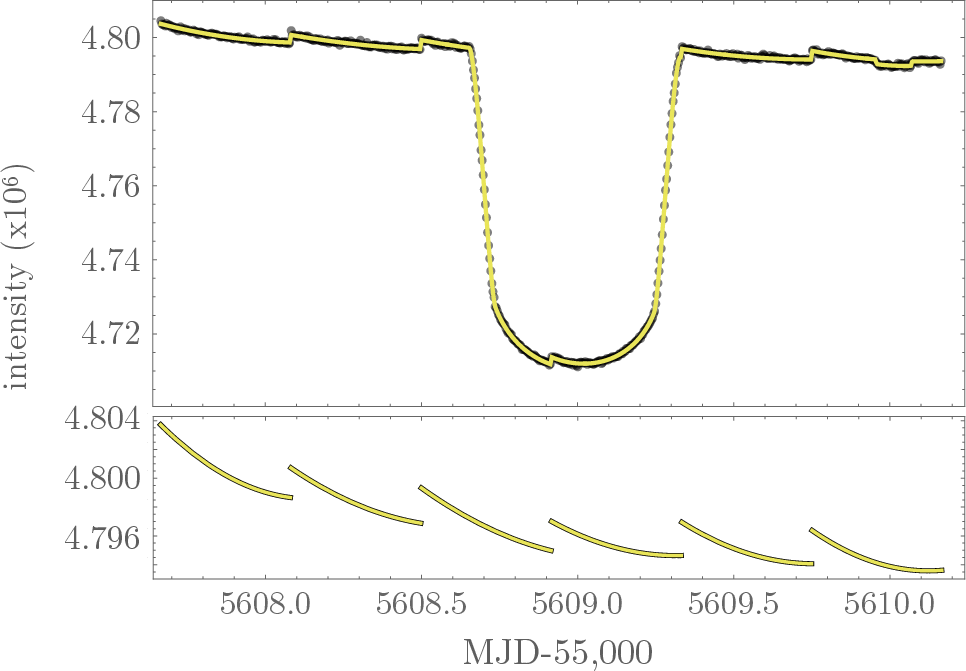
Figure 1: Broad view of the NIRSpec time series, showing the original light curve and the six segmented exposures.
Systematic Trend Modeling
A critical challenge encountered was the dominance of long-term flux drifts within each exposure, with discontinuities at exposure transitions—systematic effects likely tied to detector physics ([Rieke et al. 2023, (Rieke et al., 2022)]; [Zafar et al. 2023, (Rustamkulov et al., 2022)]). The characteristic timescale for these trends closely matches those of moon-like transit features, demanding robust modeling to avoid false-positive detections.
Four distinct trend modeling approaches were used:
- Quadratic (PL): High flexibility, but risk of overfitting and producing unphysical non-monotonic features.
- Exponential + Linear (PL): Improved physical justification for detector persistence, constrained via fixed drop-off rate.
- Gaussian Process (GP, SE and Matern-3/2 kernels): Additive stochastic modeling, marginalized hyperparameters, accounts for correlated residuals beyond parametric trend forms.
A profile likelihood (PL) technique was employed for high-dimensional fits, validated through MultiNest nested sampling runs ([Feroz et al. 2009, (0809.3437)]). The equivalence of posteriors derived via PL to full marginalization in linear trend cases justified the computational approach.
Transit Modeling and Fitting Strategy
Two astrophysical models were considered:
- Planet-only: Standard Mandel–Agol analytic transit with quadratic limb darkening, fixing orbital period and stellar pseudo-density via Gaussian priors from previous Kepler and Spitzer analysis ([Kipping et al. 2016, (Kipping et al., 2016)]; [Dalba & Tamburo 2019, (Dalba et al., 2019)]).
- Planet+Moon: Full dynamical LUNA transit code ([Kipping 2011, (Kipping, 2011)]); seven additional moon parameters were included with physically motivated priors.
MultiNest with 4000 live points was adopted to explore multimodal posteriors and robustly estimate Bayesian evidence.
Results and Signal Attribution
Detection Matrix: A 3×4 grid of (pipeline × trend model) yielded 12 independent fits for planet-only and planet+moon hypotheses. Seven configurations exceeded formal detection criteria of Bayes factor >10 (Savage-Dickey and direct marginal likelihood). Signal morphologies consistently favored tight, near-occulting moon solutions with RSP ~0.08–0.18 (planet radius units), typically corresponding to syzygy-like mid-transit events.
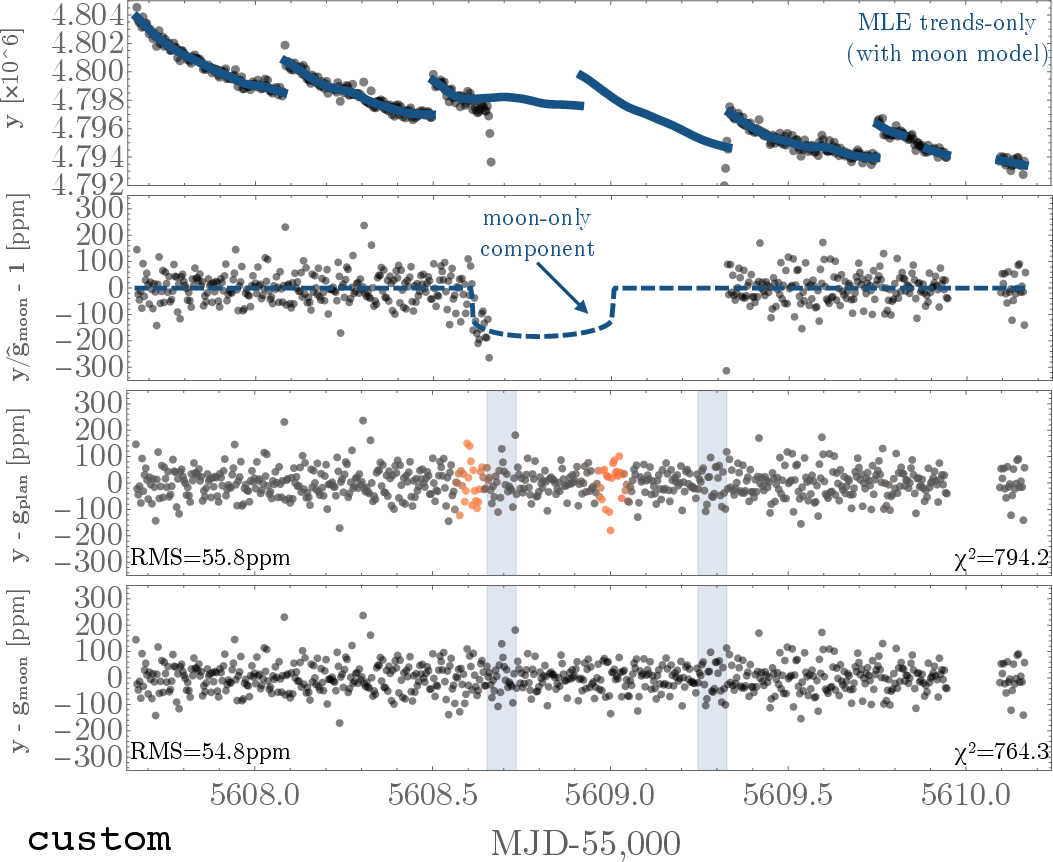
Figure 2: White light curve, trend normalization, and residuals for the custom pipeline, Matern-3/2 GP trend.
Signal localization via moving-median Δχ2 analysis revealed that detections are almost always driven by a robust mid-transit feature, spatially ambiguous with a starspot crossing ([Rabus et al. 2009, (0812.1799)]; [Beky et al. 2014, (Béky et al., 2014)]). Out-of-transit dip-like features were less robust and not consistently supported across all trend models, suggesting trend model dependence or spurious extraction.
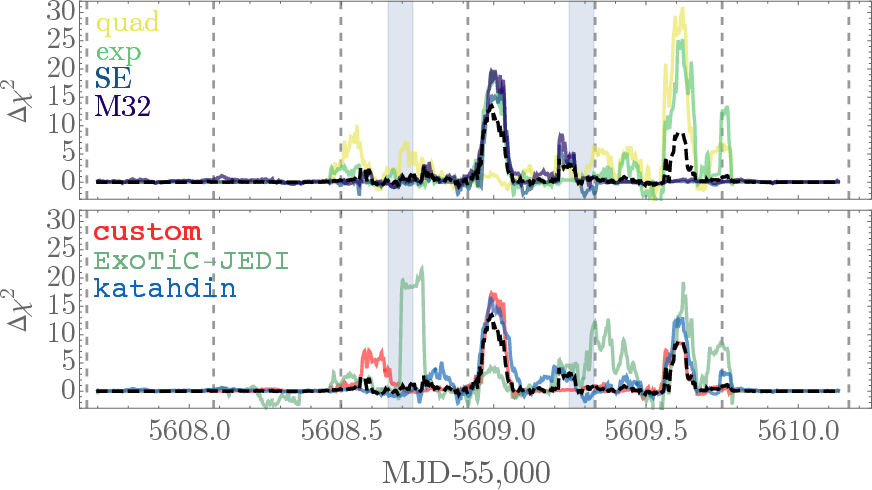
Figure 3: Median curves of Δχ2 improvement across models, identifying primary signal regions.
The two GP ExoTiC-JEDI fits yielded notably larger and highly chromatic moon radii, often requiring the moon model to compensate for strong, step-like systematic behaviors coincident with transit features—further scrutiny indicated these were artifactual and failed the negative-radius inversion test and multi-wavelength consistency checks.
Revised Planetary Parameters and Ephemerides
In addition to the moon search, the high-SNR JWST transit enabled refined Kepler-167e system parameters. Averaging over reductions and modeling approaches, the planet-to-star radius ratio is constrained to 0.12550−0.00193+0.00099 and stellar pseudo-density to 2755−27+24 kg/m3, each to ∼1% precision.
A deviation of ∼1 hour in the observed JWST transit time relative to calculated ephemerides introduces residual transit timing variations (TTVs) of 6–17 minutes—potentially indicative of dynamical perturbations requiring follow-up.
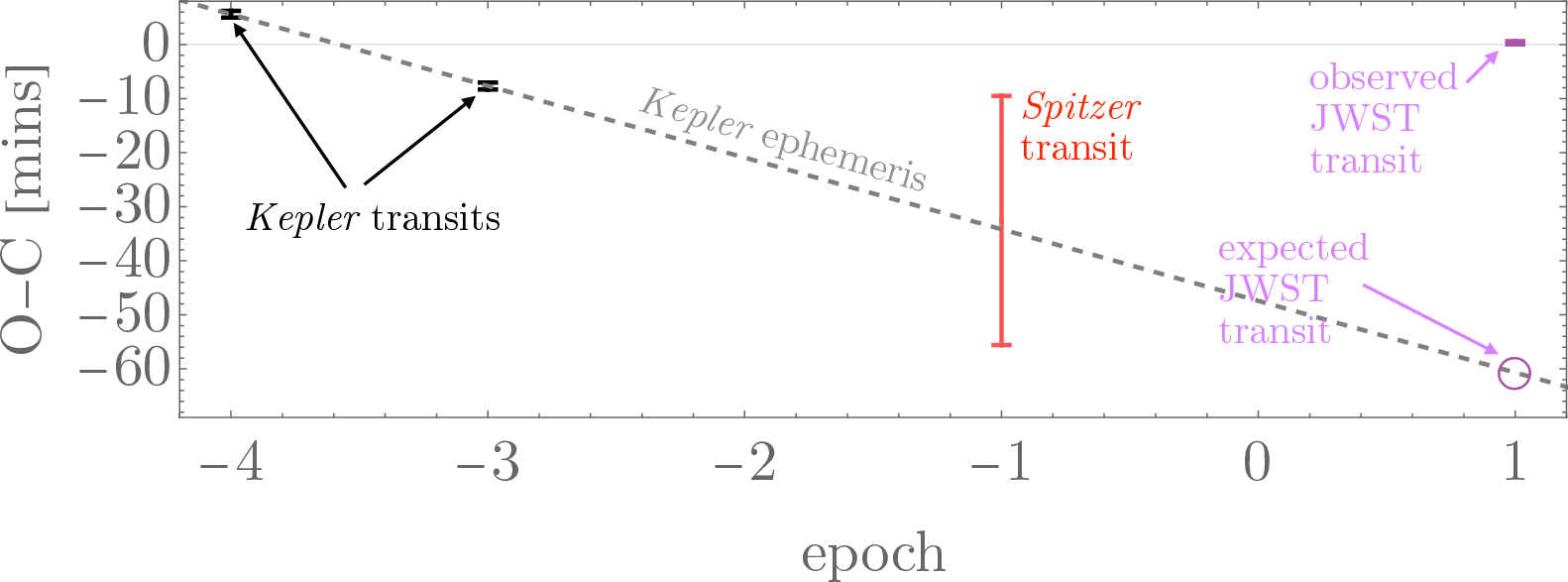
Figure 4: Transit time evolution across all Kepler-167e transits, highlighting the 2024 JWST TTV.
Assessment of Signal Origin: Spot-Crossing Versus Exomoon
Kepler-167 does not present coherent rotational photometric signals in Kepler data (amplitudes <340 ppm), yet calculations show spots of 1–1.3 R⊕ (assuming spot properties similar to HAT-P-11) could produce mid-transit anomalies indistinguishable from syzygy events to the sensitivity of the JWST data.
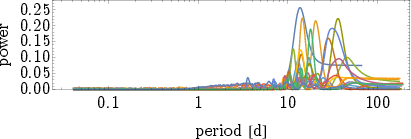
Figure 5: Lomb–Scargle periodogram of Kepler-167 quarters, confirming lack of coherent rotation signals.
Thus, the mid-transit moon candidate dip is highly degenerate with plausible spot-crossing events, especially given the lack of sequential transit coverage and multi-wavelength discrimination. Masking of the suspicious region further reduced moon detection significance in the most conservative pipeline/trend combinations.
Lessons, Sensitivity Estimates, and Future Directions
The effective sensitivity achieved for exomoon signatures was at best 0.37−0.24+0.39R⊕ in moon radius (<0.95 R⊕ at 95% confidence)—limited by:
- Higher-than-anticipated residual correlated noise and necessary aggressive masking (final custom pipeline white noise floor at 55 ppm per bin).
- Trend model uncertainties dominating regions comparable in timescale to transit duration, undermining confidence in subtle signals.
- Single-transit regime: the moon model is highly flexible, increasing risk of overfitting and type I errors ([Teachey et al. 2020, (Teachey et al., 2019)]).
Empirically, careful selection and cross-validation of trend models is critical; leveraging multiple reductions is necessary but insufficient to suppress systematics when their timescales are commensurate with transit features. The identification and modeling of spot-induced anomalies—with further data at longer wavelengths—are essential to future exomoon studies.
Observations of sequential transits will substantially reduce modeling degeneracies: the next opportunity for Kepler-167e occurs in October 2027. Multi-epoch coverage is strongly advocated to enable true dynamical and morphological discrimination of moon candidates.
Conclusion
This JWST time-series pilot exomoon search demonstrates that detector systematics and incomplete astrophysical context currently limit robust exomoon detections, despite unprecedented photometric precision. Candidate signals are ambiguous with spot-crossing events and susceptible to misattribution due to trend model flexibility and covariances. Rigorous multi-model and multi-reduction strategies can elucidate these ambiguities, but multi-epoch observations are ultimately required for decisive classification. The study highlights methodological best-practices and concrete limitations by which future exomoon search strategies with JWST should be governed.
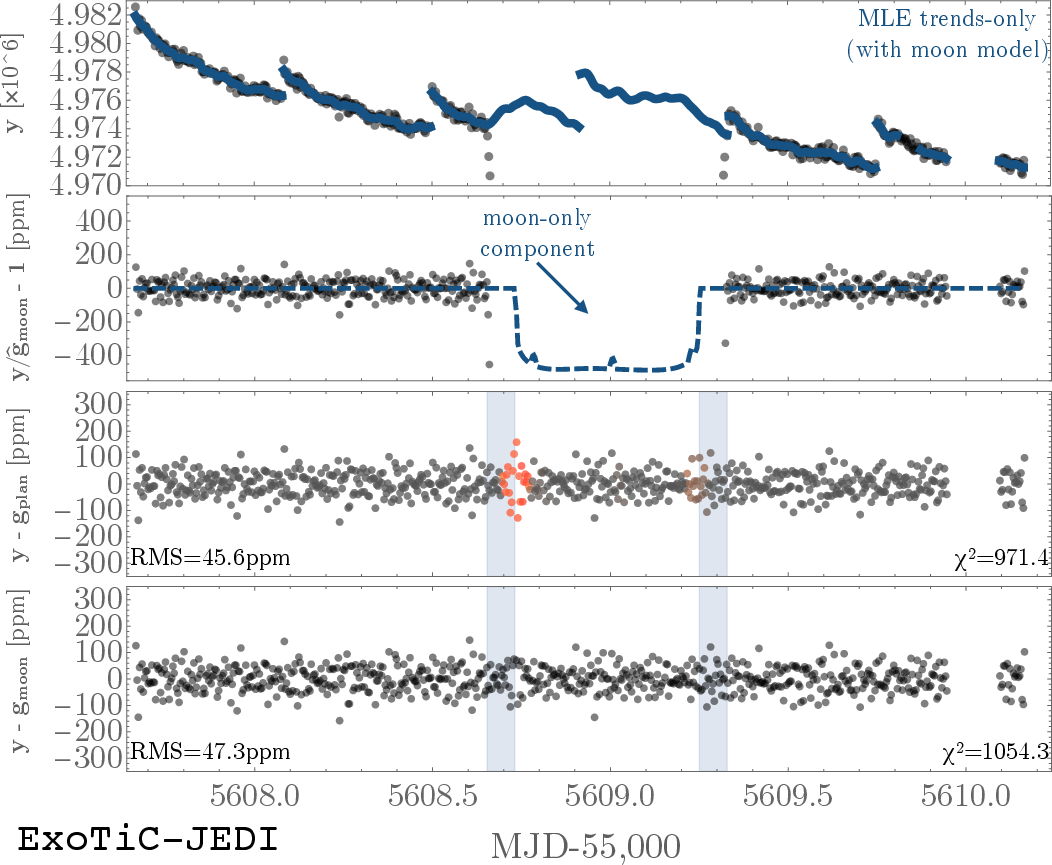
Figure 6: ExoTiC-JEDI pipeline results (Matern-3/2 GP), demonstrating inconsistent moon feature extraction.
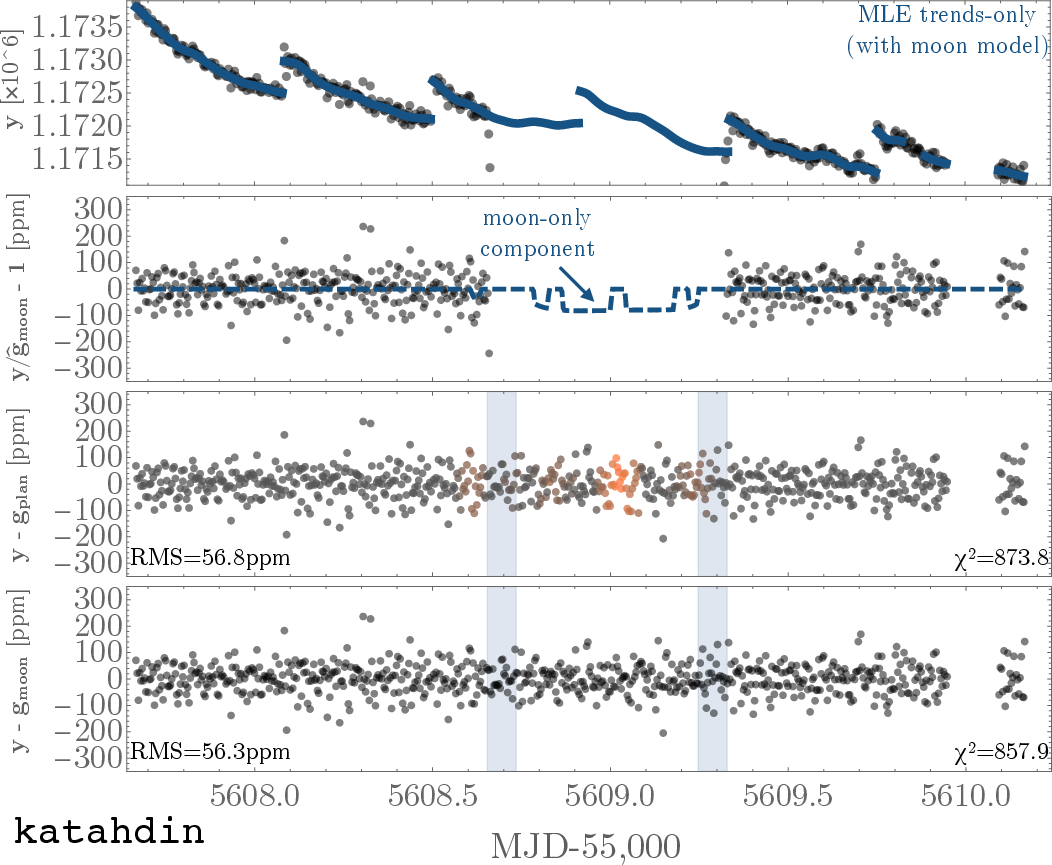
Figure 7: katahdin pipeline results (Matern-3/2 GP), consistent trending and residual structure across reductions.