- The paper presents a novel heuristic ISL topology optimization method that minimizes the network diameter in LEO constellations.
- It employs snapshot-based analysis alongside viability constraints to balance lower latency with operational stability, considering physical limitations.
- Simulation results reveal that snapshot-only configurations achieve lower latency, while viability-constrained models ensure reliable, stable inter-satellite links.
Inter-Satellite Link Configuration for Fast Delivery in Low-Earth-Orbit Constellations
Introduction
The paper "Inter-Satellite Link Configuration for Fast Delivery in Low-Earth-Orbit Constellations" (2511.15861) addresses the challenge of optimizing inter-satellite link (ISL) configurations in Low-Earth-Orbit (LEO) satellite constellations to minimize communication latency. The end-to-end latency in LEO networks can be significantly dictated by propagation delays, which in turn are a function of the satellite network's diameter—the longest shortest path measure. This study focuses on reducing network diameter while considering various physical and operational constraints, such as the maximum link distance, line-of-sight limitations, and the long-term viability of the links.
System Model
The paper adopts a snapshot-based method to analyze the network configuration. This approach defines the network's topology at static intervals, allowing deterministic routing and reducing operational overhead. Each satellite constellation follows a Walker-Delta configuration, which involves arranging satellites in evenly spaced orbital planes with circular orbits.
For practical applicability, constraints such as line-of-sight and maximum feasible link distances (dmax) are imposed to ensure the selected ISLs remain viable over orbital periods. This is particularly crucial for maintaining stable communication paths and minimizing the need for frequent topology reconfigurations, which are costly due to the physical constraints of laser terminals on each satellite.
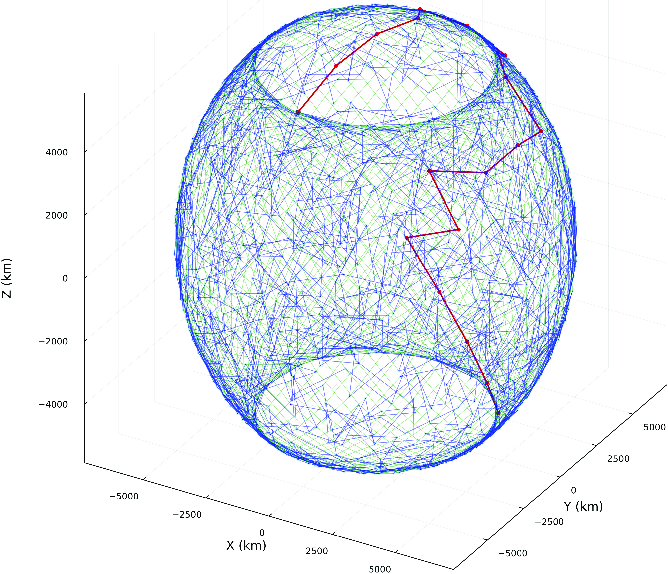
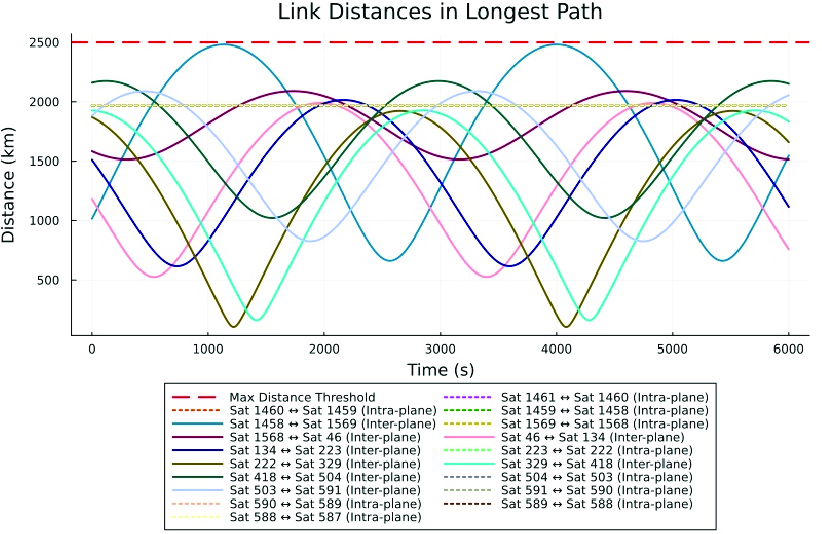
Figure 1: A 3D visualization of the optimized LEO constellation in the viability-constrained model. Intra-plane links are shown in green, while inter-plane links are shown in blue. One of the longest shortest paths is highlighted in red, illustrating the network diameter.
The paper defines two operational models for ISL selection—snapshot-only and viability-constrained. The snapshot-only model focuses on link feasibility at a single point in time, providing more flexibility in link choice but potentially sacrificing long-term stability. In contrast, the viability-constrained model ensures links remain feasible over extended periods, thus prioritizing operational robustness.
The primary objective is to minimize the network diameter, which represents the worst-case communication cost. This is achieved by configuring inter-plane and intra-plane links while adhering to geometric constraints, such as maximum allowable link distance and unobscured line-of-sight. Utilizing a local-search algorithm, the paper proposes a heuristic optimization process to refine the constellation's topology iteratively.
ISL Topology Design
The optimization process begins with constructing an initial feasible network graph based on satellite geometry and hardware limits. A local search procedure is then employed to iteratively refine the topology, focusing on reducing the network diameter. This involves two distinct phases: periodic structure reinforcement and randomized link replacement to explore new configurations.
The reinforcement phase ensures underlinked satellites receive additional connections, while the replacement phase introduces topological changes to escape local minima in the solution space.
Results
Simulations demonstrate the effectiveness of the proposed approach with a detailed comparison between the snapshot-only and viability-constrained variants. The snapshot-only approach achieves a lower network diameter by exploiting transient links, resulting in reduced worst-case latency but at the cost of stability. Meanwhile, the viability-constrained model yields a stable topology with higher latency but ensures consistent performance across orbital cycles.
Performance metrics such as maximum hop count, average maximum hop count, and link stability sustainability (shown as the percentage of stable ISLs) were analyzed, indicating that the viability-constrained network provides guaranteed operational stability with all inter-plane links remaining viable over full orbital periods. The trade-off between latency and stability is crucial for system design, with each variant offering benefits depending on performance priorities.
(Figure 1 & Figure 2)
Figure 1: A 3D visualization of the optimized LEO constellation in the viability-constrained model. Intra-plane links are shown in green, while inter-plane links are shown in blue. One of the longest shortest paths is highlighted in red, illustrating the network diameter.
Figure 2: Link distances over time for the highlighted longest shortest path. Intra-plane links (dashed lines) maintain a constant distance, while inter-plane links (solid lines) vary. All links remain below the dmax threshold.
Conclusion
The paper presents an innovative method for configuring ISLs in LEO constellations, balancing latency optimization with operational stability. The results suggest that while snapshot-only configurations may achieve lower latencies, viability-constrained approaches offer enhanced stability suited to centralized architectures, like those employed in mega-constellations. This research lays the groundwork for future exploration of time-aware routing strategies, distance-weighted metrics, and advanced network architectures leveraging relay layers or adaptive link strategies, which can further enhance scalability and performance in LEO networks.