- The paper demonstrates that GW190814-like binaries form via isolated evolution with precise natal kick geometries enabling rapid merger.
- It employs the COSMIC code and BackPop statistical framework to explore a 17-dimensional parameter space and reconstruct progenitor conditions.
- Results indicate that common envelope evolution and sub-solar metallicities are crucial for successful mergers, highlighting the interplay of binary interactions.
Introduction
The detection of GW190814 presents a major challenge for models of compact binary coalescence, exhibiting an extreme mass ratio (q≈0.1) between a 23M⊙ black hole and a 2.6M⊙ compact object that cannot be readily classified [Abbott2020]. Previous population synthesis calculations and dynamical scenarios have struggled to reproduce such asymmetric mergers at non-negligible rates. This study utilizes the COSMIC synthesis code and the BackPop statistical framework to investigate whether isolated binary stellar evolution can account for GW190814. The paper rigorously quantifies the initial zero-age main sequence (ZAMS) conditions, binary evolution hyperparameters, and supernova natal kick properties necessary for the formation and merger of GW190814-like systems.
BackPop Statistical Inference and Evolutionary Modeling
The BackPop approach performs backward inference from GW observables to the underlying 17-dimensional model space of ZAMS masses, orbital parameters, metallicity, common-envelope efficiency, stable mass transfer limits, and kick kinematics for each compact object formation. Nautilus nested sampling is employed to efficiently navigate this high dimensional space, leveraging neural network acceleration to target rare BBH mergers consistent with GW190814 and mitigate sampling plateaus from unbound or long-delay binaries.
The COSMIC code deterministically evolves ZAMS binaries according to sampled physical hyperparameters. The study adopts wide uniform priors within observationally and physically plausible domains for all model variables to avoid prior-driven biases and ensure a physically interpretable statistical posterior.
Progenitor Parameter Space: Initial Conditions and Binary Interaction Hyperparameters
Posterior inference reveals that GW190814-compatible progenitors have ZAMS primary masses of $75$-85M⊙ and secondaries of $20$-23M⊙, with mass ratios preferentially qZAMS≃0.29. The metallicity is sub-solar, peaking near 0.1Z⊙. Initial orbital separations favor configurations allowing Roche-lobe overflow during the Hertzsprung Gap, with a slight inclination to wider orbits.
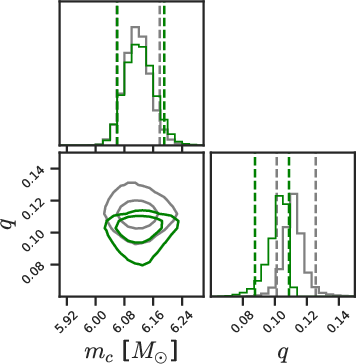
Figure 1: Posterior distribution for ZAMS initial conditions and hyperparameters yielding GW190814-like mergers, with a preference for finely tuned αλCE values and mass transfer limits.
The interaction phase is characterized by a transition from short, stable mass transfer to common envelope (CE) evolution during the primary's core helium burning. Key hyperparameter correlations include αλCE,1∼2: wider initial orbits require greater CE ejection efficiency for binary survival. The secondary RLOF episode is always stable, exhibiting broad accretion efficiency posteriors due to Eddington-limited mass transfer.
Dominant Evolutionary Channel and Merger Requirements
The reconstructed formation pathway is summarized in a schematic that traces the full stellar evolution and binary interaction sequence necessary for GW190814-like mergers.
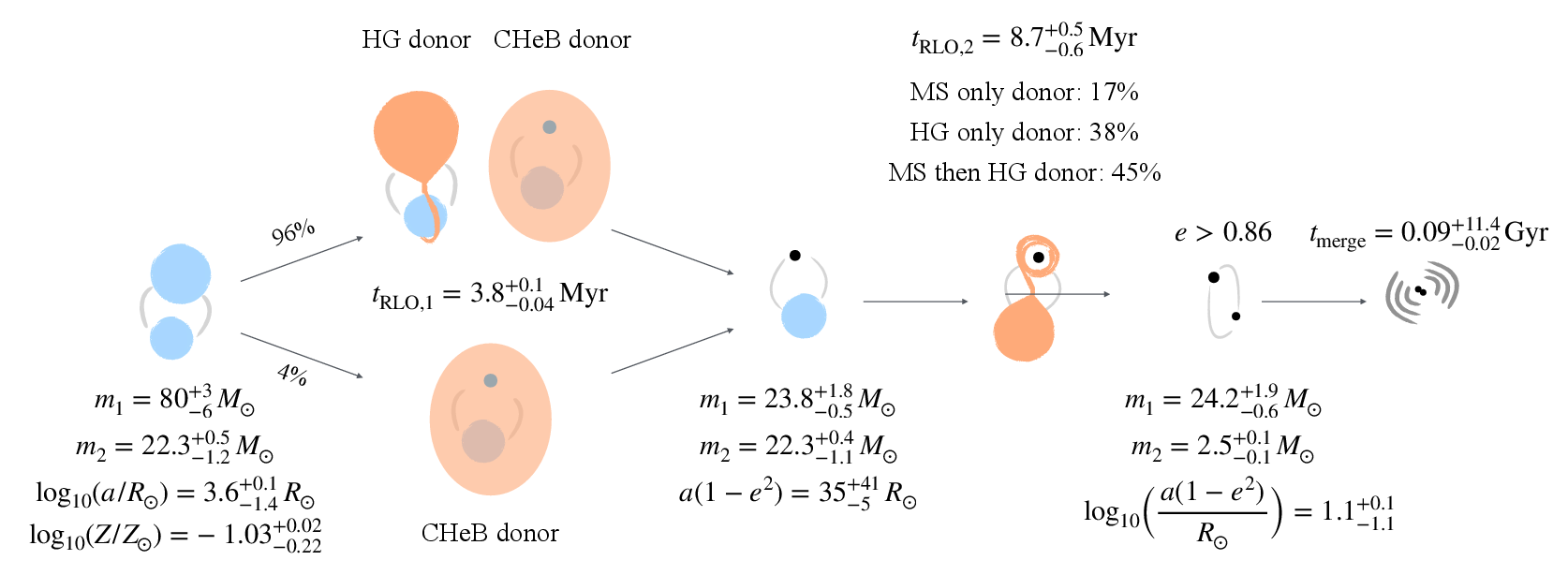
Figure 2: Evolutionary channel for GW190814-like binaries: initial mass transfer followed by CE evolution, low-kick BH formation, stable RLOF, high-kick secondary compact object formation, and merger within a Hubble time.
After CE, the first compact object (the BH) forms with a low natal kick to preserve binary binding. The secondary (with comparable mass) donates matter during Eddington-limited stable RLOF, minimally increasing BH mass. Formation of the second compact object requires a "lucky strike" -- a strong natal kick (v2≳150kms−1) delivered in the orbital plane, perpendicular to motion, to impart high post-SN eccentricity (e≳0.86), enabling GW emission to shorten the delay time below a Hubble time.
Natal Kick Distribution and Merger Likelihood
Natal kick analysis demonstrates that the merger is contingent not only on kick magnitude but also on precise geometric orientation.
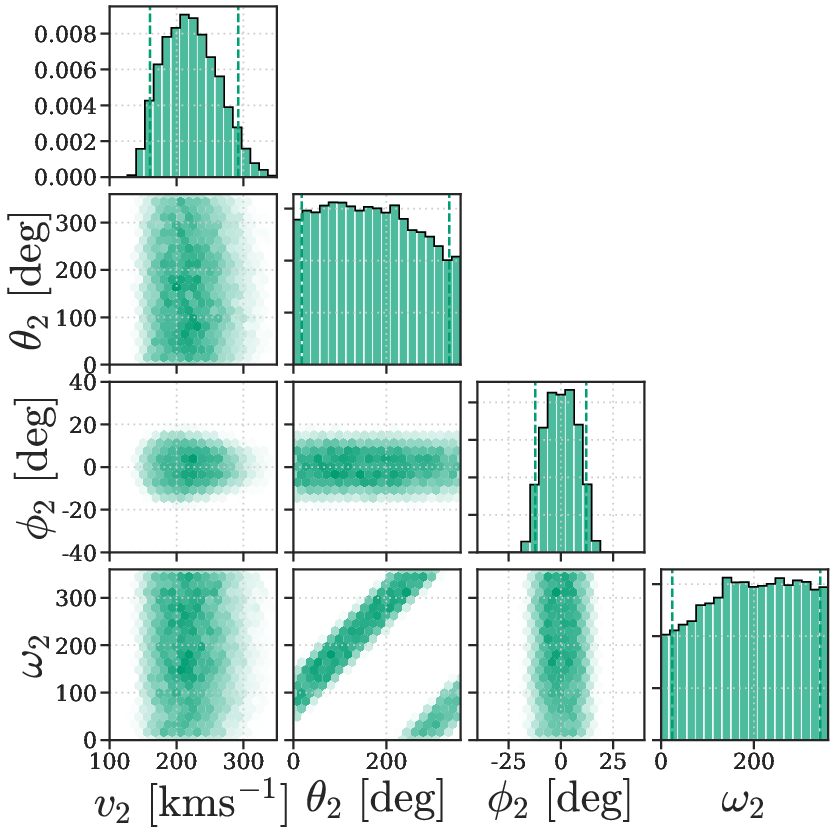
Figure 3: Marginalized posterior for second SN natal kick parameters: only a narrow range of kick magnitude and geometry produces mergers, implying low probability for the required configuration.
Approximately 20% of systems experience the necessary directional configuration (δΩ≈2.57sr solid angle for the kick), given isotropic kicks. The rarity of such kicks, rather than initial binary conditions or generic evolutionary channels, dominates the statistical history of observed GW190814-like systems.
Robustness and Comparative Simulations
The study validates its channel and parameter inference by comparing simulations that fix the first BH's natal kick to zero. Both 17-parameter (free kick) and 13-parameter (no BH kick) spaces yield qualitatively similar outcomes for the chirp mass and mass ratio distributions, with only minor quantitative differences in the mass ratio extension.
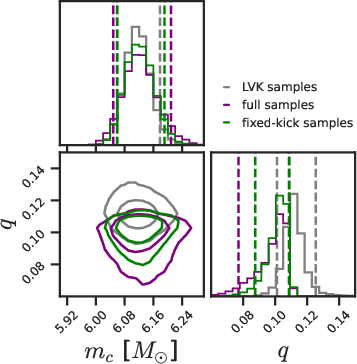
Figure 4: Simulated chirp mass and mass ratio posteriors compared for unconstrained kick and zero-kick BH formation channels, both consistent with GW190814 observational posteriors.
Astrophysical Interpretation and Population Constraints
Analysis shows the preferred ZAMS mass ratios and metallicities are consistent with observed populations in the Local Group, though precise matches to 80M⊙ stars at 0.1Z⊙ are rare but observed. The necessity of CE evolution during the HG phase introduces sensitivity to the mass-loss and CE formalism; detailed stellar evolution models may modify envelope binding parameters (λCE), potentially increasing merger or widening rates.
Stable mass transfer throughout first RLOF remains an alternative, but the channel reconstructed herein indicates orbital shrinkage through CE is crucial for bringing the binary to a separations compatible with post-SN merger. High-kick formation for 2−5M⊙ compact objects is supported by recent multi-dimensional core-collapse models, though the preferred magnitude here (vk,2≃220kms−1) is less than values of 300−1000kms−1 predicted for some SN outcomes.
Full Posterior Landscape
For completeness, the study includes full multidimensional posterior distributions for both unconstrained and zero-kick scenarios, reaffirming the specific parameter correlations and channel dominance.
Figure 5: Comprehensive posterior over the binary population synthesis parameter space from BackPop/COSMIC modeling.
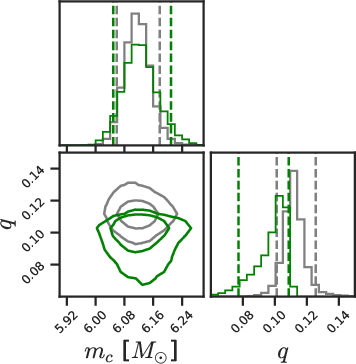
Figure 6: Full posterior for the fixed-kick BH scenario, confirming minor changes in BBH mass ratios and chirp mass distribution.
Conclusion
This study rigorously demonstrates that GW190814-like binaries can be formed in isolated binary evolution scenarios without requiring progenitor ZAMS properties that are atypical relative to local massive star populations. The decisive factor for forming and merging such asymmetric BBHs is the occurrence of a highly specific and low-probability natal kick for the second-formed compact object, which imparts merger-enabling eccentricity without disrupting the system. The statistical likelihood for GW190814-like events is therefore predominantly governed by natal kick geometry, not by restricted initial conditions or interaction prescriptions.
The formalism and statistical inference deployed here are broadly extensible to other GW events, enabling population-level constraints on binary physics such as CE efficiency, mass transfer, and natal kicks. Detailed stellar evolution and improved binary interaction models will be essential to refine the merger rate predictions and reconcile CE and mass transfer pathways with full observational datasets. As the GW event catalog expands, such multidimensional backward inference frameworks will be crucial for constraining the astrophysical drivers underlying the diversity of compact object mergers.
Essay based on "Lucky Strikes: On the Origins of GW190814 Through Isolated Binary Evolution" (2511.16648).