- The paper demonstrates that scaling domain wall networks rapidly evolve and emit gravitational waves with a universal UV spectral index.
- It validates the velocity-dependent one-scale model by extracting consistent equal time correlators across diverse cosmological backgrounds.
- Results reveal that gravitational wave signatures from domain walls remain robust against background variations, offering promising detection prospects.
Domain Walls in the Scaling Regime: Equal Time Correlator and Gravitational Waves
Introduction and Theoretical Framework
Domain walls (DWs) are topological defects arising from the spontaneous breakdown of discrete symmetries in early universe cosmology. Networks of DWs are theorized to contribute substantially to the stochastic gravitational wave (GW) background, providing signatures detectable with current and future GW observatories. The paper explores the non-equilibrium evolution, scaling regime, and GW emission from DW networks through high-resolution 3D lattice field theory simulations, focusing on the extraction and interpretation of the Equal Time Correlator (ETC) and Unequal Time Correlator (UTC) of the energy-momentum tensor.
A key theoretical setup involves a real scalar field ϕ with double-well potential, V(ϕ)=4λ(ϕ2−η2)2, yielding DWs upon Z2 symmetry breaking. The analysis proceeds under expanding universe backgrounds parameterized by the scale factor a(τ) with different equations of state. Initial conditions mimic the Kibble mechanism via randomized Gaussian fluctuations and momentum cutoffs controlling the initial density of domain walls.
Scaling Regime and Dynamic Approaches
The DW network rapidly evolves post-formation towards the scaling regime, characterized by an O(1) area parameter A—the number of DWs per Hubble volume—and mildly relativistic wall velocities. Simulations with diverse initializations, variations in m/H and kcut, confirm convergence to scaling within a few Hubble times, independently of initial overdensity. The analysis substantiates the velocity-dependent one-scale (VOS) model as an accurate description for the relaxation and scaling of DW networks.
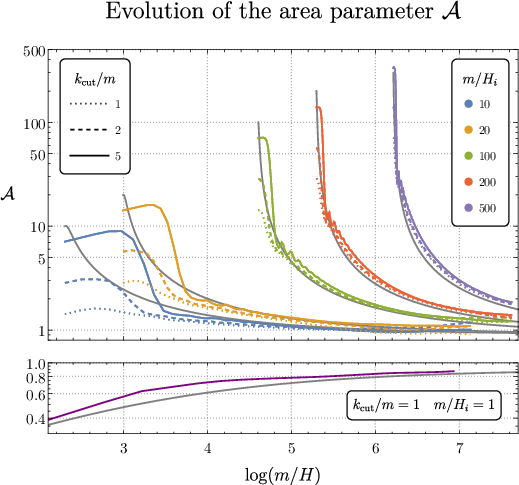
Figure 1: Top: Evolution of A across varied initial conditions and cutoffs, confirming rapid approach to scaling independent of initial DW density.
The area parameter is robustly estimated via two numerical methods: a link-based surface counting algorithm and a line-of-sight sign-flip counter, both agreeing within percent-level discrepancies. Slices of lattice simulations reveal rapid reduction from dense to sparse wall configurations, visually demonstrating the scaling transition.
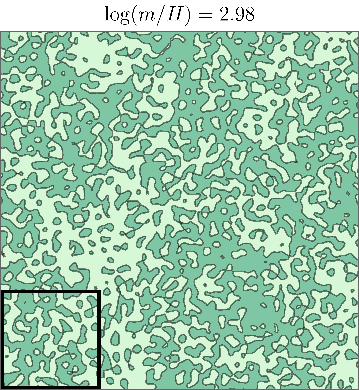
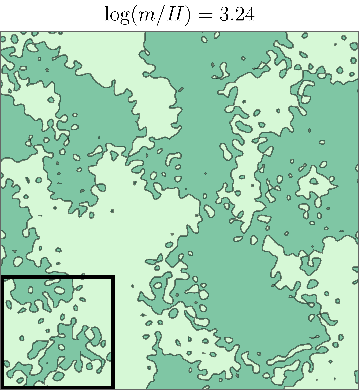
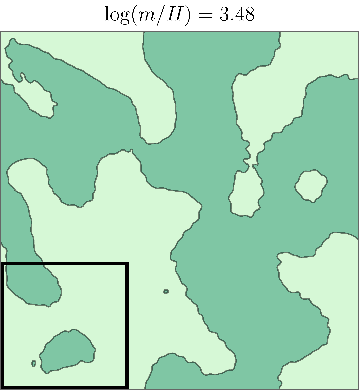
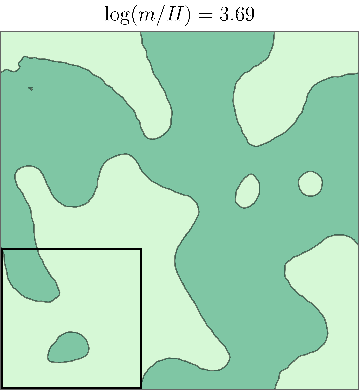
Figure 2: Slices of the domain wall network, displaying morphological simplification and reduction in wall density over cosmological time.
Gravitational Wave Emission in the Scaling Regime
DWs emit GWs efficiently during scaling, with GW energy density evolving as ρgw/ρc∝τ4 in radiation domination, consistent with quadrupolar emission estimates. The GW efficiency parameter ϵgw remains constant after the onset of scaling, with numerical values confirmed against earlier results (ϵgw≈0.54 for N=20483 grids).
Analysis of the GW power spectra reveals a characteristic broken power law: a causal IR slope (∝k3), a pronounced peak at the Hubble scale (kpeak∼H), and a subhorizon UV decay (k−1.3). The UV slope, peak position, and amplitude were robust to simulation resolution, with detailed fits presented.
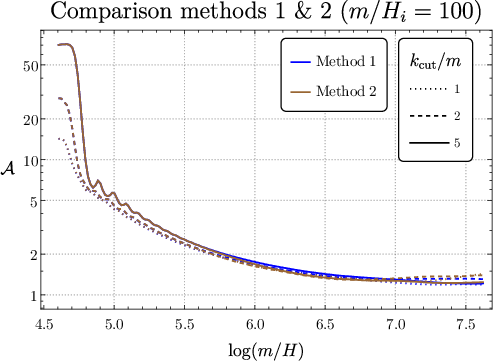
Figure 3: GW spectrum shape and peak scaling across simulation times and resolutions; peak at Hubble scale and consistent k−1.3 UV slope.
Comparative analysis across literature supports the universality of the spectrum across various initializations and grid sizes. The IR and UV slopes are stable and match previous state-of-the-art lattice studies.
Equal Time and Unequal Time Correlator Extraction
The ETC, CdwT(x,x), of the stress tensor serves as a diagnostic for scaling, exhibiting power-law decay CdwT(x,x)∝x−q with q≈2.8 for x≫1, independent of cosmological background. This scaling is confirmed via direct extraction in N=20483 and N=40963 simulations and holds for different expansion dynamics (radiation, kination, exotic equations of state).
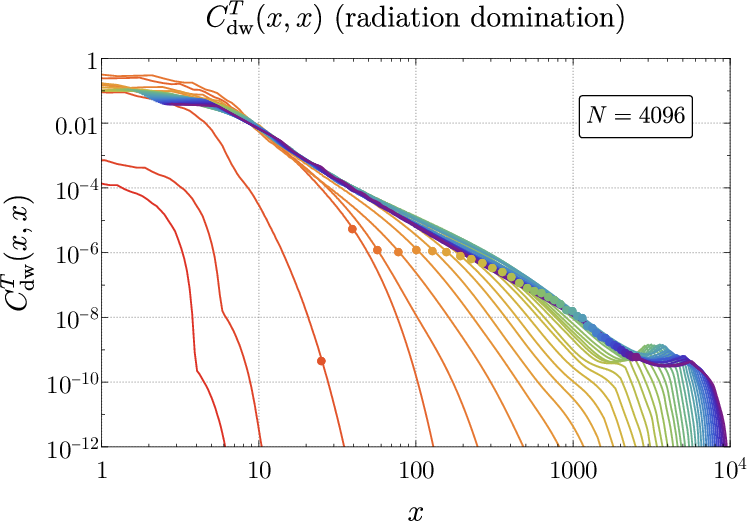
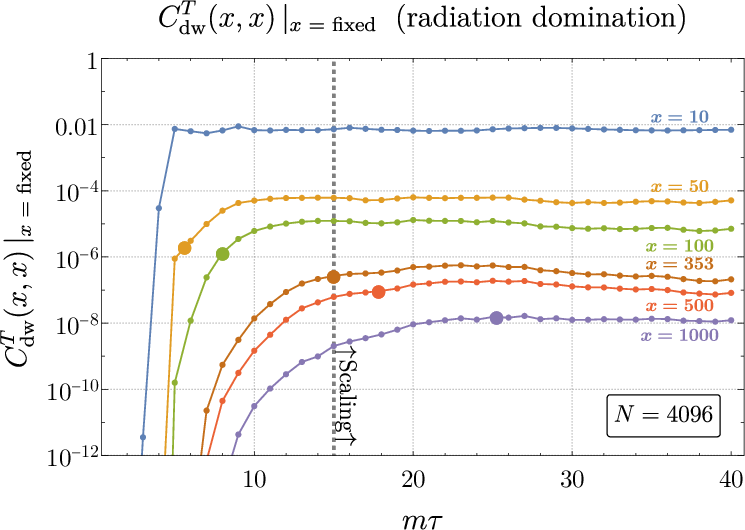
Figure 4: The ETC CdwT(x,x) as a function of self-similar variable x=kτ, demonstrating convergence and scaling for varied cosmological times.
The UTC is modeled via ansätze varying the temporal coherence of the source. Interpolating between incoherent and coherent limits, a partial coherence model (r≈0.4−0.5 in the exponential suppression term) most accurately reconstructs the simulated GW spectrum, indicating the DW network is neither fully coherent nor incoherent.
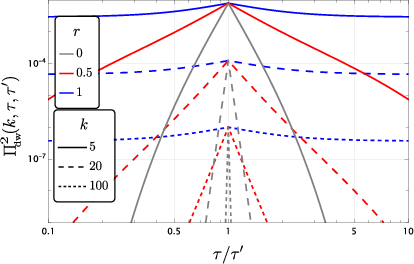
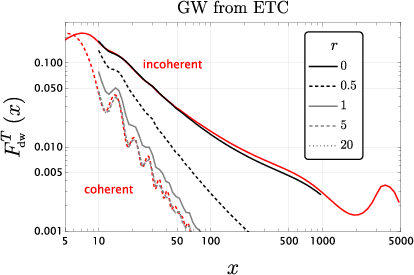
Figure 5: UTC structure across the diagonal for varying momentum and interpolation parameter r, qualitatively matching observed domain wall coherence properties.
This framework unifies the analytic prediction and simulation results—the UV GW spectrum is ultimately set by the ETC exponent q and its universality across backgrounds.
Cosmology Dependence and Universal GW Spectra
Simulations carried out in kination (ω=1) and an exotic background (ω=2/3) reveal remarkably similar ETC exponents and GW spectral slopes to the radiation case. Scaling parameters (A, ϵgw) are cosmology dependent, but the UV GW spectral index associated with scaling DWs is insensitive to the expansion history.
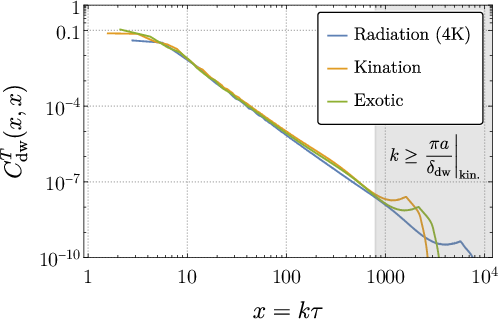
Figure 6: Overlay of CdwT(x,x) for radiation, kination, and exotic cosmologies, evidencing universal power-law decay and spectral shape for subhorizon modes.
Variation in the background expansion primarily affects the IR spectrum (for superhorizon modes) and the amplitude/location of the GW peak post-annealing. Spectra redshift and tilt accordingly for epochs with different p exponents.
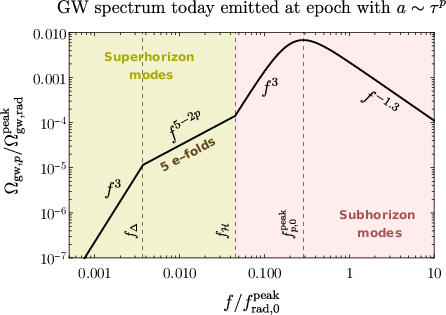
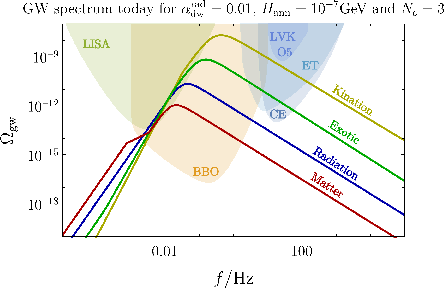
Figure 7: Sketch of expected present-day GW spectrum, demonstrating shifting peak locations and IR tilts due to non-standard cosmological epochs.
Phenomenological Implications and Detection Prospects
The results have direct consequences for cosmic GW archaeology. The universality of the UV spectrum (f−1.3) for DW networks implies robust predictivity for GW backgrounds. The IR behavior may distinguish epochs of non-standard expansion via altered spectral slopes. Simulated spectra—including amplitude shifts and IR/UV tilting—are placed in the context of forecast sensitivities for LISA, BBO, Einstein Telescope, Cosmic Explorer, and LVK O5.
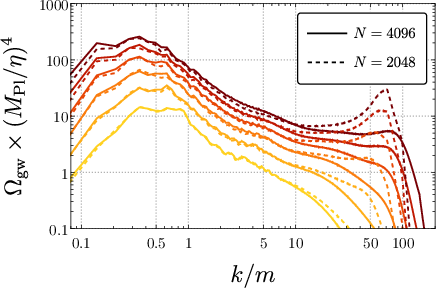
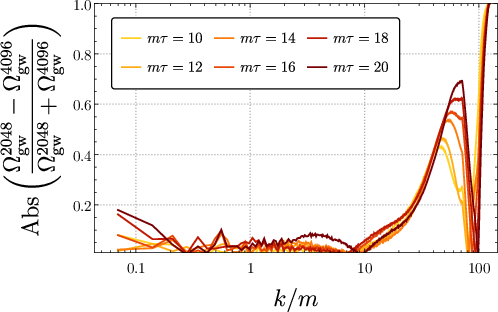
Figure 8: GW spectrum resolution comparison for 20483 vs 40963 grids, verifying UV stability of spectral slopes and illustrating numerical artifacts outside resolved regime.
Current and next-generation GW detectors could probe GW backgrounds from DWs in a variety of cosmologies, given that amplitudes remain detectable for domain wall abundances down to percent-level fractions under strong bias scenarios.
Conclusion
Comprehensive lattice simulations demonstrate that DW networks robustly enter the scaling regime, emitting GWs with stable, universal UV spectral features independent of background expansion history. Extraction and analysis of the ETC of the stress tensor enables confident extrapolation between computational and theoretical results, while the partially coherent UTC model captures the observed GW spectrum structure. The study's results imply that GW signatures from scaling domain wall networks encode information on both defect microphysics and expansion history, and the prospect for detection at interferometers is promising. Direct extraction of the UTC and extension to bias-driven network collapse phases represent natural future directions.
Table: Summary of Core Numerical Results
| Cosmology |
Grid Size |
ω |
ϵ~gw |
b (UV Index) |
xp (Peak) |
q (ETC Exp.) |
| Radiation |
4096 |
1/3 |
0.35±0.01 |
1.30±0.01 |
1.01±0.02 |
2.903±0.004 |
| Kination |
2048 |
1 |
0.49±0.02 |
1.26±0.03 |
2.16±0.11 |
2.787±0.004 |
| Exotic (2/3) |
2048 |
2/3 |
0.41±0.02 |
1.33±0.03 |
1.64±0.09 |
2.804±0.004 |
The amplitude, peak scaling, and ETC exponent are consistent across backgrounds for subhorizon modes, underscoring the universality of domain wall GW signals.
References
- "Domain walls in the scaling regime: Equal Time Correlator and Gravitational Waves" (2511.16649)