- The paper formulates a rigorous mathematical foundation for signed networks, integrating balance theory with spectral and dynamical analysis.
- It adapts traditional network measures by extending centrality and clustering coefficients to account for positive and negative interactions.
- It surveys advanced techniques for sign prediction, community detection, and dynamic modeling, emphasizing methodological rigor and practical insights.
Signed Networks: Foundations, Analysis, and Applications
Introduction and Motivation
The monograph "Signed Networks: theory, methods, and applications" (2511.17247) presents a systematic, comprehensive exposition of signed networks, formalizing their mathematical foundations, reviewing balance theory and structural properties, and surveying modern methods for inference, dynamics, and data sources. Signed networks generalize classical graphs by allowing edges to encode positive (e.g., cooperation, agreement) or negative (e.g., conflict, antagonism) relations, capturing the dual nature of interactions in social, ecological, economic, biological, and political systems.
The authors emphasize that the presence of negative (antagonistic) ties is central to understanding polarization, faction formation, and the interplay of cooperative and conflictual organizing principles across diverse complex systems. They highlight that traditional approaches, which neglect edge signs, lose crucial information and obscure the emergence of structural phenomena rooted in the tension between positive and negative relationships.
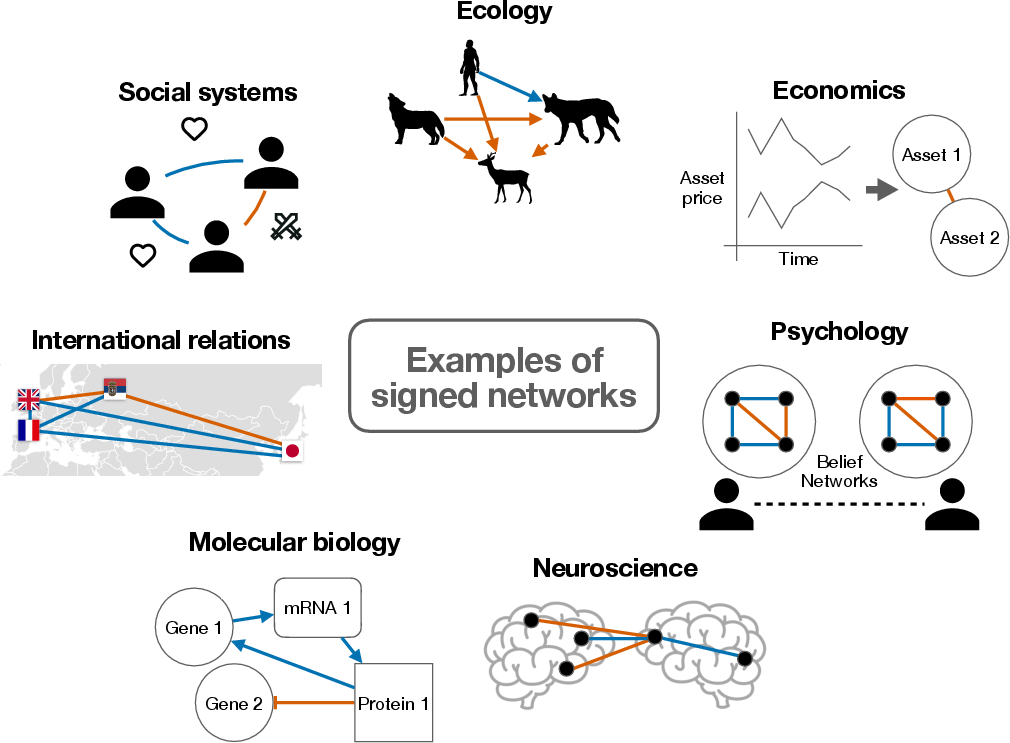
Figure 1: Examples of signed networks across social, ecological, economic, psychological, biological, neuroscience, and international relations domains.
Mathematical Foundations and Metrics
Signed networks are formalized as graphs where each edge is assigned a sign (+1 for positive, −1 for negative). Representation via signed adjacency matrices and their decompositions into positive and negative components enables algebraic and spectral analysis.
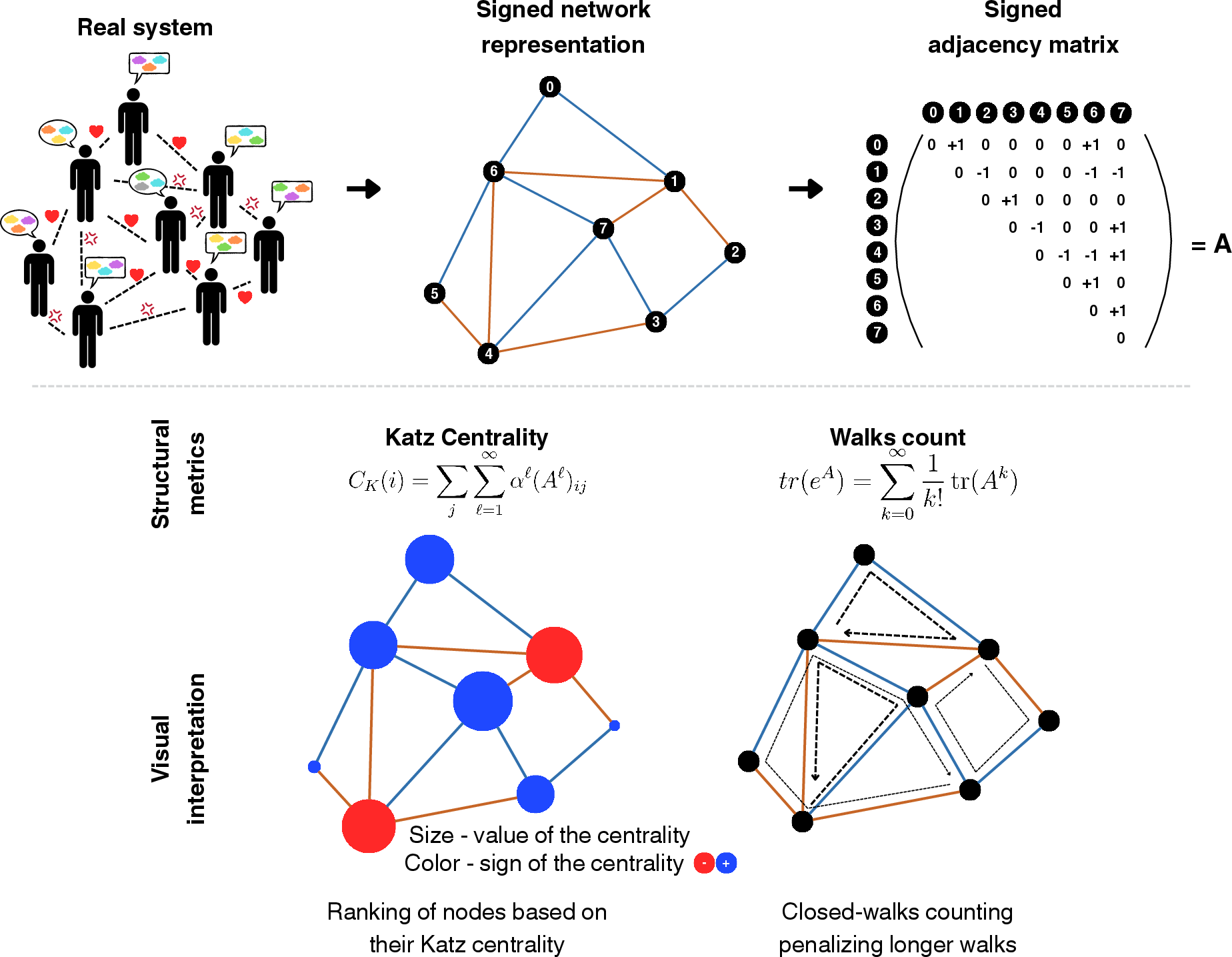
Figure 2: A real-world system abstracted to a signed network and its corresponding adjacency matrix, with illustrations of Katz centrality and closed walk counts.
The adaptation of classical network measures to the signed context is nontrivial. Degree becomes a vector (k+,k−) of positive and negative connections. Clustering coefficients require differentiating between positive and negative triangles, and generalizations of shortest-path-based distances fail as signed edge weights violate metric axioms. The work discusses generalizations such as resistance and diffusion distances, which remain well-defined for signed graphs.
Signed centrality measures—degree, closeness, Katz, eigenvector, and PageRank—are extended, but their interpretation diverges from the unsigned case. Notably, eigenvector centrality in balanced signed networks partitions nodes into factions by the sign of eigenvector components, with the sign aligning with group membership.
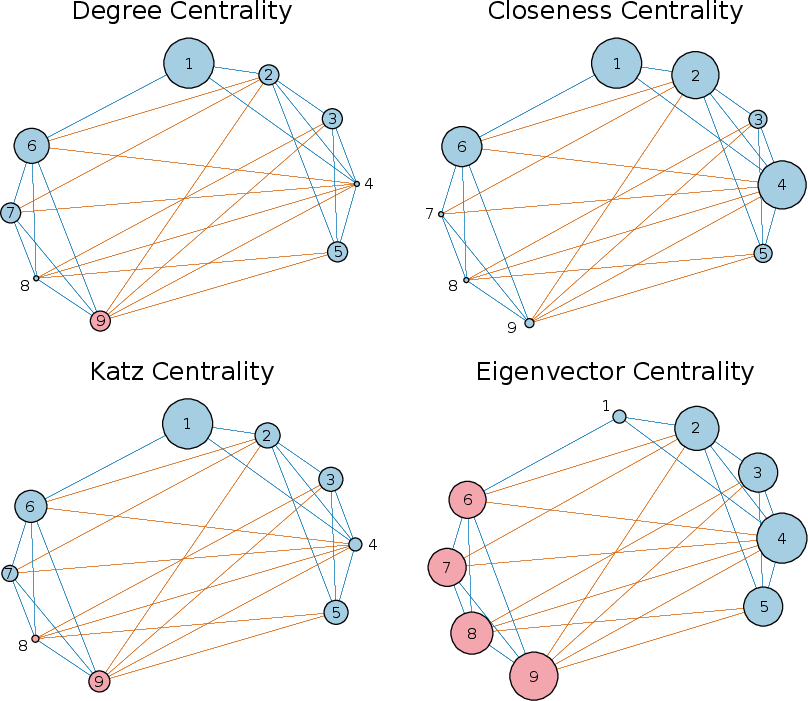
Figure 3: Visualization of degree, closeness, Katz, and eigenvector centrality in a signed network. Node size corresponds to magnitude, color to sign.
The Laplacian formalism is extended: the opposing Laplacian incorporates signs into spectral structure and underpins clustering, while the repelling Laplacian connects to dynamics and stability. These operators facilitate spectral embeddings and are central for dynamics analysis.
Balance Theory: Cognitive and Structural Perspectives
The concept of "balance" is revisited from both its original cognitive psychological roots (Heiderian balance) and its formal graph-theoretic generalization (Hararian or structural balance). Heider's local, subjective perspective focuses on the internal psychological consistency of triads (e.g., "the friend of my enemy is my enemy"), while Harary abstracts to a global property: a network is structurally balanced if every cycle contains an even number of negative edges.
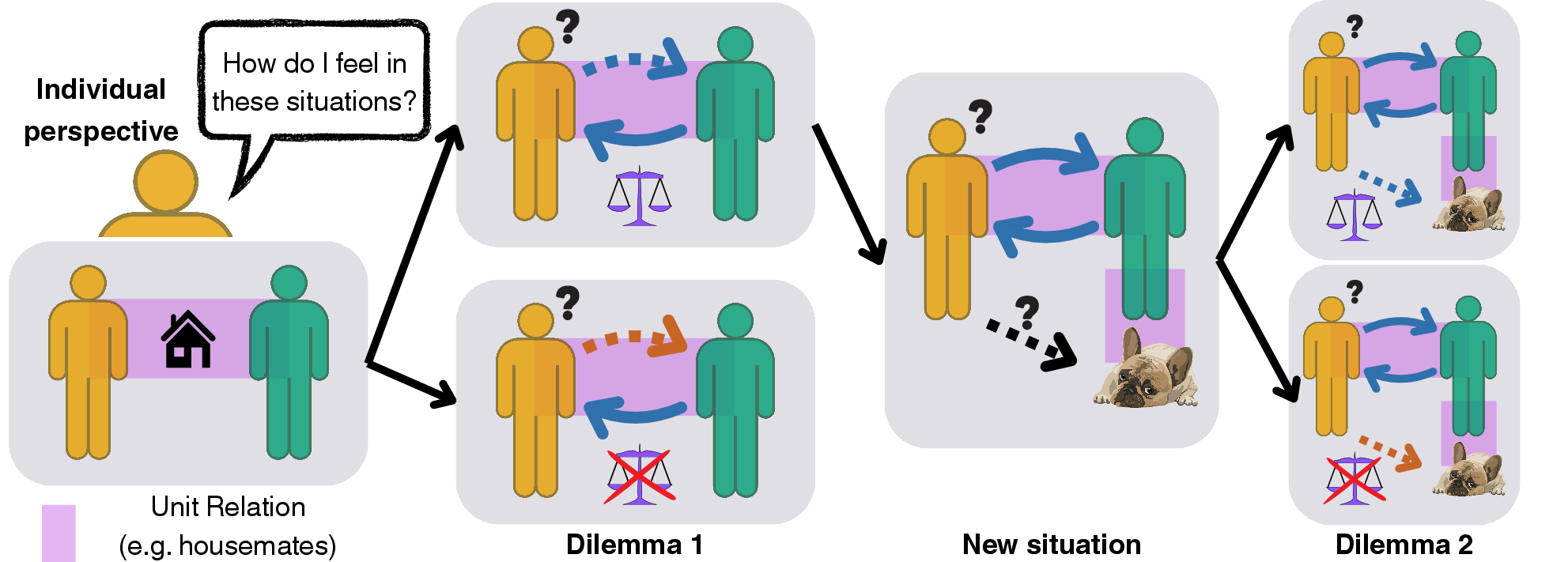
Figure 4: An illustration of Heiderian (cognitive) balance in an interpersonal context.
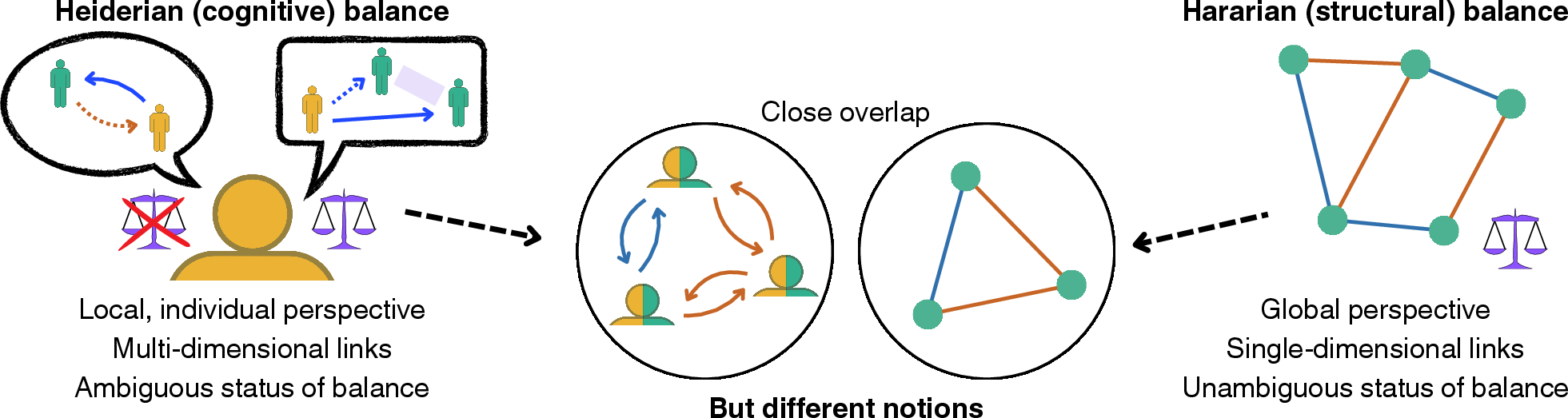
Figure 5: Comparison of the local (cognitive) and global (structural) notions of balance.
Harary's structural balance theorem has profound implications: every balanced signed network can be partitioned into two antagonistic factions with all positive edges within and all negative edges between groups.
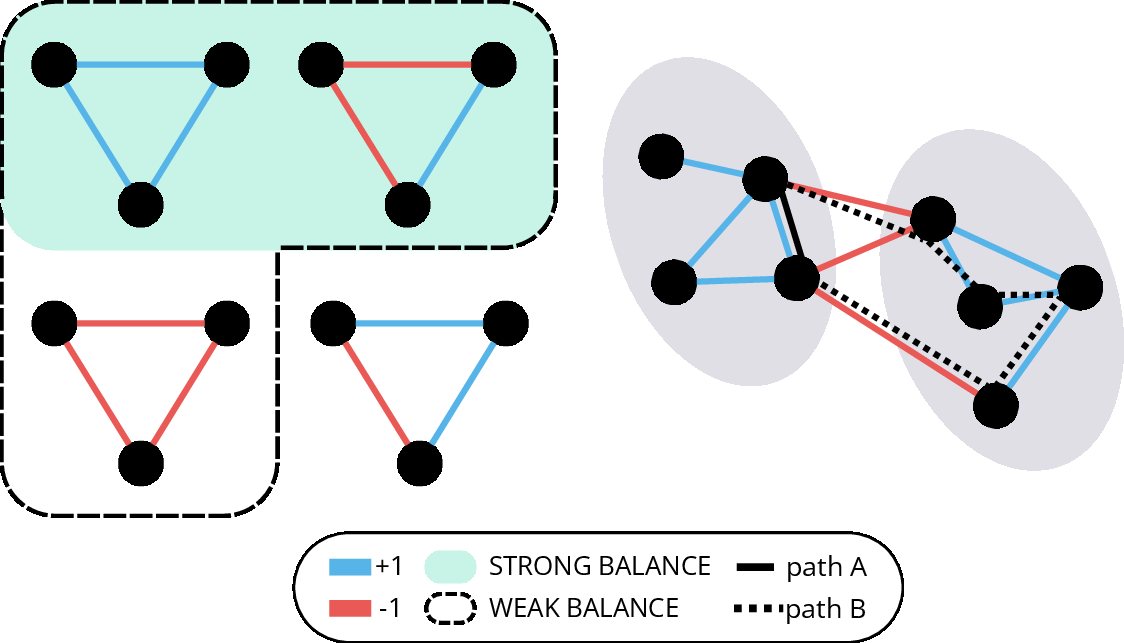
Figure 6: The four possible triads in signed networks and a demonstration of Harary's structure theorem.
The theory is extended to weak and relaxed balance models, allowing multipolar structures and general block patterns, recognizing that perfect (strong) balance is not generally observed in empirical systems.
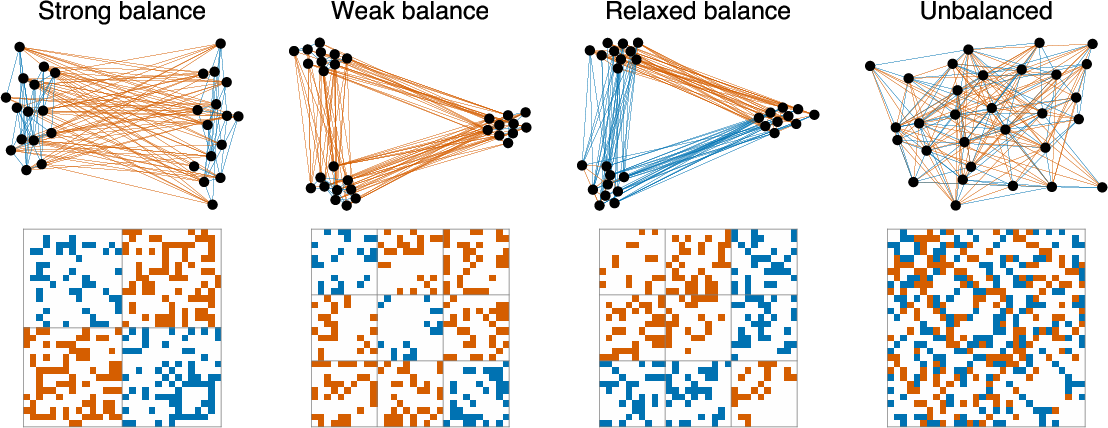
Figure 7: Visual examples of strongly balanced, weakly balanced, relaxed-balanced, and unbalanced signed networks and their adjacency matrices.
Quantification of balance employs motif and cycle counts, frustration indices, spectral gaps, and walk-based indices, each with trade-offs in computational complexity and theoretical reach.
Structural Inference and Community Detection
Analysis of signed network structure leverages sophisticated null models, spectral and embedding methods, and algorithmic frameworks for sign prediction and community detection.
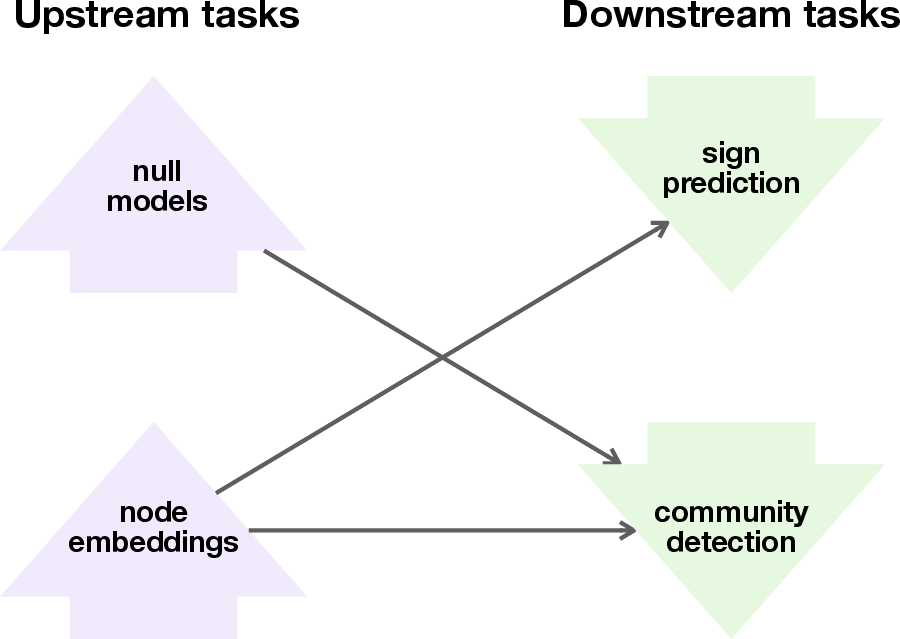
Figure 8: Schematic of upstream (null models, embeddings) and downstream (sign prediction, community detection) tasks in signed structural analysis.
Null models are categorized by which aspects (topology, degree, signed degree) are preserved, acknowledging that the choice of null model stringently shapes inferences about balance and group structure.
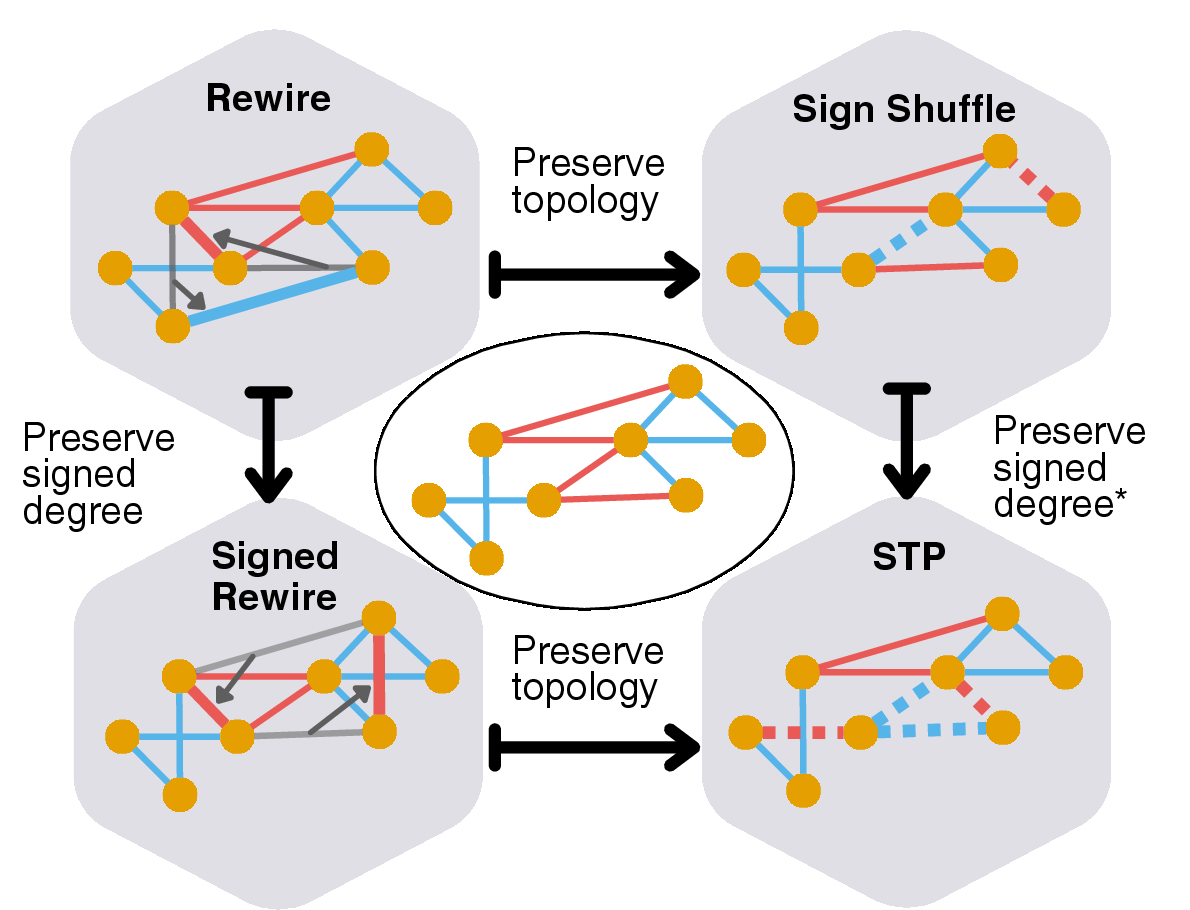
Figure 9: Taxonomy of null models for signed networks, based on constraints on topology and degree.
Community detection diverges markedly from the unsigned case. Here, "factions" minimize negative internal and positive external edges—an objective inseparable from structural balance. Modularity-based, frustration-based, spectral, and statistical inference (e.g., signed stochastic block models) approaches are detailed.
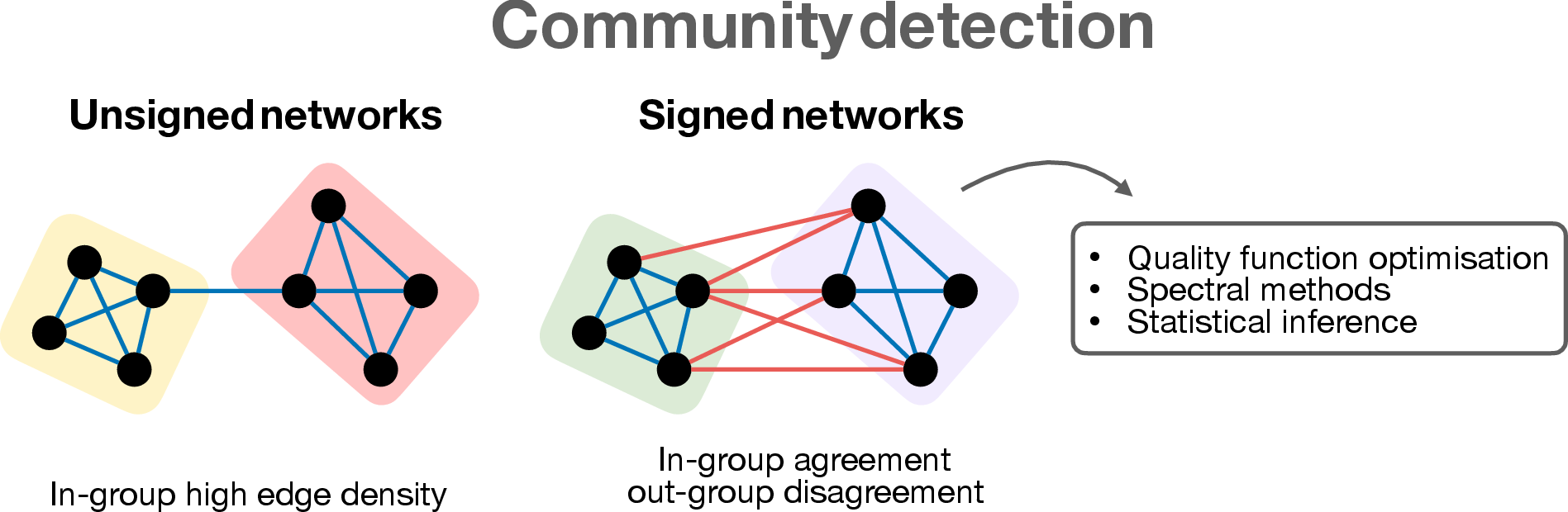
Figure 10: Conceptual contrast between unsigned and signed community detection objectives.
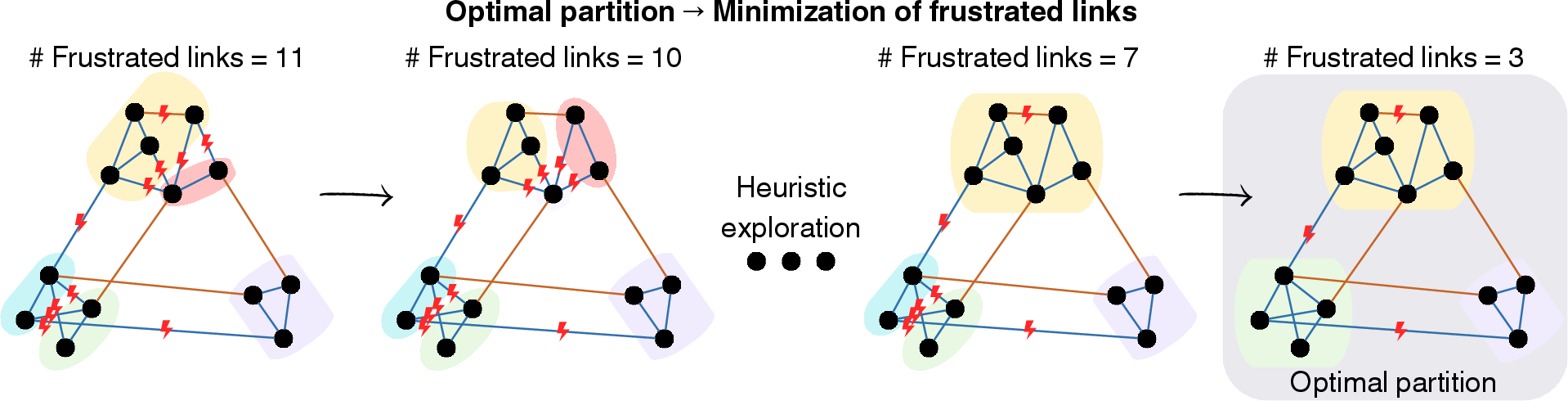
Figure 11: Algorithmic process for finding an optimal partition by frustration minimization, visualized stepwise.
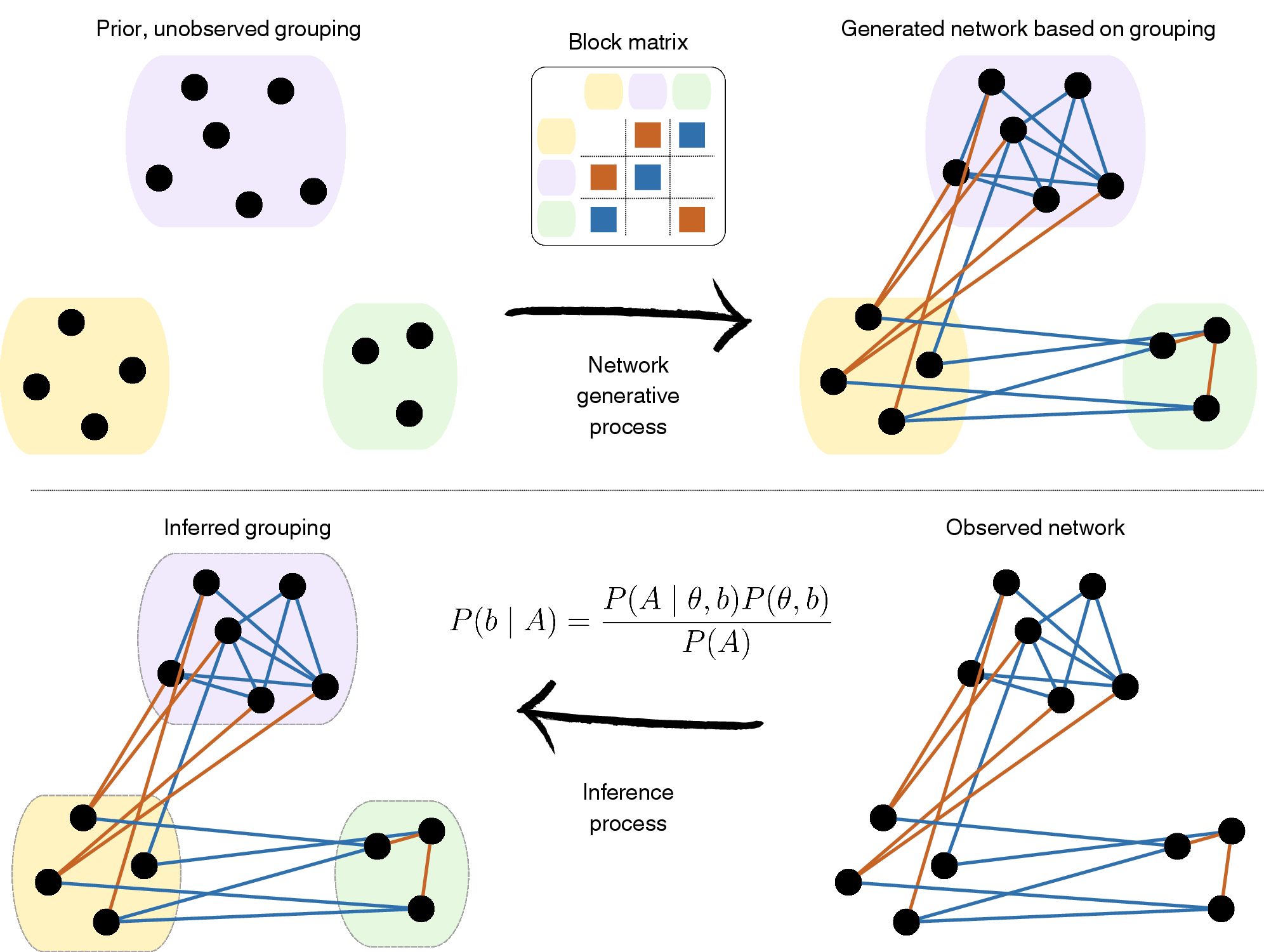
Figure 12: A graphical model view of statistical inference-based community detection in signed networks.
Dynamics: Processes On and Of Signed Networks
Signed network dynamics include both evolving processes on fixed topologies (e.g., opinion formation, contagion) and the evolution of the network structure itself. Negative edges fundamentally alter consensus, diffusion, bifurcation, and fragmentation phenomena.
Voter and diffusive models reveal that structural balance determines the possibility of polarised equilibria or consensus, with anti-balanced networks exhibiting asynchronous dynamics.
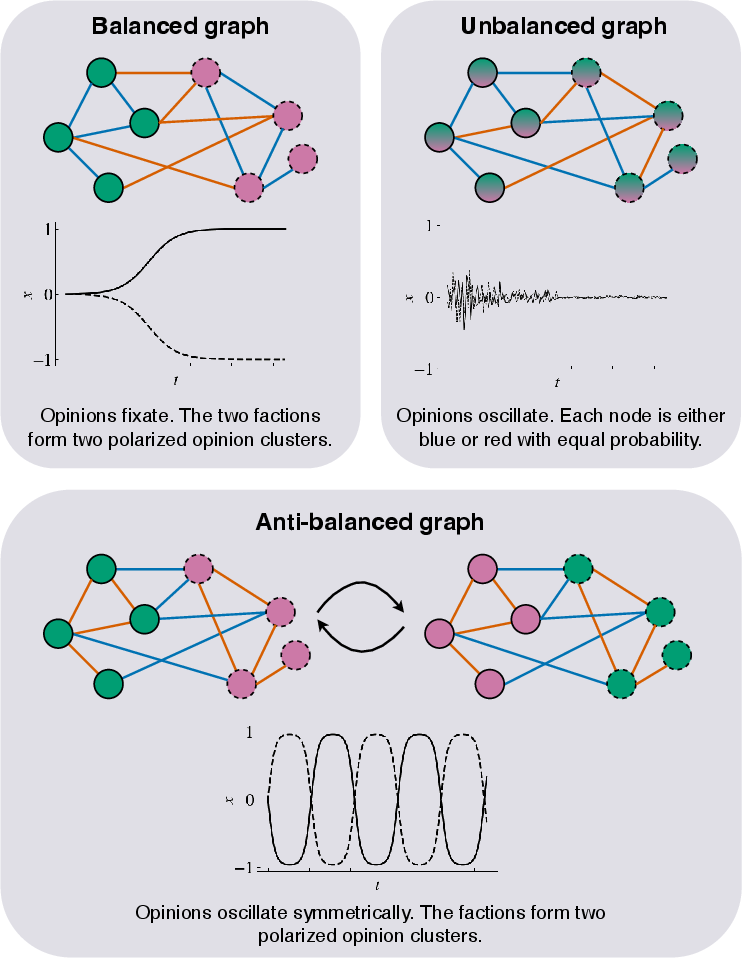
Figure 13: Asymptotic behavior of the signed voter model depends on balance: convergence to polarization, oscillation, or neutrality.
Contagion models (SIS, IC, LT) with signed interactions demonstrate that negative edges inhibit, invert, or modulate spread, leading to richer bifurcation structure and polarization transitions.
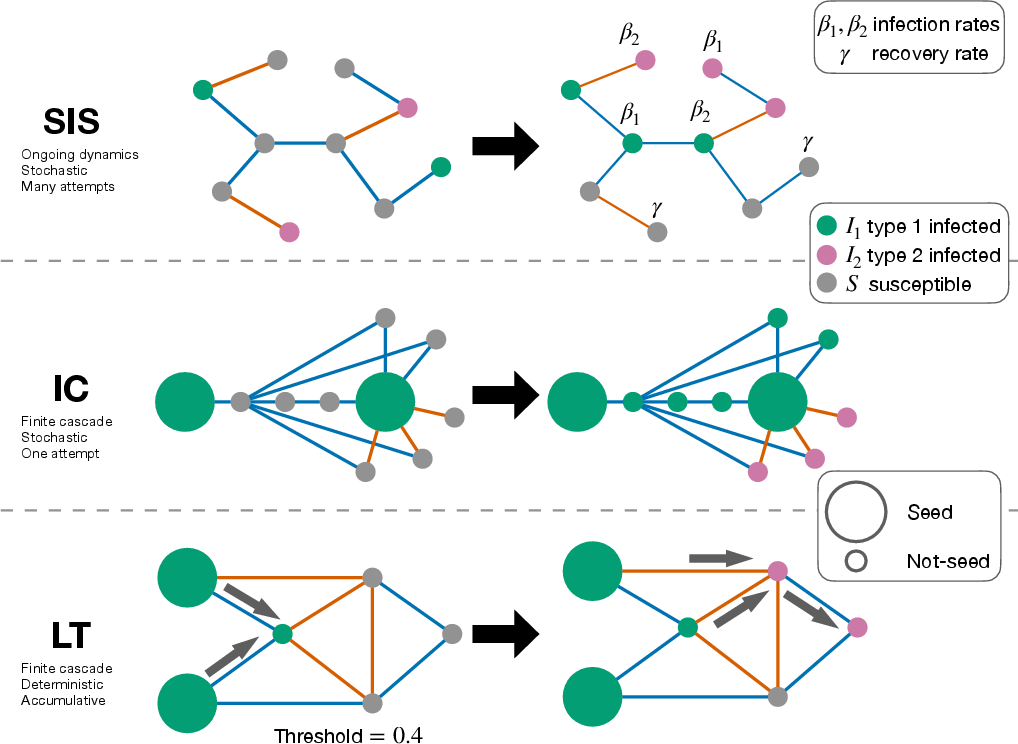
Figure 14: Dynamics of SIS, IC, LT models on signed networks, with state transmission flipped along negative edges.
Hamiltonian and game-theoretic models elucidate landscape properties of balance, frustration, and polarization, connecting to spin glass and Ising frameworks.

Figure 15: Example Hamiltonian incorporating balance and negative-link-favoring terms, ordering triad energies.
The empirical study of dynamic signed systems focuses on identifying competing mechanisms—balance, homophily, reciprocity, transitivity, differential popularity, resource constraints, memory—that interact to shape network trajectory.
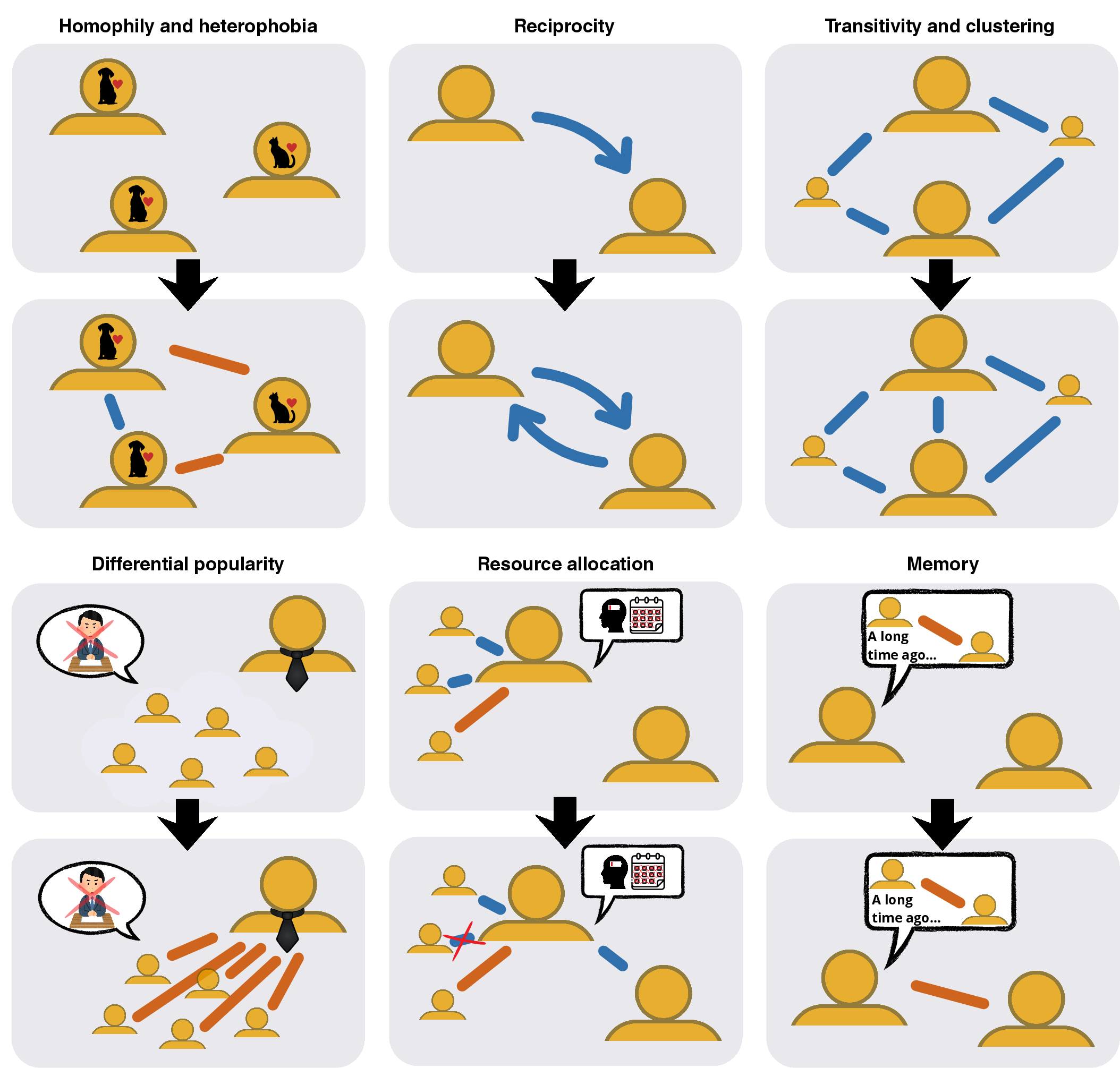
Figure 16: Visual demonstration of key social mechanisms acting in signed networks.
Data Collection, Inference, and Sources
Given the paucity of direct signed relation data, the authors review methodologies for inferring signed networks from rankings, bipartite (co-occurrence) data, online textual and voting interaction patterns, and behavioral traces. They emphasize procedural care in backbone extraction, null modeling, and interpretation of interaction absence.
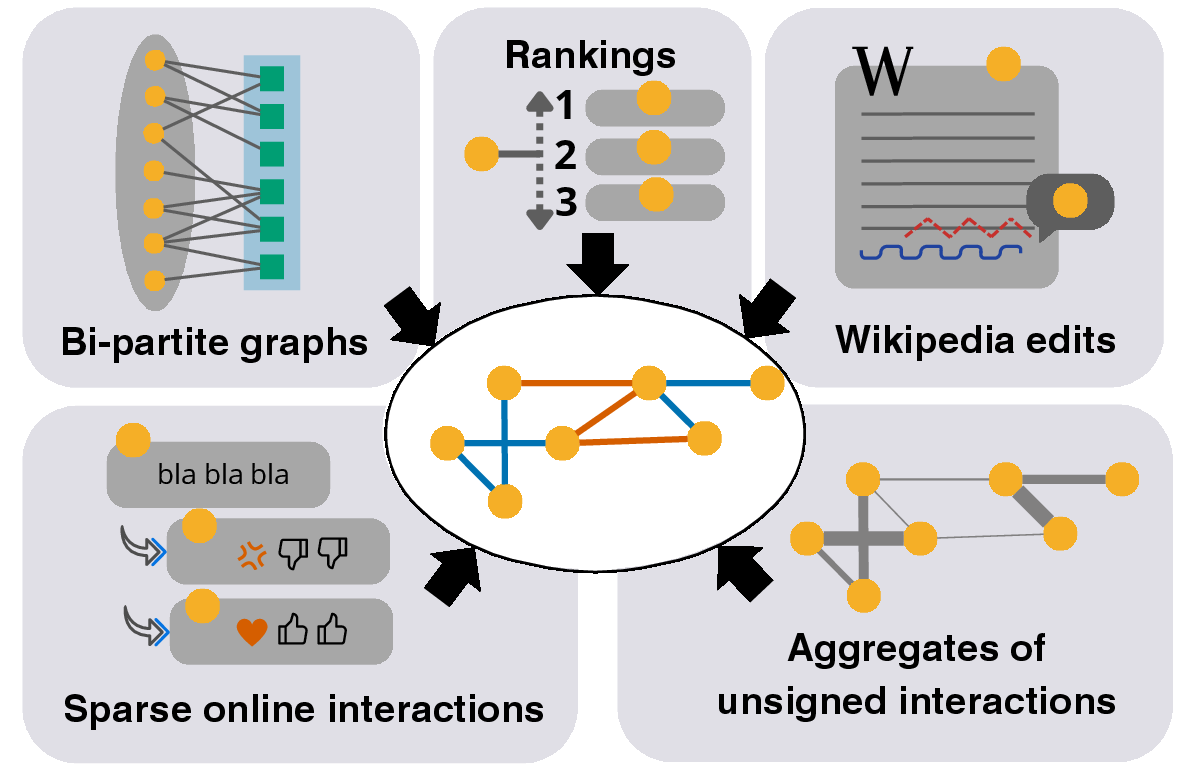
Figure 17: Data sources and methodologies for inferring signed networks: bipartite projection, event co-occurrence, textual interaction.
A curated catalog of datasets is provided, spanning in-person social contexts, online platforms (Epinions, Slashdot, Bitcoin OTC/Alpha, Wikipedia RfA, Reddit), political roll-calls, and international relations (alliances, disputes). The review encourages the development and sharing of richer, longitudinal, and domain-diverse signed network data.
Myths, Pitfalls, and Methodological Clarifications
The monograph is notable for its systematic identification and refutation of prevalent myths in the signed network literature, including: the non-interchangeability of positive and negative edges; the misapplication of unsigned methods to signed contexts; confusion of cognitive and structural balance; and misconceptions regarding "balance" as social harmony.
Notably, the work challenges the adequacy of traditional triangle-based assessments of balance, advocates for null-model-based significance testing, and underscores the limitations of universalizing balance theory outside the social domain.
Conclusions and Future Directions
The authors delineate open methodological, theoretical, and empirical challenges:
- Scalability of analysis and inference methods to large graphs.
- Proper handling of neutral/absent edges, avoiding conflation with negative or unreported relations.
- Richer dynamical models for negative edges, going beyond simplistic sign switching.
- Deepening study of signed motifs beyond triads and integrating with null statistical baselines.
- Systematic benchmarking and cross-domain evaluation of methods and data.
They emphasize the necessity of context-aware modeling, recognition of the heterogeneity of mechanisms beyond balance, and reflection on where signed network formalism is most appropriate.
The monograph positions signed networks as a powerful, but nuanced, lens for studying polarized, antagonistic, and cooperative phenomena in complex systems, contingent on careful methodological specification and domain expertise.
Conclusion
"Signed Networks: theory, methods, and applications" (2511.17247) serves as a foundational reference for researchers in network science, sociology, political science, computational biology, and machine learning. It establishes rigorous mathematical and algorithmic frameworks, clarifies conceptual distinctions, and advocates methodological rigor and domain sensitivity. The text is instrumental for both theory development and practical applications where understanding of antagonism, polarization, and the balance of relations is fundamental.