The Evolving Baryonic Tully Fisher Relation: A Universal Law from Galaxies to Galactic Clusters
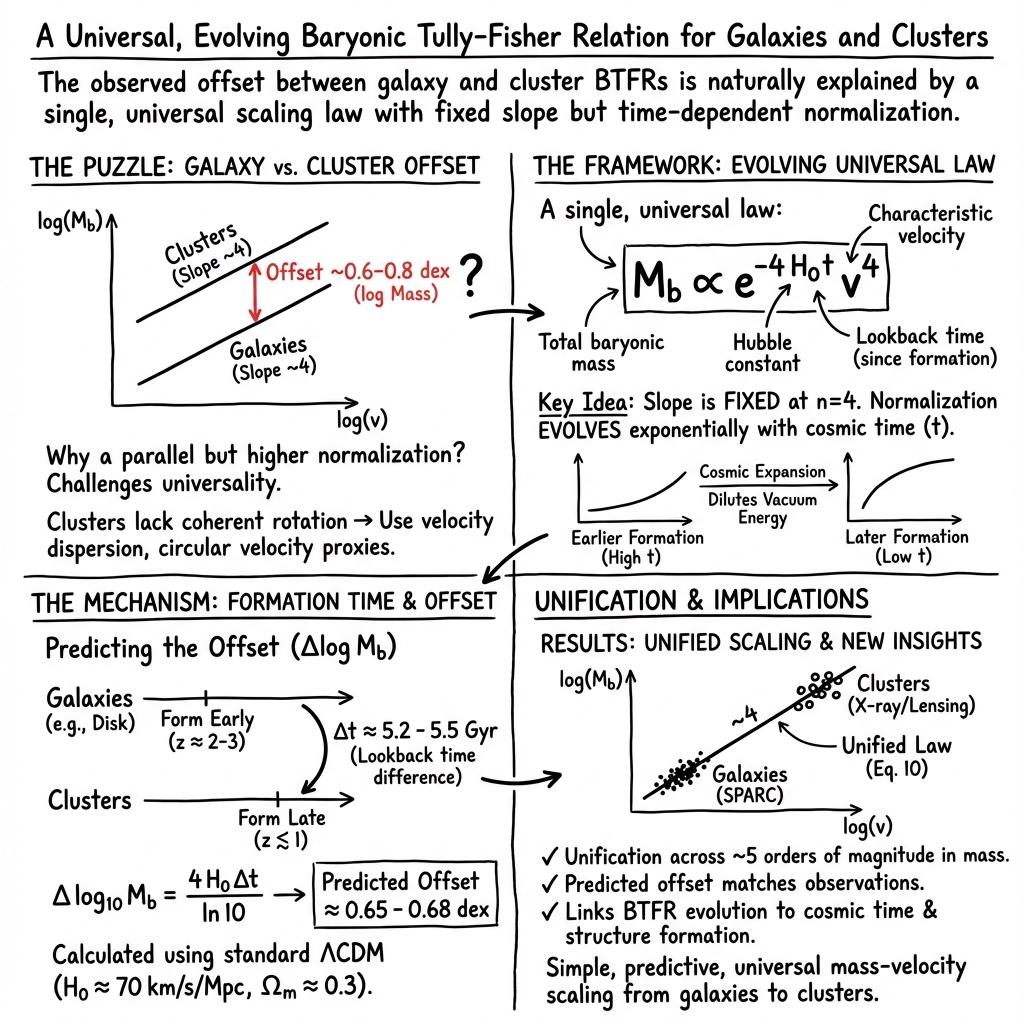
Abstract: The Baryonic Tully-Fisher relation (BTFR) links the baryonic mass of galaxies to their characteristic rotational velocity and has been shown to hold with remarkable precision across a wide mass range. Recent studies, however, indicate that galaxy clusters occupy a parallel but offset relation, raising questions about the universality of the BTFR. Here, we demonstrate that the offset between galaxies and clusters arises naturally from cosmic time evolution. Using the evolving BTFR derived from the Nexus Paradigm of quantum gravity, we show that the normalization of the relation evolves as an exponential function of cosmic time., while the slope remains fixed at $\sim 4$. This provides a simple and predictive framework in which both galaxies and clusters obey the same universal scaling law, with their apparent offset reflecting their different formation epochs. Our results unify mass-velocity scaling across five orders of magnitude in baryonic mass, offering new insights into cosmic structure formation.
Paper Prompts
Sign up for free to create and run prompts on this paper using GPT-5.
Top Community Prompts
Explain it Like I'm 14
Overview
This paper is about a simple rule that connects how much ordinary matter (stars and gas) a galaxy has to how fast it moves: the baryonic Tully–Fisher relation (BTFR). The BTFR usually says that the baryonic mass of a galaxy grows like the fourth power of its rotation speed (). The authors ask: can this same rule also work for giant galaxy clusters, which don’t spin like galaxies do? They argue yes—and explain why clusters seem to sit on a “shifted” version of the rule using how the universe changes over time.
Key questions
The paper focuses on three simple questions:
- Do galaxies and galaxy clusters follow the same mass–velocity rule or different ones?
- Why do clusters look “offset” from galaxies (they seem to have more baryonic mass at the same characteristic speed)?
- Can a time-evolving version of the BTFR explain this offset in a predictable way?
How did they study this?
The authors use two main ideas:
- A time-evolving BTFR: They keep the core shape of the rule the same () but let its “height” change with cosmic time. In plain terms, the rule is like a straight line on a log–log plot with slope 4, but the line can slide up or down depending on when the galaxy or cluster formed. Their formula is:
- is the Hubble constant (how fast the universe expands today), and is how long ago the object formed (its “lookback time”).
- Everyday analogies for the measurements:
- Galaxy “speed” : how fast the edges of a spinning galaxy move.
- Cluster “speed”: since clusters don’t spin, they use a proxy like “velocity dispersion,” which means how fast, on average, the galaxies inside the cluster zip around in different directions—like bees buzzing in a hive.
- “Offset of 0.6–0.8 dex”: a “dex” is a logarithmic unit. An offset of 0.6–0.8 dex means clusters have about 4–6 times more baryonic mass than galaxies at the same speed.
They compare this evolving rule to real data:
- Galaxies: precise rotation and mass data sets like SPARC.
- Clusters: measurements from X-ray observations, gravitational lensing, and velocity dispersions from several studies.
They also base the evolving formula on a theoretical approach they call the “Nexus Paradigm,” which treats spacetime a bit like a crystal lattice with tiny, discrete “packets,” and interprets dark matter and dark energy in specific ways. You don’t need those details to understand the main point: their math makes the BTFR “slide” over time while keeping the slope at 4.
What did they find?
Here are the main results in simple terms:
- The slope stays the same: Whether you look at galaxies or clusters, the relation between mass and speed follows (a slope of 4). This matches lots of observations.
- The normalization shifts over time: The factor means earlier-forming objects (like many galaxies) end up with lower at the same compared to later-forming objects (like many clusters). So the apparent “offset” is due to different formation times, not different physics.
- The predicted offset matches the data: Using typical formation times (galaxies often form earlier, clusters later), their formula predicts a mass offset of about 0.65 dex—right in the middle of the observed 0.6–0.8 dex range.
- One rule fits many sizes: With this time-evolving normalization, the same BTFR can describe systems spanning five orders of magnitude in baryonic mass, from small galaxies to huge clusters.
Why this matters:
- It suggests a single, universal scaling law applies across very different cosmic structures.
- It turns a puzzling difference between galaxies and clusters into a natural consequence of cosmic history.
Why it matters and what’s next
Implications:
- A unified picture: If the BTFR is universal with a time shift, it helps us understand how galaxies and clusters grew over billions of years under the same basic rule.
- Better predictions: Future observations (for example, with JWST or Euclid) can test how the BTFR “slides” at different redshifts (looking back in time). If the normalization changes as predicted, it supports this framework.
- Practical uses: A reliable BTFR helps estimate masses and distances and can refine our models of how structures form in the universe.
Caveats and future work:
- Measuring cluster baryonic mass is hard. Different methods (like how far we count hot gas around clusters) can change the measured offset. Better data will sharpen the test.
- The authors’ underlying theory (the Nexus Paradigm) is an attempt to tie cosmic expansion and gravity to a deeper structure of spacetime. Regardless of the specific theory, the simple evolving BTFR is a clear, testable idea: slope fixed at 4, normalization that changes with formation time.
In short: The paper argues that galaxies and clusters obey the same mass–speed law. The reason they look different is when they formed, not what they are. This turns the BTFR from “two parallel rules” into one rule that shifts over cosmic time.
Glossary
- ACDM: Abbreviation for the Lambda Cold Dark Matter cosmological model used to describe structure formation in the universe. "The hierarchical nature of structure formation in the Lambda Cold Dark Matter (ACDM) paradigm implies that scaling relations like the BTFR may evolve with cosmic time"
- acceleration scale: A characteristic gravitational acceleration value used in scaling relations like the RAR. "indicate a radial acceleration relation (RAR) with an elevated acceleration scale ( g+ ~ 2× 10⁻⁹ m s-2 ) compared to galactic values (~10-10 m s-2)"
- baryon fractions: The ratio of baryonic (normal) matter to total mass in a system such as a galaxy cluster. "Zhang et al. (2011) analyzed baryon fractions in clusters, finding alignment with a mass-velocity scaling but with elevated baryonic content at fixed velocity"
- baryonic Faber-Jackson relation (BFJR): A scaling relation analogous to the classic Faber-Jackson for elliptical galaxies, but using baryonic mass and velocity dispersion for groups/clusters. "Sadhu et al. (2024) introduced the "baryonic Faber-Jackson relation" (BFJR) for groups and clusters"
- baryonic mass: The total mass in normal matter (stars and gas) in a galaxy or cluster. "The baryonic Tully-Fisher relation (BTFR) links the baryonic mass of galaxies to their characteristic rotation velocity"
- baryonic scale radius: A characteristic radius defining the spatial distribution of baryonic matter in a galaxy. "exhibiting a slope of 3.8-4.0 and remarkably low intrinsic scatter of ~0.1 dex (Lelli et al. 2019). Subsequent studies have expanded the BTFR's applicability... with well-measured flat rotation curves extending beyond the baryonic scale radius"
- brightest cluster galaxies (BCGs): The most luminous galaxies residing at the centers of galaxy clusters. "studies of brightest cluster galaxies (BCGs) indicate a radial acceleration relation (RAR) with an elevated acceleration scale"
- Bloch wave packets: Wave-like excitations on a lattice; here used as an analogy for quantized spacetime modes. "This theoretical framework posits that spacetime is quantized into discrete Bloch wave packets, akin to phonons in a solid-state lattice"
- circular velocities: Rotational-speed proxies derived from mass distributions, often inferred from X-ray or lensing data, used when systems lack coherent rotation. "circular velocities derived from X-ray observations and gravitational lensing"
- CLASH: A Hubble Space Telescope multi-cycle treasury program (Cluster Lensing And Supernova survey with Hubble) providing weak-lensing and mass profiles for clusters. "Recent non-parametric weak-lensing analyses of the CLASH cluster sample further refine this picture"
- cosmic time: The time measured since the Big Bang, used to describe evolutionary changes in scaling relations. "the normalization of the relation evolves as an exponential function of cosmic time"
- Cosmicflows-4: A large survey providing distance and velocity data used to calibrate Tully-Fisher relations. "Recent large-scale surveys, such as Cosmicflows-4, have extended this to approximately 10,000 galaxies"
- dex: A logarithmic unit (base-10) used to express factors or offsets in astrophysical scaling relations. "clusters trace a parallel BTFR as depicted in Figure 1, albeit offset from the galactic relation by approximately 0.6-0.8 dex in logarithmic baryonic mass"
- effective radii: Radii enclosing half the light of a system, used in structural scaling analyses. "incorporating effective radii and luminosities across scales from globular clusters to galaxy clusters"
- Fundamental Plane: A scaling relation among galaxy structural parameters (radius, surface brightness, velocity dispersion). "affirming the offset while exploring a unified Fundamental Plane"
- Higgs-like scalar field: A scalar field analogous to the Higgs field; here invoked as a component contributing to dark energy. "dark energy arises from a Higgs-like scalar field with negative energy density"
- H0 (Hubble constant): The present-day expansion rate of the universe. "Ho = 70km/s/Mpc"
- Hubble flow: The expansion-driven motion of galaxies away from each other due to cosmic expansion. "Hubble flow dilutes the effective gravitational binding"
- hydrostatic bias: Systematic error in cluster mass estimates arising from deviations from hydrostatic equilibrium. "Recent weak-lensing reconstructions of cluster mass models, however, challenge the offset's universality, suggesting that clusters may align with the galactic BTFR when avoiding hydrostatic bias"
- hydrostatic equilibrium: The balance between pressure and gravity in a gas; used to infer cluster mass profiles from X-ray data. "circular velocities derived from X-ray hydrostatic equilibrium profiles"
- IGIMF (integrated galactic IMF): A theory describing how the galaxy-wide initial mass function emerges from a distribution of star cluster IMFs. "as per integrated galactic IMF (IGIMF) theory"
- IMF (stellar initial mass function): The distribution of stellar masses formed in a single event, affecting mass-to-light ratios and scaling relations. "an environment-dependent stellar initial mass function (IMF), as per integrated galactic IMF (IGIMF) theory"
- isotropic dispersions: Velocity dispersions assumed to be the same in all directions in a system. "velocity proxies (e.g., o converted to vc ~ 130 for isotropic dispersions or direct lensing-derived vc)"
- lookback time: The elapsed time between the present and the epoch when a given structure formed. "t, is the cosmic time elapsed since the structure's formation epoch (lookback time)"
- MaNGA IFS: Mapping Nearby Galaxies at APO using Integral Field Spectroscopy; a survey providing spatially resolved spectra. "observed across MaNGA IFS and CLASH lensing data"
- MOND (Modified Newtonian Dynamics): An alternative gravity theory modifying Newtonian dynamics at low accelerations. "similar to Modified Newtonian Dynamics (MOND; Milgrom 1983)"
- Nexus Paradigm: A proposed quantum-gravity framework where spacetime is quantized and gravitational phenomena emerge from its excitations. "Using the evolving BTFR derived from the Nexus Paradigm of quantum gravity"
- non-parametric weak-lensing: Lensing mass reconstructions that do not assume specific parametric forms for mass distributions. "Recent non-parametric weak-lensing analyses of the CLASH cluster sample further refine this picture"
- normalization: The intercept or zero-point of a scaling relation that sets its overall mass or luminosity level. "The SPARC BTFR exhibits a slope of 3.82 ± 0.22 and a normalization log A = 1.406 ± 0.100"
- phonons: Quanta of lattice vibrations; used by analogy for excitations in quantized spacetime. "spacetime is quantized into discrete Bloch wave packets, akin to phonons in a solid-state lattice"
- r200c: A characteristic radius of a halo where the mean density is 200 times the critical density of the universe. "evaluations at r200cdiminish it, potentially aligning clusters with the galactic BTFR upon inclusion of additional baryonic components"
- radial acceleration relation (RAR): An empirical relation between observed acceleration and that predicted by baryonic mass distribution. "studies of brightest cluster galaxies (BCGs) indicate a radial acceleration relation (RAR) with an elevated acceleration scale"
- redshift (z): A measure of cosmological distance/age based on wavelength stretching from cosmic expansion. "galaxies typically assembling at higher redshifts (z ~ 2-3) compared to clusters (z < 1)"
- Ricci flow: A geometric evolution equation describing how a manifold’s metric changes; applied here to spacetime curvature. "Ricci solitons-stable, soliton-like solutions to the Ricci flow equations that describe the curvature evolution of spacetime"
- Ricci solitons: Stable solutions to the Ricci flow representing localized curvature features; here interpreted as dark matter. "dark matter is interpreted as localized vacuum energy in the form of Ricci solitons-stable, soliton-like solutions to the Ricci flow equations"
- scatter (intrinsic): The degree of dispersion about a scaling relation beyond measurement errors. "exhibiting a remarkably tight correlation with a slope near 4 and intrinsic scatter as low as 0.1 dex"
- SPARC: Spitzer Photometry and Accurate Rotation Curves; a dataset used to calibrate galactic BTFR. "the Spitzer Photometry and Accurate Rotation Curves (SPARC) sample has been instrumental in refining the relation"
- TFR (Tully-Fisher relation): An empirical relation between a galaxy’s luminosity and its rotation velocity. "At 0.6 ≤ z ≤ 2.5, the TFR exhibits a gradually evolving slope and zero-point"
- velocity dispersion: The spread in velocities of galaxies or stars in a system, used as a proxy for mass and dynamics. "galaxy velocity dispersions"
- velocity proxy: A measurable quantity (e.g., dispersion or circular velocity) used in place of true rotational speed for systems without coherent rotation. "v, is the characteristic rotation velocity (or velocity proxy for clusters)"
- virial equilibrium: The state where kinetic and potential energies of a bound system satisfy the virial theorem. "theoretical expectations from virial equilibrium in self-gravitating systems"
- virialization epoch: The time when a structure becomes gravitationally bound and dynamically relaxed. "The time t is measured from the structure's virialization epoch"
- weak gravitational lensing: Subtle distortions of background galaxy shapes by mass along the line of sight, used to infer mass distributions. "mass estimates obtained through weak gravitational lensing"
- zero-point: The intercept term of a scaling relation, often indicating normalization shifts over time or between samples. "finding significant zero-point shifts indicative of mass growth at fixed velocity"
Collections
Sign up for free to add this paper to one or more collections.