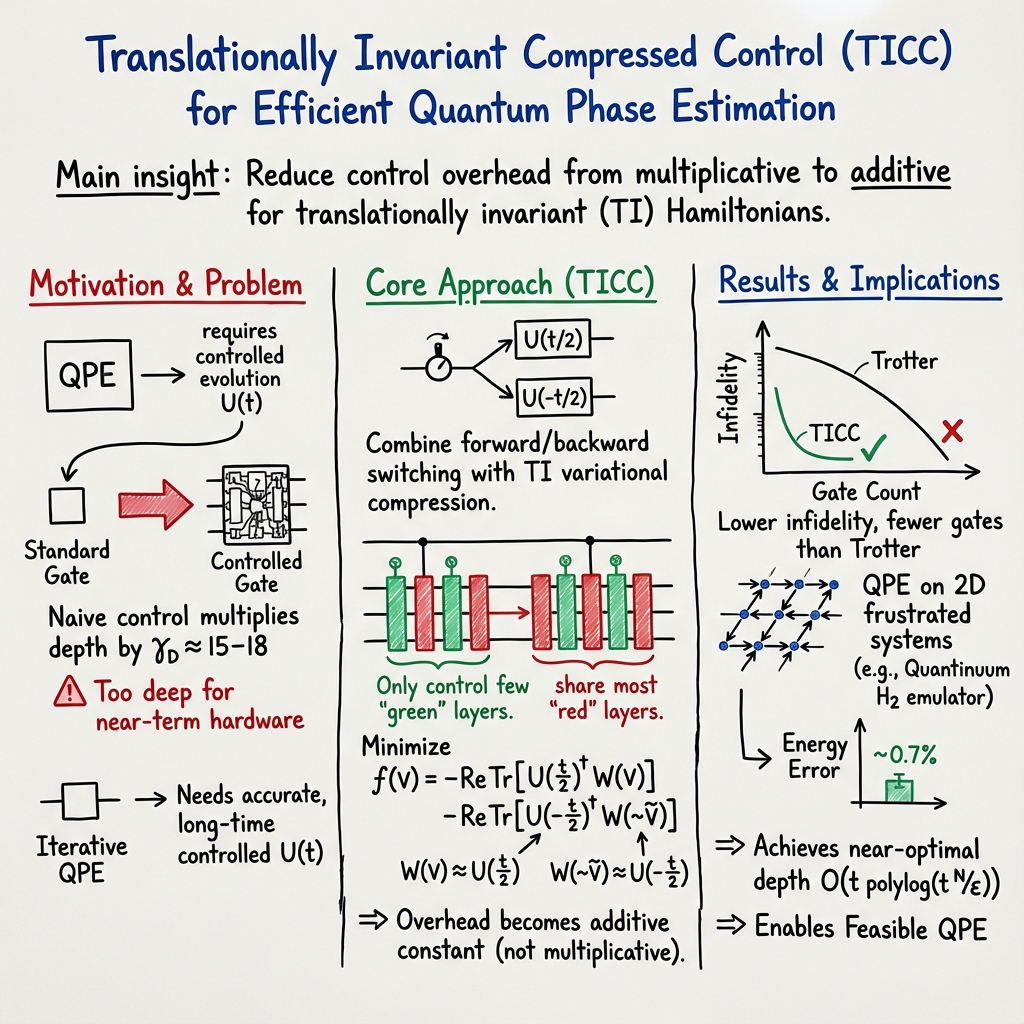
- The paper introduces the TICC protocol that compresses controlled time evolution to reduce gate complexity in quantum phase estimation.
- The methodology leverages translationally invariant local Hamiltonians and a brickwall Ansatz to achieve near-optimal circuit depth scaling.
- Numerical simulations demonstrate improved fidelity and reduced evolution infidelity, marking a significant advance in practical quantum simulation.
Phase Estimation with Compressed Controlled Time Evolution
Introduction
The paper "Phase Estimation with Compressed Controlled Time Evolution" (2511.21225) introduces a novel protocol for encoding the controlled time evolution operator of translationally invariant, local Hamiltonians into quantum circuits. This work addresses the challenge of efficiently simulating many-body quantum systems which are notoriously complex due to the exponential growth of their Hilbert space dimensions. Unlike classical approaches which struggle with certain system classes, this study leverages quantum algorithms to simulate such quantum systems on quantum computers.
Quantum Phase Estimation and Compression
Quantum Phase Estimation (QPE) stands out due to its asymptotic performance guarantees, yet its practical implementation is bottlenecked by the encoding complexity of controlled time evolution operators. The proposed compression protocol aims to mitigate this by achieving near-optimal scaling in circuit depth O(t polylog(tN/ϵ)). Importantly, it reduces control overhead from a multiplicative to an additive factor, thus facilitating more feasible hardware implementation of QPE.
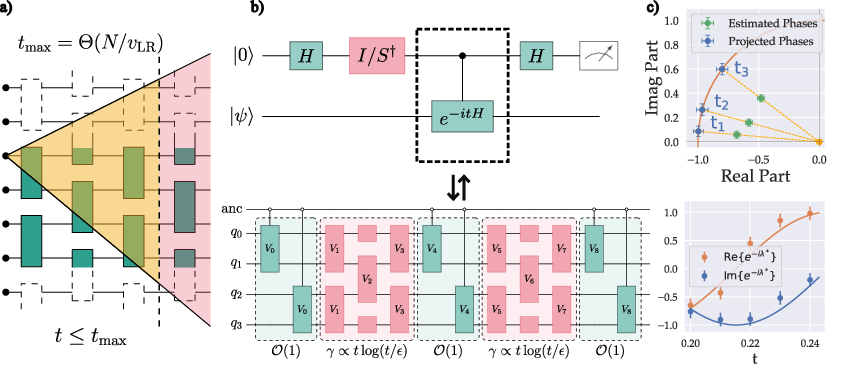
Figure 1: Conceptual visualization of the proposed protocol. A brickwall Ansatz approximates the dynamics of a 1D Hamiltonian, illustrating controlled time evolution in circuits.
Translationally Invariant Compressed Control (TICC)
Introduced within this work is the Translationally Invariant Compressed Control (TICC) protocol. TICC decreases control overhead by treating the control factor γD as an additive term rather than a multiplicative one, thus optimizing performance while reducing gate complexity. The decomposing method leverages known Hamiltonian structures and the mathematical equivalence between controlled evolution directions. This new protocol achieves substantial improvements by maintaining scalability with respect to the evolution time and the precision of the approximations.
Numerical Results and Implications
The paper benchmarks TICC's performance through numerical simulations, demonstrating its effectiveness in reducing evolution infidelity for different lattice geometries. Specifically, the protocol was tested on frustrated quantum spin systems, outperforming traditional approaches in terms of gate count and accuracy. Additionally, the study provides practical implementations utilizing quantum hardware emulators, substantiating TICC's potential for enabling early fault-tolerant demonstrations.
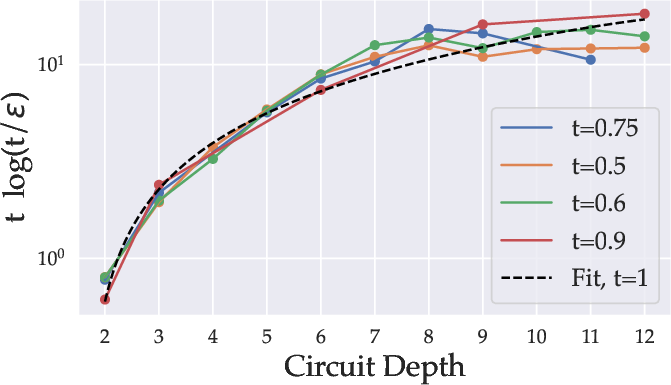
Figure 2: Numerical simulations illustrating circuit depth scaling with respect to spectral norm distance error and evolution time.
Discussion
TICC's applicability is limited to systems with translational symmetry and local interactions, excluding systems with disorder and non-local interactions. While the method extends beyond QPE to other algorithms in quantum simulations, it remains sensitive to the locality assumptions inherent to many quantum systems.
Despite these limitations, the reduction in complexity and control overhead positions TICC as a significant advancement. By providing a path towards the practicable implementation of QPE and related protocols on near-term quantum devices, the implications for fields reliant on quantum Hamiltonian simulation are profound.
Conclusion
The compression protocol outlined in this paper represents a significant stride in overcoming current hardware limitations in quantum simulation. By optimizing the encoding of controlled time evolution, the study delivers a framework that lowers the threshold between experimental quantum computing capabilities and the demonstration of quantum advantage.
In conclusion, the key achievements of this paper lie in establishing a feasible pathway for the practical deployment of complex quantum simulations, ultimately accelerating the field towards realizable quantum computing applications in understanding quantum matter.