- The paper presents a conditional density analysis from DESI DR1, revealing that galaxy clustering follows a robust power-law decay without transitioning to homogeneity up to 400 Mpc/h.
- It employs a methodology that minimizes selection bias through volume-limited subsamples and tailored angular masks to control systematic errors.
- The results challenge standard CDM predictions by showing persistent inhomogeneity and non-Gaussian fluctuations, prompting reconsideration of large-scale structure models.
Large-Scale Galaxy Correlations in the DESI DR1: Absence of Homogeneity up to 400 Mpc/h
Introduction and Motivation
The statistical characterization of galaxy spatial distributions remains fundamental for cosmological inference, particularly regarding the scale of statistical homogeneity. The standard cosmological paradigm posits that the universe is well-described by a homogeneous and isotropic metric (FRW) at sufficiently large scales, and this underpins not only the background evolution but also most galaxy clustering analyses. However, the operational detection and characterization of the actual transition to homogeneity is intricate, confounded by selection effects and survey boundary conditions. The paper "Large-Scale Galaxy Correlations from the DESI First Data Release" (2511.21585) offers the first conditional density analysis of galaxy clustering in the DESI DR1 samples, targeting both Bright Galaxy Sample (BGS) and Luminous Red Galaxy Sample (LRGS), with special attention to methodology robust against luminosity selection bias and finite-volume artifacts.
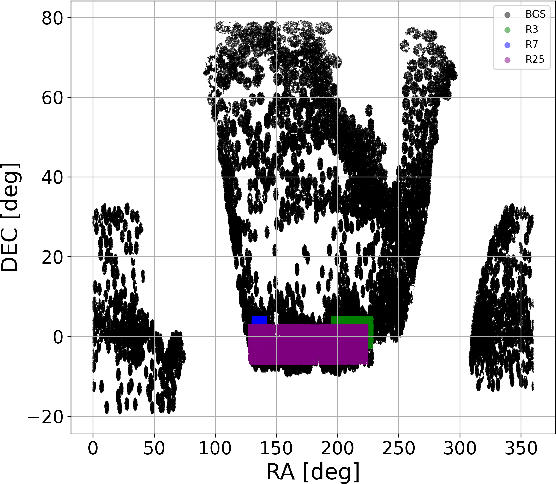
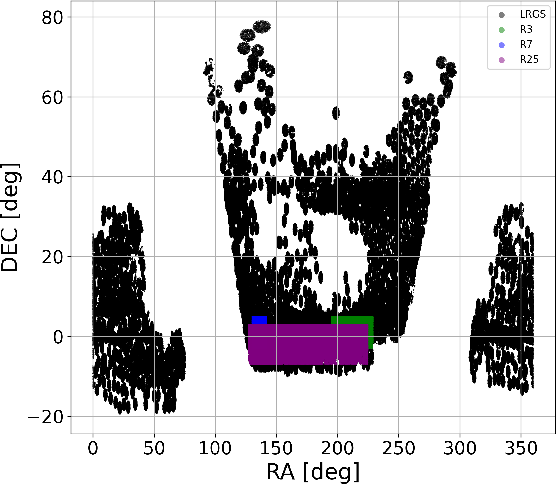
Figure 1: DESI DR1 angular projection of the BGS and LRGS, showing the footprint and selected angular regions for conditional density analysis.
DESI DR1 Sample Construction, Selection, and Volume-Limited Subsamples
DESI DR1 represents the deepest and most extensive spectroscopic mapping to date, covering ∼14,000 deg2 and up to >5 million high-quality galaxy redshifts ($0.1 < z < 2.1$ for all four major target classes). The construction of subsamples for unbiased conditional density measurements is crucial. BGS subsamples are rendered volume-limited (VL) by imposing both distance and absolute magnitude cuts; LRGS is quasi-VL by survey design. The angular selection masks are engineered to maximize contiguous coverage and minimize selection function anisotropy. Completeness corrections are verified with random catalogs tailored to DESI selections.
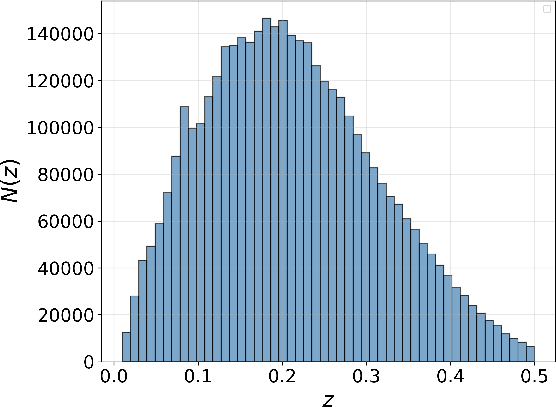
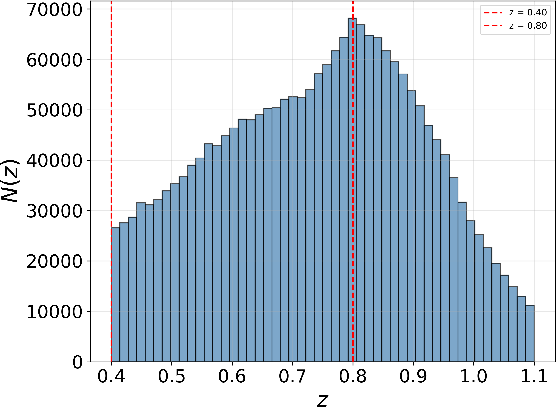
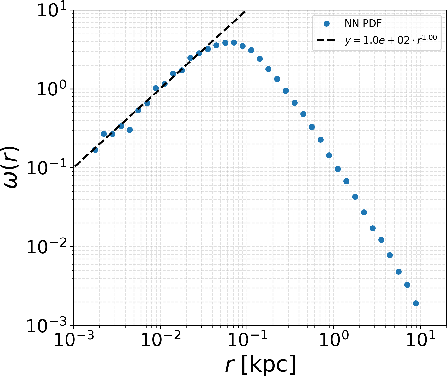
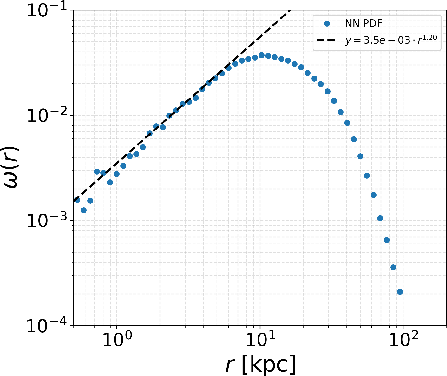
Figure 2: Redshift and nearest-neighbor distributions for both BGS and LRGS, illustrating luminosity selection effects and the underlying clustering regime.
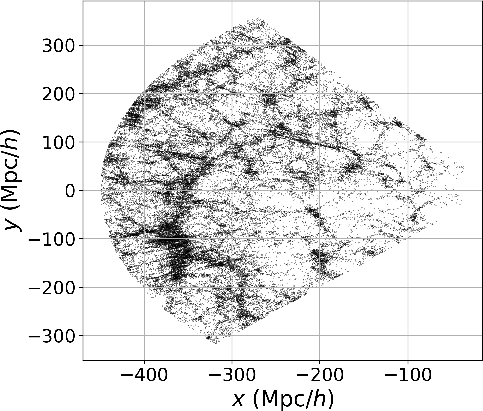
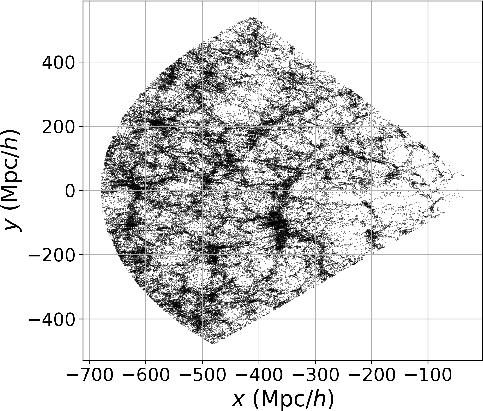
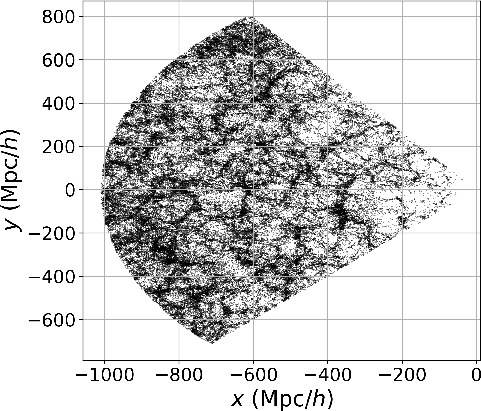
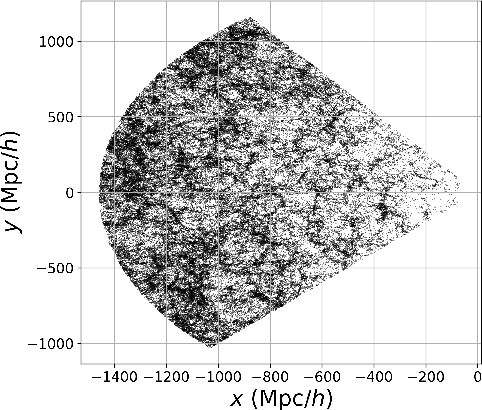
Figure 3: Projected spatial positions in Galactic coordinates for the R25 region across BGS VL subsamples, visually illustrating large-scale structure and sample depth.
Methodology: Conditional Density and Systematic Error Control
Unlike the two-point correlation function, which presumes a well-defined global mean density, the conditional average density ⟨n(r)⟩ quantifies the local average density in spheres of radius r centered on galaxies, strictly requiring spheres to be fully embedded within the survey volume to avoid geometric bias. The mean, variance, and full PDF of ni(r) provide a comprehensive picture of clustering at each scale. Given the scale-dependence of the number of available centers, C(r), and volume overlaps foverlap, the analysis explicitly tracks finite-size effects and the reliability of measured statistics.
Results: Conditional Density, Variance, and PDF of Fluctuations
Power-Law Decay and Persistence of Inhomogeneity
Across all BGS and LRGS subsamples, the conditional average density follows a robust power-law decay, ⟨n(r)⟩∝r−0.8, without transition to uniformity up to the largest probed scales (r∼400 Mpc/h). The slope conjugates with nearest-neighbor statistics, indicating self-consistent clustering well beyond 100 Mpc/h.
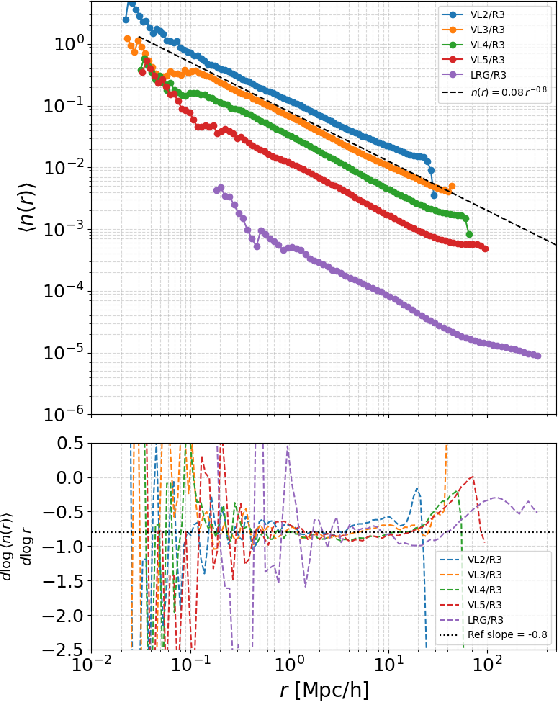
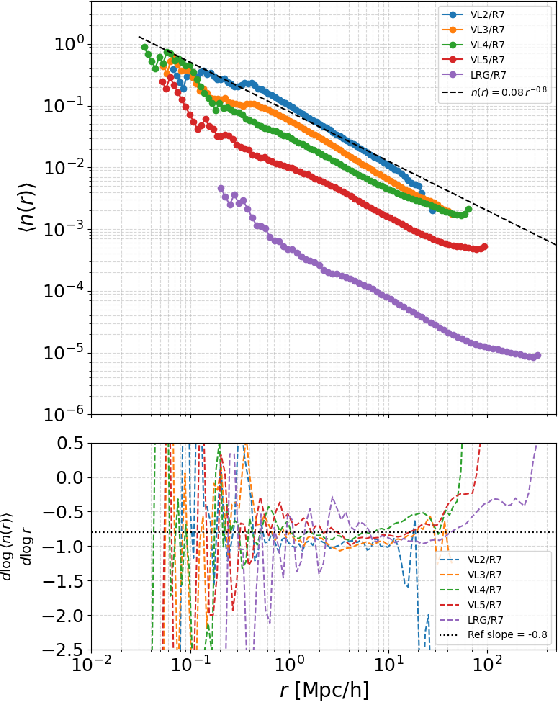
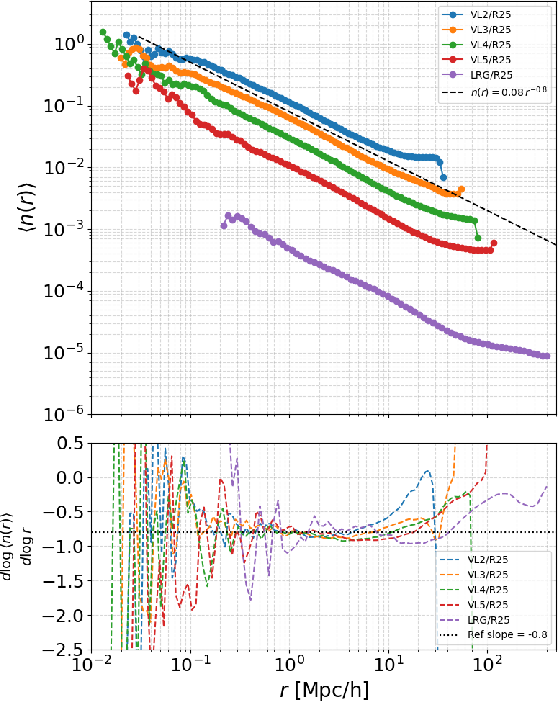
Figure 4: Conditional average density ⟨n(r)⟩ versus r for VL BGS and LRGS samples in different angular regions, showing persistent power-law decay.
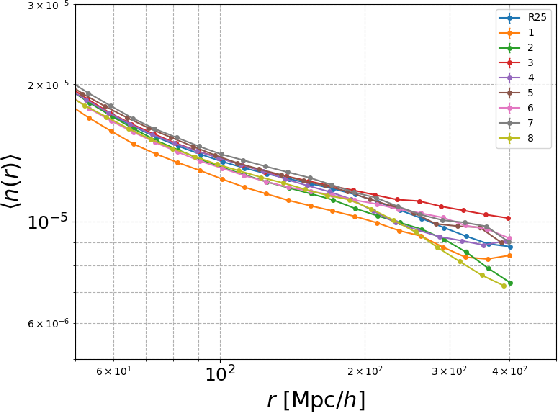
Figure 5: Conditional density for LRGS in disjoint R25 subregions; ∼20% fluctuations highlight persistent spatial inhomogeneity at large scales.
Failure of Standard Cosmological Model Predictions
Comparison with linear CDM predictions for ⟨n(r)⟩ shows a stark discrepancy: CDM models produce a rapid transition to homogeneity (γ→0) at r∼80 Mpc/h, not evidenced in the DESI data.
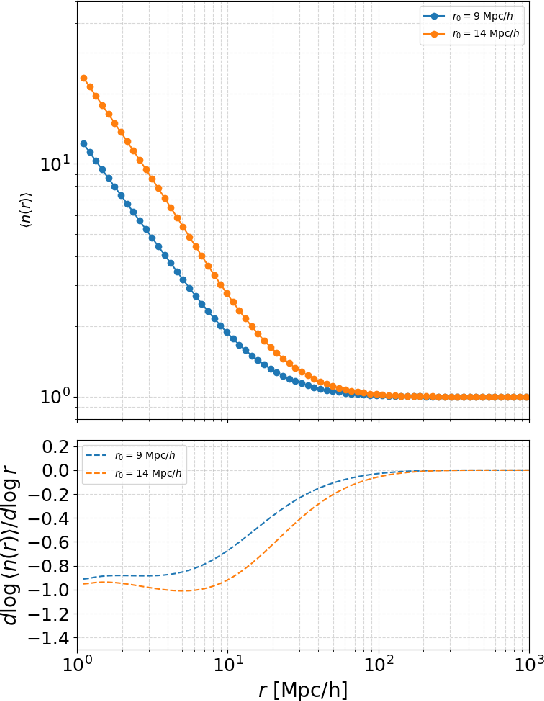
Figure 6: Conditional density predictions for CDM models, showing the rapid flattening absent in observational DESI samples.
Variance and Lack of Self-Averaging
Both the variance Σ2(r) and normalized variance Σ(r)/⟨n(r)⟩ decay slower than the r−3 expectation for a homogeneous Poissonian field, reflecting the persistence of large-scale fluctuations.
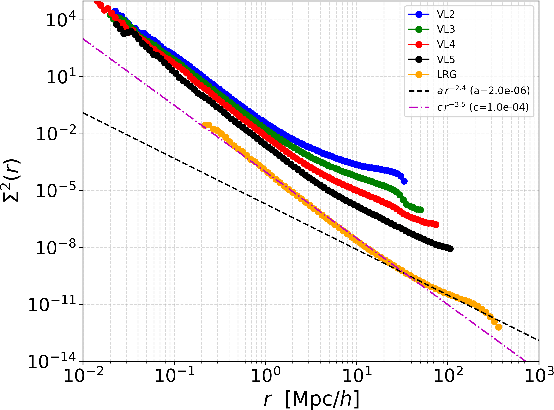
Figure 7: Variance Σ2(r) scaling for VL samples; shallow decay relative to expectation demonstrates extension of clustering.
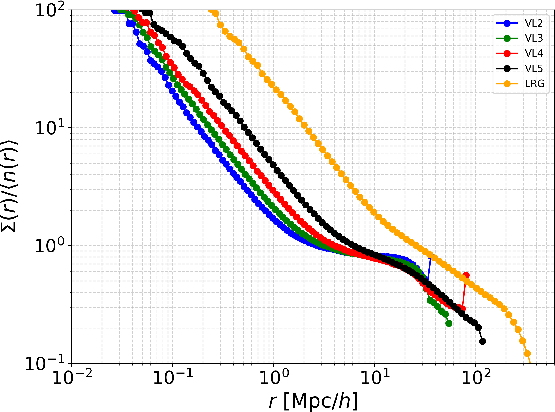
Figure 8: Ratio Σ(r)/⟨n(r)⟩ is of order unity or higher up to r∼200 Mpc/h, indicating a lack of self-averaging typical of non-homogeneous fields.
PDF Analysis: Gumbel vs Gaussian Fluctuation Statistics
The PDF of galaxy counts P(N;r) within spheres of growing radius continues to be well-approximated by a Gumbel distribution, characteristic of systems governed by extreme-value statistics, not by a Gaussian distribution as would occur for a homogeneous random field.
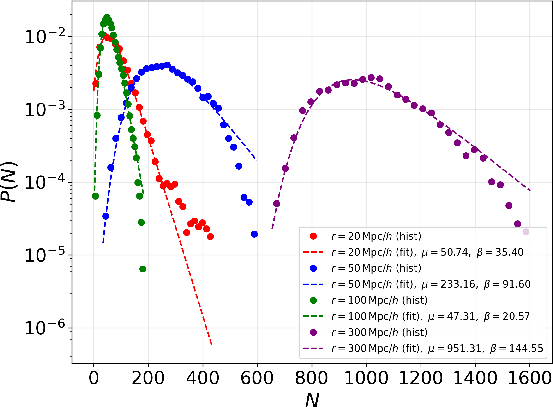
Figure 9: PDF of galaxy counts in spheres, with best-fit Gumbel overlay for various scales and samples, confirming the prevalence of extreme-value statistics.
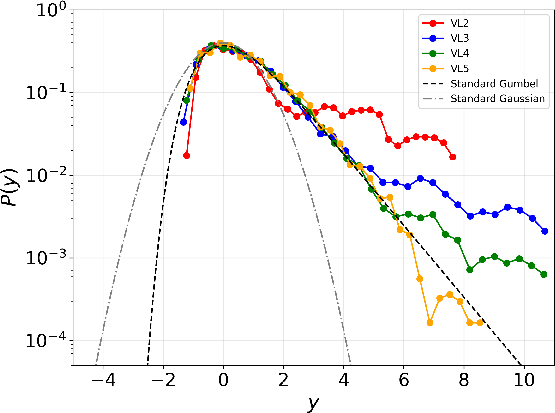
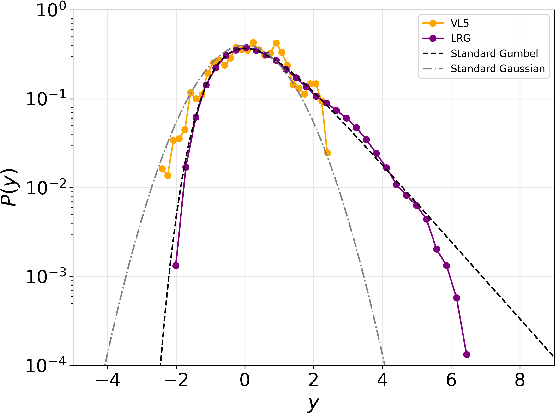
Figure 10: Normalized PDFs for r=20 and $100$~Mpc/h; Gumbel form persists across subsamples, distinct from Gaussian predictions.
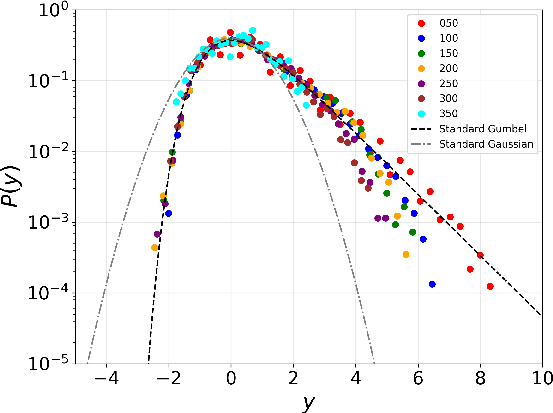
Figure 11: Collapse plot of normalized PDF for LRGS in R25, various sphere sizes; Gumbel statistics are robust against finite-size effects.
Implications for Cosmology and Structural Inference
The DESI DR1 conditional density analysis directly contradicts the standard cosmological assumption of statistical homogeneity at λ0≲100 Mpc/h. The absence of any flattening in ⟨n(r)⟩, slow decay of variance, and non-Gaussian statistics up to r∼400 Mpc/h are incompatible with models that generate large-scale structure solely through gravitational instability from initially nearly-uniform density fields. These results imply that galaxy clustering preserves significant correlations on scales previously assumed to be homogeneous, challenging both the limiting arguments for FRW metric applicability and standard galaxy formation theory.
Future Directions
Increasing survey volumes (such as future DESI data releases and Euclid) and improved control over large-scale boundary conditions will allow for more stringent testing of the homogeneity scale and provide opportunities to refine the statistical formalism. It is likely that new theories will be necessary to account for persistent, large-scale correlations, as well as the non-Gaussianity of matter distributions at scales far beyond current model expectations. There are also implications for cosmic variance estimation, baryon acoustic oscillation measurements, and dark energy constraints, which typically assume large-scale homogeneity.
Conclusion
The study reveals no transition to homogeneity in the galaxy distribution up to scales ∼400 Mpc/h, instead demonstrating persistent power-law clustering, anomalously shallow variance decay, and extreme-value statistics of density fluctuations. These findings present a substantial challenge to current cosmological paradigms and demand reconsideration of the foundational assumptions of large-scale structure formation and inference (2511.21585).