Transit Timing of the White Dwarf-Cold Jupiter System WD 1856+534
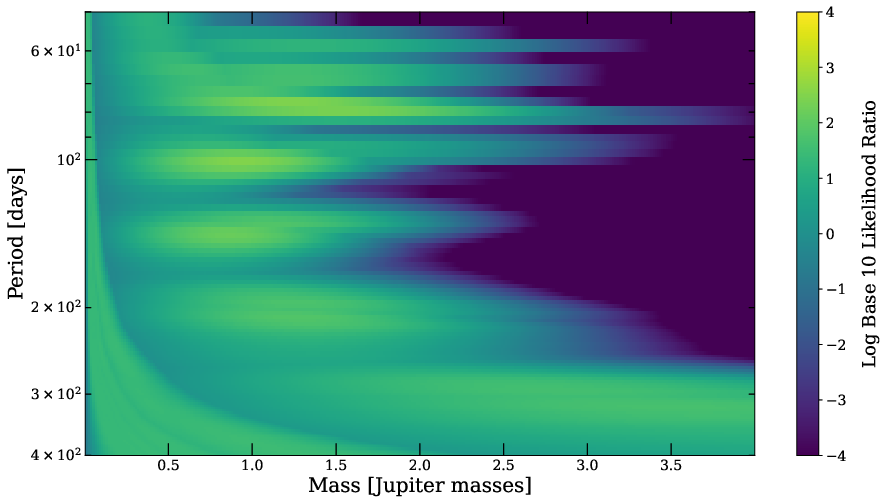
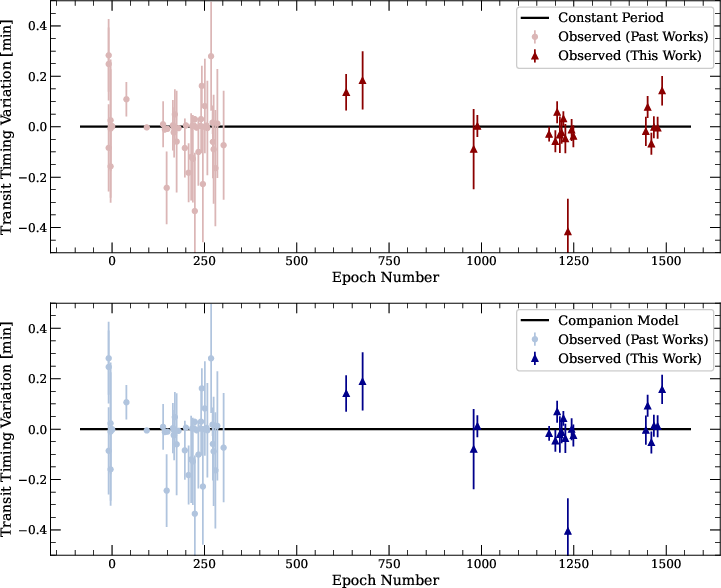
Abstract: We present new transit timing measurements for the white dwarf-cold Jupiter system WD 1856+534, extending the baseline of observations from 311 epochs to 1498 epochs. The planet is unlikely to have survived the host star's red-giant phase at its present location and is likely too small for common-envelope evolution to take place. As such, a plausible explanation for the short semimajor axis is that the exoplanet started out on a much larger orbit and then spiraled inward through high-eccentricity tidal migration (HETM). A past transit-timing analysis found tentative evidence for orbital growth, which could have been interpreted as a residual effect of HETM, but we find the data are consistent with a constant-period model after adding 18 new transit measurements. We use the estimated period derivative $\dot{P} = 0.04\pm0.43$ ms yr${-1}$ to place a lower limit on the planetary tidal quality factor of $Q_p' \gtrsim 3.1 \times 106$, consistent with that of Jupiter in our own Solar System. We also test for the presence of companion planets in the system, which could have excited WD 1856 b onto an eccentric orbit via the Kozai-Lidov process, and ultimately rule out the presence of an additional planet with a mass greater than $4.1\,M_J$ and a period shorter than 1500 days. We find no evidence for nonzero eccentricity, with an upper limit of $e\lesssim10{-2}$. If the planet indeed reached its current orbit through HETM, the low present-day eccentricity indicates that the migration process has now ceased, and any further orbital evolution will be governed solely by weak planetary tides.
Paper Prompts
Sign up for free to create and run prompts on this paper using GPT-5.
Top Community Prompts
Explain it Like I'm 14
What is this paper about?
This paper studies a strange planet called WD 1856 b that orbits a white dwarf (the hot, dense core left behind after a Sun-like star runs out of fuel). The planet is about the size of Jupiter but orbits extremely close to the white dwarf, circling it every 1.4 days. The authors carefully timed many “transits” (when the planet passes in front of the white dwarf and makes it briefly dimmer) to see whether the planet’s orbit is changing and whether there might be other, hidden planets in the system.
What questions were the scientists asking?
In simple terms, they wanted to know:
- Is the planet’s “tick-tock” regular? In other words, does it pass in front of the star exactly on schedule, or is the timing slowly drifting?
- Are there tiny timing wiggles that might hint at another unseen planet tugging on WD 1856 b?
- Did the planet get so close to the white dwarf by moving inward over time (migration), and if so, is that process still happening?
- How “squishy” is the planet when tides stretch it? This is measured by a number called the tidal quality factor (Q). A higher Q means it loses less energy to tides.
How did they study it?
Watching a planet eclipse a tiny star
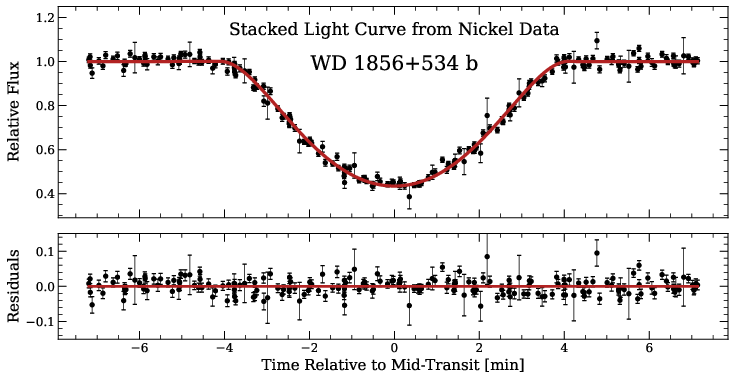
- A “transit” is like a moth flying across a flashlight: the light briefly dips when the moth crosses the beam. Here, the planet crosses the tiny white dwarf and causes a deep, short dip in brightness (about 8 minutes long).
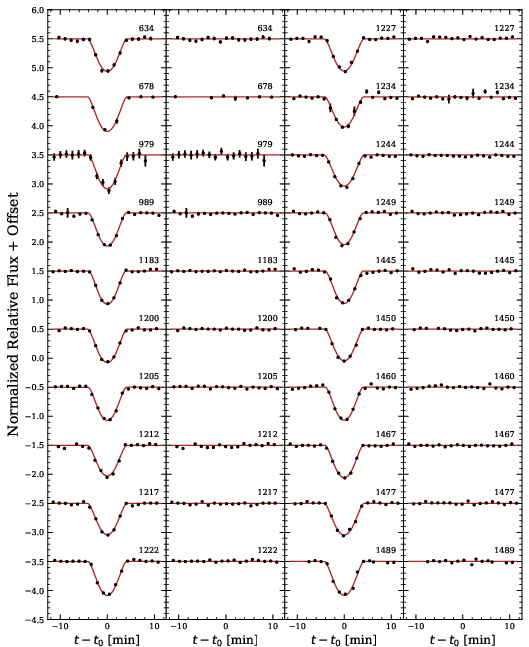
- The team observed 20 transits with a 1-meter telescope at Lick Observatory and combined them with 48 transits from other studies. That extended the timing record from 311 to 1,498 orbits.
Timing transits like a clock
- If the orbit is perfectly steady, each transit should happen exactly one period apart.
- If the orbit is shrinking or growing, the transits will arrive slightly earlier or later over time. The team compared a “constant period” model to one where the period slowly changes.
Looking for other planets using tiny timing wobbles
- If another planet is in the system, its gravity could nudge WD 1856 b, making its transits come a bit early or late. These small shifts are called Transit Timing Variations (TTVs).
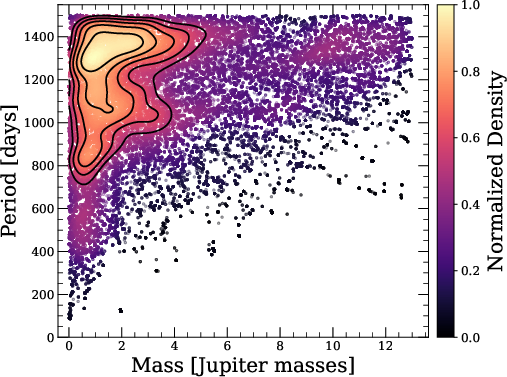
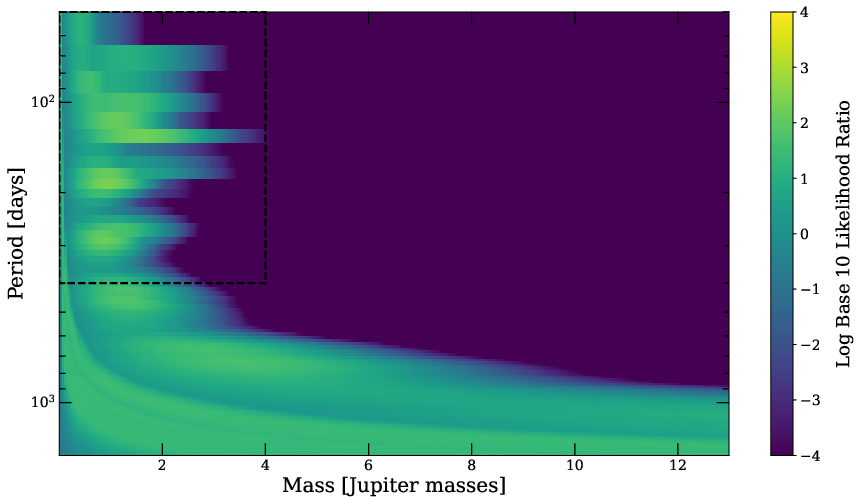
- The team used computer simulations to test thousands of possible unseen companions (with different masses and orbits) and checked which possibilities would have produced the timing wobbles we’d expect to see.
A quick note on tides and the “Q” number
- Tides aren’t just ocean waves—gravity can stretch planets and stars, turning orbital energy into heat. How efficiently a planet or star absorbs and loses this energy is captured by the tidal quality factor, Q.
- A low Q means strong energy loss (like a shock absorber that quickly slows motion). A high Q means weak energy loss (like a bouncy ball that keeps going).
- By measuring how steady the orbit is, you can estimate how strong the tides are and set limits on Q.
What did they find?
Here are the main results and why they matter:
- The orbit is steady within the measurement limits. The change in the period per year is consistent with zero: about 0.04 ± 0.43 milliseconds per year. That means no clear evidence the orbit is shrinking or expanding right now.
- The planet’s orbit is very close to circular. They find no sign of a noticeable oval shape (eccentricity is small), with an upper limit of about e < 0.01. If the planet once had a very stretched-out orbit, it’s now settled down.
- The planet’s tides dominate, not the star’s. Because white dwarfs are so compact, they don’t get stretched much. The data suggest the planet’s tidal quality factor is at least Qp’ ≳ 3.1 × 10⁶—similar to or a bit higher than Jupiter’s. That means the planet doesn’t lose much orbital energy to tides today.
- No strong evidence for another planet. Their timing data rule out a big companion (more than about 4.1 times Jupiter’s mass) with an orbital period shorter than about 1,500 days, and more than about 2.3 Jupiter masses if it orbits in less than 700 days. Smaller or more distant companions could still be there, but they don’t see timing wobbles caused by a big nearby one.
Why that’s important:
- WD 1856 b orbits so close that it shouldn’t have survived where it is when the original star became a giant. One idea is that it started far away and later moved inward on a very stretched (highly eccentric) path, slowly “circularizing” due to tides—a process called high-eccentricity tidal migration (HETM).
- The new results show the orbit is now calm and round, which fits a picture where any migration has already finished.
What does it mean for the big picture?
- How did the planet get so close? It probably didn’t plow through the star’s swollen outer layers (the “common-envelope” idea), because the planet seems too light to have survived that way. The calmer present-day orbit supports the idea that it migrated inward earlier on a stretched path (HETM) and then settled.
- If HETM happened, what kicked it onto that stretched path? Possibilities include:
- Another planet (not yet detected),
- A passing star long ago,
- Or the system’s distant M-dwarf companions stirring its orbit.
- Today, the system looks stable: the orbit is steady, nearly circular, and big companion planets that could cause obvious timing wobbles are unlikely. Any further changes should be slow and driven by weak tides in the planet.
In short: The team extended the timing record a lot and found the planet’s orbit is steady and round, with no signs of a big second planet nearby. That suggests the dramatic inward journey—if it happened—ended long ago. Continued timing and future observations could still reveal smaller or more distant companions and help solve how giant planets can end up hugging tiny stellar remnants like white dwarfs.
Knowledge Gaps
Below is a concise list of the paper’s unresolved knowledge gaps, limitations, and open questions. Each item is framed to be concrete and actionable for future research.
- White-dwarf tidal dissipation remains unconstrained: the lower bound reported for the modified stellar tidal quality factor ( ≳ 0.0034) is physically uninformative, leaving the tidal properties of isolated white dwarfs essentially unknown; alternative approaches (e.g., longer-baseline timing, constraints from close WD binaries, asteroseismology-informed tidal models) are needed.
- Assumptions behind the planetary tidal quality factor () limit are restrictive: the bound () assumes , zero obliquity, and negligible spin effects; quantify how realistic ranges of obliquity, rotation states, and frequency-dependent alter this constraint.
- Planet’s spin state is unmeasured: whether WD 1856 b is tidally synchronized is unknown; obtain constraints on rotation via thermal phase curves or rotational modulation to test the synchronization assumption used in tidal-timescale arguments.
- Eccentricity constraints rely only on TTVs: the upper limit () is derived from timing alone; incorporate transit-duration variations (TDVs), ingress/egress shape changes, and secondary eclipse timing (if feasible) to tighten and break degeneracies with and precession.
- Companion planet search was limited to circular, coplanar orbits: the TTV analysis did not explore eccentric or mutually inclined companions, retrograde orbits, or Kozai-Lidov architectures; extend the search to non-coplanar and eccentric parameter spaces with dynamical-stability priors.
- Period range ceiling in companion search (≤1500 days) leaves wide-orbit perturbers unconstrained: assess longer-period companions via continued timing, Gaia astrometry, and high-contrast imaging to probe the perturber parameter space that can drive high-eccentricity tidal migration (HETM).
- Resolution near mean-motion resonances was not optimized: small-mass resonant companions can yield enhanced TTVs; perform high-resolution scans around low-order resonances to improve sensitivity to sub-Jupiter companions near commensurabilities.
- TTV modeling sets the inner planet’s mass to zero (with compensation via “stellar” mass): verify that this approximation does not bias TTV predictions; rerun with non-zero inner-planet mass using an N-body integrator (e.g., REBOUND) to test robustness.
- Rømer delay correction is approximate and assumes circularity: implement a full light-travel time and barycentric correction model for eccentric and inclined companions to avoid timing-systematics in long-period regimes.
- Limb-darkening treatment for a cool white dwarf and grazing transit is uncertain: quadratic coefficients from main-sequence tables and an extreme [Fe/H] value (−4.5) may not reflect WD atmospheres; generate WD-specific limb-darkening coefficients (H/He atmospheres) and fit multi-band transits to reduce geometric parameter biases.
- Finite exposure integration (45 s) and smearing were not explicitly modeled: incorporate supersampling in the transit model to correct for exposure-time smearing, which can bias mid-transit times for 8-minute events.
- Heterogeneous datasets (filters/instruments) were not fully homogenized: band-dependent limb darkening and instrument systematics can bias stacked light-curve parameters and Tmid estimates; develop a uniform reduction pipeline with per-band limb-darkening fits or simultaneous multi-band observations.
- Absolute timing calibration and clock stability are not independently validated: beyond AIJ BJD_TDB conversion, there is no GPS-synchronized timestamp audit; implement GPS-disciplined timing checks and shutter-delay calibration to minimize timing systematics.
- No search for TDVs or long-term impact-parameter drift: nodal precession from distant companions would alter and transit duration; systematically track TDVs and evolution to detect secular nodal precession signatures.
- General-relativistic and quadrupole-induced apsidal/nodal precession were not modeled: quantify GR precession and WD quadrupole effects on TTV/TDV signals and include them in joint fits to distinguish tidal vs relativistic contributions.
- Uncertainties in WD 1856 b radius and Love number () propagate strongly into (via ): obtain tighter constraints on (e.g., via improved limb-darkening and transit geometry) and explore plausible ranges to report bounds with full posterior propagation.
- The role of the G229-20A/B M-dwarf triple as a Kozai-Lidov perturber remains unquantified: compute the KL timescales with updated 3D orbits, mutual inclinations, and separations; assess whether the observed architecture can feasibly drive HETM consistent with the current circular, close-in orbit.
- Stellar flyby as a perturber is not constrained: use Gaia kinematics to search for past close encounters and quantify encounter rates and parameter space capable of producing the required eccentricity excitation.
- Radial-velocity (RV) and astrometric constraints are absent: although challenging for WDs, explore high-resolution spectroscopic techniques (e.g., line-shape monitoring, gravitational redshift-corrected RVs) and Gaia/ground-based astrometry to detect or bound distant massive companions.
- Correlated photometric noise and systematics were not modeled: timing fits assume Gaussian noise; apply Gaussian Process or time-correlated-noise models to assess their impact on Tmid uncertainties and subtle TTV signals.
- Ephemeris evolution modeled only with a quadratic term: realistic tidal evolution may be non-constant (frequency-dependent , evolving , thermal tides); test alternative ephemeris models (power-law, piecewise, or physically motivated tidal-evolution prescriptions) over extended baselines.
- Potential exomoons or rings were not investigated: these can produce TTV/TDV and alter transit morphology, especially for a grazing transit; conduct shape-based searches (e.g., residual modeling, ring-like ingress/egress signatures) in high S/N photometry.
- Baseline length still limits sensitivity to secular changes and long-period companions: extend timing over decades to sample full precession cycles, accumulate sensitivity to ms yr⁻¹-level , and improve exclusion limits beyond 1500-day companions.
Practical Applications
Immediate Applications
Below is a concise set of actionable use cases that can be deployed now, grounded in the paper’s findings, methods, and tools.
- Observatory operations optimization for short-duration transits (sector: astronomy/instrumentation)
- Use the paper’s cadence design (e.g., 45 s exposures in R-band for a 4710 K white dwarf) to plan observations of minute-scale, deep transits and to minimize ingress/egress smearing.
- Tools/workflows: exposure-time calculators tuned to short transits, fast-readout CCD/CMOS configurations, dynamic scheduling for 8–10 minute events.
- Assumptions/dependencies: target brightness and weather constraints; filter choice aligned with stellar SED; detector dead-time/readout effects must be minimized.
- Iterative light-curve stacking with limb-darkening handling for grazing transits (sector: software/academia)
- Adopt the paper’s two-stage workflow: initial fits with tabulated limb-darkening coefficients, stack aligned light curves, then refit with limb-darkening free to improve parameter precision on challenging grazing geometries.
- Tools: AstroImageJ for calibration/photometry; Mandel–Agol transit model; emcee for MCMC; SciPy optimizers.
- Assumptions/dependencies: consistent filter usage across nights for stacking; accuracy of tabulated limb-darkening for white dwarfs; adequate sampling across ingress/egress.
- Precision timing standards adoption (BJD_TDB) in multi-site campaigns (sector: astronomy/software standards)
- Standardize mid-exposure timestamps to BJD_TDB across observatories to reduce timing systematics in transit timing variation (TTV) studies.
- Tools/workflows: barycentric correction libraries; clock synchronization procedures.
- Assumptions/dependencies: reliable observatory clocks; correct handling of leap seconds, timezones, and exposure midpoints.
- TTV analysis toolkit combining TTVFast with Rømer delay correction and BIC-based model selection (sector: software/data analysis)
- Replicate the paper’s approach to efficiently rule out companion planets by comparing simulated TTVs to observations and selecting parsimonious models with BIC.
- Tools: TTVFast for fast integrations; custom Rømer delay correction; emcee; BIC/Δχ² reporting.
- Assumptions/dependencies: circular, coplanar companion hypothesis; sensitivity limited by timing precision and baseline length; Rømer correction formula assumes circular orbits.
- Follow-up prioritization for space and ground facilities (sector: space mission planning/observatory time allocation)
- Apply the constraints (e.g., ruling out companions >4.1 MJ with P <1500 d; e ≲ 10⁻²; no measurable period drift) to triage targets for JWST/HST/ground-based follow-up toward systems with higher likelihood of active migration or perturbers.
- Tools/workflows: decision matrices incorporating companion and eccentricity limits, updated ephemerides.
- Assumptions/dependencies: latest mass/radius constraints and ephemerides; evolving target lists.
- Educational labs and workforce training using open data and reproducible fits (sector: education)
- Build undergraduate/graduate labs around transit modeling, MCMC fitting, and TTV searches using the paper’s datasets and code paradigms.
- Tools: Python notebooks with emcee/TTVFast; AIJ; open-source code repositories.
- Assumptions/dependencies: access to observational data; computational resources; student familiarity with Python.
- Citizen-science timing campaigns for deep, short exoplanet transits (sector: community/education)
- Mobilize advanced amateur networks to collect additional mid-transit timings for WD systems with large transit depths (e.g., WD 1856’s ~56% depth) to extend baselines.
- Tools/workflows: coordinated observing windows; ephemeris distribution; standardized reporting in BJD_TDB; community QC procedures.
- Assumptions/dependencies: robust ephemerides; consistent calibration standards; geographic coverage for cadence.
- Model selection and uncertainty practices transferable to other time-series domains (sector: data science/finance/IoT)
- Emulate the paper’s use of BIC, Δχ², and nuisance parameters (log f) to guard against overfitting and mis-specified uncertainties in time-series model comparisons.
- Tools/workflows: model comparison frameworks; diagnostics for priors hitting bounds.
- Assumptions/dependencies: analogous noise characteristics and sampling; careful prior design.
- Filter and instrument choice guidance for cool white dwarfs (sector: instrumentation)
- Apply the R-band preference for ~4700 K white dwarfs to optimize SNR in similar targets; adjust exposure times to balance cadence vs. photon noise.
- Assumptions/dependencies: stellar temperature and spectral response known; detector QE curves considered.
- Community efficiency via publication of null results (sector: academia/policy)
- Use the paper’s null detections (no orbital growth; no companions above specified thresholds) to avoid redundant searches and reallocate limited telescope time.
- Assumptions/dependencies: community uptake of negative results; metadata-rich reporting for re-use.
Long-Term Applications
The following applications will require further research, scaling, instrumentation development, or longer baselines.
- Global, distributed timing networks for white dwarf systems (sector: astronomy/education)
- Establish a coordinated network of small/medium telescopes to sustain multi-year baselines for minute-scale transits, enabling detection of subtle period drifts (to constrain and ) and low-amplitude TTVs.
- Tools/products: cloud-based scheduling platforms; unified calibration pipelines; centralized BJD_TDB timestamping; open repositories.
- Assumptions/dependencies: funding, institutional cooperation, standardized data formats, reliable timekeeping.
- High-cadence detector and pipeline development for minute-scale transits (sector: hardware/instrumentation)
- Design EMCCD/CMOS systems with sub-second readout, low dead-time, and high QE in relevant bands; build pipelines optimized for ultra-short-duration, deep transits.
- Products: fast-readout cameras; shutterless modes; real-time photometry software.
- Assumptions/dependencies: budgets; engineering effort; trade-offs between speed and SNR.
- Dedicated survey concepts for white dwarf exoplanets (sector: space/ground survey design)
- Propose missions/surveys tuned to detect short, deep transits around white dwarfs (optical/UV), enabling population statistics and migration pathway studies.
- Outcomes: catalogs of WD planets; constraints on survival vs. engulfment pathways; detection of residual eccentricities.
- Assumptions/dependencies: proposal acceptance; instrument sensitivity; cadence optimization.
- Advanced dynamical inference frameworks (sector: software/HPC)
- Integrate N-body dynamics (beyond TTVFast approximations), hierarchical Bayesian inference, and robust noise models to fit the full 7D+ parameter space for companion searches and migration signatures.
- Products: scalable inference toolkits; containerized workflows; benchmarking datasets.
- Assumptions/dependencies: improved priors from RV/imaging; HPC resources; cross-validation across systems.
- Empirical tidal theory constraints for white dwarfs and giant planets (sector: academia)
- With extended baselines and precision timing, measure small to constrain white dwarf and tighten planetary bounds, informing models of degenerate matter dissipation and giant planet interiors.
- Outcomes: revised tidal dissipation theories; comparative studies across compact objects.
- Assumptions/dependencies: decades-long monitoring; timing precision at sub-ms yr⁻¹; multiple WD systems.
- Joint thermal–dynamical diagnostics of tidal heating (sector: astronomy/JWST)
- Combine timing-derived eccentricity limits with thermal emission measurements to quantify tidal heating contributions and test cessation of HETM.
- Workflows: joint SED + TTV modeling; multi-wavelength campaigns.
- Assumptions/dependencies: JWST/ELT access; accurate radiative transfer; disentangling reflected vs. emitted components.
- Automated ephemeris maintenance and alerting services (sector: SaaS/software)
- Create services that ingest new timings and continuously update ephemerides for short-period WD planets, with APIs and alerts to coordinate worldwide observers.
- Products: real-time ephemeris APIs; observer dashboards; anomaly detectors.
- Assumptions/dependencies: sustained data streams; community adoption; reliable CI/CD for updates.
- Policy frameworks supporting open, long-baseline monitoring (sector: science policy)
- Encourage funding lines and credit mechanisms for student-led observatories, open data mandates, and standard timekeeping (BJD_TDB) in exoplanet timing research.
- Outcomes: more robust, reproducible science; diversified participation.
- Assumptions/dependencies: institutional buy-in; shared infrastructure.
- Outreach and interactive learning tools (sector: education/media)
- Build apps that simulate WD transits and TTVs using real system parameters (e.g., WD 1856), illustrating migration hypotheses and tidal effects for the public.
- Products: browser-based simulators; classroom modules.
- Assumptions/dependencies: accurate physical models; stable APIs for data.
- Cross-domain transfer of robust uncertainty and model selection practices (sector: software/data science)
- Adapt the paper’s approaches (nuisance parameters for mis-specified uncertainties, BIC/likelihood ratios, prior sensitivity checks) to industrial time-series problems (e.g., energy demand, financial risk, sensor timing).
- Outcomes: improved model parsimony, better risk calibration.
- Assumptions/dependencies: domain-specific noise models; careful validation.
Key assumptions and dependencies highlighted across applications
- Circular and coplanar companion hypotheses were used in TTV analyses; real systems may deviate.
- Limb-darkening treatment for white dwarfs is imperfect and especially challenging for grazing transits.
- Timing sensitivity depends critically on long baselines, uniform filters, and high-cadence detectors.
- Rømer delay corrections in this work assume circular orbits; eccentric companions require more complex handling.
- Current planetary mass constraints (e.g., ≤6 MJ) and system parameters rely on JWST and prior studies; updates may shift feasibility.
- Inference quality is limited when posteriors hit prior bounds; better priors and richer datasets improve detectability.
- The lack of detected orbital growth and low eccentricity suggest HETM has ceased; future signatures may be subtle and demand higher precision.
Glossary
- Anomalistic period: The orbital period measured from one periapsis passage to the next; differs from the sidereal period when apsidal precession is present. Example: " is the anomalistic period"
- Aperture photometry: Measuring a star’s flux by summing pixel values within a defined aperture and subtracting background. Example: "perform aperture photometry on the target star"
- Apsidal precession: The gradual rotation of the orbit’s line of apsides due to perturbations or tidal effects. Example: "is expected to undergo apsidal precession at a rate given by"
- Argument of periastron: The angle in the orbital plane from the ascending node to the periapsis. Example: "argument of periastron (which has no physical meaning for circular orbits)"
- AstroImageJ (AIJ): An astronomy-focused image processing package for calibration and photometry. Example: "AstroImageJ (AIJ), an image-processing package specialized for calibrating and reducing astronomical datasets"
- Barycentric Dynamical Time: A relativistic time standard used for precise astronomical timing at the Solar System barycenter. Example: "Barycentric Julian Date in Barycentric Dynamical Time"
- Barycentric Julian Date: The Julian Date corrected to the Solar System’s barycenter for high-precision timing. Example: "Barycentric Julian Date in Barycentric Dynamical Time"
- Bayesian information criterion (BIC): A model selection metric that penalizes complexity while rewarding goodness of fit. Example: "we computed the Bayesian information criterion (BIC) for each model evaluated in the grid search"
- Circumbinary planet: A planet that orbits around two stars rather than a single star. Example: "a circumbinary planet orbiting the white-dwarf--pulsar system PSR B1620-26"
- Common-envelope evolution (CE): A phase where a compact object and a companion share a stellar envelope, potentially shrinking the orbit dramatically. Example: "Under common-envelope evolution, the planet is engulfed by the expanding star's envelope"
- Eccentric anomaly: A parameter that relates mean anomaly to the position of a body on its elliptic orbit. Example: "the eccentric anomaly "
- Forbidden zone: A region where planetary survival through stellar evolution is considered implausible. Example: "host star's ``forbidden zone,''"
- Full width at half-maximum (FWHM): The width of a signal profile measured at half its maximum intensity. Example: "full width at half-maximum intensity (FWHM)"
- Grazing transit: A transit where the planet only partially covers the stellar disk, producing distinctive light-curve shapes. Example: "the (grazing) WD\,1856\,b transit"
- High-eccentricity tidal migration (HETM): Inward orbital migration driven by tidal dissipation at periapsis after excitation to high eccentricity. Example: "high-eccentricity tidal migration (HETM)"
- Impact parameter: The sky-projected distance between the centers of the star and planet at mid-transit, scaled by stellar radius. Example: "impact parameter ()"
- James Webb Space Telescope (JWST): A space observatory optimized for infrared astronomy and exoplanet characterization. Example: "James Webb Space Telescope (JWST) observations"
- Kozai-Lidov mechanism: A dynamical effect where a distant perturber induces oscillations in a planet’s inclination and eccentricity. Example: "through the Kozai-Lidov mechanism"
- Limb darkening: The decrease in a star’s brightness from center to edge due to its atmospheric properties. Example: "The effect of limb darkening is challenging to model"
- Longitude of ascending node (LAN): The angle from a reference direction to the ascending node of an orbit. Example: "longitude of ascending node (LAN)"
- Love number: A dimensionless measure of a body's response (deformability) to tidal forces. Example: "incorporating the effects of its internal structure through the Love number"
- Markov chain Monte Carlo (MCMC): A sampling method for estimating posterior distributions of model parameters. Example: "emcee Markov chain Monte Carlo (MCMC) ensemble sampler"
- Mean anomaly: The angle that increases uniformly with time, used to parameterize an orbit. Example: "mean anomaly of the companion"
- Microlensing: Brightness changes due to gravitational lensing by a foreground object, used to detect exoplanets. Example: "the microlensing event KMT-2020-BLG-0414"
- O-C diagram: Observed-minus-calculated transit timing residuals used to identify timing variations. Example: "The combined diagram in Figure \ref{fig:o-c}"
- Orbital decay: A gradual decrease in a planet’s orbital period or semimajor axis due to tidal or other dissipative processes. Example: "undergoing orbital decay: WASP-12\,b"
- Planetary tidal quality factor (Q_p'): A parameter quantifying tidal dissipation efficiency within a planet. Example: "planetary tidal quality factor "
- Quadratic limb-darkening law: A two-parameter function describing how stellar intensity decreases toward the limb. Example: "assuming a quadratic limb-darkening law"
- Red-giant phase: An evolutionary stage where a star expands and cools after exhausting core hydrogen. Example: "red-giant phase"
- Rømer delay: Light travel time effect causing periodic timing offsets due to the system’s barycentric motion. Example: "Rømer delay"
- Semimajor axis: Half the longest diameter of an elliptical orbit, effectively the orbit’s size. Example: "short semimajor axis"
- Sidereal period: The orbital period measured relative to a fixed reference direction in space. Example: " is the sidereal period"
- Spin-orbit synchronization: A state where a planet’s rotation period equals its orbital period due to tidal forces. Example: "spin-orbit synchronization"
- Transmission spectroscopy: Measuring starlight filtered through a planet’s atmosphere during transit to infer composition. Example: "Transmission spectroscopy is another area"
- Transit timing variations (TTVs): Deviations from strictly periodic transit times caused by gravitational interactions. Example: "Transit timing variations between observed mid-transit times"
- TTVFast: A fast n-body integrator for computing expected transit times and their variations. Example: "we used the TTVFast code to efficiently simulate the expected transit times"
- White dwarf: A compact, degenerate stellar remnant left after low-mass stars shed their outer layers. Example: "white dwarf WD\,1856+534"
Collections
Sign up for free to add this paper to one or more collections.