- The paper identifies a z=5.07 quasar magnified by gravitational lensing, where the SMBH exhibits a super-Eddington accretion rate.
- JWST and HST imaging, alongside SED modeling, distinguishes the quasar from the lensing galaxy and constrains the maximum magnification (μmax=3.2).
- Results imply an intrinsic Eddington ratio >4.9, supporting rapid SMBH growth and extending lensing studies to z~3.6 massive galaxies.
A Super-Eddington, Lensing-Magnified Quasar at z=5.07 Observed with JWST
Introduction
The discovery and detailed observation of high-redshift quasars are critical for understanding the formation and growth of supermassive black holes (SMBHs) during the early universe. The paper "A Super-Eddington, Lensing-Magnified Quasar at z=5.07 observed with JWST" (2511.21618) presents JWST/NIRCam imaging and quantitative multiwavelength analysis of J0025–0145, a z=5.07 quasar candidate for gravitational lensing magnification by a foreground galaxy at a projected separation of 0.6 arcsec. This system stands out due to the unusually high apparent Eddington ratio inferred for the SMBH, suggesting highly efficient, possibly super-Eddington, accretion during a cosmic epoch shortly after reionization. The analysis leverages JWST's superior spatial resolution to resolve key ambiguities in the lensing geometry and intrinsic quasar properties previously inaccessible with HST.
Observational Constraints from JWST and HST
Multi-band imaging from HST (F435W and F606W) and JWST/NIRCam (F070W, F480M) enables spatially resolved photometry and lensing geometry characterization:
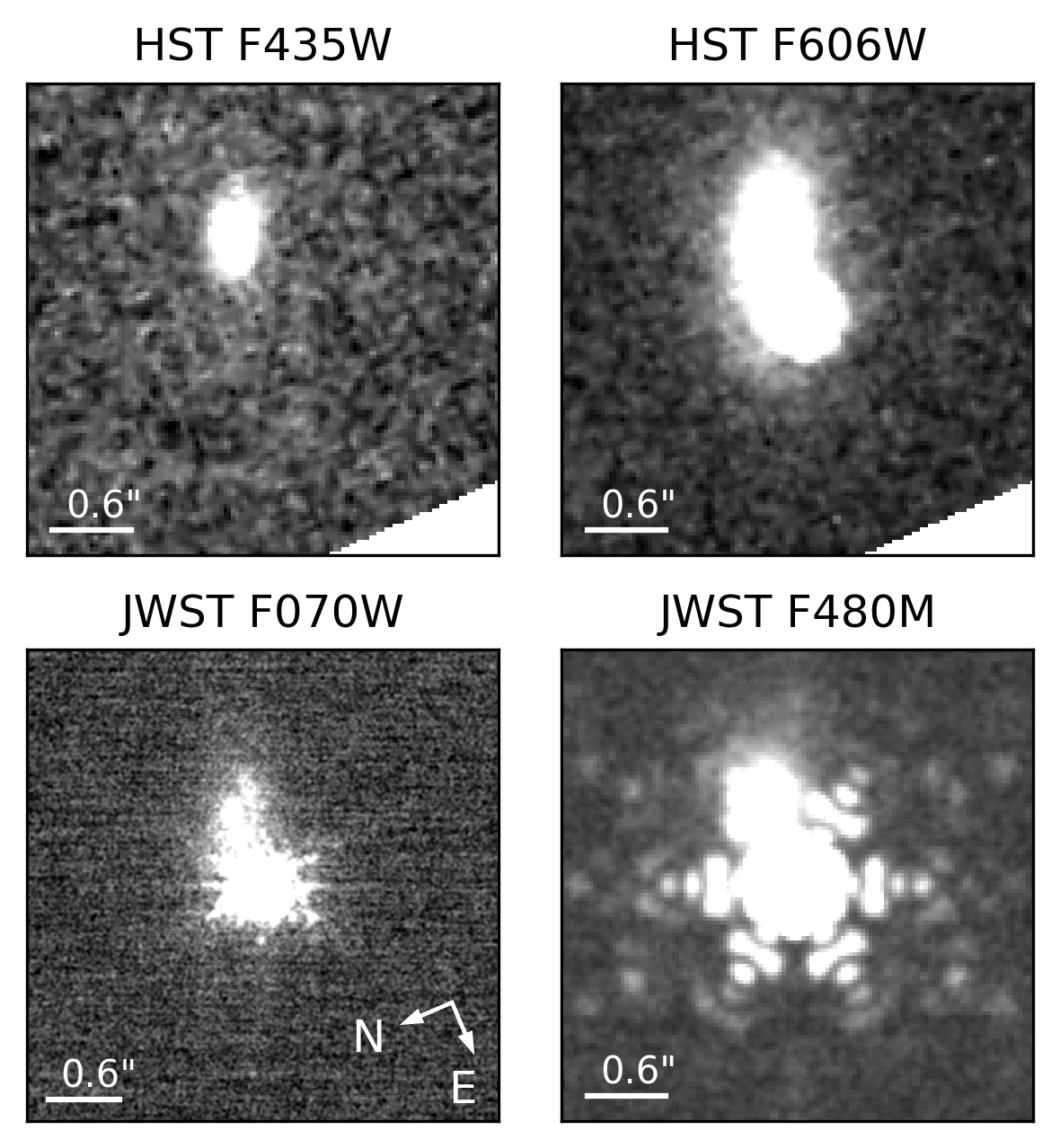
Figure 1: J0025–0145 imaging: HST F435W and F606W (top), JWST NIRCam F070W and F480M (bottom), showing quasar and lensing galaxy separation; quasar is undetected in F435W, confirming the lens is foreground.
HST/F435W confirms the lensing galaxy lies in the foreground, as the quasar is undetected at these wavelengths due to Lyman break absorption, while the lensing galaxy remains visible. JWST/NIRCam F070W achieves ~0.03 arcsec FWHM, a factor of ~3 improvement over HST/ACS, sharply probing the lensing structure. In F070W and F480M, the quasar exhibits an unresolved PSF, and the lensing galaxy is separately detected.
Robust PSF construction and image decomposition (using Galfit and a Sersic model for the galaxy) conclusively demonstrate that the quasar is singly imaged, with no evidence for multiple lensed images or extended host galaxy emission detectable above JWST's sensitivity in either band.
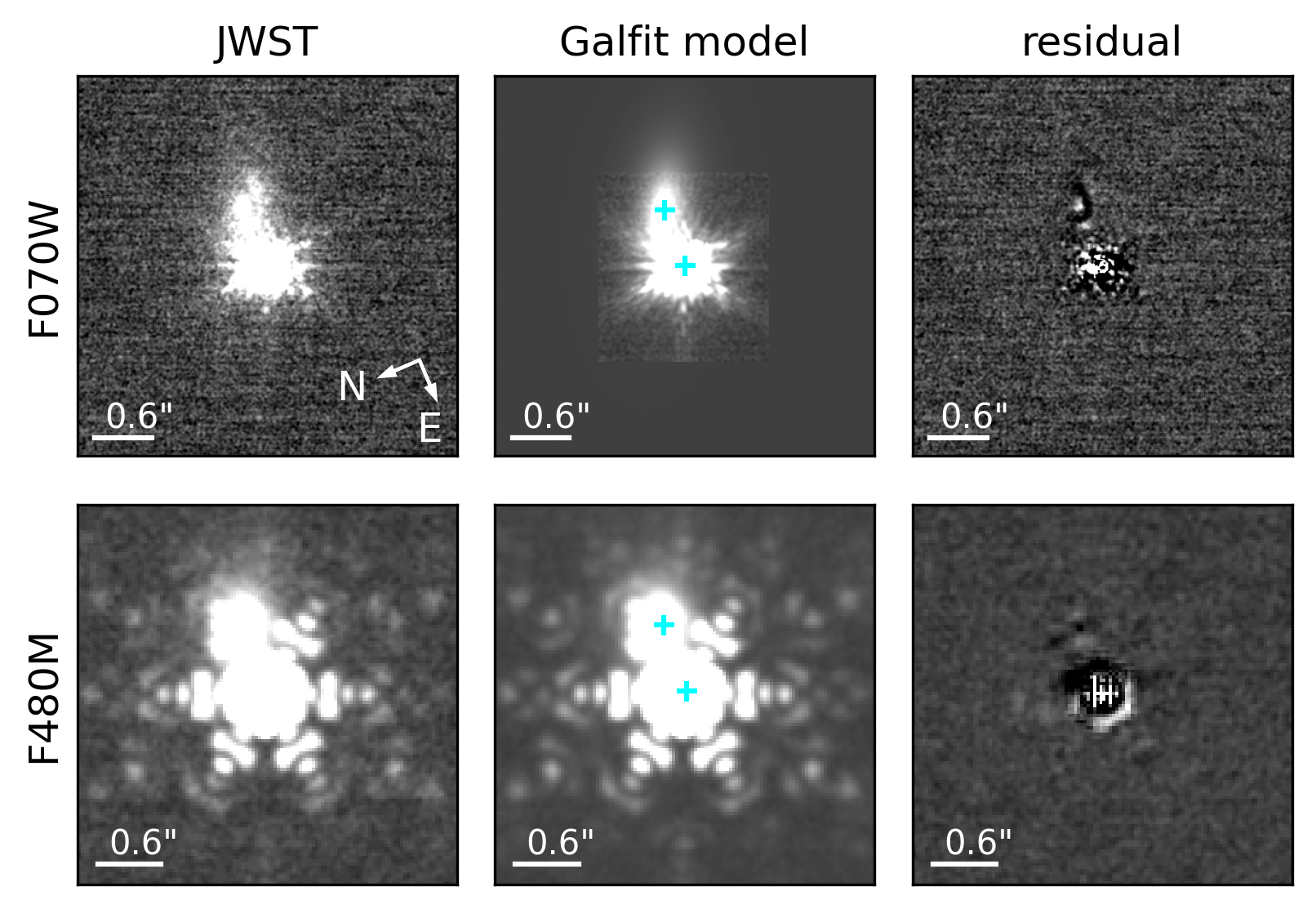
Figure 2: Galfit modeling/residuals for JWST F070W and F480M. The quasar is best fit by a single PSF, with no significant host or secondary image residuals.
The absence of multiply imaged structures, alongside measurement of the projected separation, rules out the high-magnification strong lensing regime and constrains the lensing geometry to an intermediate configuration.
Foreground Lensing Galaxy Characterization
Comprehensive SED fitting with Prospector, incorporating HST and JWST photometry, yields a precise photometric redshift for the lensing galaxy of zphot=3.62−0.04+0.06 and a stellar mass log(M∗/M⊙)=11.15±0.16. No evidence for a low-z solution is found.
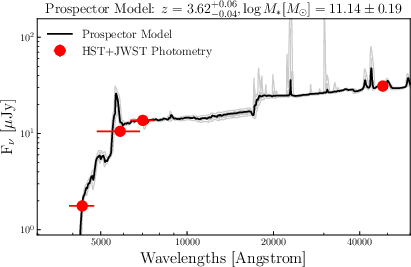
Figure 3: Prospector SED modeling for the lensing galaxy: photometric points and fit shown, yielding zphot≃3.6 and high stellar mass.
Using the dynamical mass–velocity dispersion relation (assuming a virial scaling, K=6), the lensing galaxy's velocity dispersion is inferred as σ=285−53+68 km/s. This propagates to an Einstein radius estimate of θE=0.27−0.08+0.10 arcsec, consistent with singly imaged lensing given the measured separation.
Remarkably, the likely lens redshift of z=3.62 would make it the highest-redshift confirmed gravitational lens deflector known if spectroscopically confirmed, providing a unique probe of massive galaxies in the n > 3 regime.
Lensing Magnification, Geometry, and Maximum Eddington Ratio
Parametric modeling with a singular isothermal ellipsoid mass profile reveals that the observed image configuration can only be produced for θE<0.38 arcsec; above this threshold, multiple images would necessarily appear, which are ruled out by the JWST data. The maximum allowed total flux magnification is then μmax=3.2.
The relation between observed and intrinsic Eddington ratio is
λEdd,app=λEdd,int×μ0.5
Given the observed apparent Eddington ratio λEdd,app≈9, the maximum allowed magnification imposes a strict lower bound on the intrinsic accretion rate: λEdd,int>4.9. This value is among the highest known for any z>5 SMBH [wu_catalog_2022], and notably it is robust to lensing-induced luminosity uncertainties.
Implications for Early SMBH Growth and Lensing Demographics
The demonstration that J0025–0145 is undergoing super-Eddington accretion (with λEdd>4.9 intrinsically) has direct implications for models of early SMBH assembly. It confirms, in a regime with minimal lensing ambiguity, that Eddington-limited accretion is not a universal ceiling; instead, rapid super-Eddington episodes are required and do occur in luminous, unobscured quasars at early cosmic times. This complements recent JWST discoveries of faint, super-Eddington AGN at z=4–7 [suh_super-eddington-accreting_2025], and resolves some of the previously noted tension between the observed high-mass end of SMBH populations at z>6 and the timescales available for assembly since the Big Bang [yang_probing_2021, banados_800-million-solar-mass_2018].
From a lensing perspective, the system adds statistical weight to the rarity of strong (multiply imaged) lensing among luminous z>5 quasars, despite expectations of a non-negligible lensed fraction [pacucci19, yue22b]. The high redshift of the lens further extends the empirical boundary for massive early-type galaxies with significant lensing cross-section.
Prospects for Future Observational and Theoretical Work
Spectroscopic confirmation of the lens redshift would establish this as the most distant known galaxy-galaxy lensing deflector, enabling stringent constraints on the structure, dynamics, and mass assembly of massive galaxies at z>3.5. The system provides an ideal laboratory for future studies of the circumgalactic medium via absorption, and dynamical modeling via higher S/N, multiwavelength data.
On the SMBH growth front, this work motivates renewed focus on identifying and characterizing super-Eddington systems in the high-z quasar population, both through lensing-assisted selection and by direct survey approaches. Super-Eddington accretion and its feedback signatures must be systematically incorporated into cosmological models of SMBH–host galaxy co-evolution. The limits imposed by lensing geometry modeling, as demonstrated here, can robustly de-bias inferred Eddington ratios in the presence of incomplete information on lensing configurations.
Conclusion
The resolved JWST imaging and lensing/SED analysis of J0025–0145 constrains the system to a regime of modest gravitational magnification, excludes multiple imaging, and establishes a lower limit λEdd,int>4.9 on the accretion rate for its SMBH. This provides direct evidence for sustained, intrinsic super-Eddington accretion powering luminous quasars at z>5, with bearings on early SMBH and host galaxy assembly. The lensing galaxy, likely at z∼3.6, would, if spectroscopically confirmed, represent an unprecedentedly high-redshift deflector, providing novel constraints on the evolution of massive galaxies and cosmic structure at early times. The results underscore the unique strengths of combining high-resolution rest-UV/optical imaging with lensing analysis for precision characterization of the high-z quasar population and their environments.
References:
(2511.21618), [yue_survey_2023], [fan_discovery_2019], [yang_probing_2021], [suh_super-eddington-accreting_2025], [banados_800-million-solar-mass_2018], [wu_catalog_2022], [eilers_eiger_2023], [zhuang_characterization_2023], [yue22], [pacucci19], [yue22b].