- The paper demonstrates a tunable WS2 micro-dome open cavity platform that enables deterministic single-photon emission with a 17-fold enhancement in photoluminescence signal.
- It leverages hydrogen ion irradiation and hBN capping to create strain-induced, monolayer domes with spatially localized exciton emission verified by micro-photoluminescence mapping.
- Precise cavity coupling yields narrow emission (ZPL linewidth ~0.2054 meV) and non-classical light (g(2)(0)=0.27±0.08), paving the way for scalable quantum photonics.
Tunable WS2 Micro-Dome Open Cavity Single Photon Source
Introduction
This paper presents an engineered open cavity platform integrating tunable micro-dome quantum emitters derived from monolayer WS2, fabricated through deterministic hydrogen ion irradiation. The system exploits van der Waals layered semiconductors and leverages local strain fields induced in WS2 to generate spatially localized exciton emission. These micro-dome structures are capped with hBN to ensure cryogenic stability and are coupled to a finely adjustable open Fabry–Pérot cavity. The principal aim is to realize and control single-photon emission with high spatial and spectral determinism, directly relevant for quantum photonic applications.
Fabrication and Structural Characterization
The device comprises a mechanically exfoliated WS2 flake, transferred onto a distributed Bragg reflector (DBR). The fabrication process induces well-ordered, one-atomic-monolayer-thick domes through low-energy hydrogen ion irradiation, which subsequently become stable under hBN capping. Atomic force microscopy highlights dome topography and reveals post-capping wrinkle formation induced by the hBN layer. Micro-photoluminescence (PL) mapping identifies emission centers highly localized at dome positions, confirming spatial determinism.
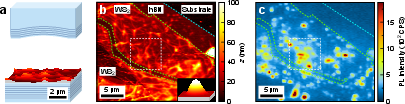
Figure 1: Structural schematic of the open cavity device and AFM/PL mapping of the hydrogenated, hBN-capped WS2.
Cavity Coupling and Emission Control
Integration into the open Fabry–Pérot cavity allows for nanometer-scale spatial alignment and spectral tuning of the emission centers with respect to discrete cavity resonances. Spectroscopic measurements demonstrate stable, narrow single-photon emission at EX=1.962 eV. Non-resonant emitter–cavity coupling manifests under negative detuning (Ec−Ex<0), observed as distinct cavity mode luminescence with a ∼2.3 meV linewidth. As the cavity mode is tuned through resonance, the PL signal enhances by a factor of approximately 17, indicative of Purcell-type cavity enhancement. Higher-order Laguerre–Gaussian cavity modes (C2, C3) also emerge, though their interaction with the emitter is less pronounced due to mode spatial profiles and increased scattering losses.
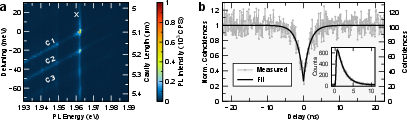
Figure 2: Photoluminescence as a function of cavity detuning, demonstrating mode tuning and single-photon purity (HBT with g(2)(0)=0.27±0.08).
Second-order correlation via HBT configuration confirms non-classical light emission with g(2)(0)=0.27±0.08. The emitter displays a characteristic decay time τ1=1.954±0.024 ns, consistent with time-resolved PL studies.
Phonon Sidebands and Cavity–Emitter Dynamics
A central theme is the investigation of phonon-mediated sideband emission, using a model adapted from quantum dot phonon kinetics [abbarchi_phonon_2008] and cavity quantum electrodynamics approaches [mitryakhin_engineering_2024]. High-resolution emission spectra reveal two discrete zero-phonon lines (ZPLs) and pronounced acoustic phonon sidebands in select domes, producing asymmetric intensity distributions. Under negative detuning, phonon emission events efficiently couple into the cavity mode, while positive detuning strongly suppresses cavity emission due to reduced phonon absorption at 4 K.
Quantitative analysis employs Lorentzian modeling for ZPL and cavity contributions and a detailed convolution for the PSB, introducing cavity–emitter coupling factors αi to capture deviations from multiplicative filtering. Fitting results yield ZPL linewidths of 0.2054±0.0004 meV. Critically, the cavity mode intensity profile peaks at slightly negative detunings, while quenching occurs at exact resonance—a behavior analogous to InAs quantum dot systems but previously unreported for van der Waals quantum emitters.
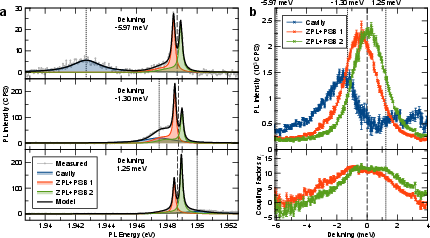
Figure 3: Experimental spectra and model fits demonstrating detuning-dependent partitioning of energy between ZPL/PSB and cavity modes.
Implications and Future Directions
The demonstrated deterministic generation and cavity integration of WS2 micro-dome quantum emitters represent significant steps toward scalable quantum photonic sources based on TMDCs. The open-cavity architecture provides versatile spatial and spectral control, while the pronounced exciton–phonon coupling observed here introduces opportunities for studying quantum optomechanical effects [barzanjeh_optomechanics_2022]. The single-photon purity and control over emission properties have direct relevance for on-chip quantum information processing and quantum communication networks, particularly where high brightness, scalability, and integration are required.
Potential future developments include:
- Extending strain engineering and cavity integration to other van der Waals materials and heterostructures.
- Utilizing multiplexed arrays of emitters for photonic quantum computing applications.
- Exploring strong-coupling regimes and photon indistinguishability through phonon lifetime engineering [steinhoff_impact_2025].
- Investigating optomechanical coupling leveraging the tailored exciton–phonon interactions in micro-domes.
Conclusion
This study demonstrates a tunable WS2 micro-dome single-photon source integrated into an open cavity architecture, offering spatially and spectrally deterministic emission with pronounced phonon-sideband coupling effects. The system achieves a notable combination of brightness, tuning, and quantum purity, establishing a platform for scalable 2D-material-based quantum emitter arrays. Strong exciton–phonon interactions in these structures further position them as candidates for emergent quantum optomechanical technologies and advanced quantum networking architectures.

