- The paper proposes a novel WPL geometric framework that replaces intractable mixed-state QFIM estimation with a low-dimensional, experimentally accessible surrogate.
- It details an efficient experimental pipeline using only 12 circuits per qubit to extract curvature and anisotropy parameters from noisy channels.
- Empirical results on superconducting hardware confirm that WPL-informed quantum natural gradient optimizers enhance VQE convergence and stability.
Curvature-Aware Optimization of Noisy Variational Quantum Circuits via Weighted Projective Line Geometry
Introduction and Motivation
This work introduces a differential-geometric framework for variational quantum circuits, in which noise-distorted qubit parameter spaces are modeled precisely as weighted projective lines (WPLs). The standard information-geometric models—such as the constant-curvature unit Bloch sphere (CP1) equipped with the Fubini–Study (FS) or Bures metric—fail to capture the anisotropic, noise-induced contractions found in real quantum hardware. The authors’ central aim is to replace intractable mixed-state QFIM estimation with a low-dimensional, experimentally accessible geometric surrogate for parameter space curvature, grounded in orbifold geometry.
This framework is motivated by the concrete observation that single-qubit noise channels empirically display two principal contraction rates (λ⊥,λ∥) of the Bloch ball: one for the transverse (xy) directions and one for the longitudinal (z) axis. These rates fully define a WPL metric, whose curvature and anisotropy govern the effective preconditioning structure for natural-gradient-based quantum variational optimization. Critically, the mapping from hardware measurements to WPL parameters can be performed with minimal tomography, and the geometric surrogate admits analytic expressions for both the metric and its invertibility structure.
Geometric Model: Weighted Projective Lines as Surrogates for Noisy Qubit Manifolds
The pure-state Bloch sphere (S2≅CP1) possesses SU(2) isotropy and constant scalar curvature R=2. Physical noise channels—including dephasing, amplitude damping, and imperfect controls—break this symmetry, resulting in an ellipsoidal contraction of the Bloch ball. The contraction is typically phase-covariant and can be modeled by an axis-aligned, diagonal map with eigenvalues (λ⊥,λ⊥,λ∥).
The key geometric object, the weighted projective line P(a,b;κ), is an orbifold quotient of CP1 with conical singularities of weights (a,b). The two weights are set by the ratios of the contraction rates: b∼1/λ⊥, a/b∼λ∥/λ⊥, while the curvature is R=2/b2. The model therefore encodes not only isotropic contraction (through b) but also direction-dependent deformations (anisotropy, through a/b). Notably, this construction leads to orbifold points (cone angles 2π/a and 2π/b with corresponding degeneracies in the QFIM) and variations in metric degeneracy, requiring routine use of Moore–Penrose pseudoinverses for stable optimization.
Experimental Pipeline: From Tomography to Geometry
The authors provide an experimentally efficient protocol for extracting (λ⊥,λ∥) from hardware via a minimal set of $12$ circuits per qubit. This consists of:
- Preparation of four linearly independent probe states and measurement in three Pauli bases per probe.
- Linear regression to estimate the Bloch contraction map T.
- Singular value decomposition, followed by regularization and clipping to enforce CPTP channel constraints.
- Direct mapping from the regularized singular values to WPL parameters by analytic expressions, yielding (a/b,b,R).
This pipeline yields stable curvature and anisotropy estimates on superconducting backends such as IBM’s ibm_torino, across a range of idle depths and temporal drift. In regimes with near-degenerate principal contractions or nearly unital channels, the extracted WPL parameters are both robust to statistical noise and consistent across repeated runs.
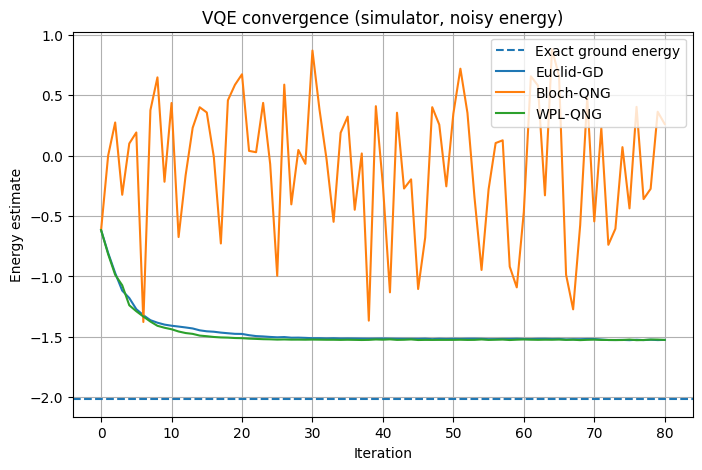
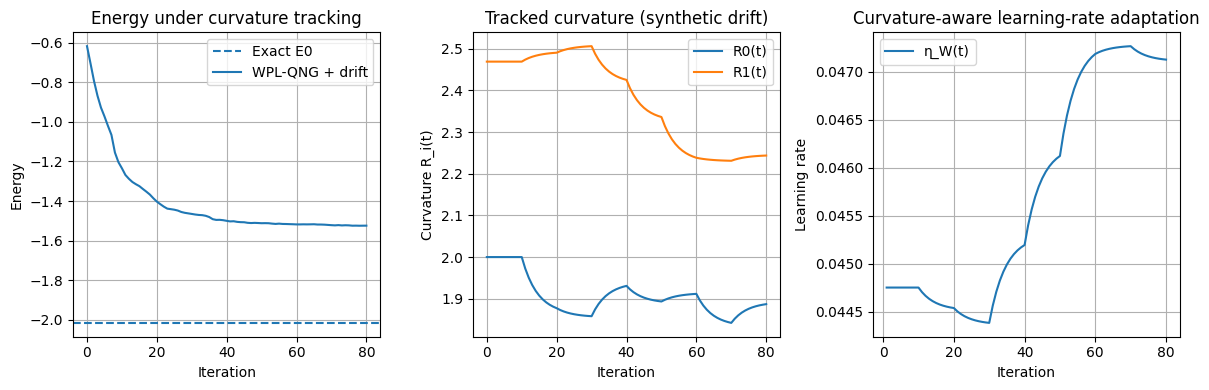
Figure 1: Static noise (no drift).
Noisy circuits render the QFIM ill-conditioned or singular; the naive inverse is unstable near cone points associated with anisotropic contraction. The WPL framework provides two main algorithmic advances:
- Block-Diagonal Metric Approximation: For hardware-efficient ansätze, independent local operations allow the block-diagonalization of the QFIM into single-qubit WPL components. This makes preconditioning analytic and efficient.
- Moore–Penrose Inversion and Adaptive Step-Size Control: The generically singular nature of the WPL (and noisy) QFIM motivates routine use of the Moore–Penrose pseudoinverse, with eigenvalue clipping to guarantee stability. The curvature parameter R acts as an explicit control on effective step sizes in each metric block, reflecting the noise strength in each physical qubit’s channel as captured by tomography.
WPL-QNG, the proposed curvature-aware optimizer, demonstrates stable and accelerated VQE convergence versus both standard Euclidean gradient descent and conventional quantum natural gradient descent (which assumes constant-curvature geometry). The anisotropy parameter a/b, extracted from the channel’s contraction asymmetry, is shown to be operationally significant: neglecting it demonstrably degrades optimization performance.
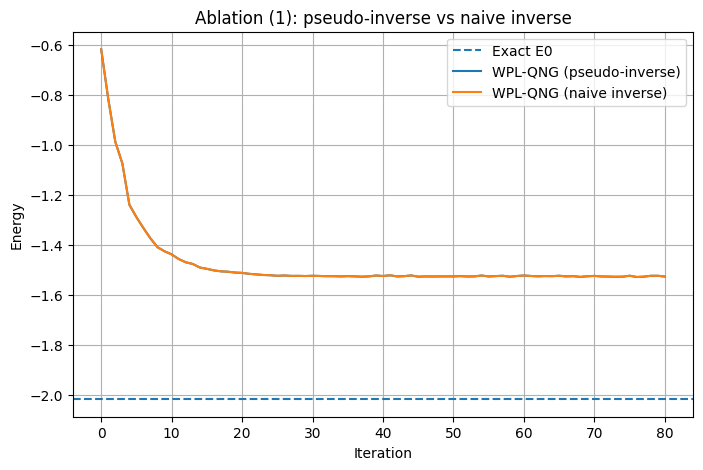
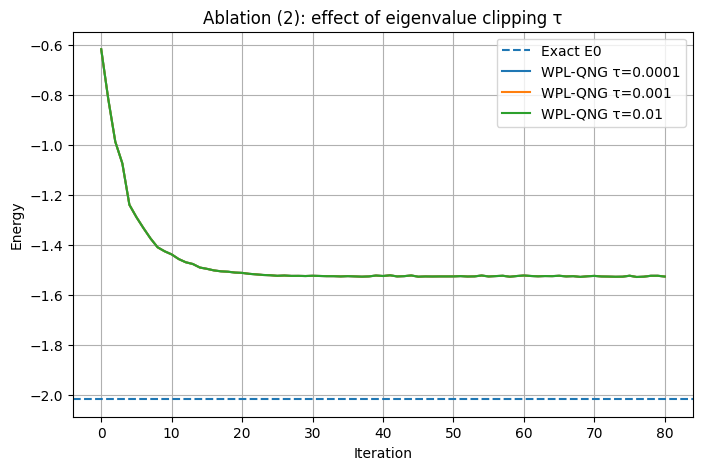
Figure 2: Tracked curvature radii R0(t) and R1(t) under synthetic drift.
Hardware Validation and Practical Implications
Empirical validation on ibm_torino demonstrates the following:
- Experimental Accessibility: The pipeline requires only $12$ single-qubit circuits per qubit, allowing per-block WPL parameters to be re-estimated efficiently throughout variational training.
- Curvature Stability Under Drift: Synthetic and observed device drift on calibration timescales produces negligible fluctuations in WPL curvature, allowing the derived preconditioners to be used reliably across many VQE iterations.
- Kraus-Invariant Channel Summary: Multiple noise sources (dephasing, amplitude damping, depolarizing) yield nearly identical WPL parameters if the principal contractions match, confirming that WPL curvature is a universal summary of axis-aligned decoherence irrespective of Kraus decomposition.
Ablation Studies and Regularization Techniques
A comprehensive suite of ablations confirms that:
- Regularization via the Moore–Penrose pseudoinverse is essential; naive inversion leads to unstable, divergent updates, especially near the metric cone points where the QFIM is rank-deficient.
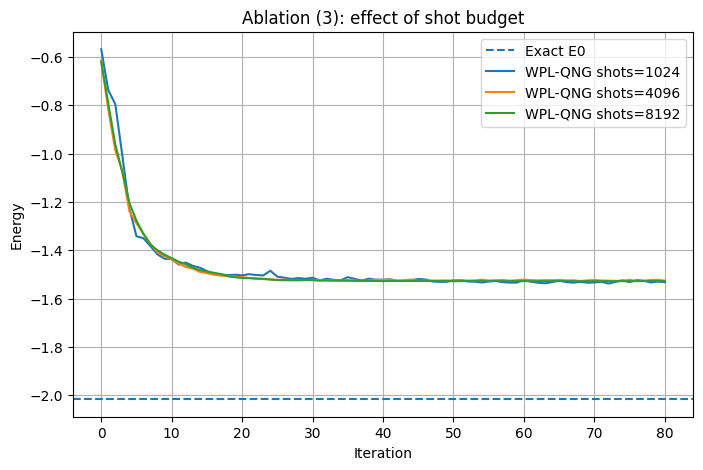
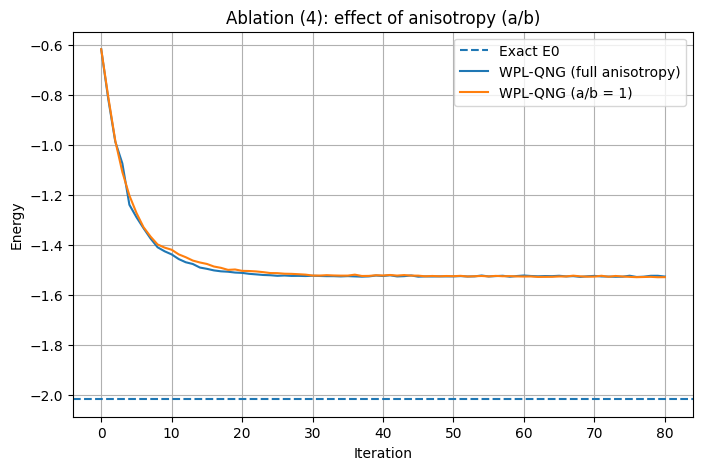
Figure 3: Pseudoinverse vs naive inverse of the WPL-QFIM.
- The choice of eigenvalue threshold (τ) in the pseudoinverse procedure only weakly affects convergence.
- The WPL framework is robust against realistic shot noise budgets and stabilizes optimization across a wide range of hardware and simulated conditions.
- Explicitly neglecting the anisotropy (a/b=1) diminishes, but does not eliminate, the advantages of curvature-aware optimization.
Theoretical and Practical Implications
The adoption of WPL geometry as a surrogate for noisy parameter manifold curvature has both immediate and far-reaching consequences:
- It renders device-specific curvature measurable, shifting the traditional focus from abstract manifold theory to operational, hardware-specific geometric diagnostics.
- Curvature-aware optimization, with curvature tracked in real time, mitigates the onset of barren plateaus by quantifying noise-induced flattening.
- The block-diagonal, analytic invertibility and low-dimensionality of the WPL surrogate implies scalability for larger ansätze under shallow noise, as well as potential for automated device calibration, qubit routing, and real-time drift diagnostics.
- The WPL model provides a natural geometric embedding for channel-informed variational optimization, and can be extended to more sophisticated algebraic geometric models (e.g., higher-dimensional weighted projective spaces or flag manifolds) as quantum hardware and noise models become more complex.
Limitations and Future Directions
While the WPL surrogate is both practical and theoretically motivated, it has inherent expressiveness limitations:
- Non-unital and non-axis-aligned noise is not captured within the two-parameter WPL structure; high-dimensional QFIMs for nontrivial noise processes require richer geometric modeling.
- Correlated multi-qubit noise, leakage, and crosstalk are outside the scope of singletensor orbifold modeling.
- The WPL can be seen as a first-order compression of the true Fisher geometry, and may be insufficient for full characterization of parameter landscapes as quantum processors scale.
Future work should focus on the integration of the WPL framework with toric and flag-manifold geometry for multi-qubit surrogates, the unification with Petz monotone metrics, and further development of curvature-driven learning rules for reinforcement and adaptive optimization protocols.
Conclusion
This work presents a rigorous, experimentally validated framework linking noisy channel tomography, geometric curvature of parameter manifolds, and stable variational optimization via weighted projective line geometry. By distilling the intrinsic anisotropy and contraction of noisy quantum channels into low-dimensional geometric parameters, the authors provide both theoretical insights and practical algorithms for curvature-aware quantum optimization. The approach opens new directions for geometric diagnostics, noise-aware quantum control, and the integration of real-time information geometry into the quantum software stack.