Resonant Annihilation of WIMP Dark Matter for Halo Gamma Ray Signal
Abstract: We propose a resonant annihilation as a way to reconcile the WIMP annihilation cross sections in a recently reported gamma ray signal from the Milky Way halo with that for the freeze-out and the upper limit from dwarf galaxies. We perform a simple model-independent analysis based on this hypothesis and determine the required parameters. We also present a simple particle-physics model that can accommodate them.
Paper Prompts
Sign up for free to create and run prompts on this paper using GPT-5.
Top Community Prompts
Explain it Like I'm 14
A clear, simple explanation of “Resonant Annihilation of WIMP Dark Matter for Halo Gamma Ray Signal”
What is this paper about?
This paper looks at a new way to explain a possible signal of dark matter in our galaxy. A recent study reported extra gamma rays (very energetic light) coming from the Milky Way’s halo (the big, faint cloud of matter around the galaxy). These gamma rays could be produced if dark matter particles are bumping into each other and destroying (annihilating) themselves.
There’s a problem, though: the amount of annihilation needed to make the observed gamma rays doesn’t match what we expect from the early universe or from nearby small galaxies. This paper suggests a clever fix called “resonant annihilation,” which can make dark matter annihilate more in some places (like the Milky Way) and less in others (like dwarf galaxies), solving the mismatch.
What questions are the authors trying to answer?
- Why does the Milky Way halo seem to need a much higher dark matter annihilation rate than the early universe calculation and observations of dwarf galaxies allow?
- Could a special “resonance” effect make annihilation strong only at certain speeds, matching the Milky Way but not dwarf galaxies or the early universe?
- Do the needed numbers make sense physically, and can a simple particle model produce them?
How did they study it? (Simple picture of the method)
Think of resonance like pushing a child on a swing: if you push at just the right rhythm, the swing goes much higher. Too fast or too slow, and nothing much happens. The authors apply this idea to dark matter:
- Dark matter particles have different typical speeds in different places:
- In the early universe (“freeze-out”), speeds were very high.
- In the Milky Way today, typical speeds are around a few hundred kilometers per second.
- In small dwarf galaxies, speeds are much lower (a few to a few tens of kilometers per second).
- If dark matter annihilation is “resonant,” it’s strongest at a particular relative speed —like hitting just the right note. At other speeds, it’s much weaker.
- The authors use standard physics of resonances (the “Breit–Wigner” shape, which describes how likely a collision is near a special energy) and average it over the bell-shaped distribution of dark matter speeds in each environment. They also account for “escape velocity” (the maximum speed a dark matter particle can have and still stay in a halo), which matters for galaxies.
- They keep the analysis “model-independent” first (no detailed particle assumptions), then show a simple toy particle model that naturally produces the needed resonance.
In everyday terms: they calculated how often dark matter hits the “just right” speed in the early universe, our Milky Way, and dwarf galaxies, and how that changes the expected amount of gamma rays.
What did they find, and why is it important?
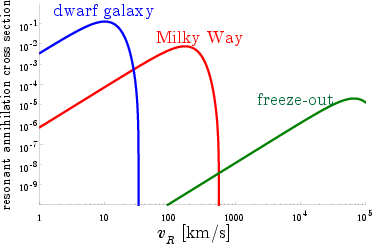
- A speed-tuned resonance can make the annihilation rate much higher in the Milky Way but still small in dwarf galaxies and at early times. This can match all three:
- Early universe “freeze-out” needs a typical annihilation rate of about cm³/s to get the right amount of dark matter today.
- The Milky Way halo signal seems to require roughly 20–40 times higher (about – cm³/s).
- Dwarf galaxies put strict upper limits that would normally rule this out—but if the resonance “sweet spot” is at speeds higher than what dwarf galaxies’ dark matter can reach, the annihilation stays small there and the limits are satisfied.
- A good “sweet spot” is when the resonance speed is around km/s. That is:
- Milky Way: many particles move near this speed → big boost in annihilation → gamma rays can match the signal.
- Dwarf galaxies: particles are too slow to hit the resonance → no big boost → still safe with observations.
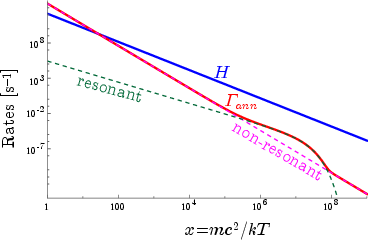
- Early universe: particles were much faster, and the thermal conditions make the resonance contribute very little → standard freeze-out result remains intact.
- They checked that this extra annihilation does not “turn back on” later in the universe and erase too much dark matter. It doesn’t: as the universe cools, it becomes too hard to hit the resonant energy, so the effect fades before causing trouble.
- They also show a simple particle model that can make this happen:
- Dark matter is a new particle that can annihilate into Higgs and W/Z bosons (standard particles).
- Add a new “mediator” particle with a mass just a tiny bit above twice the dark matter mass. This creates the resonance at the right speed.
- The needed couplings (how strongly the particles talk to each other) are small but sensible and are not excluded by collider measurements of the Higgs. In fact, future precise Higgs studies could test this idea further.
Why it matters: This provides a neat, physics-based way to make the Milky Way look “bright” in gamma rays without breaking early-universe physics or dwarf galaxy limits.
What could this mean going forward?
- If the Milky Way halo gamma-ray excess is real and comes from dark matter, resonant annihilation is a promising explanation that fits the numbers.
- It suggests new targets for experiments:
- Particle physics: very precise measurements of the Higgs and searches for tiny mixings with a new light-mixed scalar could find hints of the mediator.
- Astrophysics: comparing galaxies with different typical dark matter speeds could reveal the “speed-dependent” fingerprint of resonance.
- The idea is also natural: in known physics (like nuclear and particle physics), many systems have resonances sitting very close to the energy where two particles meet—so having a mediator mass nearly equal to twice the dark matter mass isn’t far-fetched.
- Even if other mechanisms (like “Sommerfeld enhancement,” another speed-sensitive effect) might also work, this resonance picture is a clean and testable way to solve the puzzle.
In one sentence
By tuning dark matter to annihilate most efficiently at about the speeds found in our Milky Way—but not in slower dwarf galaxies or the hot early universe—this paper shows how a “resonance” can reconcile a possible gamma-ray signal with all other known constraints, and it outlines a simple particle model that could make it real.
Knowledge Gaps
Below is a single, consolidated list of knowledge gaps, limitations, and open questions that remain unresolved in the paper. Each item is intended to be concrete enough to guide follow-up research.
- Quantitative gamma-ray spectrum: The paper asserts consistency of the 500–800 GeV WIMP annihilation channels (hh, WW, ZZ via Higgs decays) with the ∼20 GeV halo excess, but provides no computed prompt spectrum or inverse-Compton/bremsstrahlung contribution; a full spectral prediction (including hadronization, electroweak corrections, and propagation) compared to Totani’s data is missing.
- Morphology under velocity-dependent annihilation: Resonant annihilation implies the effective rate is weighted by the local velocity distribution rather than purely ρ2; the paper does not model how radially varying velocity dispersion in the Milky Way modifies the expected spatial morphology and whether this remains consistent with the observed “halo-like” signal.
- Sensitivity to halo velocity distribution assumptions: The analysis assumes Maxwellian distributions with fixed v0 and a hard escape-velocity cutoff; realistic, anisotropic, and radially varying distributions from simulations (e.g., Eddington inversion) are not incorporated, nor is the impact of uncertainties in v0 and vesc quantified.
- Dwarf galaxy diversity: The conclusion that dwarfs suppress the resonance by vR > vesc relies on representative values (v0 ≈ 10 km/s, vesc ≈ 33 km/s); a survey across dwarf systems (including dispersion anisotropy, tidal effects, and J-factor uncertainties) and the resulting spread in constraints is not provided.
- Cluster-scale predictions: The model does not evaluate annihilation rates in galaxy clusters with much higher velocity dispersions; it is unclear whether off-resonance contributions or the finite width could yield detectable signals or constraints from cluster gamma-ray observations.
- Freeze-out treatment beyond narrow-width/Breit–Wigner: The impact of the resonance on the Boltzmann evolution at freeze-out is discussed qualitatively; a full numerical solution including the finite-width, near-threshold effects, coannihilations, and p-wave contributions is not performed.
- CMB energy-injection constraints: The non-resonant s-wave piece is velocity independent and set to the canonical freeze-out value; the paper does not assess Planck/CMBlike constraints on late-time annihilation for the proposed final states and mass range, which could pressure the model.
- Antiproton and positron constraints: WW/ZZ/hh (→ bb̄) final states produce antimatter; the paper does not check AMS-02 (antiprotons and positrons) limits for the Milky Way annihilation rate inferred, which may significantly constrain such channels.
- Neutrino constraints: The associated high-energy neutrino yield (especially from WW/ZZ) and limits from IceCube or ANTARES are not evaluated.
- Extragalactic gamma-ray background: The impact on the isotropic gamma-ray background from annihilation in external halos (with varying velocity dispersions) is not assessed.
- Direct detection viability of the toy Higgs-portal model: The required Higgs-portal coupling λ ≈ 0.25 for m ≈ 800 GeV likely implies a spin-independent scattering cross section on nuclei orders of magnitude above current LZ/XENONnT limits; the paper does not calculate this or propose suppressions (e.g., blind spots, pseudoscalar portals, isospin violation).
- Collider constraints on Σ: A ∼1.6 TeV scalar with ε ≈ 4×10⁻⁷ mixing to the Higgs may be difficult to produce, but the paper does not quantify production rates or check diboson/di-Higgs resonance searches, off-shell Higgs interference, or precision Higgs coupling fits beyond a qualitative statement.
- Parameter-space scan and uncertainties: The study fixes benchmark values (e.g., vR = 100 km/s, B_in = B_out = 1/2, m ≈ 800 GeV, ⟨σv⟩MW ≈ 6×10⁻²⁵ cm³/s) but does not propagate observational and astrophysical uncertainties to allowed ranges of μ, ε, Γ, vR, nor does it present confidence intervals or degeneracies among these parameters.
- Robustness to escape-velocity modeling: The finite vesc treatment uses a delta-function energy selection and a sharp truncation; the effect of smooth truncations, tails, and non-equilibrium features (streams, substructure) on the resonant average is not analyzed.
- Subhalo contributions: The impact of subhalos (with lower velocity dispersions) to the total Milky Way flux in a resonance-dominated scenario is not quantified; subhalos could alter the signal morphology and normalization.
- Galactic Center predictions: Given higher typical velocities near the GC, the model should predict relative enhancement/suppression versus the halo; this is not calculated, nor compared with GC excess studies or limits in regions Totani excises.
- Unitarity/partial-wave bounds: The required σR and Γ values near resonance are not checked against s-wave unitarity limits in the relevant velocity regime.
- Stability of the near-threshold mass relation: The toy model does not provide a UV mechanism that naturally pins M ≈ 2m + m vR² with the required precision; radiative stability of this relation and loop-induced detuning are not addressed.
- Radiative corrections and technical naturalness: While μ and ε are said to be small and technically natural (breaking Σ → −Σ), loop-induced operators (e.g., χ–H mixing, additional portals) and their impact on direct detection/annihilation are not quantified.
- Alternative annihilation structures: The paper mentions Sommerfeld enhancement as a possible route but does not analyze whether it competes with or spoils the resonance signature in the Milky Way or dwarfs, nor how to observationally distinguish the two scenarios.
- Final-state channel mix: Assuming B_in = B_out = 1/2 is ad hoc; a realistic branching mix (including bb̄ via Higgs decays and gauge bosons) and its effect on spectra and multi-messenger constraints is not explored.
- Line-of-sight integration with velocity dependence: The flux calculation for the Milky Way is not carried out with a spatially varying velocity distribution; a proper line-of-sight integral of ρ² weighted by the local ⟨σv⟩(r) is required to make predictive maps and test against Fermi data.
- Time-dependent reannihilation and structure impact: Beyond the brief rate comparison, late-time resonant annihilation in high-velocity environments (e.g., during halo assembly) and any impact on small-scale structure or subhalo survival are not examined.
- Experimental roadmap: The paper notes collider tests but does not lay out concrete, falsifiable predictions and required sensitivities across gamma rays, cosmic rays, neutrinos, direct detection, and colliders that would validate or exclude the resonance scenario.
Practical Applications
Immediate Applications
The following applications can be deployed now, leveraging the paper’s model-independent framework for resonant dark matter annihilation, its analytic averaging over realistic velocity distributions, and its toy particle-physics model consistent with present constraints.
- Indirect-detection data reanalysis pipelines (sector: space/astronomy; software)
- Action: Incorporate the paper’s velocity-dependent, resonant annihilation averaging formulas—especially the finite-escape-velocity expression—to re-fit gamma-ray data sets (e.g., Fermi-LAT 15-year halo analysis) and compare against dwarf galaxy constraints.
- Tools/workflows: Add a “resonant <σv> module” implementing Eq. (σaverage2) to existing codes (MicrOMEGAs, DarkSUSY, PPPC4DMID; or Python packages integrated with Fermitools/gammapy). Provide routines parameterized by vR, Γ, Bin, Bout, v0, vesc, xf.
- Assumptions/dependencies: Halo excess is non-astrophysical (per Totani); velocity distributions approximated as Maxwellian with chosen v0 and vesc; narrow width approximation holds; DM mass in the 500–800 GeV range; annihilation channels matching W/Z/H final states.
- Environment-dependent signal forecasting and cross-instrument checks (sector: space/astronomy)
- Action: Predict and compare annihilation fluxes across environments with different velocity dispersions (Milky Way halo vs dwarfs vs external galaxies like M31) to test the resonance hypothesis (strong signal when vR ≈ 100 km/s and vesc ≫ vR; suppressed in dwarfs).
- Tools/workflows: Generate sky templates proportional to ρ2 with velocity-dependent weights; run morphology fits excluding disk/GC to minimize contamination; cross-check with current instruments’ archival data (Fermi-LAT, H.E.S.S.) within 10–50 GeV sensitivity.
- Assumptions/dependencies: J-factor estimates and density profiles (e.g., NFW) are robust; instrument systematics are under control; astrophysical source subtraction is sufficiently accurate.
- Rapid parameter inference and consistency checks (sector: high-energy theory; software)
- Action: Use analytic relations to map observed fluxes to resonant parameters (vR, Γ, Bin, Bout) and validate consistency with freeze-out and dwarf limits; perform scans to identify viable islands in parameter space.
- Tools/workflows: Bayesian/likelihood fits with priors from thermal relic abundance and dwarf upper limits; automated generation of predicted spectra peaking near ~20 GeV.
- Assumptions/dependencies: Thermal relic target <σv> ≈ 2.2 × 10⁻²⁶ cm3/s; dwarfs’ upper limits per Fermi/MAGIC analyses; systematic uncertainties correctly propagated.
- Collider and Higgs-fit model plumbing (sector: particle physics)
- Action: Integrate the paper’s toy model (scalar χ, portal λχ2H†H, resonance Σ with tiny Higgs mixing ε) into global Higgs coupling fits and heavy-scalar search benchmarks to track prospective deviations or diboson signatures.
- Tools/workflows: Extend LHC/HL-LHC effective field theory fit frameworks to include a feeble scalar mixing ε ~ 10−7; evaluate impacts on Higgs couplings and rare decays; set targeted limits on Γ × Bin × Bout near the derived scales.
- Assumptions/dependencies: The resonance is weakly coupled and narrow; Bin, Bout may deviate from 1/2; sensitivity at current colliders is insufficient for discovery but enables bounding.
- Curriculum and training materials (sector: education)
- Action: Use the paper’s derivations (Breit–Wigner narrow-width averaging with realistic escape-velocity truncation) in graduate-level courses on astroparticle physics, as a case study in environment-dependent signals.
- Tools/workflows: Classroom notebooks illustrating Eq. (σaverage2), velocity-distribution effects, and realistic sky modeling; problem sets comparing freeze-out vs halo vs dwarf regimes.
- Assumptions/dependencies: Standard astrophysical inputs and numerical values for v0, vesc; reproducible data for student exercises.
Long-Term Applications
These applications require further research, scaling, instrument development, or precision improvements before practical deployment.
- Mission design for diffuse, halo-focused gamma-ray instruments (sector: space/astronomy; policy)
- Concept: Optimize future gamma-ray telescopes for wide-field, low-background mapping of ~10–50 GeV halo emission while excluding disk/GC contamination, directly testing resonance-driven signals.
- Potential products: Requirements for energy resolution and background modeling; observing strategies tailored to environments with vesc ≫ vR; coordinated campaigns with AMEGO-X/e-ASTROGAM successors and CTA for complementary coverage.
- Assumptions/dependencies: The halo excess is non-astrophysical; instrument sensitivity and systematics can surpass current Fermi-LAT analyses; accurate modeling of velocity dispersions across targets.
- Precision collider programs probing feeble Higgs mixing and heavy scalars (sector: particle physics)
- Concept: Leverage HL-LHC and future Higgs factories (FCC-ee, CEPC, ILC) to tighten constraints on ε and diboson final states associated with a ~TeV-scale Σ resonance, as suggested by the toy model.
- Potential products: Global fit frameworks and dedicated searches targeting tiny ε via precision Higgs couplings; heavy-resonance searches in dibosons with model-informed kinematic benchmarks.
- Assumptions/dependencies: ε is technically natural but tiny (~10−7); discovery may require larger Bout or alternative portals; direct production may be beyond e+e− energies, shifting emphasis to precision coupling deviations.
- Targeted astrophysical tests across velocity-dispersion ladders (sector: space/astronomy)
- Concept: Systematically observe systems spanning velocity dispersions (dwarfs, LMC/SMC, Milky Way halo, external galaxies, clusters) to exploit the resonance’s predicted on/off pattern with vR and vesc.
- Potential products: A catalog of velocity-weighted J-factors; cross-target comparison workflows; robustness tests against stellar contamination using multi-wavelength data.
- Assumptions/dependencies: Maxwellian approximation holds sufficiently well; escape-velocity thresholds are well constrained; background models are mature.
- Integrated structure-formation and indirect-detection modeling (sector: cosmology/astrophysics; software)
- Concept: Embed resonant annihilation into cosmological simulations to assess its subtle effects on thermal histories, reionization-era energy injection, and small-scale structure, in tandem with SIDM scenarios.
- Potential products: Simulation modules coupling annihilation heating with environment-dependent rates; joint fits to CMB/21 cm constraints and gamma-ray data.
- Assumptions/dependencies: Resonance parameters remain consistent across epochs; energy injection remains below CMB constraints; interplay with self-interactions is controlled.
- Cross-domain analytics and signal-separation methods (sector: software/data science)
- Concept: Advance statistical approaches (e.g., Gaussian processes, morphology-based component separation) tailored to environment-dependent signals, improving reliability of dark-matter vs pulsar discrimination.
- Potential products: Open-source toolkits that integrate resonance-aware priors; standardized benchmarks for excess-morphology inference.
- Assumptions/dependencies: High-quality training data; agreement on priors; community validation.
- Strategic prioritization and funding roadmaps (sector: policy)
- Concept: Inform agency decisions (DOE, NSF, ESA, NASA) on investments in gamma-ray missions and precision Higgs programs by quantifying the discovery potential of resonance-driven dark-matter scenarios.
- Potential products: White papers outlining science returns from environment-dependent DM tests; cross-mission synergies.
- Assumptions/dependencies: Sustained multi-agency support; alignment with broader high-energy physics and astrophysics goals.
Notes on feasibility common to several applications:
- The resonance hypothesis hinges on the halo signal being of dark-matter origin rather than unresolved astrophysical sources (pulsars). Community consensus and improved systematics are critical.
- Velocity-distribution modeling (v0, vesc, departures from Maxwellian) and density profiles (J-factors) introduce astrophysical uncertainties that need continuous refinement.
- The narrow-width approximation and toy-model parameters (e.g., tiny ε, specific Bin/Bout) guide phenomenology but may shift with future theoretical or experimental insights.
Glossary
- Annihilation cross section: A measure of the probability that particles annihilate when they collide, often expressed as σann times relative velocity. "In order to account for the gamma ray flux, the annihilation cross section in the halo was estimated to be"
- Boltzmann factor: The exponential weight e{-E/kT} that suppresses high-energy states in a thermal distribution. "the Boltzmann factor is "
- Branching fraction: The fraction of decays of a particle that result in a particular final state. " is the branching fraction of the resonance decaying into the initial state (dark matter), and that into the final state (standard model)."
- Breit--Wigner formula: A resonance line shape describing the energy dependence of scattering through an unstable intermediate state. "The standard Breit--Wigner formula for a resonance is"
- Center-of-momentum (CM) frame: The frame in which the total momentum of the incoming particles is zero. "where is the momentum of each incoming particle and the total energy in the center-of-momentum (CM) frame."
- Cosmic Microwave Background (CMB): Relic radiation from the early universe used to infer cosmological parameters and dark matter evidence. "CMB observations and gravitational lensing made the evidence unmistakeable."
- Delta function: A distribution (Dirac delta) used to localize contributions at a specific energy or velocity in integrals. "The integral can hit the delta function only if"
- Dwarf galaxies: Small, low-luminosity galaxies whose gamma-ray observations constrain dark matter annihilation. "it is in tension with the upper limit from dwarf galaxies"
- Error function (erf): A special function arising in Gaussian integrals and cumulative probabilities. ""
- Equivalence theorem: A high-energy relation equating longitudinal gauge boson scattering to Higgs-Goldstone interactions. "the annihilation cross section can be worked out using the equivalence theorem limit ,"
- Escape velocity: The maximum speed a particle can have and remain gravitationally bound to a halo. "is not appropriate if the escape velocity is comparable or below the resonant velocity in a galactic halo,"
- Full Width at Half Maximum (FWHM): The width parameter Γ of a resonance defining its energy spread at half-maximum. " is the Full Width at Half Maximum (FWHM) in the energy dependence, and is related to the lifetime of the resonance as ."
- Gravitational lensing: The deflection of light by mass, used to map dark matter distributions. "CMB observations and gravitational lensing made the evidence unmistakeable."
- Higgs doublet: The Standard Model scalar field responsible for electroweak symmetry breaking and particle masses. " is the Higgs doublet in the standard model."
- Kaluza--Klein states: Quantum excitations arising from momentum modes in compact extra dimensions. "both the dark matter and the resonance are Kaluza--Klein states of flat extra dimensions"
- Maxwellian (velocity distribution): The Maxwell–Boltzmann distribution used to model particle velocities in thermal or halo environments. "Both in the thermal bath and the halo, we approximate the velocity distribution to be Maxwellian,"
- Narrow width approximation: An approach that treats a resonance as a delta function in energy when Γ ≪ E, simplifying integrals. "For a narrow resonance, we can use the narrow width approximation,"
- N-body simulations: Computational simulations of many gravitating particles to model cosmic structure formation. "discrepancy between the observed diverse density profiles and the N-body simulations"
- Radiation dominated universe: The early epoch when radiation energy density dominated over matter, setting the expansion rate. "The expansion rate of the radiation dominated universe and the annihilation rate as a function of "
- Resonant annihilation: Annihilation process enhanced when the incoming energy matches an intermediate-state resonance. "We propose a resonant annihilation as a way to reconcile the WIMP annihilation cross sections"
- Resonant velocity: The specific relative speed at which the kinetic energy of incoming particles matches the resonance energy. "Therefore, the resonant velocity is"
- Self-interacting dark matter (SIDM): Dark matter models where particles scatter off each other, affecting halo structures. "There is a similar issue in self-interacting dark matter (SIDM)"
- Sommerfeld enhancement: A quantum effect where attractive potentials amplify low-velocity annihilation cross sections. "the Sommerfeld enhancement may be a good way to reconcile Milky Way halo and freeze-out cross sections."
- Thermal freeze-out: The epoch when annihilations become too slow to maintain equilibrium, fixing the relic abundance. "Here, is the piece for the standard -wave thermal freeze-out \eqref{eq:sigmafo}, while"
- Thermal relic: A particle species whose present-day abundance was set by early-universe thermal processes. "It is a thermal relic of a stable unknown particle produced in the early universe, whose abundance was drastically depleted by annihilation into the particles in the standard model."
- Weakly Interacting Massive Particle (WIMP): A dark matter candidate with weak-scale interactions and masses, yielding the right relic density. "Weakly Interacting Massive Particle (WIMP) has long been the favorite candidate among particle physicists"
- Z_2 symmetry: A discrete symmetry under χ → −χ that stabilizes a dark matter candidate. "There is a symmetry which makes stable and hence the dark matter."
Collections
Sign up for free to add this paper to one or more collections.