On extremal black holes
Abstract: We take a fresh look at the viability of physically realistic extremal black holes within our (non-supersymmetric) low energy physics. By incorporating prefactors and volume effects, we show that Schwinger discharge in charge neutral environments is far more efficient than commonly assumed. Using ionization estimates for neutral hydrogen, we obtain a new and robust lower bound on the mass of an extremal electrically charged black hole, exceeding $10{14} M_\odot$. For magnetic black holes, we compute the Lee-Nair-Weinberg instability and revisit early universe pair creation rates, including singular instantons that substantially enhance production, to demonstrate that the extreme charges required for stability are cosmologically implausible. Finally, we suggest that an extremal Kerr black hole could shed angular momentum via superradiant scattering from the stochastic gravitational wave background. Taken together, our results provide a unified picture that extremal black holes of any type are unlikely to persist in our universe.
Paper Prompts
Sign up for free to create and run prompts on this paper using GPT-5.
Top Community Prompts
Explain it Like I'm 14
A simple explanation of “On extremal black holes”
Overview
This paper asks a big question: could “extremal” black holes really exist in our universe and survive for long? An extremal black hole is one that has pushed its limits to the max — either it has as much electric charge or spin (rotation) as a black hole can possibly have. These special black holes have strange thermodynamics: their temperature is zero, but their area (and therefore their entropy) is still nonzero, which makes them fascinating to physicists.
The authors look at extremal black holes with electric charge, magnetic charge, and extreme spin, and argue that in realistic conditions they are very unlikely to last. They show that nature has many ways to drain charge or spin from such black holes.
What questions does the paper try to answer?
To make the ideas clear, here are the main questions the paper tackles:
- Could an electrically charged extremal black hole keep its charge without quickly losing it?
- Could a magnetically charged extremal black hole exist and stay stable in our universe?
- Could an extremely spinning (Kerr) black hole remain truly extremal, or would it naturally lose spin?
How did the authors study it?
The authors used mathematical physics and known physical processes to estimate how black holes interact with their surroundings. Here’s what they did, with simple explanations:
- Electric discharge through pair creation (the “Schwinger effect): In very strong electric fields, empty space can “spark” into particle pairs (an electron and a positron). Think of the electric field like a stretched rubber band that can snap into little pieces — the energy turns into matter. The original formula tells you the “chance per tiny volume per tiny time” that this happens. The authors point out that you must multiply by the actual region around the black hole where the field is strong and by a realistic time window. This “prefactor and volume effect” makes discharge far more efficient than people often assume.
- Electric discharge through ionization of nearby matter: Real black holes aren’t alone in empty space — they often sit in gas and dust (mostly hydrogen). A strong electric field can rip electrons off neutral hydrogen atoms (ionization). Those freed charges can fall into the black hole and neutralize it. The authors estimate how often hydrogen near a black hole gets ionized and show this is an even more powerful way to discharge the black hole.
- Magnetic black holes and monopoles: A magnetically charged black hole would carry magnetic “monopoles” — hypothetical particles that are like isolated north or south poles. These are predicted by some grand unified theories but haven’t been found. The authors study whether a black hole loaded with many monopoles could be stable. They analyze an instability (the Lee–Nair–Weinberg instability) where the black hole’s field configuration becomes wobbly and tends to “shed” its magnetic charge. They solve the relevant equations to estimate how fast that happens.
- Early universe formation (pair creation of black holes): Could the very early universe (during inflation) have created highly charged black holes? The authors revisit calculations of how likely it is for black holes to pop into existence during inflation via quantum tunneling. They consider more general “instantons” (tunneling paths), including ones with mild singularities that still have finite action. Even then, making enough highly magnetically charged black holes is extraordinarily unlikely and would be diluted away by inflation.
- Extremal spinning black holes: They suggest another way extremal spin might be reduced in the real universe: superradiance, where waves (including the background of gravitational waves filling space) can steal rotational energy from the black hole, like a surfer pulling energy from an ocean wave.
What did they find, and why is it important?
Here are the main results, explained in everyday terms:
- Electric extremal black holes are extraordinarily hard to keep charged. When you correctly include the “how many places and how long” factor for pair creation, small black holes discharge fast. Even very large black holes would discharge via ionizing nearby hydrogen. The authors find that to avoid discharge, an electrically extremal black hole would need a mass greater than about 1014 times the Sun’s mass. The biggest known supermassive black holes are around 3.6 × 10¹⁰ solar masses, so this required mass is thousands of times larger than anything we’ve observed or expect to form. That means electrically extremal black holes are not plausible in our universe.
- Magnetically extremal black holes would need absurdly large magnetic charge. To be stable against the instability that sheds magnetic charge, an extremal magnetic black hole would need roughly a million to a hundred million monopoles packed in. Forming such objects in the early universe is wildly unlikely. Inflation would have spread out monopoles so that, at most, there would be about one per huge cosmic region, not millions inside a single black hole. The chance of creating enough highly charged black holes by quantum tunneling is also extremely tiny. So magnetically extremal black holes are also implausible.
- Extremal spinning black holes likely lose spin. Even if a black hole spins close to the theoretical max, processes like superradiance can slowly drain its spin. The cosmic background of gravitational waves may overlap with the “superradiant” frequencies, giving a natural long-term spin-down effect. Together with known astrophysical limits from how black holes gain spin (for example, through accretion disks), exact extremal spin looks unreachable.
Why this matters: Extremal black holes have special properties that could have been a window into quantum gravity, but if nature prevents them from existing, then researchers should look to near-extremal cases or other systems for such clues.
What could this mean for science?
- It gives a unified, realistic picture: once you include the environment and the early universe, extremal black holes of any type — electric, magnetic, or exactly extremal spin — are unlikely to persist. Nature has multiple “safety valves” that drain charge or spin.
- It guides future research: Instead of searching for exact extremal black holes, scientists should focus on near-extremal spinning black holes, which do exist in the universe and might still reveal interesting quantum effects. It also motivates experiments looking for magnetic monopoles and signs of grand unified theories, because those would change the story.
- It connects theory with observation: The paper uses straightforward physical processes (like ionization of hydrogen) and cosmic history (like inflation) to set hard limits. That makes its conclusions robust and relevant to astrophysics.
In short, the paper argues that while extremal black holes are mathematically possible, the real universe almost certainly prevents them from surviving. Near-extremal rotating black holes, however, remain an exciting and realistic place to look for new physics.
Knowledge Gaps
Knowledge gaps, limitations, and open questions
Below is a consolidated list of concrete gaps and unresolved questions that, if addressed, would strengthen or extend the paper’s conclusions.
Electrically charged extremal black holes
- The Schwinger discharge is treated at 1-loop with flat-spacetime intuition; a self-consistent curved-spacetime QED calculation (including backreaction of produced pairs on the electromagnetic field and metric) is missing.
- The “prefactor × volume × time” estimate uses a heuristic four-volume r_h4/c and evaluates Γ at the horizon; a proper integral of ΓSchwinger(r) over the physical near-horizon 4-volume (e.g., in Kruskal coordinates) and sensitivity to the chosen timescale are not quantified.
- The worldline-instanton insights referenced were obtained for charge-to-mass ratios O(1), not for electrons (q/m ~ 1022); a dedicated computation of the exponent and prefactor for electrons in RN geometry is needed.
- Higher-loop, finite-temperature, and finite-density corrections to the Schwinger rate are neglected; the impact of ambient plasma, radiation fields, and curvature on pair production rates should be quantified.
- The ionization bound relies on tunneling ionization of isolated ground-state hydrogen in a uniform static field; near BHs the electric field is strongly radial, non-uniform, and the medium is typically a hot, magnetized plasma. A realistic GRMHD-based discharge model (composition, ionization fraction, radiation, magnetic fields, collisional processes) is needed.
- The adopted hydrogen number density (n ~ 106 cm-3) is environment-specific; perform a sensitivity analysis across observed ranges (e.g., 102–1012 cm-3 in AGN/galactic nuclei) to determine how the mass bound scales with n.
- The discharge criterion “probability ≈ 1 within one light-crossing time” is heuristic; derive charge-depletion timescales from continuous rate equations and compare to astrophysical times (accretion, dynamical inflow, feedback).
- Only e± pairs are considered; assess contributions from heavier species (muons, protons), pair cascades, and field-induced avalanches, and their effect on discharge efficiency.
- Gravitational redshift and frame effects on local field strengths and rates are not explicitly incorporated; compute rates in the proper frame of near-horizon observers.
- Observational constraints on BH charge (e.g., EHT shadows, orbital dynamics of S-stars, jet energetics, lensing) are not confronted with the model; quantify and compare predicted discharge limits to current and upcoming observational bounds.
Magnetically charged extremal black holes
- The Lee–Nair–Weinberg instability is analyzed in the SU(2) t’Hooft–Polyakov model with g = 1, η ~ 10-4; stability thresholds and timescales for realistic GUT groups (SU(5), SO(10), etc.), different couplings g, and scalar self-coupling λ are not explored.
- Only the s-wave mode is treated explicitly; compute the full perturbation spectrum (higher multipoles, non-spherical modes) and its effect on the onset and growth rate of the instability.
- The endpoint of the instability (nonlinear evolution, charge shedding via detached monopoles, formation of hairy BH solutions, or evaporation) is not simulated; perform nonlinear Einstein–Yang–Mills–Higgs evolutions to determine the discharge dynamics.
- Rotation is ignored; analyze the instability for magnetically charged Kerr–Newman BHs, including possible superradiant channels in the non-Abelian sector.
- Dyonic BHs are only briefly treated via a horizon E-field formula; provide a consistent analysis of how simultaneous electric/magnetic charges affect instability, discharge channels (e.g., W-boson/dyon production), and stability thresholds.
- The instanton analysis revisits uncharged BH nucleation; compute Euclidean actions for nucleating magnetically charged or dyonic BHs (including gauge field contributions and singular instantons) to assess whether magnetic charge facilitates nucleation.
- The requirement to capture N ~ 106–108 monopoles is estimated via volume arguments; include gravitational focusing, monopole–BH capture cross sections, cosmic expansion, and reheating dynamics to derive realistic capture probabilities.
- Monopole abundance assumptions follow the standard Kibble mechanism with canonical inflation; investigate nonstandard cosmologies (e.g., low-scale/short inflation, inhomogeneous reheating, defect networks) that could raise monopole densities or aid capture.
- Competition with Hawking evaporation for small seed BHs is not quantified; model temperature evolution, evaporation timescales, and their interplay with charge acquisition.
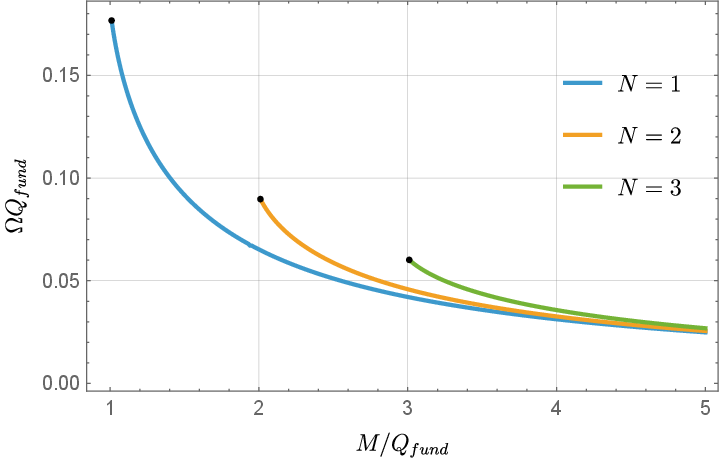
- Numerical instability results are displayed for low N due to dynamic range limitations; develop scalable numerics to directly verify the large-N regime where stability is claimed.
Near-extremal Kerr black holes
- The proposed spin-down via superradiant scattering of the stochastic gravitational-wave background (SGWB) is qualitative; compute the superradiant amplification, overlap with measured SGWB spectra, and resulting spin-down timescales across BH mass ranges.
- Compare SGWB-induced spin-down rates to accretion-driven spin-up and other environmental torques to determine whether near-extremal spins are sustainable over cosmological times.
Methodological and observational outlook
- Several displayed equations contain typographical/formatting issues (missing brackets/labels), which hinder reproducibility; provide corrected expressions and derivations in an ancillary document.
- The analysis omits coupling to realistic accretion flows and magnetic fields; integrate discharge mechanisms into GRMHD simulations to obtain environment-dependent bounds and observables.
- Quantum-gravity corrections near extremality (e.g., JT-gravity-induced entropy suppression) are mentioned but not tied to observational signatures; identify measurable effects (spectral features, ringdown deviations) and forecast detection prospects.
- Define an observational program to search for transient near-extremality (e.g., constraints from EHT, QPOs, GW ringdown) and translate theoretical discharge/spin-down rates into testable predictions.
Practical Applications
Immediate Applications
The following items can be actioned now using existing data, models, and infrastructure; they primarily guide observational practice, simulation workflows, experimental strategy, and software tooling.
- Tighten priors on black hole electric charge in observational inference
- Sector: astrophysics, gravitational-wave astronomy
- Tools/Products/Workflows: update parameter-estimation pipelines (EHT imaging, GRAVITY stellar dynamics, LIGO/Virgo/KAGRA ringdown modeling) to strongly disfavor nonzero electric charge for astrophysical black holes; include the paper’s mass threshold (>1014 M⊙) to justify near-zero charge priors
- Assumptions/Dependencies: accretion environments are not perfect vacuum; neutral/partly neutral hydrogen is present; ionization estimates apply in galactic nuclei; Schwinger rate prefactors and near-horizon volume weighting are appropriate
- Incorporate ionization-driven discharge into accretion and plasma models
- Sector: computational astrophysics, MHD/plasma modeling
- Tools/Products/Workflows: add ionization tunneling rates for hydrogen (with correct prefactor and near-horizon volume/radius scaling) to GRMHD codes; sensitivity tests using realistic densities (e.g., n ≈ 106 cm⁻³); produce a “charge-evolution” module that rapidly damps any residual charge
- Assumptions/Dependencies: local composition dominated by hydrogen; representative discharge timescale approximated by the light-crossing time r_h/c; near-horizon geometry approximation (volume factor ∼ r_h4/c) holds sufficiently for order-of-magnitude constraints
- Revise data-analysis strategies for charged black holes to focus on null results and upper limits
- Sector: astrophysics (EHT, GRAVITY), high-energy astrophysics
- Tools/Products/Workflows: shift search strategies from “detection” to “upper-limit reporting” on BH charge; publish instrument-specific upper bounds informed by the paper’s thresholds; prioritize spectroscopic targets that constrain ionization rather than direct charge signatures
- Assumptions/Dependencies: sensitivity limits for observable charge effects are much weaker than the required extremal thresholds; environmental ionization dominates over vacuum pair production for realistic SMBHs
- Use superradiant spin extraction by the stochastic gravitational-wave background (SGWB) to refine spin-evolution models
- Sector: gravitational-wave astronomy, cosmology
- Tools/Products/Workflows: incorporate SGWB-induced superradiant scattering in SMBH spin-evolution codes; compare predicted spin-down rates against PTA-inferred SGWB amplitudes and SMBH spin catalogs; add a quality-control check on near-extremal spin claims
- Assumptions/Dependencies: SGWB amplitude and spectral content overlap the superradiant window (Ω_h ≈ c³/2GM); superradiant amplification for gravitational waves is small but nonzero; SMBHs traverse environments where background persists over long times
- Redirect expectations in monopole-related searches away from astrophysical magnetically charged black holes
- Sector: particle physics (MoEDAL), cosmology
- Tools/Products/Workflows: emphasize terrestrial/accelerator monopole detection (MoEDAL) and proton-decay experiments (Hyper-Kamiokande, DUNE) over astrophysical BH signatures that require implausibly high monopole multiplicities (N ≳ 106–108)
- Assumptions/Dependencies: typical GUT symmetry breaking scale (η ∼ 10⁻⁴ in Planck units); inflation dilutes monopole density to ≲ O(1) per Hubble volume; Lee–Nair–Weinberg instability operates as computed
- Apply “prefactor and effective volume” methodology to strong-field QED rate estimates beyond gravity
- Sector: high-intensity laser physics (ELI, SLAC), theoretical QED
- Tools/Products/Workflows: adjust Schwinger-like rate extrapolations in laser-plasma contexts to include realistic prefactors and finite spacetime volumes; develop cross-checks for rate predictions and experimental design thresholds
- Assumptions/Dependencies: translation of near-horizon volume-weighting logic to laboratory field geometries requires careful mapping; non-gravitational field profiles must be characterized accurately
- Software module for discharge thresholds and instabilities
- Sector: scientific software
- Tools/Products/Workflows: open-source library that computes discharge probabilities for given BH mass, charge, and environment using Lambert W–based thresholds; includes worldline-instanton-informed prefactors; optional module to estimate Lee–Nair–Weinberg instability timescales vs. mass/charge
- Assumptions/Dependencies: semi-analytic approximations remain valid across parameter ranges used; numerical stability of Lambert W evaluations and shooting methods for perturbation equations
- Education and science communication updates
- Sector: education, public outreach
- Tools/Products/Workflows: update graduate courses and outreach materials to reflect that extremal charged BHs are implausible in realistic environments; emphasize near-extremal Kerr as the relevant frontier
- Assumptions/Dependencies: community adoption through curricula revisions; alignment with current observational consensus
Long-Term Applications
These depend on further research, scaling, or development, and target deeper tests of spin dynamics, cosmology, and quantum-gravity signatures.
- Multi-band gravitational-wave program to test SGWB-induced superradiant spin-down
- Sector: gravitational-wave astronomy (PTAs, LISA, DECIGO), cosmology
- Tools/Products/Workflows: design and optimize detectors and analysis pipelines covering ~10⁻⁵–10 Hz to probe SMBH superradiant windows; long-term tracking of SMBH spin distributions to detect net spin-down correlated with SGWB properties
- Assumptions/Dependencies: sustained SGWB amplitude across relevant bands; accurate spin measurements for large BH samples; controlled systematics from accretion and mergers
- Near-extremal Kerr as a testbed for quantum-gravity corrections
- Sector: fundamental physics, astrophysics
- Tools/Products/Workflows: observational strategies to identify and monitor near-extremal Kerr BHs; model signatures of entropy suppression and quantum corrections (e.g., JT-gravity-inspired) in realistic astrophysical observables
- Assumptions/Dependencies: observable consequences of quantum corrections survive astrophysical noise; sufficient sample of rapidly spinning SMBHs; theoretical models connecting microscopic corrections to macroscopic signals
- Fully coupled GR–QED simulations of discharge processes
- Sector: computational physics, HPC
- Tools/Products/Workflows: develop numerical relativity frameworks that include quantum discharge rates (Schwinger + ionization) with spacetime dynamics; validate approximations (prefactors, near-horizon volumes, backreaction)
- Assumptions/Dependencies: tractable effective-field descriptions in curved spacetime; scalable HPC resources; robust treatment of backreaction on geometry and plasma
- Cosmological constraints on GUTs and inflation from refined BH nucleation and monopole capture
- Sector: cosmology, particle physics
- Tools/Products/Workflows: integrate singular-instanton-enhanced BH nucleation rates and monopole capture requirements into Bayesian cosmology pipelines; translate “implausible extremal magnetic BH” results into quantitative bounds on inflationary e-folds, monopole production, and GUT scales
- Assumptions/Dependencies: reliability of semiclassical instanton actions with conical singularities; accurate modeling of monopole dynamics and capture efficiencies in the early universe
- High-intensity laser tests of Schwinger rates with realistic prefactors
- Sector: high-field science, industry–academia partnerships
- Tools/Products/Workflows: next-generation facilities to approach critical fields; experimental designs that isolate prefactor impacts and finite-volume effects; cross-validation against theoretical predictions
- Assumptions/Dependencies: achievable field strengths and diagnostics; controlled backgrounds; extrapolation from idealized to experimental geometries
- Spectroscopic strategies to bound residual BH charge via environmental line diagnostics
- Sector: observational astrophysics
- Tools/Products/Workflows: design ultra-high-resolution spectroscopy programs to look for subtle ionization or Stark-broadening signatures consistent with weak residual electric fields; long-term surveys of galactic nuclei
- Assumptions/Dependencies: sufficient sensitivity to distinguish charge-induced signatures from MHD/turbulence effects; calibration of environmental parameters (density, composition, temperature)
- Standardized libraries for BH spin-evolution with superradiance and environmental torques
- Sector: scientific software, data science
- Tools/Products/Workflows: public “SpinDown” libraries coupling accretion torques, radiative feedback, ultralight boson clouds, and SGWB scattering; interoperable with GW and EM survey data
- Assumptions/Dependencies: sustained community support and validation; shared data standards; convergence of theory modules across collaborations
- Policy and funding roadmaps aligning monopole searches with cosmological plausibility
- Sector: science policy
- Tools/Products/Workflows: programmatic guidance emphasizing terrestrial monopole searches (MoEDAL) and GUT tests (Hyper-Kamiokande, DUNE) over astrophysical magnetically charged BH signatures; coordinated multi-experiment data sharing
- Assumptions/Dependencies: evolving experimental sensitivities; theoretical updates on GUT scales and proton-decay channels; international collaboration frameworks
Glossary
- Adjoint: A representation of a Lie group where fields transform like the group's generators; often used for scalar fields in non-abelian gauge theories. "the scalar is in the adjoint of SO(3)"
- BPS limit: The Bogomolny–Prasad–Sommerfield regime where scalar self-coupling vanishes and solutions saturate an energy bound, yielding simplified analytic forms. "in the \lambda \to 0, or BPS limit, they have an exact analytic form:"
- Bogoliubov coefficients: Parameters relating “in” and “out” quantum field modes that quantify particle production in curved spacetime or external fields. "computing the Bogoliubov coefficients between in and out states"
- Boltzmann suppression: Exponential reduction in process probability due to entropy or action barriers in thermodynamic or semiclassical contexts. "reduced entropy, hence is strongly Boltzmann suppressed;"
- C-metric: An exact general relativity solution describing uniformly accelerating black holes, useful for pair-creation instantons. "where the C-metric was used to construct a Euclidean instanton interpolating between the initial string or magnetic field to a pair of black holes accelerating apart."
- Compton wavelength: The quantum wavelength associated with a particle, inversely proportional to its mass; sets scales for quantum processes. "is the Compton wavelength of the electron."
- Conical singularity: A spacetime defect with a deficit angle in Euclidean geometry, often arising from temperature mismatches between horizons. "thus a conical singularity in the Euclidean section."
- Cosmic censorship: The conjecture that singularities formed in gravitational collapse are hidden behind event horizons, avoiding naked singularities. "their threshold nature in terms of cosmic censorship"
- Cosmic strings: One-dimensional topological defects formed during symmetry-breaking phase transitions in the early universe. "decay of cosmic strings"
- de Sitter lengthscale: The curvature radius of de Sitter spacetime set by the cosmological constant. "where \ell = \sqrt{\Lambda/3} is the de Sitter lengthscale of inflation."
- Dyonic black hole: A black hole carrying both electric and magnetic charges simultaneously. "For an extremal dyonic black hole, the mass is related to the magnetic and electric charges via ."
- Euclidean instanton: A classical solution in Euclidean time mediating tunnelling or pair creation processes. "a Euclidean instanton interpolating between the initial string or magnetic field to a pair of black holes accelerating apart."
- Fine structure constant: The dimensionless electromagnetic coupling constant, α ≈ 1/137. "where is the fine structure constant"
- Grand Unified Theory (GUT): A high-energy framework unifying the strong, weak, and electromagnetic interactions. "for a typical grand unified theory (GUT) breaking scale"
- Hawking evaporation: The quantum radiative process by which black holes lose mass due to Hawking radiation. "the horizon may shrink further by Hawking evaporation,"
- Hawking temperature: The temperature associated with black hole radiation, proportional to surface gravity. "Their vanishing Hawking temperature suggests a connection"
- Hawking–Moss instanton: A homogeneous tunnelling configuration in de Sitter space between potential maxima/minima. "completely general Hawking-Moss instantons tunnelling from a lower to higher cosmological constant"
- JT gravity: Jackiw–Teitelboim gravity, a two-dimensional model used for exact quantum gravity computations. "via an exact computation in JT gravity"
- Kerr black hole: The rotating black hole solution of general relativity characterized by mass and angular momentum. "an extremal Kerr black hole could shed angular momentum"
- Kerr–Newman black hole: The rotating, electrically charged black hole solution of general relativity. "overcharging or overspinning a Kerr-Newman black hole"
- Kibble mechanism: The causal formation process of topological defects during phase transitions. "the density of monopoles at production is determined by the Kibble mechanism"
- Kruskal coordinates: Regular coordinates that cover black hole horizons smoothly, avoiding coordinate singularities. "The local Kruskals are distinct from the usual expressions"
- Lambert function: The inverse function of z ez, used to solve transcendental equations. "The critical electric field is therefore set by the Lambert function, or the inverse of "
- Lee–Nair–Weinberg instability: A linear instability of magnetically charged Reissner–Nordström black holes in non-abelian gauge theories. "we compute the Lee-Nair-Weinberg instability"
- Light-crossing time: The time it takes light to traverse a characteristic length scale, such as a black hole radius. "for simplicity we will take the representative time as the light-crossing time for the black hole, ."
- Magnetic monopole: A topological soliton carrying isolated magnetic charge, predicted in many gauge theories. "monopoles are expected to be a by-product of phase transitions in the early universe"
- Naked singularity: A spacetime singularity not shielded by an event horizon. "rendering it a naked singularity."
- Nariai black hole: A maximal black hole in de Sitter space where black hole and cosmological horizons coincide. "uncharged Nariai black hole"
- Null energy condition: A constraint that T_ab ka kb ≥ 0 for all null vectors ka, used in GR proofs. "assuming only the null energy condition."
- Partition function: The statistical sum encoding thermodynamic and quantum properties of a system. "explores the partition function of near extremal black holes"
- Planck length: The fundamental length scale, L_p = sqrt(G ℏ / c3), in quantum gravity. "is the Planck length"
- Prasad–Sommerfeld Ansatz: A spherically symmetric field configuration used to construct monopole solutions. "motivated by the Prasad-Sommerfeld Ansatz \cite{Prasad:1975kr}"
- Reissner–Nordström black hole: The static, spherically symmetric charged black hole solution. "extremal Reissner-Nordstr\"om black hole"
- Schwinger pair production: Nonperturbative creation of charged particle pairs in strong electromagnetic fields. "Schwinger pair production in the vicinity of a charged black hole"
- Singular geometries: Spacetimes with controlled singularities that can have finite action and contribute to tunnelling. "finite action singular geometries contribute to tunnelling processes"
- Stochastic gravitational-wave background: A random, diffuse background of gravitational waves from many unresolved sources. "the stochastic gravitational wave background."
- SU(2): The special unitary group of degree 2, a non-abelian gauge symmetry. "internal SU(2) structure"
- Surface gravity: The acceleration experienced at a black hole horizon; sets the Hawking temperature. "reduce the surface gravity of a black hole to zero"
- Supermassive black hole (SMBH): A black hole with mass ≳ 106 solar masses, typically at galactic centers. "supermassive black holes (SMBH)"
- Superradiance: Wave amplification extracting energy (e.g., angular momentum) from rotating black holes. "the superradiance effect"
- Tortoise coordinate: A radial coordinate mapping horizons to infinite coordinate distance to simplify wave equations. "r_\star = \int dr/f(r) is the tortoise coordinate"
- t’ Hooft–Polyakov monopole: A finite-energy non-abelian monopole solution in gauge theories with symmetry breaking. "the solution of t' Hooft and Polyakov"
- Tunnelling ionization: Quantum ionization of atoms via barrier penetration in strong external fields. "The tunnelling ionization rate, , for an individual hydrogen atom"
- U(1): The abelian gauge group underlying electromagnetism. "electromagnetic U(1) subgroup"
- Vacuum polarization: Quantum field effect where the vacuum behaves like a medium in strong fields, modifying charges/fields. "Once vacuum polarization becomes inhibited, the black hole can also discharge"
- Weak energy condition: The requirement that T_ab va vb ≥ 0 for all timelike vectors va. "while maintaining the weak energy condition."
- Worldline instanton: A semiclassical trajectory method for computing tunnelling rates in quantum field theory. "used a worldline instanton approach"
- Winding number: A topological integer counting how many times a field configuration wraps the vacuum manifold. "where is the winding number of the map into the vacuum manifold at infinity."
Collections
Sign up for free to add this paper to one or more collections.