- The paper uses spatially-resolved JWST NIRSpec IFS combined with extreme lensing (μ∼90) to map sub-kpc physical conditions in a z=5 post-starburst galaxy.
- It applies robust corrections for stellar absorption and dust, enabling precise measurements of nebular metallicity, star formation rates, density, and ionization parameters.
- The study reveals the first direct evidence of diffuse ionized gas at z>5 and challenges inside-out enrichment models in early galaxy evolution.
Spatially Resolved Physical Conditions in a z=5 Post-Starburst Galaxy: Insights from JWST NIRSpec IFS Observations of the Waz Arc
Introduction
The analysis presented in "JWST & the Waz Arc I: Spatially Resolving the Physical Conditions within a Post-Starburst Galaxy at Redshift 5 with NIRSpec IFS" (2512.02000) details a comprehensive spatially-resolved spectroscopic and photometric investigation of the strongly-lensed galaxy COOL J1241+2219—designated the "Waz Arc"—at z=5.043. Exploiting the combination of JWST/NIRSpec Integral Field Spectroscopy (IFS) and extreme lensing magnification (factor μ∼90), this work characterizes sub-kiloparsec variations in post-starburst stellar populations, nebular metallicity, star formation rates, nebular density, ionization parameters, and dust across the arc during the era immediately following cosmic reionization.
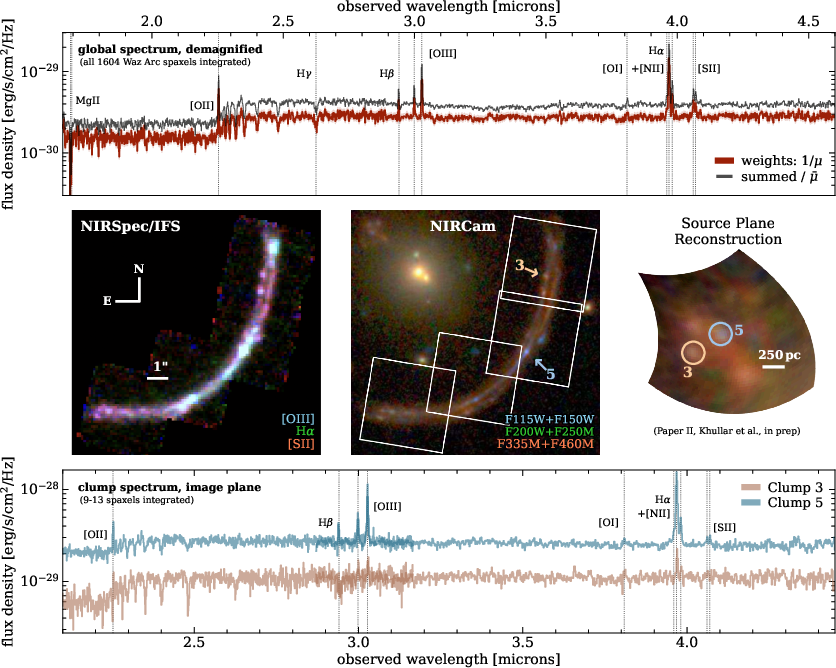
Figure 1: Global and spatially-resolved observations from JWST GO-2566 of COOL J1241+2219 (the "Waz Arc"), characterized as a post-starburst galaxy at z=5.
Dataset and Observational Strategy
The Waz Arc is currently the brightest known galaxy at z>5, with a stellar mass of approximately 1010 M⊙ and rest-frame UV brightness (zAB=20.5). The study utilizes JWST NIRSpec IFS data (medium-dispersion gratings), spanning four contiguous pointings to map the full arc. Complementary JWST/NIRCam imaging allows for robust SED fitting with spatially matched photometric apertures, yielding resolved star formation histories and robust corrections for stellar absorption features.
The spatial resolution achieved is ∼10–100 pc, enabling the dissection of individual star-forming clumps and quiescent regions otherwise inaccessible at these cosmological distances.
Correction of Stellar Absorption and Dust Attenuation
A critical methodological component is the correction for underlying stellar absorption in the Balmer series, which is essential in post-starburst environments dominated by A/B type stars. Population synthesis modeling via Prospector, leveraging aperture-matched NIRCam photometry, quantifies variable Balmer absorption across the arc, with rest-frame equivalent widths from −1 to −2 Å in Hβ and −5 to −6 Å in Hα, necessitating up to a 45% correction of nebular line flux in certain regions.
Coupled with Balmer decrement (Hα/Hβ) diagnostics, this enables a robust spatially-resolved mapping of dust attenuation, yielding median E(B−V)=0.44±0.14 and global E(B−V)=0.47±0.10.
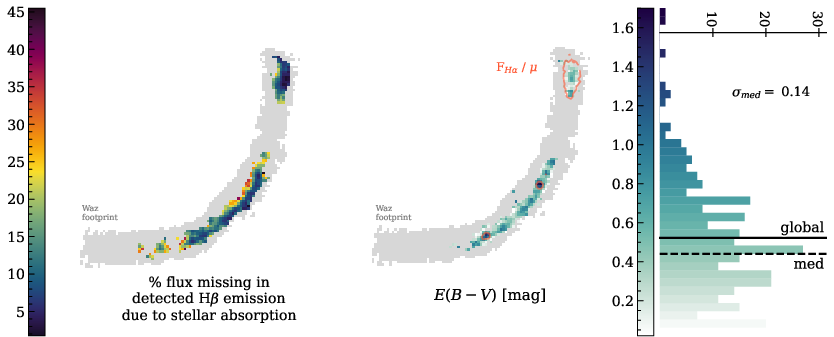
Figure 2: Left: Fraction of Balmer emission missed due to stellar absorption; Right: spatially-resolved E(B−V) after absorption correction.
Gas-phase metallicity maps utilize several strong-line diagnostics—N2O2, N2Hα, and R23—and incorporate the appropriate corrections for both dust and absorption. The median metallicity ranges from 12+log(O/H)=8.43 (N2O2) to $8.45$ (N2Hα), corresponding to ∼50%–54% of solar. The N2O2 diagnostic indicates a local spatial dispersion of ∼1.5 dex in metallicity, with systematic offsets between the star-forming clumps and the arc’s periphery.
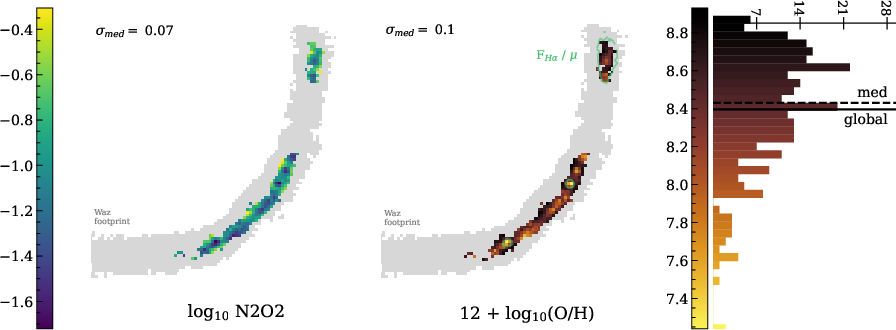
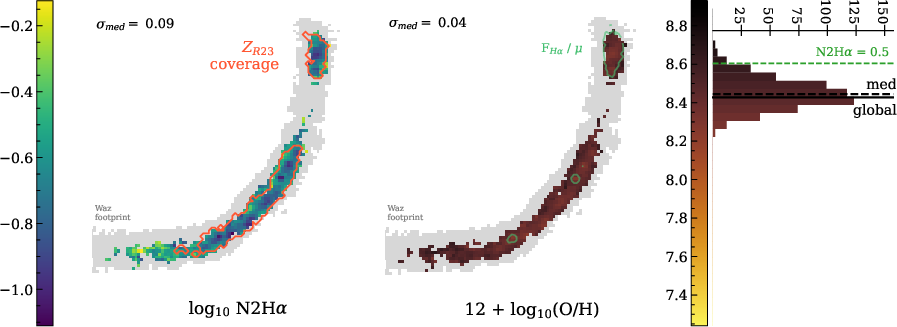
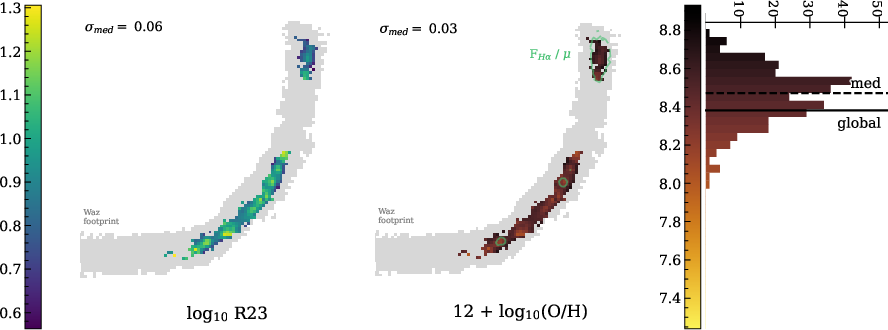
Figure 3: Three strong-line diagnostic metallicity maps illustrating both small-scale variations and overall global agreement.
Significantly, the central star-forming clumps manifest metallicities substantially lower than the arc-wide average, in contrast to canonical expectations for massive high-z galaxies. This is hypothesized to reflect either recent inflows of pristine gas or delayed N/O enrichment in ultra-young bursts.
Spatially-resolved mapping of SFR using both Hα and [O II] emission, fully corrected for attenuation as above, highlights low values everywhere in the arc, with global SFRHα=0.024±0.001 M⊙ yr−1 and the majority of spaxels below $1$ M⊙ yr−1. Only a handful of clumps approach this threshold. This, combined with strong Balmer absorption, unambiguously classifies the Waz Arc as a post-starburst system.
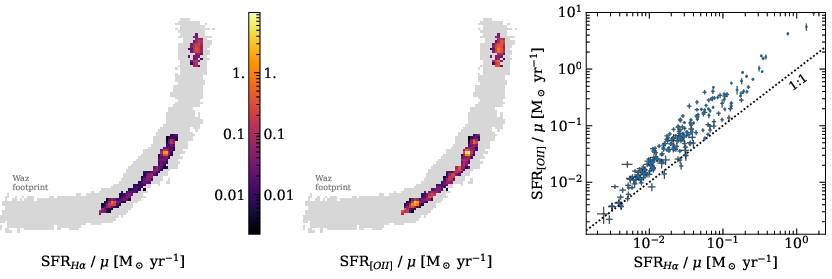
Figure 4: Instantaneous SFR maps and their correlation, demonstrating low SFR across the arc, with rare localized enhancements.
ISM Density and Ionization Structure
Nebular densities are measured from the [S II] 6717/6731 doublet, revealing significant spatial diversity: ne ranges from 102 to 103.5 cm−3 with a median density ne=540−360+1400 cm−3. In all cases, densities in star-forming knots are enhanced. Ionization parameters, traced by the O32 index ([O III]/[O II]) and calibrated as log10U, also display broad variation (up to 0.5 dex), but with central clumps typically less ionized than their surroundings—counter to starburst expectations.
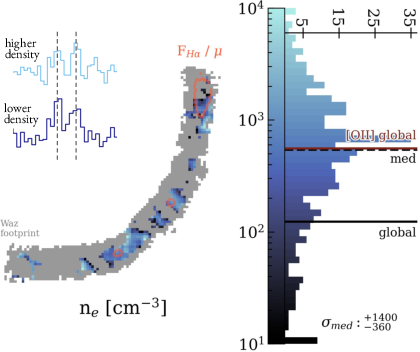
Figure 5: Spatially-resolved nebular density, with orange contours tracing the most actively star-forming regions.
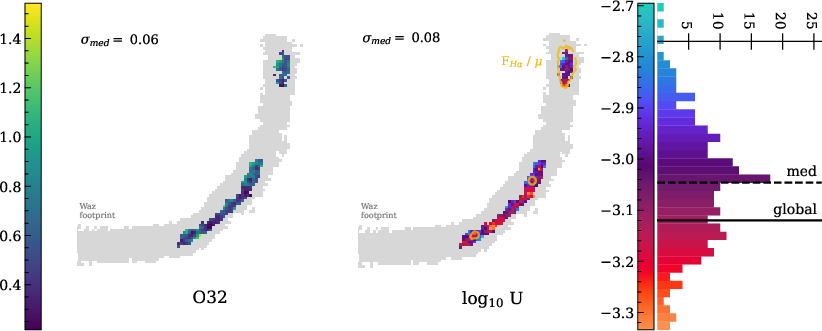
Figure 6: Ionization parameter map displaying spatial heterogeneity and lower U in star-forming clumps.
Diffuse Ionized Gas at High Redshift
A salient result is the spatial segregation of Hβ-bright and Hβ-sparse regions, the latter interpreted as evidence for diffuse ionized gas (DIG)—the first such indication at z>5. DIG-sensitive line ratios ([S II]/Hα, [N II]/Hα, [O I]/Hα) are systematically higher in Hβ-sparse regions. Additionally, resolved spectra in these zones exhibit distinct Mg II absorption line ratios, implying lower optical depths and supporting the DIG scenario.
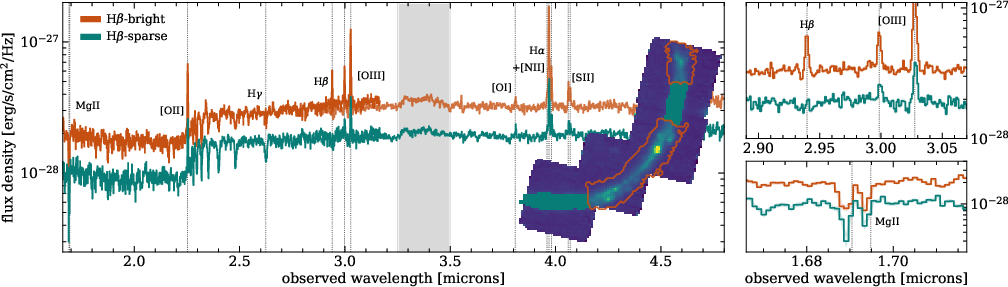
Figure 7: Comparison of -bright and -sparse regions, with stacked 1D spectra revealing DIG-like features in Hβ-sparse areas.
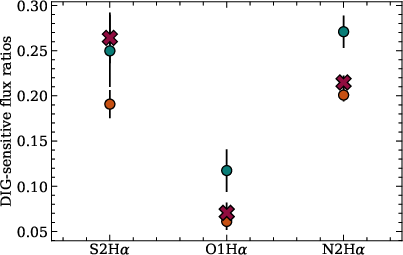
Figure 8: DIG-sensitive line ratio diagnostics, with -sparse regions distinctly enhanced in all three indicators compared to both -bright and global spectra.
Systematic Trends: The Value of Spatially-Resolved Diagnostics
Aggregate diagrams mapping ionization parameter versus density and metallicity at the spaxel level reveal that the global, integrated spectrum would mask considerable internal diversity and would not capture the physical decoupling of SFR, ne, and U seen in the resolved data.
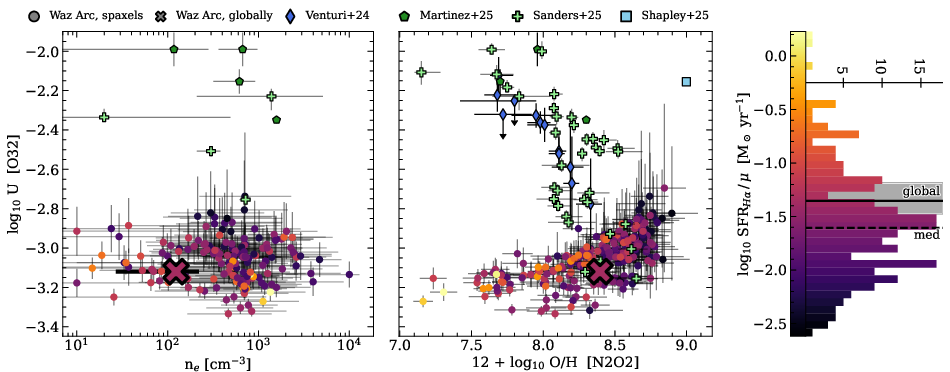
Figure 9: Correlation diagrams of logU vs ne and metallicity, with global (X) and resolved (circles) values illustrating the hidden spread absent from integrated measurements.
Theoretical and Practical Implications
The small-scale ISM heterogeneity and the spatial coincidence of low-metallicity, low-ionization, high-density clumps challenge the inside-out enrichment models and favor scenarios involving external gas accretion or inefficient mixing, in line with some recent cosmological simulations at z>4 [Graf.2025, Tapia-Contreras.2025]. The detection of post-starburst signatures and DIG in such a massive high-z system suggests rapid quenching and complex ISM thermodynamic histories, which need to be incorporated into both semi-analytic and hydrodynamical models of early galaxy formation.
Furthermore, the demonstrated necessity of robust corrections for stellar absorption and differential attenuation underscore the limitations of global-integrated line diagnostics in the early universe. Future surveys leveraging JWST, ELTs, and gravitational lensing will need to prioritize spatial resolution for accurate characterization of ISM and star formation properties.
Zoom-in studies of arc clumps at ≲100 pc scales reveal localized metallicity inversions—lower metallicity at clump centers increasing radially outward—which may indicate ongoing accretion of pristine material or chemical inhomogeneity from recent feedback or mergers.
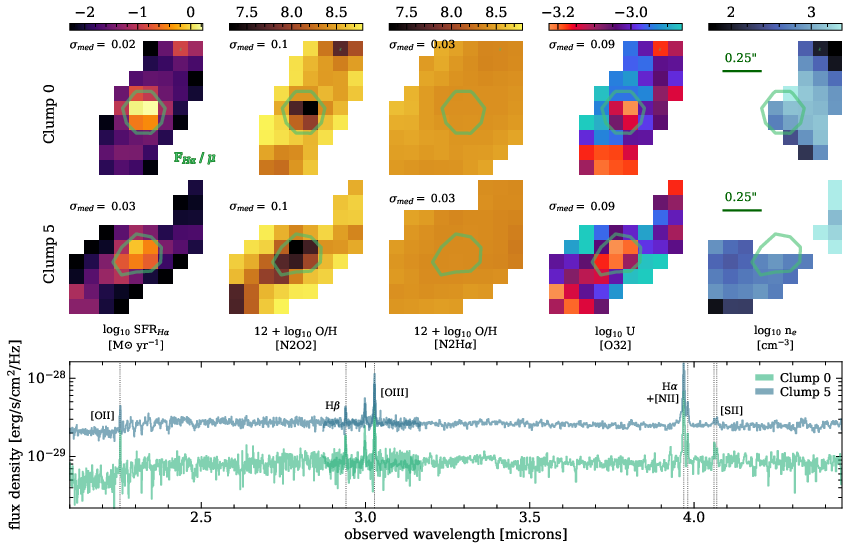
Figure 10: Resolved clump characterization, with spatially mapped ISM diagnostics and corresponding 1D spectra highlighting diversity at ≲100 pc scales.
Conclusion
Through the synergy of JWST/NIRSpec IFS and lensing magnification, this analysis recovers sub-kpc structure in the ISM, dust, and star formation of a z=5 post-starburst galaxy. Strong results include:
- Confirmation of extremely low global and local SFR, and a demographic transition toward quiescence.
- Observation of significant internal variation in metallicity (up to 1.5 dex), nebular density, and ionization that are otherwise averaged out in integrated measurements.
- The first direct observational evidence for DIG at z>5.
- Inversion of classical inside-out metallicity gradients in star-forming knots.
- Demonstration that spatially resolved diagnostics are necessary for accurate physical modeling of early galaxy evolution.
Theoretical models must assimilate the diversity and spatial decoupling of ISM properties presented here. Upcoming applications include systematically probing the incidence, energetics, and chemical structure of high-z post-starburst populations, as well as integration of ALMA and future ELT datasets to resolve gas and dust reservoirs on smaller scales.
(2512.02000)