- The paper identifies that GenAI chatbots achieve an 80.5% adoption rate, significantly displacing legacy tools in assisted writing and web search.
- It employs a multi-dimensional survey of 1,906 respondents to assess usability, literacy, and risk, revealing high substitution rates with traditional technologies.
- Findings highlight pronounced gender and age divides, with women and older users less likely to adopt, underscoring the need for targeted educational interventions.
Empirical Mapping of Generative AI Adoption, Literacy, and Digital Divides in Italy
Introduction
"Generative AI Practices, Literacy, and Divides: An Empirical Analysis in the Italian Context" (2512.03671) addresses the adoption and real-world usage of generative AI (GenAI) chatbots among Italian-speaking adults. Leveraging a sample of 1,906 survey respondents, the study delivers a multi-dimensional mapping of GenAI adoption, technology substitution, usage intents, literacy, and emergent sociotechnical divides. The analysis contributes to the scant body of evidence focused on non-English-speaking contexts, where both linguistic asymmetries and Italy's documented digital competence deficit drive the need for region-specific insight.
GenAI Chatbot Adoption and Technology Displacement
The findings reveal high GenAI chatbot adoption (80.5%), outpacing long-standing LTs such as voice assistants, and nearly reaching the saturation seen in machine translation tools. Platform market concentration is marked, as ChatGPT dominates with a 74.5% user share. Notably, GenAI is actively displacing existing tools: 44.4% of users report that GenAI chatbots have "completely" or "partially" replaced at least one other language technology, with significant shifts in the domains of assisted writing (44.3% replaced) and web search (39% replaced or partially substituted).
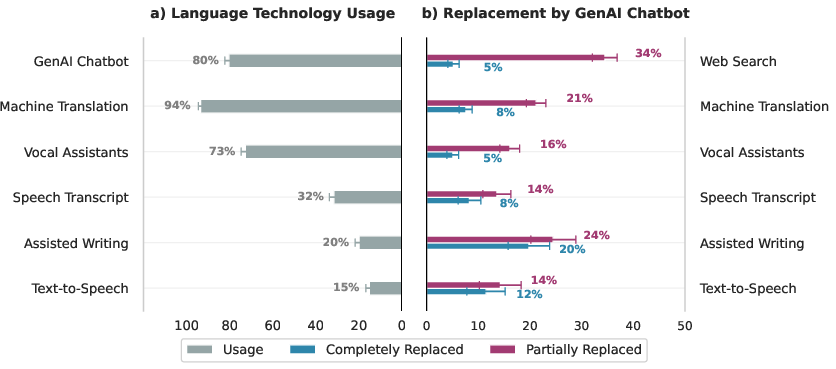
Figure 1: Language technology adoption and substitution, demonstrating GenAI chatbots' rapid prevalence and partial displacement especially in assisted writing and information retrieval.
Crucially, the drivers of adoption and substitution are not technical superiority, but rather usability and convenience. Flexibility and ease of access are cited by 68% as primary justifications for adopting GenAI at the expense of prior LTs, while trust, transparency, and perceived accuracy are secondary. This decoupling of adoption from literacy or trust exposes risk vectors related to user incapacity to evaluate model limitations or outputs correctly.
Usage Patterns and Multimodal Engagement
GenAI chatbots are integrated across a variety of work, study, and personal settings, with instrumental and companionate applications observed. Learning (mean usage frequency 2.1/3) and information retrieval (2.06/3) dominate, while leisure use, although less frequent, remains non-trivial with about 20% engaging monthly or more for non-utilitarian interaction. Users, on average, perform 5.73 distinct activities, with younger cohorts demonstrating the most diverse engagement and older cohorts experiencing both greater concentration and increased reliance for high-stakes tasks (e.g., medical advice, fact verification).
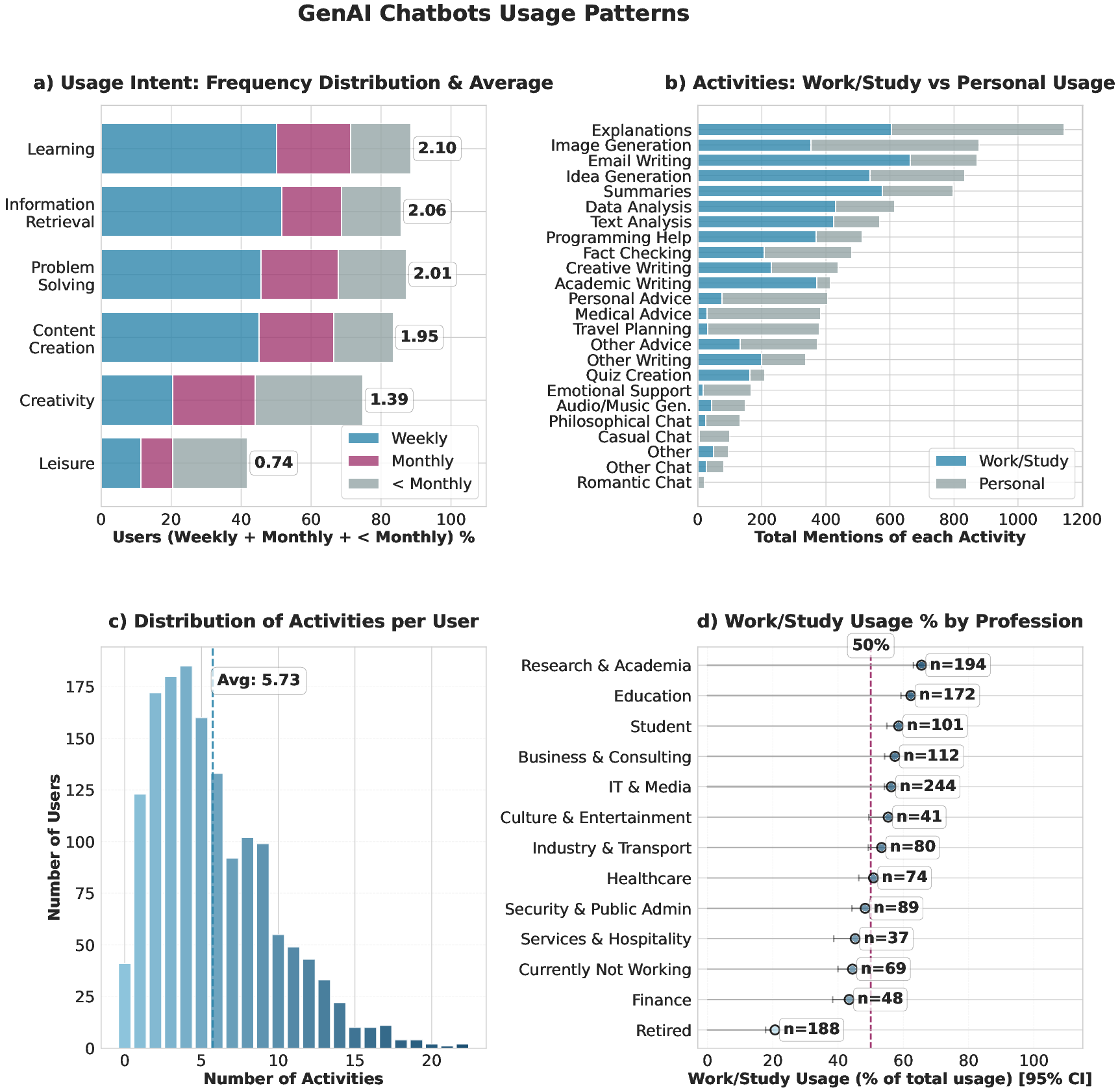
Figure 2: Usage intent and activity distribution, highlighting the breadth of application, the balance between work/study and personal use, and profession-specific patterns.
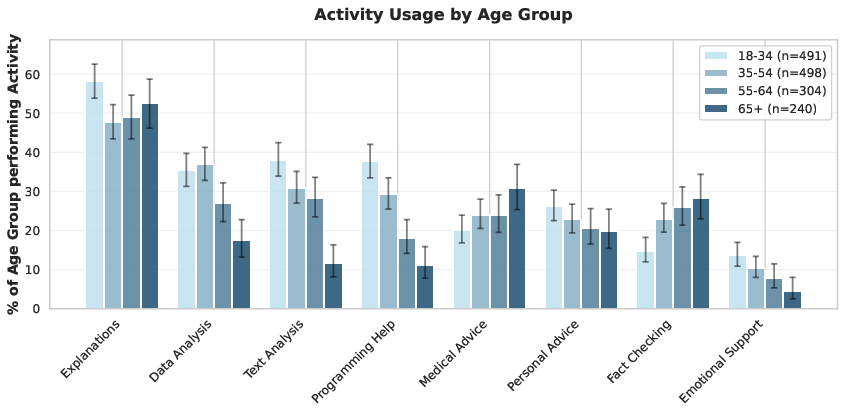
Figure 3: Age-group breakdown of activity engagement, confirming increased heterogeneity and technical engagement among younger users, with older cohorts engaging more in high-risk contexts.
Language and modality preferences show strong inertia: the vast majority prefer Italian, but a significant segment (52%) uses English, particularly for technical or work queries and where higher fidelity is perceived. Textual modalities are overwhelmingly preferred; privacy, control, and communication precision are positively attributed to written interaction, while voice is used sparingly.
Literacy, Risk Awareness, and Education Desiderata
Formal and informal education in language technology remains insufficient. Over half of GenAI users and over three-quarters of non-users report no prior training in language technology or AI tools. Self-reported LT literacy is low overall (mean score 0.23 on a −1.5 to +1.5 scale), with a pronounced generational gradient—older users systematically rate their competence lower, exacerbating their risk profile as GenAI adopters.
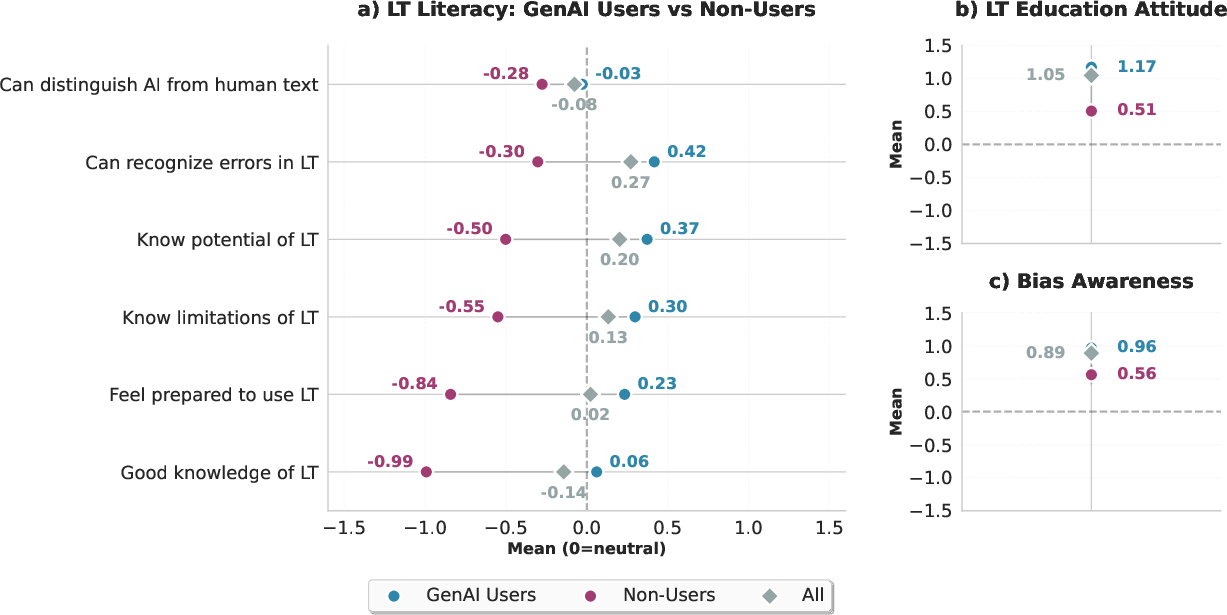
Figure 4: LT literacy differentials and attitudes, indicating statistically significant discrepancies between users and non-users and strong support among users for integrating LT education in curricula.
While awareness that GenAI can perpetuate bias is moderately high (users mean 0.96/2, non-users 0.56/2), operational ability to recognize errors or stereotyping lags (mean 0.27/2). Users frequently cite hallucination, legal/bureaucratic inaccuracies, and gender or ethnic stereotyping in open-ended responses. The gulf between recognition of abstract risk and concrete identification of problematic outputs is pronounced and suggests literacy interventions must move beyond generic awareness toward targeted, actionable skills.
Among non-adopters, lack of knowledge (40.7%) and perceived non-utility (26.3%) outstrip direct distrust or technical skepticism; most would consider adoption if support infrastructure and educational opportunities improved.
Sociotechnical Divides: Literacy, Demographics, and Gender
Odds ratio analysis reveals multiple axes of digital divide. Age and gender are the strongest negative predictors for adoption: controlling for all other factors, individuals 65+ are 80% less likely than 18-34-year-olds to use GenAI, and women are half as likely as men to adopt. Higher education and socioeconomic status predict higher odds of adoption (+48% and +73%, respectively). Importantly, each point of prior LT experience increases adoption odds by 72%, and self-assessed LT literacy exhibits an extremely high predictive odds ratio (20.8).
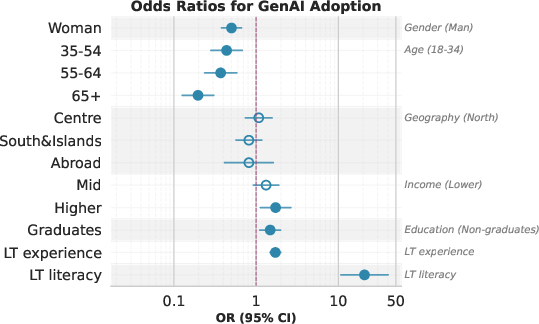
Figure 5: Odds ratios quantifying the magnitude of sociodemographic and literacy effects on GenAI adoption.
Post-adoption, the influence of age, SES, and education on usage frequency becomes intent-dependent and comparatively diffuse. Literacy remains highly correlated with most types of engagement, with the exception of basic information retrieval, where no relationship to prior literacy or LT experience is observed. This exposes low-literacy users to unmitigated risk through routine information querying.
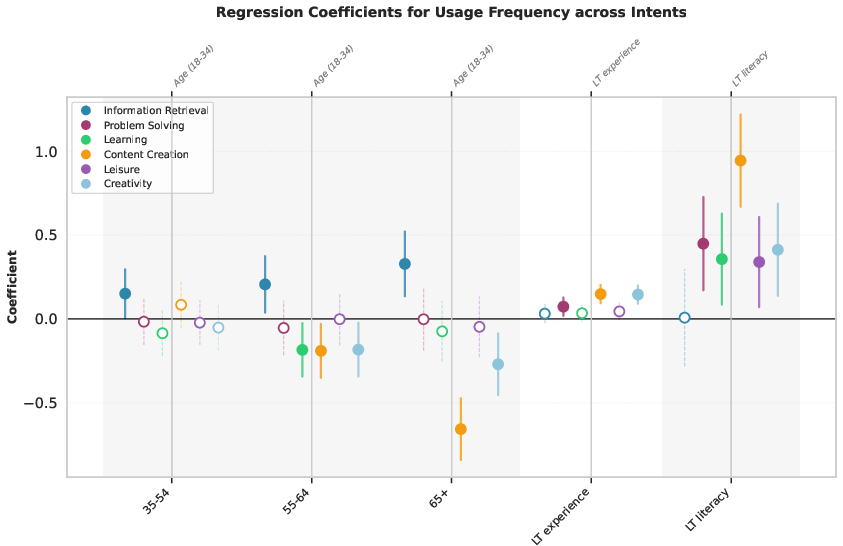
Figure 6: Regression model results quantifying heterogeneous impact of predictors on intent-specific usage frequency.
The gender divide is the most robust. Gender differences persist even after controlling for observable variables: women evidence lower adoption rates and, among adopters, use chatbots less frequently in all task domains. The largest effect is for problem solving (AME = -0.38 on a 0-3 scale), with the divide intensifying among older users—among those 65+, women are 13.5 percentage points less likely to adopt than men. Literacy, educational attainment, and socioeconomic status together explain only one-third of the observed adoption gap and less than a fifth of the usage frequency gap, indicating unmeasured social, psychological, or cultural influences.
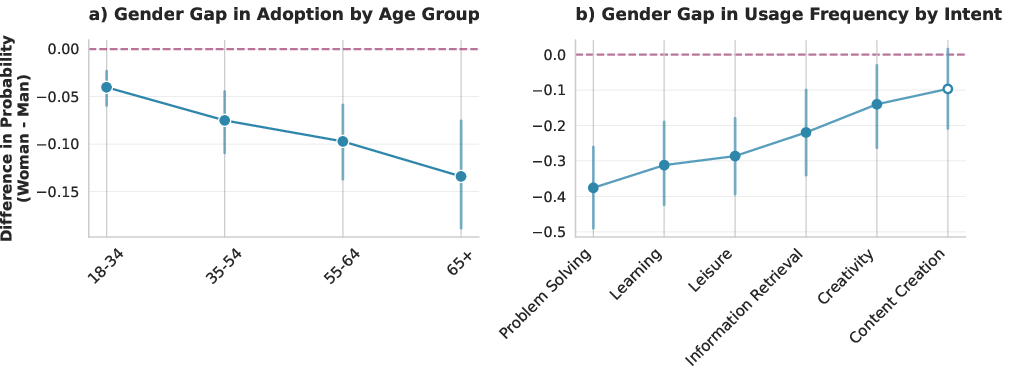
Figure 7: Gender gap marginal effects in chatbot adoption and usage frequency, with negative values denoting lower values for women.
Implications and Prospects
The findings signal an urgent need for targeted interventions. GenAI's velocity of adoption and its ongoing displacement of established digital technologies, especially for knowledge and support tasks, amplifies societal risk when not accompanied by commensurate literacy. Legacy digital divides (by age and SES) persist at the adoption threshold but dissipate for usage intensity except for the domain of gender, which remains an unresolved axis of inequality. The entrenchment of platform-specific interaction patterns (e.g., ChatGPT hegemony) may inadvertently reinforce epistemic inequality, particularly as user feedback loops and model refinement are increasingly dictated by a non-representative user pool.
From a practical perspective, educational strategies must differentiate between raising general awareness of GenAI risks/biases and developing discriminatory skills to detect and mitigate concrete harms. The observed "convenience over trust" paradigm creates especially salient risks in high-stakes domains (legal, medical, emotional support) where model hallucination and hidden biases have acute real-world consequences.
Theoretically, the finding that literacy and technical competence only partially mediate demographic divides underscores the need for intersectional, sociologically attuned research on technology adoption and engagement. Iterative, regionally diverse empirical mapping is required to monitor the evolution of divides as GenAI technologies become embedded in workflow infrastructure.
Conclusion
This study provides an extensive, statistically robust mapping of emergent GenAI practices, digital literacy, and divides in the Italian context. It highlights the velocity with which GenAI chatbots are supplanting prior information access tools, the centrality of usability as an adoption driver, the low penetration of effective literacy even among advanced users, and the persistence of significant gender-based and age-based divides not explained solely by measurable technical competence. Ongoing longitudinal data collection and targeted educational interventions are essential for minimizing asymmetric risk exposure and ensuring equitable societal benefit from GenAI advancements.