Exchange Symmetry in Multiphoton Quantum Interference
Abstract: Photons are bosons, and yet, when prepared in specific entangled states, they can exhibit non-bosonic behaviour. While this phenomenon has so far been studied in two-photon systems, exchange symmetries and interference effects in multi-photon scenarios remain largely unexplored. In this work, we show that multi-photon states uncover a rich landscape of exchange symmetries. With three photons already, multiple pairwise combinations are possible, where each pair of photons can exhibit either bosonic, fermionic, or anyonic exchange symmetry. This gives rise to mixed symmetry systems that are not possible to achieve with two photon alone. We experimentally investigate how these symmetry configurations manifest themselves in the observed interference of three photons. We show that multi-photon interference can be effectively turned on and off by tuning the symmetry of the constituent pairs. The possibility of accessing and tuning new quantum statistics in a scalable photonic platform not only deepens our understanding of quantum systems, but is also highly relevant for quantum technologies that rely on quantum interference.
Paper Prompts
Sign up for free to create and run prompts on this paper using GPT-5.
Top Community Prompts
Explain it Like I'm 14
What is this paper about?
This paper explores how light particles called photons can be made to act in surprising ways when they’re put into special quantum states. Normally, photons are “bosons,” which means they like to bunch together. But by cleverly arranging how multiple photons are prepared and mixed, the researchers show that groups of three photons can behave as if some pairs like to bunch (boson-like) while other pairs prefer to avoid each other (fermion-like). They test how these different “exchange symmetries” change the patterns we see when the photons interfere—basically, when their quantum waves overlap and affect where they end up.
What questions did the researchers ask?
They asked:
- Can we build a three-photon state where different pairs of photons have different swap behaviors (symmetries), like one pair acting bosonic and another acting fermionic?
- How does this mix of pairwise symmetries change the interference pattern we see at the output of a beam splitter (a device that splits and mixes light)?
- Can we “turn on” or “turn off” genuine three-photon interference just by tuning the symmetry of the state, without changing anything else?
How did they study it?
First, some simple ideas:
- Photons are bosons: they tend to “bunch,” meaning they like to end up together.
- Fermions (like electrons) are the opposite: they “anti-bunch,” avoiding each other.
- Exchange symmetry is what happens to a quantum state when you swap two identical particles. If nothing changes, it’s symmetric (boson-like). If the state flips sign, it’s anti-symmetric (fermion-like).
Photons don’t normally turn into fermions, but their overall symmetry can be “distributed” across different properties (degrees of freedom). Think of a photon as having:
- An internal label (here, its polarization: like horizontal H or vertical V), and
- An external label (which path it takes: path a or path b).
By entangling photons—linking their properties in a quantum way—you can arrange things so that the total three-photon state is bosonic (as it must be), but individual pairs within that trio can act bosonic, fermionic, or in between (anyonic-like). This can’t be done with just two photons—it needs at least three to mix pairwise behaviors.
What they built:
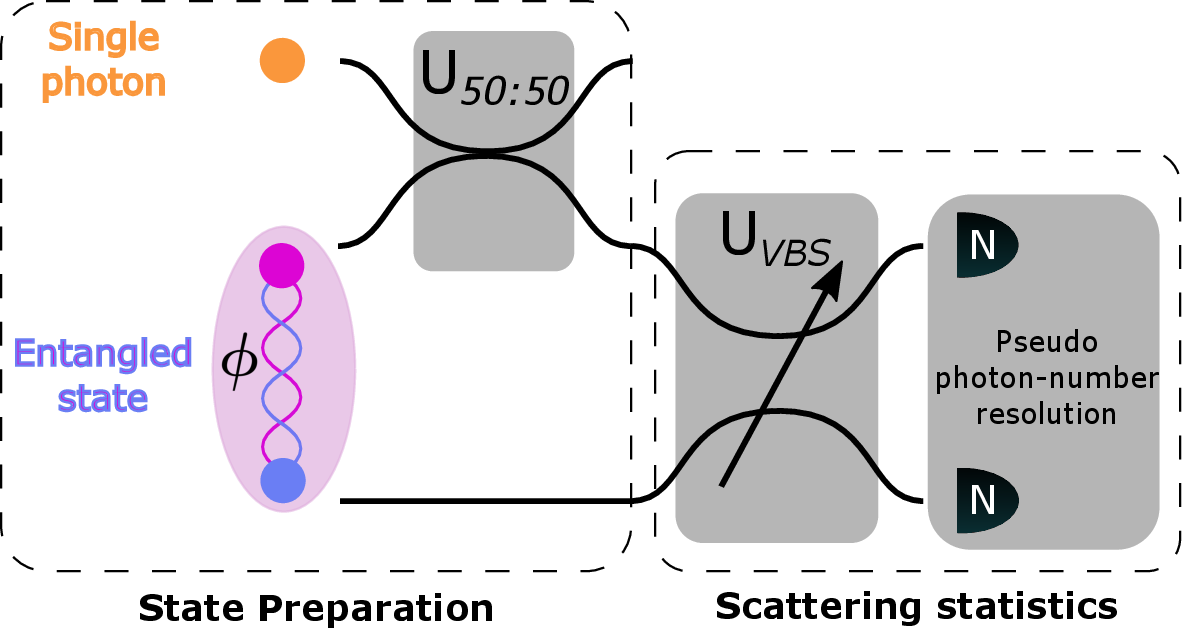
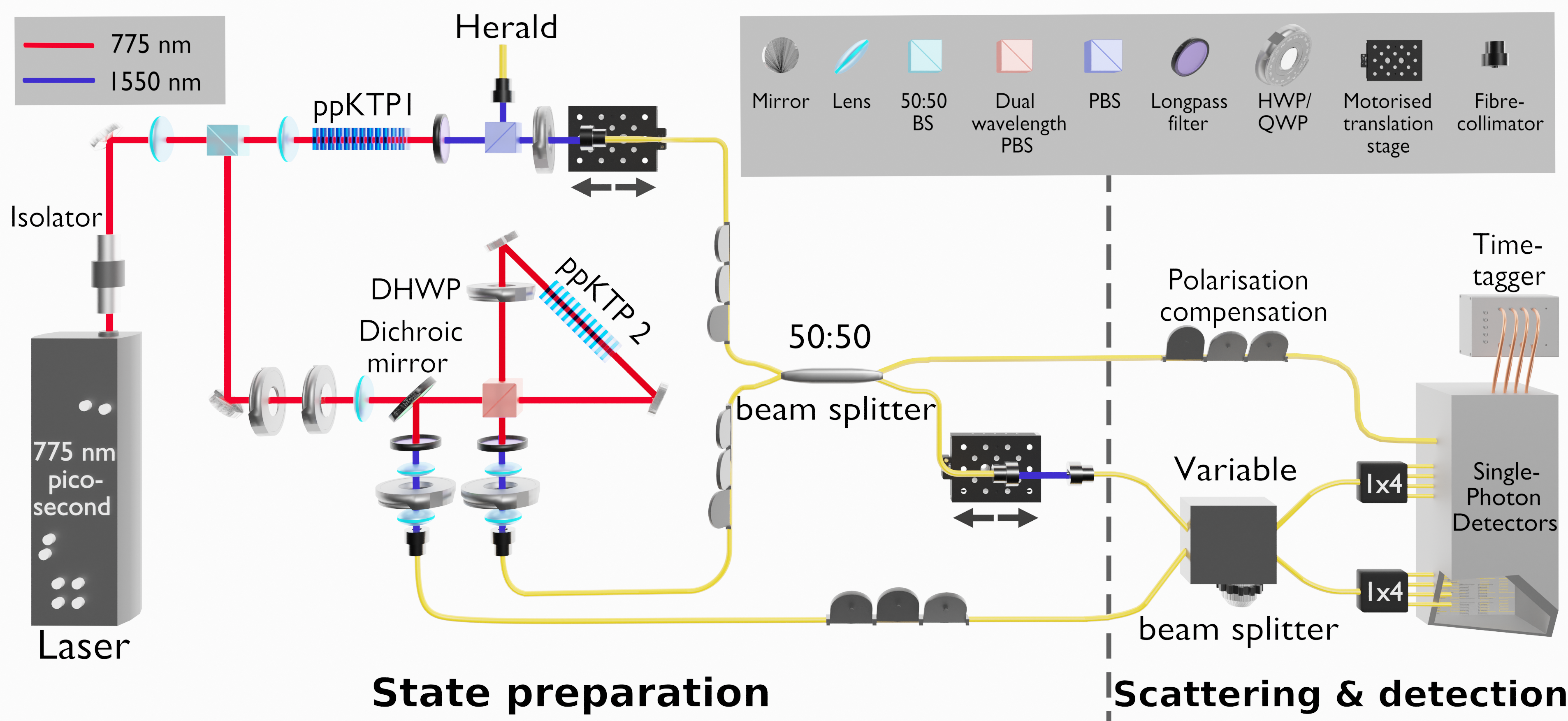
- They created a three-photon state by combining:
- A Bell pair (two photons entangled in polarization), and
- An extra single photon.
- They used a “variable beam splitter” (like an adjustable light mixer) to test how the photons scatter into two output paths.
- They added a “phase” knob (called φ, the Greek letter phi) that smoothly changes the state’s pairwise symmetry. You can think of φ as a dial that slides the system from “more symmetric” to “more anti-symmetric.”
- They recorded how often they detected 3-and-0, 2-and-1, or 1-and-2 photons at the outputs using very sensitive detectors.
How they checked for genuine three-photon interference:
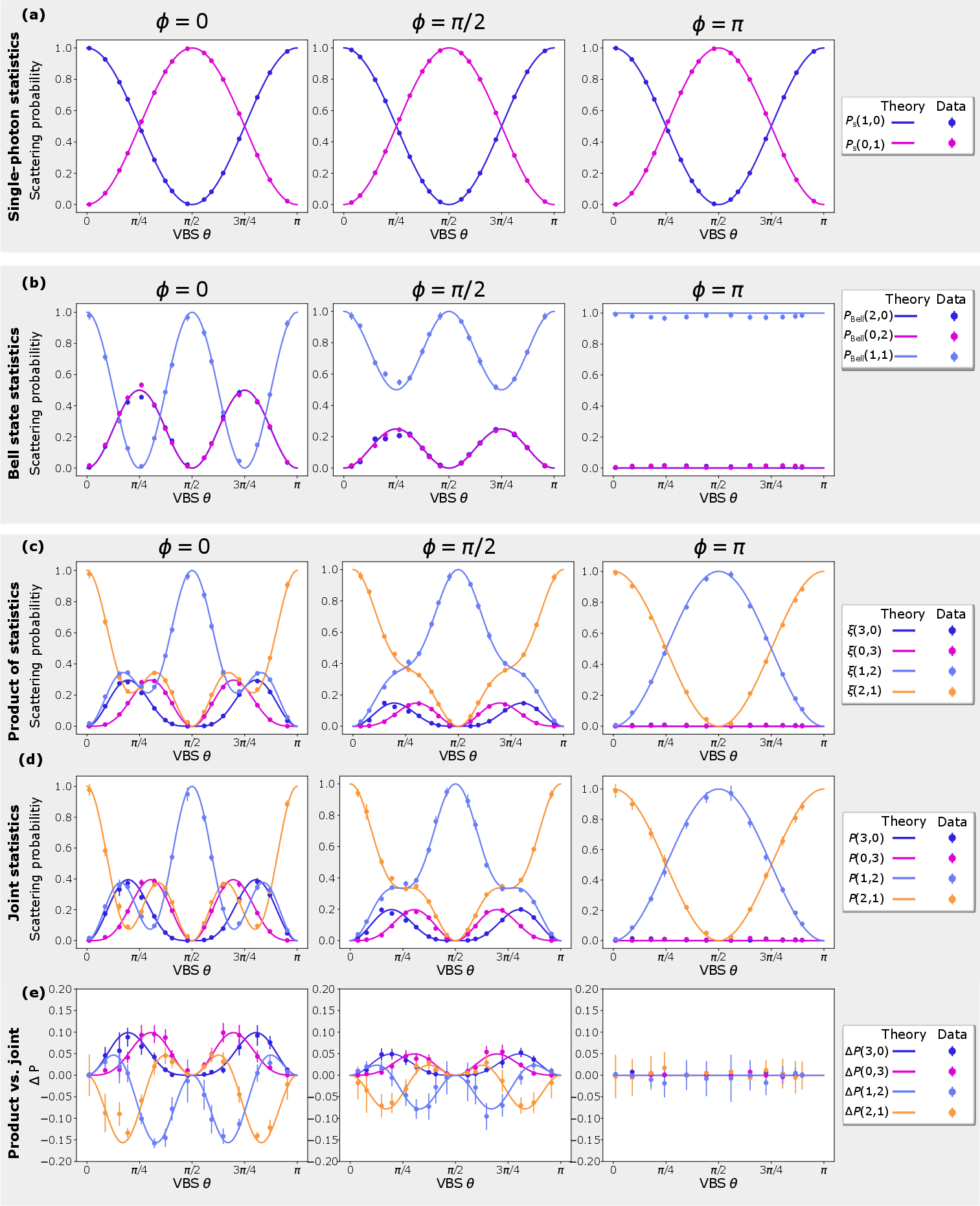
- If the three photons were not truly interfering as a trio, the results should look like “the product” of two independent things: the two-photon Bell pair’s scatter pattern times the single photon’s pattern.
- They compared the real three-photon results with this “product of separate results.” Any differences show genuine three-photon interference.
What did they find and why is it important?
By turning the symmetry dial (φ), they could control the interference:
- φ = 0 (fully symmetric pairs): Strong three-photon interference appears. The measured three-photon patterns differ a lot from the simple product of separate patterns. Fully bunched outputs (like all three photons in the same port) can occur.
- φ = π/2 (halfway): Medium effect. The differences are smaller but still present—some three-photon interference remains.
- φ = π (mixed symmetry): The state contains one symmetric pair and one anti-symmetric pair. The anti-symmetric pair always anti-bunches, which blocks “all-three-together” outcomes. Here, the measured three-photon results match the product of separate patterns. That means genuine three-photon interference is effectively turned off.
Why this matters:
- They showed you can switch multi-photon interference on and off just by tuning symmetry—without changing the photons’ energy or the device, only the state’s internal phase.
- They also uncovered new “mixed symmetry” behaviors that only show up with three or more photons, not with just two.
What could this lead to?
- Better control of quantum interference: Many quantum technologies—like quantum communication, sensing, and certain kinds of quantum computing—depend on precise interference between many photons. Being able to tune symmetry gives a powerful new control knob.
- Simulating exotic particles: Photons can be made to mimic particles with unusual statistics (like anyons) that are important for ideas in topological quantum computing and error correction.
- Scaling up: The approach is photonic (uses light), which is naturally scalable. With more photons or more internal states, researchers could explore even richer forms of quantum statistics and build new kinds of quantum simulators.
In short, this work shows that by cleverly arranging how three photons share their symmetries, scientists can control complex quantum interference effects—an important step toward more advanced and reliable quantum technologies.
Knowledge Gaps
Knowledge gaps, limitations, and open questions
Below is a focused list of what remains missing, uncertain, or unexplored in the paper, framed to guide future research.
- Limited to three photons and a single control parameter: The experiment tunes a single global phase φ to interpolate between one symmetric and one mixed-symmetry configuration. It does not explore the full space of pairwise exchange symmetries in three-photon systems (e.g., independently controlling symmetry for each pair, or realizing arbitrary representations of S3), nor does it address N>3 photons where richer irreducible representations and immanants arise.
- No direct measurement or reconstruction of immanonic contributions: Although the paper mentions “immanonic statistics,” it does not explicitly compute or reconstruct immanants of the unitary scattering matrix, nor does it link measured probabilities to specific S3 irreducible characters. A methodology to extract immanant weights (permanent/determinant/intermediate) from multiphoton data is missing.
- Anyonic claims lack braiding and topological context: The work invokes “anyonic exchange symmetry” via phase-tuned internal entanglement but does not implement actual particle exchanges or braiding operations that yield fractional statistics. A concrete mapping from the phase φ to an anyonic statistical angle (and its robustness to local perturbations) is not established.
- Restricted unitary dynamics (2-mode VBS only): Interference is probed exclusively with a tunable two-mode beam splitter. The effect of mixed exchange symmetry on interference in multiport interferometers, random linear optical networks (as in boson sampling), or general unitaries is not investigated.
- Product-of-statistics baseline needs formalization: “Genuine three-photon interference” is inferred from deviations between joint statistics and a product of single-photon and Bell-state statistics. A rigorous, quantitative witness (e.g., connected correlators, higher-order cumulants, or an interference visibility metric with confidence bounds) is not defined or validated.
- Lack of full φ sweep and systematic phase calibration: Experiments are reported at φ ∈ {0, π/2, π}; continuous phase scans, calibration of absolute φ, phase stability over time, and sensitivity analyses are not provided. This limits claims about continuously tunable exchange statistics.
- No polarization-resolved detection: The detection resolves only photon number per spatial mode; internal (polarization) degrees are traced out. How polarization-resolved detection would modify observed statistics, or allow direct verification of internal-external symmetry distribution, is not explored.
- Postselection-based state preparation and scalability: The three-photon state is prepared by postselecting successful addition at a 50:50 BS (success probability 3/8). The scalability of this approach to larger N (including resource overhead, success rates, and sampling biases introduced by postselection) is not addressed.
- Pseudo photon-number resolution may bias statistics: Demultiplexing to four SNSPDs per output port is used instead of true number-resolving detectors. Potential biases from splitting ratios, dead time, saturation, and channel imbalance are not quantified or corrected.
- Imperfections not fully modeled: Partial distinguishability, spectral mismatch (especially between independent sources), higher-order SPDC emissions, VBS hysteresis/drift, and detector effects are acknowledged but not incorporated into a quantitative error model to predict and correct their impact on scattering probabilities.
- No full state tomography: The prepared three-photon state (including the internal-external symmetry distribution) is not verified via quantum state or process tomography. A reconstruction would enable quantitative fidelity estimates and a direct test of the intended mixed symmetry.
- Pairwise symmetry not independently controllable: In a three-photon system, multiple pair exchanges can be tuned independently in principle; here, a single phase φ controls two terms simultaneously. A scheme to engineer independent pairwise exchange phases (including different symmetry per pair and cyclic exchanges) is absent.
- Unexplored alternative input states: The work focuses on a Ψ-type Bell state plus a single photon. The influence of starting from different two-photon entangled states (e.g., Φ±) or genuine three-photon entangled states (GHZ, W, Dicke) on accessible exchange symmetries and interference signatures is not studied.
- No analysis of losses and robustness: The sensitivity of three-photon interference signatures to losses, mode-dependent efficiencies, and decoherence is not quantified. Protocols to maintain or certify symmetry-controlled interference under realistic photonic network imperfections are missing.
- Application pathways not demonstrated: While relevance to quantum technologies is claimed, concrete applications (e.g., symmetry-gated entanglement generation, metrology gains, or advantages in photonic simulation tasks) are not implemented or benchmarked against conventional protocols.
- No exploration of higher-dimensional internal spaces: The theory mentions potential extensions to qutrits, but experiments are restricted to binary polarization. How higher-dimensional internal states affect symmetry partitioning and interference (including new mixed-symmetry classes) is left open.
- Absence of explicit group-theoretic decomposition: A systematic S3 (and, for N>3, Sn) representation-theoretic decomposition of the three-photon Hilbert space into symmetry sectors, with predicted interference patterns per sector, is not provided, limiting generalization and design of target states.
- Missing metrics for “on/off” switching efficacy: The extent to which tuning φ “turns off” multiphoton interference is not quantified via a robust metric (e.g., an interference contrast or hypothesis test), especially under realistic noise and distinguishability.
- No comparison to distinguishable-photon baselines: A control experiment with deliberately introduced distinguishability (e.g., temporal or spectral mismatch) to separate symmetry-induced effects from indistinguishability-induced interference is not performed.
- Scaling to integrated platforms and on-chip sources: The feasibility of realizing symmetry-tunable multiphoton states on integrated photonic chips with deterministic sources, stable phase control, and true number-resolving detectors is not addressed.
Practical Applications
Immediate Applications
Below are actionable use cases that can be deployed now or with minimal adaptation to current photonic labs and products. Each item includes sector relevance, potential tools/workflows, and feasibility notes.
- Stronger calibration and health checks for photonic interferometers
- Sectors: photonics hardware, test and measurement, telecom/quantum communications
- What: Use the “symmetry dial” (phase φ) to turn multi-photon interference on/off and isolate device errors (e.g., beam-splitter imbalance, phase drift, loss asymmetry). Compare joint statistics P(n,m) against product statistics ξ(n,m) as a diagnostic.
- Tools/workflows: Variable beam splitter (VBS) scan; automated fit of φ, θ from counts; acceptance thresholds for ΔP=ξ−P as a pass/fail.
- Assumptions/dependencies: Requires high visibility (>95%), pseudo-PNR detection, stable phase control, and repeatable VBS transfer matrices.
- Fast QA/benchmarking of entangled-photon sources and indistinguishability
- Sectors: photonics industry, quantum communications (QKD), R&D labs
- What: Use the φ-dependence of the fully bunched outcomes (P(3,0), P(0,3) ∝ cos²(φ/2)) as a sensitive metric for spectral distinguishability, Bell-state phase, and multi-photon quality beyond standard two-photon HOM tests.
- Tools/workflows: Routine source acceptance test that sweeps φ and VBS ratio; quality flags for source drift and higher-order SPDC contamination.
- Assumptions/dependencies: Narrowband filtering, SNSPDs, synchronized SPDC sources.
- On-bench verification of nonclassical interference in integrated photonics
- Sectors: semiconductor foundries (PICs), academic foundry shuttle programs
- What: Deploy three-photon symmetry-controlled experiments as a compact benchmark for complex linear optical circuits (transfer matrix validation, multi-mode balance).
- Tools/workflows: On-chip VBS elements; modular “symmetry tuner” input (single+Bell preparation) and automated count-analysis software.
- Assumptions/dependencies: Low-loss routing and thermal/EO phase shifters to control φ; fiber-to-chip coupling repeatability.
- Improved detector and system calibration via interference toggling
- Sectors: test and measurement, detector vendors
- What: Toggle genuine three-photon interference to separate detector nonlinearity and accidental coincidences from quantum correlations; calibrate pseudo-PNR demultiplexers.
- Tools/workflows: ΔP maps across θ, φ; per-channel linearity and crosstalk estimation.
- Assumptions/dependencies: Stable count rates; Poissonian statistics with known accidentals.
- Education and training modules that demonstrate exchange symmetry beyond bosons/fermions
- Sectors: education (university labs, online programs), EdTech
- What: Lab-in-a-box or remote lab experiments that show bosonic, fermionic-like, and mixed symmetry behavior using photons; emphasizes pairwise vs. multipartite exchange symmetry.
- Tools/workflows: Pre-built SPDC modules, VBS, wave plates, web-based count dashboards; lesson plans linking symmetry to interference outcomes.
- Assumptions/dependencies: Safe and maintainable hardware; clear learning analytics.
- Open-source analysis software for symmetry-aware multi-photon interference
- Sectors: software for scientific computing, quantum software tooling
- What: Libraries that compute and fit P(n,m)(φ,θ), compare P vs. ξ, estimate φ, and quantify “genuine multi-photon” signatures; device characterization and Bayesian parameter estimation.
- Tools/workflows: Python/Julia packages; Jupyter templates for lab integration; CI-ready test suites with synthetic data.
- Assumptions/dependencies: Accurate physical models of the VBS and detectors; community datasets.
- Rapid acceptance tests in quantum communications hardware
- Sectors: telecom/quantum communication (QKD vendors, systems integrators)
- What: Quick, in-factory verification that entangled sources and beam splitters behave as expected by scanning φ to enforce/forbid bunching.
- Tools/workflows: Turnkey “symmetry-scan” QC script; thresholds for deployment readiness.
- Assumptions/dependencies: Availability of compact, telecom-band sources and SNSPDs; environmental stability.
Long-Term Applications
These use cases require additional research, scaling, or integration (e.g., larger N, on-chip sources/detectors, true PNR). They indicate product and policy trajectories likely to emerge as the platform matures.
- Programmable statistics in photonic simulators (anyon/immanon emulation)
- Sectors: quantum simulation, materials science, academic research
- What: Use symmetry distribution across internal/external DOFs to emulate anyonic/immanonic statistics on scalable photonic chips; study topological phases and exchange-driven phenomena.
- Tools/products: “Symmetry-programmable” PICs with integrated sources, VBS meshes, true PNR detectors; simulation stacks handling immanants (beyond permanents/determinants).
- Assumptions/dependencies: Scaling beyond three photons; low-loss integrated platforms; verified control over multi-DOF entanglement.
- Verification-friendly boson sampling and photonic benchmarks with tunable symmetry
- Sectors: quantum computing, benchmarking/standards
- What: Engineer instances (via mixed symmetry) that retain quantum hardness but offer improved verification (e.g., by comparing P vs. ξ structure); create standardized benchmark suites.
- Tools/products: Reference circuits and datasets; cross-entropy/likelihood tools adapted to symmetry knobs.
- Assumptions/dependencies: Sufficient photon number and fidelity; community-accepted verification protocols.
- New gate primitives for linear-optical quantum computing via symmetry engineering
- Sectors: quantum computing (photonic platforms)
- What: Gates and gadgets that exploit controlled bunching/anti-bunching by pairwise symmetry to implement entangling operations, error detection, or post-selection with higher success probability.
- Tools/products: Compiler passes that target symmetry-conditioned transformations; libraries of symmetry-structured ancilla states.
- Assumptions/dependencies: Deterministic sources, low-loss processors, fast feed-forward, and PNR detection.
- Photonic networking/routing protocols leveraging symmetry-controlled collisions
- Sectors: quantum networking, data center interconnects (future)
- What: Use symmetry to deterministically route multi-photon states via controlled (anti-)bunching at nodes; collision-avoidance and multiplexing based on exchange symmetry.
- Tools/products: Reconfigurable network elements with embedded VBS meshes; symmetry-aware network control planes.
- Assumptions/dependencies: Robust phase control in the field; multi-node synchronization; loss-tolerant protocols.
- Quantum metrology and imaging that modulate multi-photon absorption via symmetry
- Sectors: sensing/metrology, biomedical imaging (long horizon)
- What: Enhance or suppress multi-photon absorption pathways by switching between symmetric and mixed symmetry components; reduce photodamage or boost signal in nonlinear regimes.
- Tools/products: Symmetry-programmable sources paired with nonlinear samples; adaptive control loops for symmetry selection.
- Assumptions/dependencies: Efficient generation of higher-N states at relevant wavelengths; interaction cross-sections that benefit from engineered statistics.
- Standards and certification for “symmetry controllability” in quantum photonic devices
- Sectors: policy, standards bodies, certification labs
- What: Define metrics, test suites, and certification marks quantifying symmetry control and its stability (e.g., minimum ΔP contrast over φ sweeps).
- Tools/products: Reference implementations, compliance tests, calibration artifacts.
- Assumptions/dependencies: Consensus across industry/academia on metric definitions; accessible reference hardware.
- ML-driven real-time control of symmetry and interference
- Sectors: software/AI for lab automation, advanced manufacturing
- What: Use ML inversion to infer φ, θ, loss, and distinguishability from streaming counts and actively stabilize devices to desired symmetry points that optimize task-specific figures of merit.
- Tools/products: Edge ML controllers, digital twins of photonic interferometers, reinforcement learning policies for drift compensation.
- Assumptions/dependencies: High-rate, low-latency detectors; reliable physical models and labeled datasets.
- Detector and integration roadmap: true PNR arrays and fully integrated symmetry engines
- Sectors: detector vendors, integrated photonics
- What: Transition from pseudo-PNR demultiplexing to scalable PNR arrays; integrate SPDC/quantum-dot sources, VBS networks, and SNSPD arrays on-chip for turnkey symmetry control.
- Tools/products: Cryo-compatible PIC stacks, superconducting integration, compact control electronics.
- Assumptions/dependencies: Fabrication maturity, cryogenic packaging, yield and uniformity.
- Scalable curricula and remote labs for workforce development
- Sectors: education, workforce training
- What: Standardized courseware and cloud labs that teach exchange symmetry and multi-photon interference using programmable experiments; credentialing for quantum photonics skills.
- Tools/products: MOOC modules, virtual labs with real hardware access, automated graders using P vs. ξ analytics.
- Assumptions/dependencies: Sustainable hosting of lab hardware; institutional partnerships.
Notes on feasibility across applications:
- Core dependencies include high-visibility (>95%) indistinguishability, phase-stable VBS control, low loss, and (eventually) true photon-number resolution.
- Scaling from three to N photons is essential for computational/simulation advantages; loss and drift become dominant at scale.
- Integration at telecom wavelengths (1550 nm) plus cryogenic SNSPDs is the most practical near-term path but adds system complexity.
- The analytical framework (explicit φ- and θ-dependent P(n,m) vs. ξ(n,m)) supports robust parameter estimation and is ready for software packaging today.
Glossary
- Anyonic exchange symmetry: Pairwise exchange behavior where particles acquire nontrivial phases, distinct from bosonic or fermionic cases. "With three photons already, multiple pairwise combinations are possible, where each pair of photons can exhibit either bosonic, fermionic, or anyonic exchange symmetry."
- Anti-bunching: A quantum-statistical effect where identical particles tend to avoid occupying the same mode. "identical fermions, constrained by the Pauli exclusion principle, exhibit anti-bunching"
- Beam splitter: A linear optical element that mixes two input modes into two output modes according to a unitary transformation. "the state $\ket{\psi^{-}_{ext}$ is an eigenstate of the transformation of a beam splitter and, therefore, remains unchanged upon passing through it."
- Bell basis: The set of four maximally entangled two-qubit states forming a complete basis for bipartite systems. "a possible basis for describing an arbitrary internal state is given by the Bell basis"
- Bell state: A maximally entangled two-qubit state, often used as a resource in quantum information protocols. "The Bell state is generated using a photon source based on spontaneous parametric down conversion (SPDC) in a Sagnac interferometer"
- Bosonic permanents: Matrix function arising in bosonic multi-particle interference amplitudes, contrasting with determinants for fermions. "generalised immanonic statistics that lie between bosonic permanents and fermionic determinants."
- Bosons: Particles with symmetric exchange statistics that permit multiple occupancy of the same state. "Photons are bosons, and yet, when prepared in specific entangled states, they can exhibit non-bosonic behaviour."
- Bunching: A quantum-statistical effect where identical bosons preferentially occupy the same mode. "identical bosons bunch together"
- Creation operator: Operator that adds a particle to a specified mode and internal state. "Note that the normalisation is absorbed in the creation operators acting on the same mode(s)."
- Eigenstate: A state unchanged (up to a phase) under a given operator’s action. "the state $\ket{\psi^{-}_{ext}$ is an eigenstate of the transformation of a beam splitter"
- Exchange symmetry: The symmetry of a multi-particle wavefunction under the exchange of identical particles. "Particles in nature are either bosons or fermions and have wavefunctions that are symmetric or anti-symmetric, respectively, under the exchange of two identical particles"
- Fermionic determinants: Matrix function associated with fermionic interference amplitudes due to anti-symmetry. "generalised immanonic statistics that lie between bosonic permanents and fermionic determinants."
- Fermions: Particles with antisymmetric exchange statistics that obey the Pauli exclusion principle. "Particles in nature are either bosons or fermions"
- Hong-Ou-Mandel interference: Two-photon interference effect yielding a dip in coincidence rates due to indistinguishability. "To check this, we performed Hong-Ou-Mandel interference using the VBS and estimated a visibility of "
- Immanonic statistics: Interference statistics interpolating between bosonic (permanent) and fermionic (determinant) regimes, governed by immanants. "generalised immanonic statistics that lie between bosonic permanents and fermionic determinants."
- Majorana fermions: Exotic quasiparticles with non-Abelian exchange statistics relevant to topological quantum computing. "theoretical models of particles with more exotic exchange statistics---such as those of anyons, and Majorana fermions---"
- Mixed symmetry: A multipartite state where some pairwise exchanges are symmetric while others are antisymmetric. "The resulting state, therefore, exhibits a so-called mixed symmetry (see Table~\ref{table:sym})."
- Multiphoton interference: Quantum interference effects arising from the indistinguishability and symmetry of more than two photons. "multiphoton interference can be harnessed to generate entanglement"
- Pauli exclusion principle: Quantum rule forbidding two identical fermions from occupying the same quantum state. "identical fermions, constrained by the Pauli exclusion principle, exhibit anti-bunching"
- Periodically poled potassium titanyl phosphate (ppKTP): A nonlinear optical crystal engineered for efficient frequency conversion, widely used for SPDC. "two spontaneous parametric down-conversion sources consisting of periodically poled potassium titanyl phosphate (ppKTP 1, ppKTP 2) crystals."
- Polarisation-entangled: Entanglement encoded in the polarisation degree of freedom of photons. "polarisation-entangled photon pairs with different symmetries in their spatial modes have been used to explore particle statistics going beyond those of bosons"
- Post-selection: Conditioning on certain detection outcomes to select desired quantum state realizations. "post-selecting cases where both photons end up in the same spatial mode"
- Pseudo photon number resolution: Approximate photon-number detection achieved by multiplexing onto several single-photon detectors. "to have pseudo photon number resolution."
- Qutrits: Three-level quantum systems generalizing qubits, enabling richer state spaces and statistics. "Extensions to larger multiphoton states, potentially qutrits, could facilitate the emulation of even more complex quantum systems"
- Sagnac interferometer: A loop interferometer producing bidirectional pumping for high-quality entangled photon generation. "The Bell state is generated using a photon source based on spontaneous parametric down conversion (SPDC) in a Sagnac interferometer"
- Superconducting nanowire single-photon detectors (SNSPDs): Ultra-sensitive single-photon detectors with low jitter and high efficiency. "four superconducting nano-wire single photon detector (SNSPD) channels"
- Spontaneous parametric down-conversion (SPDC): Nonlinear optical process generating correlated photon pairs from a higher-energy pump photon. "two spontaneous parametric down-conversion sources"
- Symmetrisation operator: Operator that enforces symmetric exchange under particle permutation. "the corresponding symmetrisation operator is given by {}"
- Unitary operator: An evolution preserving norm and inner products, describing lossless optical transformations. "when the state is evolved under some unitary and then measured."
- Variable beam splitter (VBS): A beam splitter with tunable splitting ratio, implemented as a unitary transformation. "a variable beam splitter (VBS), described by the transformation"
- Wavefunction: The complete quantum state encoding amplitudes over degrees of freedom and governing interference. "The overall symmetry of the wavefunction of bosons or fermions must be preserved."
Collections
Sign up for free to add this paper to one or more collections.