- The paper quantifies the excitation coefficients (Cₗₘₙ) governing gravitational wave ringdown amplitudes from ISCO plunges using Teukolsky and Sasaki-Nakamura formalisms.
- It reveals that overtones can surpass the fundamental mode in highly spinning Kerr black holes, offering a detailed mapping of spin and overtone dependence.
- Numerical validation demonstrates that excitation coefficients remain robust to variations in plunge conditions, bolstering waveform models for gravitational spectroscopy.
Excitation Coefficients for Ringdown from Equatorial Plunges in Kerr Black Holes
Introduction
This work ("Quasinormal ringing of Kerr black holes. III. Excitation coefficients for equatorial inspirals from the innermost stable circular orbit" (2512.07959)) presents a comprehensive theoretical and numerical treatment of the excitation coefficients Cℓmn, which govern the amplitudes of individual quasinormal modes (QNMs) in the gravitational wave ringdown signal from a Kerr black hole following the equatorial inspiral and plunge of a point particle from the innermost stable circular orbit (ISCO). The excitation coefficients depend critically on both the spacetime geometry (encoded by the remnant mass M and spin a) and the details of the progenitor dynamics. Precise quantification of these coefficients is vital for accurate waveform modeling and for gravitational spectroscopy of black holes. The analysis builds on and extends the frequency-domain perturbative formalism, leveraging closed-form solutions for critical plunge geodesics and advanced regularization procedures to deliver mode-resolved excitation data across the full span of Kerr spins.
The signal generated in a BH merger's ringdown phase is modeled as a sum over multipolar components and damped exponentials at discrete QNM complex frequencies ωℓmn, with amplitudes encapsulated in the excitation coefficients Cℓmn:
h(t,r,θ,ϕ)≃r1ℓ,m,n∑Cℓmn−2Sℓmaω(θ,ϕ)e−iωℓmn(t−r⋆)
Analytical construction of Cℓmn proceeds through a separation of variables via the Teukolsky formalism for gravitational perturbations in Kerr, subsequently transformed into the Sasaki-Nakamura (SN) formalism to handle asymptotic boundary conditions efficiently. The SN approach further facilitates the evaluation of Green's function contributions from QNMs using analytic continuation and contour integration in the complex frequency plane. The excitation coefficients are split into a source-independent excitation factor Bq and a source-dependent regularized integral Iq.
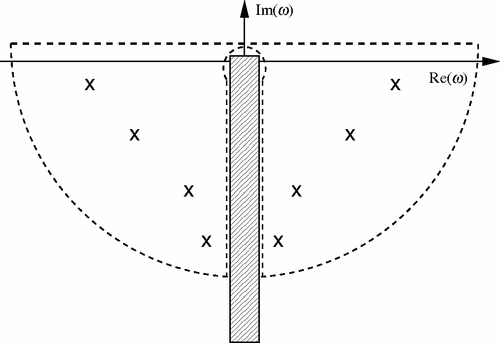
Figure 1: Integration contour in the complex ω-plane, isolating pole contributions from QNMs and excluding branch cut effects.
The critical plunge geodesics from the ISCO provide closed-form expressions for the relevant Kerr geodesics, enabling a precise specification of the source term for the Teukolsky equation. The regularization of the divergent integral Iq is handled by contour modification and subtraction of surface terms, extracting physically meaningful excitation data at null infinity.
To validate the calculated excitation coefficients, the SN waveform is constructed both using the full Green's function method and as a sum over QNMs with numerically determined Cq. Systematic comparisons confirm the accuracy of higher-overtone coefficient calculations, particularly in the regime where t−uLR≳5M, with mode sums converging to the Green's function waveform as additional overtones are included.
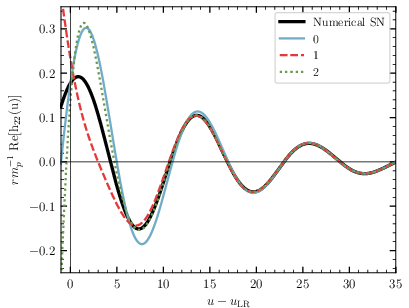
Figure 2: Comparison of the real part of the full SN function with mode superposition including successive overtones; improved agreement with addition of n=1,2.
Dependence of Excitation Coefficients on Spin and Overtone Structure
A principal result is the detailed mapping of Cℓmn as a function of black hole spin a/M for dominant and subdominant modes. For ℓ=m=2, the fundamental mode (n=0) is maximally excited for moderate spins (a/M≲0.994). However, as a/M→1, overtone (n>0) excitation can surpass the fundamental, implying increased detectability of overtones for highly spinning remnants.
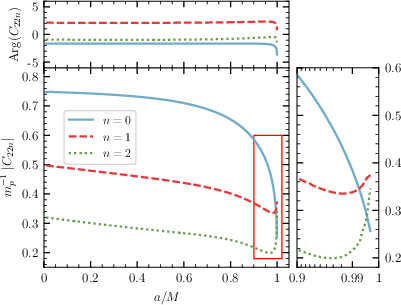
Figure 3: Absolute value and phase of Cq for ℓ=m=2, n=0,1,2 across a/M. Overtone amplitudes exceed the fundamental for a/M≳0.994.
The trajectories of Cq in the complex plane exhibit increased sensitivity to spin near extremality (a/M→1), both for the amplitude and phase, signifying a regime where small changes in spin yield substantial changes in ringdown morphology.
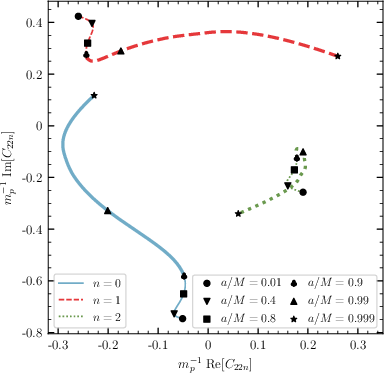
Figure 4: Trajectories of Cℓmn in the complex plane as a/M varies, highlighting rapid variation near extremality for all overtone indices.
Mode excitation for higher multipoles (ℓ=m=3,4) and overtones (n=1) also demonstrates monotonic or non-monotonic dependence on a/M, with overtone crossings prominent in the near-extremal regime. The amplitude and phase evolution imply that mode selection in the gravitational wave signal is highly sensitive to remnant spin for astrophysically relevant systems.
Robustness to Plunge Starting Point and Transition Modeling
The critical plunge geodesics from the ISCO yield excitation coefficients that are only mildly sensitive to the initiation radius or orbit parameters, particularly for small mass-ratio systems. Tests varying the angular frequency of the starting point demonstrate sub-percent level variation in C220 for moderate changes, supporting the use of critical plunge models as effective proxies in GW template calibration.
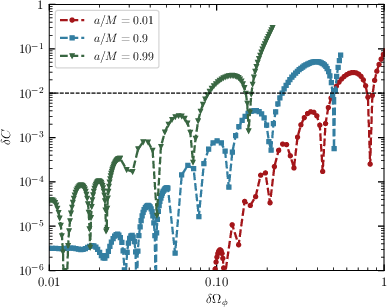
Figure 5: Relative variation δC for C220 as a function of changes in plunge orbital frequency; excitation coefficients are robust to order-unity variations far from ISCO.
Astrophysical and Theoretical Implications
The explicit mapping of ringdown excitation as a function of spin and overtone index has direct implications for gravitational wave data analysis, signal extraction, and black hole spectroscopy. For LISA and third-generation detectors poised to observe high-SNR mergers of supermassive black holes, the enhanced excitation of overtones in highly spinning remnants increases prospects for multimode ringdown detection and precision tests of the Kerr hypothesis. The results also propose an origin for nonlinear mode interference and possible gravitational turbulence in regimes with strong overtone excitation [Ma:2025rnv, Redondo-Yuste:2023seq]. For waveform modeling, the point-particle excitation model provides a benchmark for validating numerical relativity, effective-one-body, and self-force transition-to-plunge templates, informing future improvements in parameter estimation and waveform generation.
Conclusion
This work offers a rigorous frequency-domain analysis of QNM excitation coefficients for particles plunging from the ISCO of a Kerr black hole, resolving the dependence of Cℓmn on spin, overtone, and multipole structure, and demonstrates the increasing importance of higher overtones and multipoles as the remnant approaches extremality. These findings are integral to enhancing the fidelity of gravitational wave ringdown models and unlocking the potential for detailed spectral characterization of black hole mergers in both current and upcoming GW observatories (2512.07959).