- The paper presents analytical evaluation of one- and two-loop quantum corrections using spectral zeta regularization in confined geometries.
- It finds that the Elko field yields a Casimir energy density four times that of a real scalar, highlighting enhanced quantum vacuum effects.
- The study reveals that boundary-induced topological mass shifts can trigger vacuum instabilities and phase transitions in coupled field systems.
Vacuum Energy and Topological Mass in Interacting Elko and Scalar Field Theories
Introduction
The manuscript "Vacuum Energy and Topological Mass in Interacting Elko and Scalar Field Theories" (2512.08750) provides a technical investigation of planar Casimir geometry for a composite quantum field system: the Elko fermionic field (mass-dimension one) coupled to a real scalar via a quadratic (Yukawa-like) interaction, supplemented by scalar self-interaction, with Dirichlet boundary conditions for both fields. This work is motivated by the unique mass dimension and Lorentz-violating structure of Elko fields, their relevance to dark matter, and their limited renormalizable couplings, which favor interaction with scalar degrees of freedom.
The analysis employs the Euclidean path integral formalism, focusing on the evaluation of the effective potential, the associated renormalization program, and analytic determination of one- and two-loop quantum corrections, including induced topological mass terms and first-order interaction shifts. Notably, this setup allows an explicit assessment of how quantum vacuum energy and boundary-induced mass corrections can manifest in systems containing exotic fermionic sectors with suppressed Standard Model couplings.
Model Definition and Quantum Effective Potential
The field content consists of an Elko spinor η and a real scalar φ. The full Euclidean action encompasses the free terms, a quartic scalar interaction, and a quadratic Elko-scalar coupling: S=SElko+Sscalar+Sint,
where the interaction is Sint=−g∫d4xφ2ηˉη. Both fields are imposed to satisfy Dirichlet BCs at z=0 and z=L (see Figure 1 for the geometry).
(Figure 1)
Figure 1: Planar geometry with two parallel, perfectly reflecting plates at z=0 and z=L. Both the Elko field and the scalar field satisfy Dirichlet boundary conditions.
The effective potential is constructed via the background field method, expanding fields about constant background values. The tree-level potential includes standard mass terms, the quartic and the Yukawa-like scalar–Elko interaction, with renormalization counterterms. The nontrivial quantum corrections—particularly under nontrivial BCs—are captured at one- and two-loop order.
The one-loop terms are written via functional determinants, mapped to generalized spectral zeta functions built from the eigenvalue spectra determined by the BCs. Notably, the Elko one-loop determinant is traced over a 4×4 spinor space, enhanced by a factor of four relative to the scalar case, and twice that of the Dirac field. This difference, confirmed by canonical quantization (Appendix), is a key numerical result that distinguishes Elko vacuum energies in confined geometries.
One-Loop Corrections and Spectral Zeta Regularization
The eigenvalue spectra for both Elko and scalar fields are quantized by the BCs—so, for a slab of width L, the z-direction spectrum is discrete, while spatial momenta parallel to the plates remain continuous. Explicitly, the eigenvalues for the Elko field are
Λn=kτ2+kx2+ky2+(nπ/L)2+ME2
with ME2=mE2+gΦ2.
By evaluating the path integral determinants via zeta function techniques, the authors express the one-loop effective potential in terms of modified Bessel (Macdonald) functions Kν, with sums over the BC quantization indices. After renormalization, the L-dependent parts contribute to the physical Casimir energy, while bulk and divergent self-energy terms are absorbed in counterterms.
The combined renormalized one-loop potential thus yields for the vacuum energy per unit area (after evaluating at the trivial vacuum): AE=LVeffren(v)=π2LmE2n=1∑∞n−2K2(2nmEL)−8π2LmR2j=1∑∞j−2K2(2jmRL)
This gives the explicit Casimir energy for the coupled system. Crucially, the Elko contribution is four times that of a real scalar with identical mass. The behavior of the total dimensionless vacuum energy E(mRL) as a function of mRL for fixed mEL is shown in Figure 2.
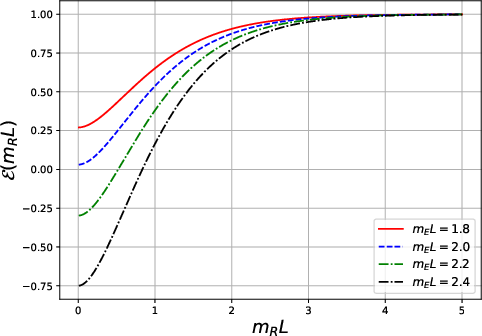
Figure 2: Dimensionless vacuum energy E(mRL) as a function of mRL for various mEL values, illustrating the dominance of the Elko contribution for large mRL.
Two-Loop Corrections and Interaction-Driven Vacuum Effects
The authors compute leading two-loop (first order in couplings) corrections via their corresponding Feynman diagrams and renormalized spectral zeta functions, focusing on scalar quartic and Elko-scalar cross-interaction effects. The explicit formulas contain products of sums over Bessel functions, which encode all information about the influence of the boundary and the plate separation.
In the massless scalar limit, the expressions reduce to known results, but for the Elko field, nonlocality leads to a singular massless limit, consistent with the peculiar structure of Elko quantum theory.
Topological Mass Generation and Boundary-Induced Instabilities
A central theoretical result is the explicit formula for the boundary-induced "topological mass" for each field. These mass corrections are computed from second derivatives of the renormalized effective potential with respect to the appropriate background fields, capturing both self-interaction and cross-interaction effects.
For the Elko field, the topological mass shift is
mT2=mE2+4π2LgmRj=1∑∞j−1K1(2jmRL),
a strictly positive correction (Figure 3).
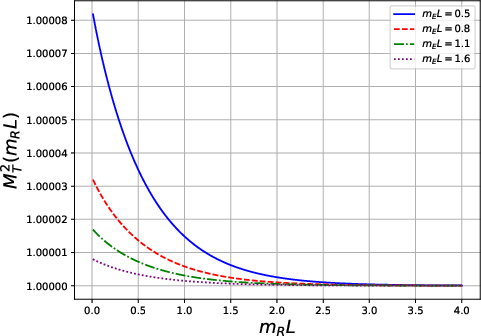
Figure 3: Behavior of the Elko topological mass squared MT2(mRL) as a function of mRL for various mEL and g=10−3, illustrating the growth of the mass shift with coupling and the rapid asymptotics.
For the scalar, the topological mass can be driven negative by the Elko-scalar coupling,
mT2=mR2−π2L2gmEn=1∑∞n−1K1(2nmEL)+8π2LλφmRj=1∑∞j−1K1(2jmRL)
Depending on the relative size of g and λφ, this correction can become negative, signaling possible vacuum instability or boundary-induced symmetry breaking—see Figure 4 for phase structure.
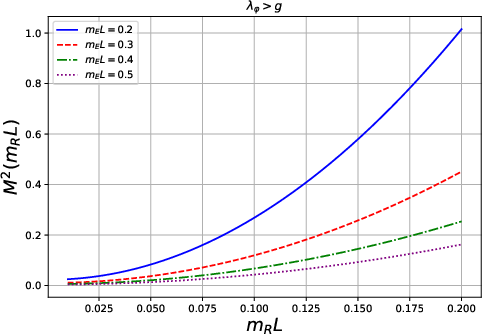
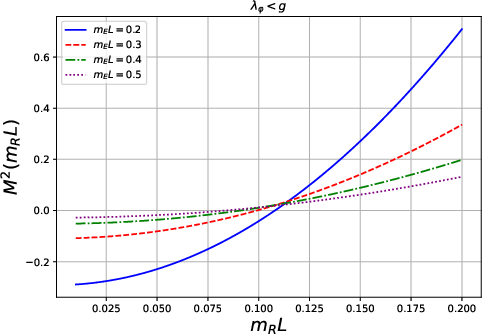
Figure 4: (Left) Scalar topological mass squared for dominant self-coupling (g≪λφ) remains positive; (Right) Larger g/λφ allows for negative mass shifts, indicating possible instability or a transition to a nontrivial vacuum.
Discussion and Implications
This analysis establishes several key results for quantum field theories with non-standard fermions in confined geometries:
- Casimir Enhancement: The Elko field yields a Casimir energy density per area four times that of a real scalar, a numerically strong result and twice the Dirac case, offering a precise statement for the benchmark scenario of mass-dimension-one fermions under Dirichlet BC. This difference is confirmed at both path-integral and canonical quantization level.
- Boundary-Induced Masses: Topological masses generated by boundary conditions and field interactions shift the physical spectrum; for the Elko, this yields positive-definite corrections, while for the scalar field, boundary-induced corrections can destabilize the vacuum depending on coupling strengths, indicating a novel mechanism for boundary-driven phase transitions unrelated to thermal effects.
- Vacuum Structure and Multiple Minima: The effective potential with interplay between Elko bilinears, scalars, and their interactions admits potentially richer vacuum structures with the possibility of multiple minima and metastable points, dependent on the values of L, coupling strengths, and field masses.
- Elko Phenomenology Relevance: As Elko fields are candidates for dark matter due to their suppressed Standard Model couplings and unusual transformation properties, the present analysis shows they can still produce sizeable boundary quantum effects. These quantum vacuum characteristics may have indirect phenomenological implications in, e.g., astrophysical or high-precision condensed matter or nanotechnological setups where boundary physics is relevant.
- Numerical Analysis: The strong dependence of all results on the plate separation L suggests measurable departures from standard Casimir effects when boundaries are probed at scales inverse to the field masses, and that dark-sector fields, generically "invisible" in bulk, may be indirectly constrained by boundary-sensitive observables.
Conclusion
The paper advances the theoretical understanding of quantum vacuum properties in multiplet field systems featuring non-standard fermions, by quantifying the intricate interplay of geometry, boundary conditions, and interaction via spectral methods. The analytical determination of both Casimir energy and induced mass corrections for the Elko-scalar system under Dirichlet BCs demonstrates both quantitative enhancement in vacuum contributions from Elko and qualitative new phenomena (instability, multiple vacua) accessible in the topological mass sector.
Future research directions include systematic vacuum stability analysis beyond perturbation theory, generalization to finite temperature and curved manifolds, and an explicit mapping to physical setups in which such induced boundary effects could serve as indirect signatures of Elko or dark-sector dynamics.