- The paper demonstrates that photoionization by hard X-ray photons, rather than collisional excitation, is the dominant mechanism for Fe Kα emission during the UX Arietis superflare.
- It utilizes simultaneous FUV and X-ray observations, revealing a 1.4-hour delay between the nonthermal FUV peak and the thermal X-ray peak, in line with the Neupert effect.
- 3D Monte Carlo radiative transfer modeling constrains flare loop geometry and latitude, providing critical insights for future high-resolution spectroscopic campaigns.
Clarifying the Origin of the Stellar Fe Kα Line in UX Arietis Superflare through FUV and X-ray Observations
Introduction and Background
The Fe Kα fluorescence line in the 6.4–6.6 keV band is an established diagnostic of coronal geometry and near-surface ion physics during solar and stellar flares. Its emission mechanism, however, remains ambiguous: both photoionization by hard X-ray photons and collisional ionization by nonthermal electrons can excite neutral or mildly ionized iron. This paper presents high-significance evidence, derived from simultaneous far-ultraviolet (FUV) and X-ray observations of a superflare on the RS Canum Venaticorum-type binary UX Arietis, that supports a photoionization-dominated mechanism (2512.09750).
Observational Campaign and Data Characterization
Simultaneous coverage of FUV (Hisaki/EXCEED, 900–1480 Å) and X-ray (NICER, 0.2–12 keV) bands was achieved during an energetic superflare sequence on UX Ari. The event registered a total release of 2×1036 erg in FUV and 3×1036 erg in soft X-rays. The flare light curve exhibits a canonical impulsive phase followed by exponential decay. Notably, the FUV emission peaks 1.4 hours preceding the soft X-ray peak, fulfilling a Neupert effect scenario and distinguishing the timing between the nonthermal electron-related energy release (FUV proxy) and thermal coronal response (soft X-rays).
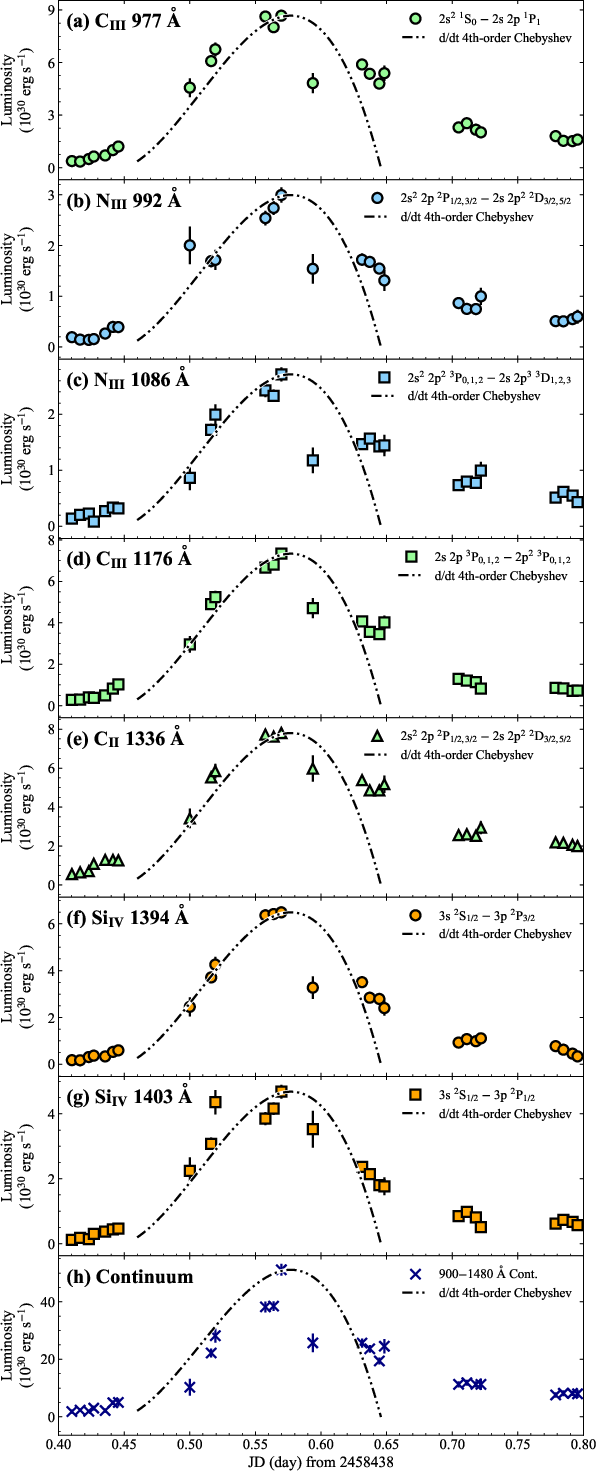
Figure 1: Time evolution of luminosity among FUV emission lines and continuum, illustrating Neupert-type correlation with the derivative of the soft X-ray light curve.
Spectroscopic Identification of the Fe Kα Line
High-resolution NICER spectra, analyzed across flare intervals, reveal the presence of strong Fe lines: collisional excitation of highly ionized iron (Fe XXV Heα at 6.7 keV, Fe XXVI Lyα at 6.9 keV) and the low-ionization Fe Kα core at ∼6.4 keV. The Fe Kα line attains 5.3σ statistical significance with equivalent width 67−20+28 eV at the flare's thermal X-ray maximum. Residual analysis and matched-filtering methods decisively exclude coincident nonthermal electron signatures as the principal excitation channel.
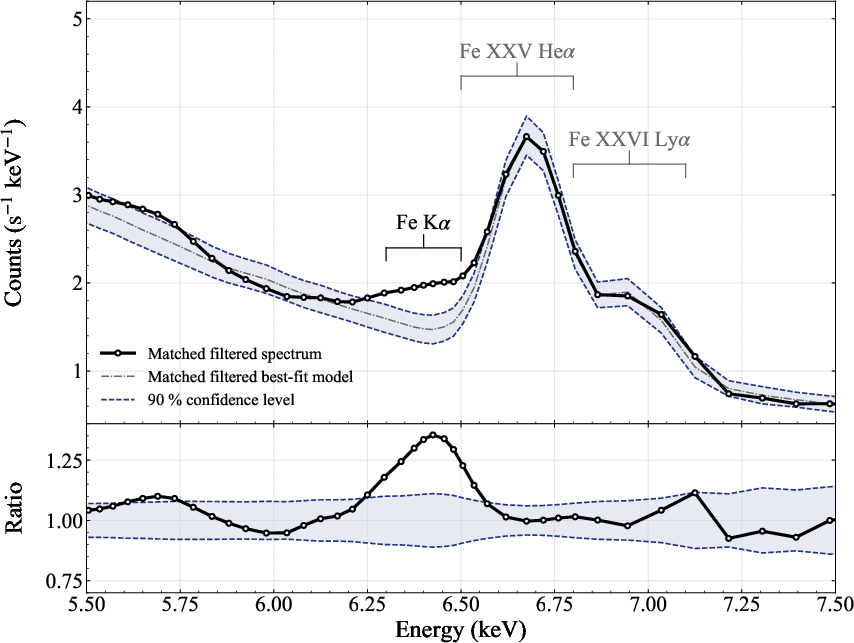
Figure 2: Matched-filtering reveals Fe Kα emission as an outlier in significance, decisively ruling out false-positive continuum fluctuations.
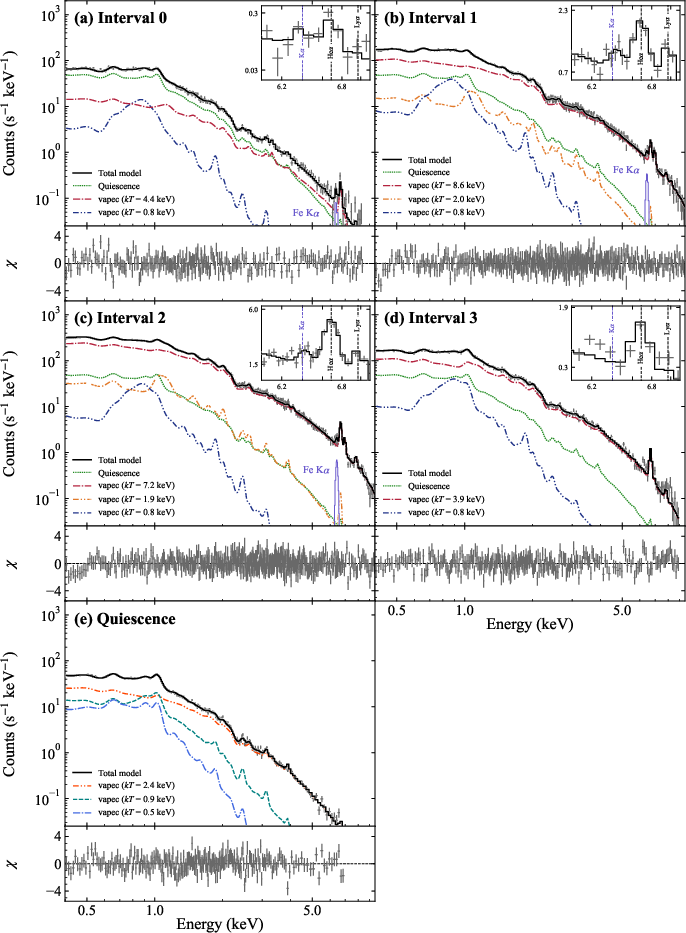
Figure 3: X-ray spectra show discrete Fe Kα, Fe XXV Heα, and Fe XXVI Lyα line evolution across flare phase intervals.
Temporal and Physical Disambiguation of Excitation Mechanism
A key result is the simultaneous peaking of Fe Kα line flux with the thermal coronal X-ray emission, rather than the earlier nonthermal FUV peak. The characteristic atomic timescales for K-shell excitation/emission (10−12–10−9 s) invalidate any significant temporal lag, implying that Fe Kα is responsive to the contemporaneous coronal X-ray photon flux and not to the impulsive-phase electron population or associated nonthermal processes.
Radiative Transfer Modeling and Geometric Diagnostics
3D Monte Carlo radiative transfer simulations (SKIRT v9.0) were conducted to quantify the dependence of Fe Kα equivalent width on flare geometry. The model incorporates photoexcitation, Compton scattering, and fluorescence efficiency over a range of flare loop heights and observer inclination angles. The observed equivalent width is reproduced for loop lengths lSY=1−3 R⊙ and specific inclination regimes, supporting the photoionization scenario. The diminishing equivalent width with increasing loop height confirms geometrical dilution effects and aligns with radiative transfer theory.
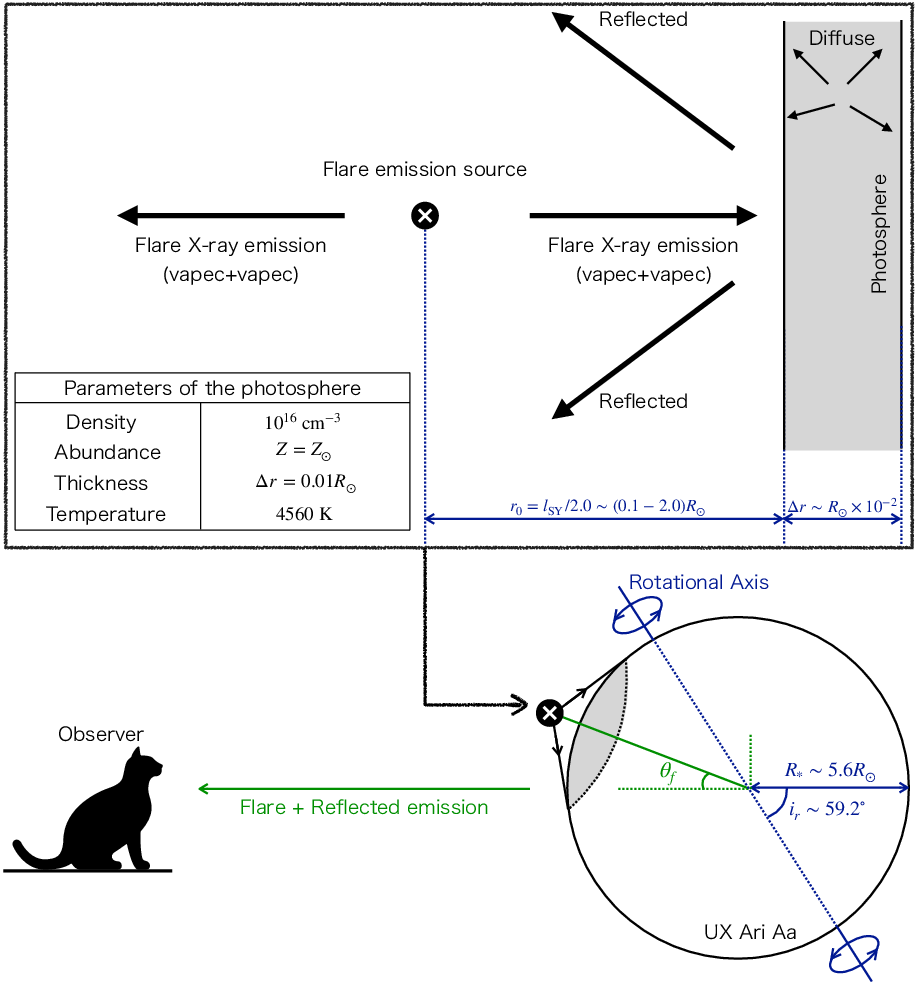
Figure 4: Schematic of SKIRT simulation setup, demonstrating incident X-ray irradiation of the photosphere from a coronal point source.
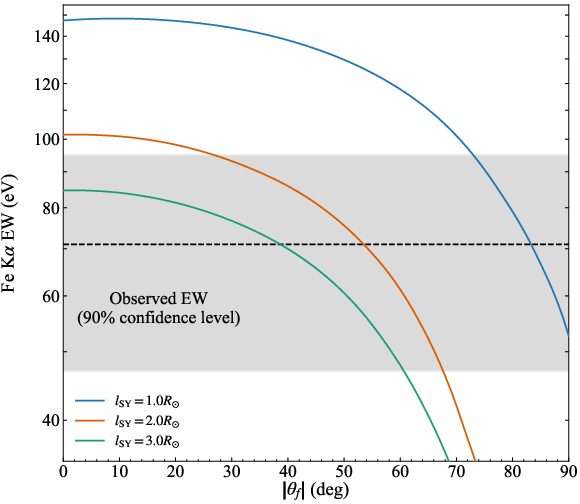
Figure 5: Comparison of calculated versus observed Fe Kα equivalent width as a function of flare-observer inclination angle θf for several loop heights, constraining flare geometry and latitude.
Implications for Stellar Flare Diagnostics
The robust link between Fe Kα line intensity and simultaneous thermal X-ray emission invalidates the collisional excitation scenario in the context of this flare, contradicting prior ambiguous results for M-dwarf and RS CVn-type systems. The explicit modeling presented enables constraint of flare loop size and latitude, a critical variable in quantifying surface irradiation, flare energetics, and space weather impacts on planetary systems. These methods provide a template for future high-resolution (e.g., XRISM) spectroscopic campaigns, with promise for constraining directionality and CME diagnostics.
Conclusions
The results provided by this multiwavelength campaign constitute a conclusive demonstration that photoionization by hard X-ray photons is the dominant origin of the Fe Kα fluorescence line during stellar superflares of RS CVn-type binaries. The precision timing, line significance, and modeling permit constraints on flare geometry and flare latitude, opening avenues for advanced diagnostics with upcoming calorimeter missions. These advances are critical to developing quantitative models of stellar-coronal mass ejections, exoplanetary space weather, and stellar magnetic field generation.