- The paper introduces simultaneous classical and quantum communications (SCQC) to multiplex shared spectral resources, reducing hardware redundancy in multi-band wireless networks.
- It details DV and CV-based protocols with experimental validations, achieving secure transmission distances of up to 583 km (DV) and 487 km (CV) under optimal conditions.
- Key challenges identified include data rate–key rate imbalance, thermal noise management, and the need for advanced quantum hardware in THz regimes.
Simultaneous Classical and Quantum Communications: Progress, Architectures, and Open Challenges
Integration of Quantum Communications in Multi-Band Wireless Networks
The paper delineates the imperatives driving the integration of quantum communication functionalities within future wireless networks, premised on the anticipated evolution toward Space-Air-Ground Integrated Networks (SAGIN). With the emergence of quantum computing, classical cryptographic mechanisms are threatened, motivating systemic transformations that embed quantum key distribution (QKD) and other quantum protocols directly into the communication infrastructure. The SAGIN vision exploits a heterogeneous mix of classical and quantum communications via layered links spanning microwave, millimeter-wave (mmWave), terahertz (THz), and free-space optical (FSO) bands. This multi-band and multi-layered strategy is aimed at maximizing connectivity, resilience, and quantum-enhanced security.
A fundamental bottleneck in current infrastructures arises from the need for separate transceiver architectures to support classical and quantum signals. Such duplication is prohibitive when constrained by size, weight, power, and cost (SWaP-C), especially for UAVs and Low-Earth Orbit (LEO) satellites. Consequently, the paper explicates the rationale and emergent solutions for simultaneous classical and quantum communication (SCQC), where a single transceiver and shared spectral resources multiplex both signal types.
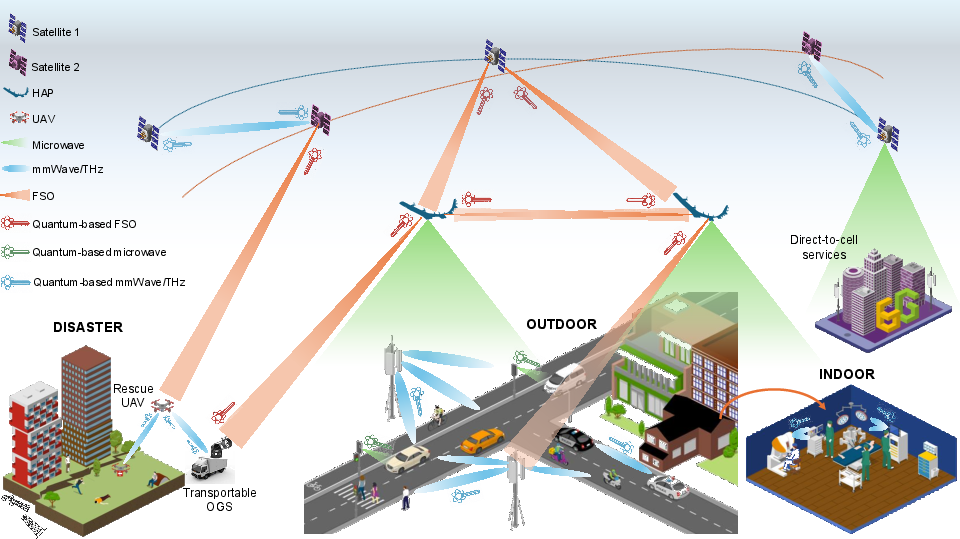
Figure 1: Schematic of simultaneous classical and quantum communications illustrating use across various frequency bands and network tiers in future wireless architectures.
System Architectures and Protocols for SCQC
The distinction between coexistent classical and quantum communications (CCQC) and SCQC protocols is systematically articulated. CCQC relies on strict division, allocating classical and quantum signals to separate time slots, wavelengths, or frequency bands, entailing duplicate hardware and reduced spectral efficiency. In contrast, SCQC employs signal overlap—classical and quantum information are jointly modulated and transmitted on the same pulse—drastically reducing hardware redundancy and enabling operation within rigid SWaP-C constraints at the cost of heightened design and security complexity.
Within FSO and optical fiber networks, two main SCQC paradigms are developed:
- Discrete-Variable (DV)-based SCQC/QSDC: Utilizes one-way quantum secure direct communication (QSDC), whereby quantum states transmit encrypted classical messages while enabling secret key extraction from measurement results. This achieves both encryption and key renewal with the same quantum channel, with demonstration over standard fiber links exceeding 100 km, supporting practical payload rates for text, images, and voice (see [Pan et al., Sci. Adv., 2025]).
- Continuous-Variable (CV)-based SCQC: Embeds classical and quantum data on coherent states, with classical information encoded via phase-shift keying and quantum information as Gaussian-modulated quadrature variables. Homodyne or heterodyne detection and phase correction at the receiver enables joint decoding. Experimental implementation over 25 km fiber underscores practical readiness ([Qi, Phys. Rev. A, 2016]).
The feasibility of these protocols is analyzed for LEO satellite-to-ground FSO downlinks, accounting for real atmospheric impairments, path losses, and misalignment effects. Robust, composable key rate frameworks are used to evaluate security under finite-size blocks and coherent attacks.
(Figure 2)
Figure 2: Secure key rate and operational altitude for SCQC with DV QKD in satellite-to-ground FSO channels.
(Figure 3)
Figure 3: Corresponding performance of SCQC with CV QKD, highlighting maximum secure altitudes and classical rates.
For DV-based SCQC, positive key rates are attainable up to 583 km (asymptotic) and 305 km (with N=109 block size). CV-based SCQC achieves 487 km (asymptotic), decreasing to 276 km for similar block sizes. Notably, payload and mutual information rates increase at shorter operational distances due to superior SNR. While DV QKD outperforms in secure distance due to noise tolerance, CV QKD delivers superior spectral utilization and compatibility with existing telecommunication hardware.
SCQC’s applicability in the mmWave and THz regimes is complicated by steep frequency-dependent atmospheric attenuation and burgeoning background thermal noise.
(Figure 4)
Figure 4: Altitude-dependent atmospheric gas attenuation indicating practical operating windows for microwave, mmWave, and THz channels.
The analysis demonstrates that, while the microwave band (1–30 GHz) supports long-range links (~28 km) with minimal attenuation, mmWave (30–300 GHz) and THz (>300 GHz) require precise spectral placement to avoid excessive molecular absorption—transmission becomes infeasible in much of the THz band for distances exceeding 1 km under ground-level conditions.
Additionally, thermal photon number increases sharply as frequency decreases—posing an insurmountable obstacle for DV-based protocols at room temperature and challenging even for CV QKD. Cryogenic operation can suppress thermal noise, but such requirements limit mobile or non-terrestrial deployments.
(Figure 5)
Figure 5: Mean thermal photon number as a function of frequency and temperature, highlighting critical thermal noise penalties for sub-THz SCQC.
Outstanding Research Problems
Three key open issues essential for widespread SCQC adoption are elevated:
- Data Rate–Key Rate Disparity: The classical data throughput in SCQC can vastly outpace quantum key generation. In DV-based schemes, the requirement of an OTP for each data bit creates a bottleneck unless the key can be continuously renewed; CV-based schemes face receiver-limited bandwidth constraints. Addressing these imbalances will require advances in high-speed quantum photonics and efficient error-correcting schemes.
- Thermal Noise and Hardware Integration at Lower Frequencies: For microwave/mmWave SCQC, thermal background photons at ambient temperatures preclude feasible DV-QKD, rendering even CV approaches difficult without advanced, integrated photonics, sensitive modulators, and cryogenic receivers. Progress in quantum-compatible, dual-use microwave/mmWave components is urgently needed.
- Quantum Technology Gap in the THz Regime: The absence of practical, low-noise quantum emitters and receivers in the THz domain inhibits SCQC despite theoretical channel advantages. Materials progress (e.g., silicon photonics, superconducting electronics) and miniaturized quantum hardware development will be decisive.
Implications and Future Directions
The integration of SCQC into multi-band wireless architectures is positioned as an essential pathway toward a quantum-secure communication landscape that is scalable, cost-efficient, and optimized for mobile non-terrestrial platforms. Theoretical advances in secure protocol design must be complemented by innovation in photonic and electronic integration, enabling dual-use devices to operate effectively in high-noise and high-attenuation environments. SCQC remains most technologically mature at optical frequencies, but future work will determine the practicality of these paradigms in the mmWave and THz bands, with success fundamentally dependent on hardware breakthroughs and protocol resilience.
Conclusion
SCQC represents a credible and efficient method to unify classical and quantum data transmission over shared physical infrastructure, directly addressing the SWaP-C and cost constraints of next-generation wireless applications. While mature for optical domains, further progress in device integration, noise mitigation, and secure protocol design is critical to extend these capabilities across the entire spectrum, establishing quantum-secure, multi-layer connectivity for future networks.