- The paper shows that higher curvature corrections in the WDW equation result in a nonzero wavefunction at X=0, undermining the annihilation-to-nothing mechanism.
- It employs perturbative expansions and Green's function techniques to derive explicit corrections to the conventional quantum gravity approach.
- The findings stress that effective field theory alone cannot resolve black hole singularities, necessitating UV-complete quantum gravity models.
Higher Curvature Corrections to the Black Hole Wheeler-DeWitt Equation and the Annihilation-to-Nothing Scenario
Introduction and Context
Kanai systematically investigates the fate of the annihilation-to-nothing scenario for black hole singularity resolution under the inclusion of higher curvature corrections within the Wheeler-DeWitt (WDW) quantum gravity framework. By embedding higher-derivative operators in the low-energy effective action, this work critically addresses whether the vanishing of the black hole interior wavefunction at the "crossover" (the feature underpinning Yeom's annihilation-to-nothing interpretation) is robust to UV-sensitive EFT effects or is merely an artifact of the lowest-order Einstein gravity quantization. The main claims are that singularity resolution via WDW quantization does not survive higher curvature corrections and that any genuine quantum-gravitational singularity resolution must invoke UV-complete degrees of freedom beyond effective field theory (EFT).
The Wheeler-DeWitt Equation Inside Black Holes and Yeom’s Interpretation
The traditional approach involves writing the interior of a Schwarzschild-like black hole as a homogeneous Kantowski–Sachs minisuperspace model, yielding a dimension-reduced WDW equation for a wavefunction Ψ(X,Y). Yeom et al. previously showed that certain WDW wave packet solutions display vanishing probability density along X=0—interpreted as the annihilation of two quantum cosmological branches, one evolving from the horizon and one from the singularity, eliminating each other before encountering the classical singular region. The corresponding probability density ρ=∣Ψ∣2 is highly localized on semiclassical trajectories and, crucially, vanishes on the would-be singular locus, as illustrated below.
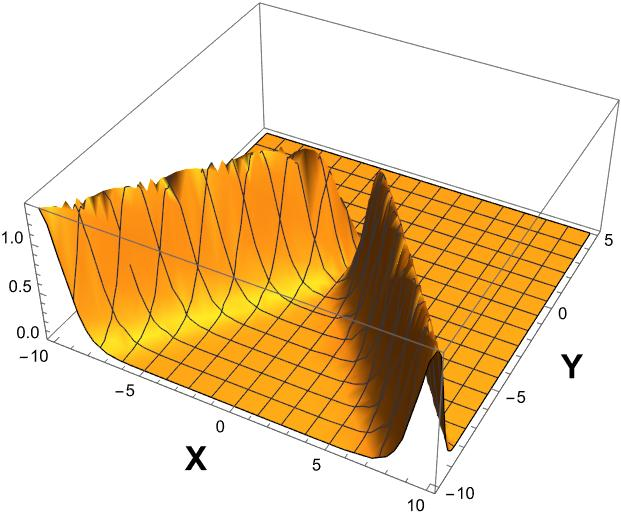
Figure 1: Probability density of the wave function for rs=1.
The zero set at X=0 in Figure 1 underlies the annihilation-to-nothing picture. However, this analysis neglects generic deformations allowed in effective quantum gravity at sub-Planckian scales.
EFT Higher Curvature Corrections to the WDW Equation
Kanai extends the theory by considering curvature-cubed (Riemann3) and quartic invariants in the gravitational action, constrained by spherical symmetry and field redefinitions. Such terms contribute new nontrivial potential terms to the Hamiltonian constraint in the WDW equation. Using perturbative expansion in the small coefficients (γ,η) of these higher-derivative operators, Kanai computes the first-order correction to the quantum wave function via a Green's function approach in a properly defined Z,W coordinate system diagonalizing the minisuperspace kinetic term.
The explicit evaluation of the wavefunction near the would-be crossover at X=0 and large negative Y (inside the horizon, far from the singularity) reveals divergence in the cutoff parameter ϵ but, after regularization, yields a manifestly nonzero and scheme-dependent value. The key result is:
Ψ(1)∣X=0,Y≪−1=0
Thus, the annihilation feature is explicitly destroyed by the consistent inclusion of higher-derivative EFT corrections, and the probability density no longer vanishes at the “crossover”, invalidating the annihilation-to-nothing mechanism in the presence of such corrections.
Quantum Curvature Corrections and the Limitations of EFT
The analysis is repeated for quadratic gravity—specifically, including R2 and RμνRμν operators—in both the classical action and in the quantum constraint. After canonical field redefinition to eliminate Ostrogradsky ghosts and constructing the corresponding Hamiltonian, the modified WDW operator is implemented using Weyl ordering. The perturbative solution for the quantum wavefunction correction (Ψ(1)) is again evaluated using Green’s function techniques, and the same nonvanishing behavior at X=0 is obtained:
ρ(0,Y)=∣Ψ(1)(0,Y)∣Y≪−12=0
This result is robust to regularization prescriptions. The upshot is that even when quantum corrections (at the level accessible within EFT) are systematically included, no mechanism supports the annihilation-to-nothing scenario suggested by the tree-level quantized GR Wheeler-DeWitt equation.
Implications for Singularity Resolution and Future Directions
The analysis demonstrates that the apparent classical singularity resolution within minisuperspace WDW quantization is not a generic property of underlying quantum gravity; it is a consequence of neglecting derivative corrections and emergent UV degrees of freedom beyond low-energy GR. The findings reinforce standard EFT reasoning: the low-energy quantum gravitational action (even with all local higher curvature operators included) is insufficient for robustly resolving black hole singularities. Genuine singularity resolution mechanisms must invoke fundamentally quantum degrees of freedom inaccessible in the GR+EFT framework.
Practical implications include the inapplicability of semiclassical annihilation-to-nothing type transitions for the internal consistency of quantum black holes within realistic quantum gravity. Theoretically, these results clarify the domain of validity of minisuperspace WDW analyses and motivate fully UV-complete quantum gravity programs such as loop quantum gravity, asymptotic safety, or string theory, as candidate frameworks where nonperturbative singularity resolution mechanisms may arise.
Conclusion
Kanai’s work provides a robust and explicit demonstration that higher curvature corrections, necessarily present in the low-energy expansion of quantum gravity, eliminate the vanishing-wavefunction feature at the interior crossover in the black hole WDW equation. Therefore, the annihilation-to-nothing scenario is not viable within the domain of validity of effective field theory. This analysis underscores the necessity of UV-complete quantum gravity degrees of freedom for addressing singularity resolution—EFT extensions of general relativity are insufficient. Future developments should focus on nonperturbative/UV-complete frameworks if a mechanism akin to annihilation-to-nothing is to be reliably established.