- The paper demonstrates that incorporating a second, incommensurate delayed feedback in bistable oscillators replicates nonlocal network dynamics and accelerates wavefront propagation.
- The authors combine numerical simulations with analog electronic experiments to validate the theoretical model and quantify deterministic and stochastic wavefront behavior.
- The paper's insights are significant for applications in reservoir computing and optical Ising machines, offering a pathway to hardware implementations of complex spatio-temporal dynamics.
Wavefront Propagation in a Bistable Dual-Delayed-Feedback Oscillator: Analogy to Networks with Nonlocal Interactions
Introduction and Theoretical Foundation
The paper presents a rigorous analysis of a bistable oscillator subjected to two distinct delayed-feedback loops, focusing on its capacity to replicate the wavefront propagation phenomena classically associated with nonlocally coupled networks of bistable elements (2512.10733). By employing a spatio-temporal representation of delay dynamics, the study demonstrates that the temporal evolution within a dual-delayed system mirrors the dynamics of a ring network with nonlocal unidirectional coupling. The central hypothesis is that the dual-delay structure—comprising two delays of incommensurate lengths—permits the emulation of nonlocal connections, extending the established equivalence between single-delay oscillators and locally coupled ensembles.
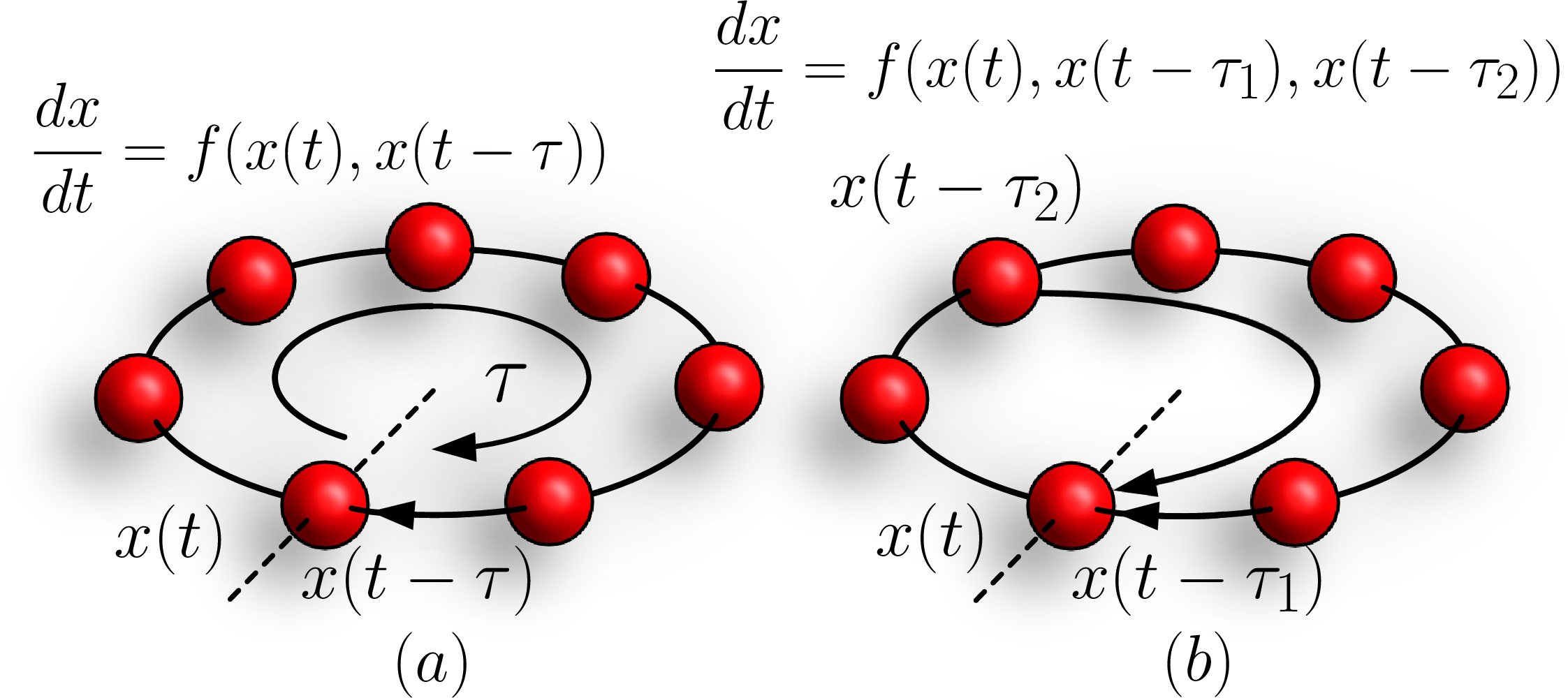
Figure 1: Schematic representation of delayed-feedback oscillators with single (a) and dual (b) feedback, clarifying their analogy to network topologies.
This theoretical construction provides the framework for a detailed experimental and numerical exploration of deterministic and stochastic wavefront propagation, with direct implications for the hardware realization of high-dimensional temporal processing systems, including reservoir computing architectures and optical Ising machines.
Experimental Design and Methodology
The authors realize the dual-delayed system both numerically and physically. They introduce a core dynamical equation for the oscillator with two delay lines,
dtdx=−x(x−a)(x+b)+F(t)+2γ(x(t−τ1)+x(t−τ2)−2x(t)),
with bistability enforced via the cubic nonlinearity. Parametric details—i.e., feedback gains, delay times, and noise configurations—are systematically controlled. The physical instantiation employs an analog electronic circuit with an integrated PC-based delay line, allowing for precise manipulation and measurement of wavefront dynamics.
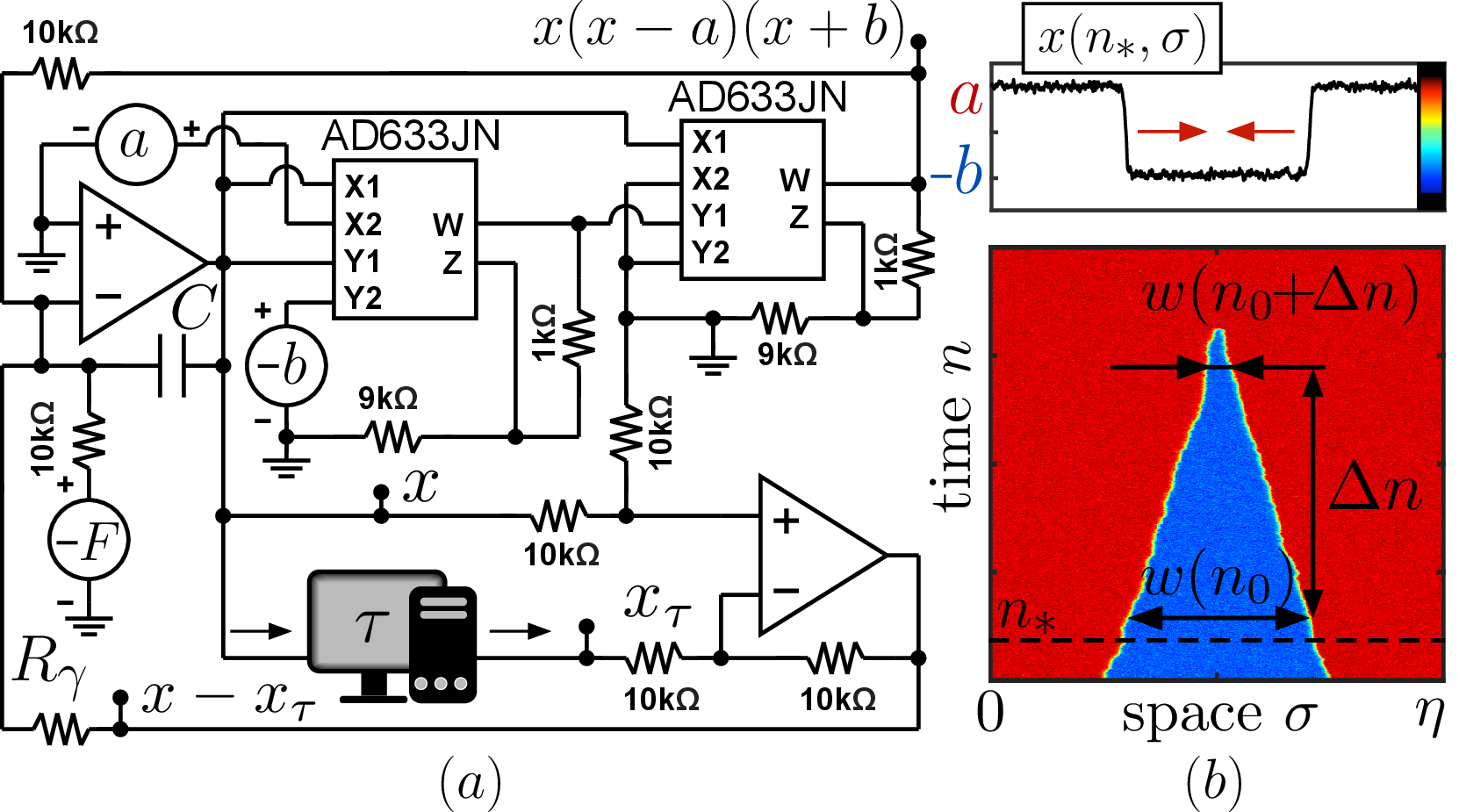
Figure 2: Circuit diagram of the experimental dual-delayed-feedback oscillator and the methodology for measuring wavefront velocities.
To quantify the wavefront dynamics, space-time plots are extracted via pseudo-spatial embedding of the temporal trace, and front velocities are determined using robust width-based metrics.
Deterministic Wavefront Propagation: Dual Delay Effects
A primary result is the strong acceleration of deterministic wavefront propagation when the system transitions from single to dual-delay feedback. Empirically, when reducing the secondary delay τ2 from equality with τ1, the normalized front velocity increases substantially (Figure 3a), with space-time diagrams confirming near-immediate domain annihilation for sufficiently small τ2.
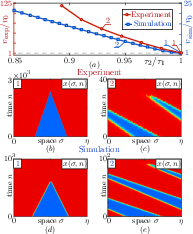
Figure 3: Deterministic wavefront velocity normalized by the single-delay reference, and characteristic space-time diagrams for key delay regimes.
These outcomes are in excellent agreement between experiment and simulation, though the physical realization exhibits increased sensitivity to τ2 owing to circuit-level nonidealities. The results support the claim that dual-delay feedback emulates an extended coupling radius in networked models, thereby increasing front propagation speed—a hallmark of nonlocal interaction.
Stochastic Wavefront Control: Multiplicative and Additive Noise
The study systematically investigates responses to both multiplicative and additive noise. In the case of multiplicative (parametric) noise, noise-induced reversal and stabilization of propagation are observed, with dual-delay systems achieving near-zero mean velocities ("pinned" fronts) at lower noise intensities compared to single-delay counterparts.
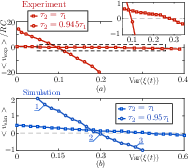
Figure 4: Mean wavefront velocity as a function of multiplicative noise variance for different delay configurations, showing sharper response and stabilization for dual delays.
Furthermore, additive noise experiments expose a critical nonlocality effect: whereas single-delay systems exhibit collapse of wavefronts and loss of spatial domains above a noise threshold, dual-delay configurations maintain robust, propagating domains under the same noise amplitude, thereby preventing noise-induced propagation failure.
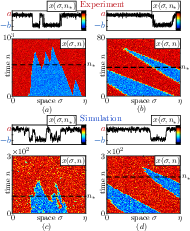
Figure 5: Demonstration that dual delayed feedback prevents additive-noise-induced front collapse, as clearly seen in both experiment and simulation.
This effect is a rigorous reproduction of the nonlocal-coupling-stabilized wavefronts observed in spatial networks, confirming the oscillator's capability to encode nonlocal interactions intrinsically.
Implications and Research Trajectory
These results have significant implications for the dynamical systems and computational hardware communities:
- Nonlocality Emulation: The dual-delayed oscillator serves as an effective minimal model for studying nonlocality-driven phenomena (e.g., interface depinning, stochastic resonance control, disorder-induced transitions) within a single-node framework.
- Reservoir Computing and Ising Machines: The precise modulation of front velocities and robustness to noise via delay engineering enables controllable temporal and spatial dynamics in photonic and electronic reservoirs, with direct bearing on neuromorphic and combinatorial optimization hardware.
- Potential Extensions: The analogy may be extended to multiplex or hierarchical topologies by incorporating more delay lines, with implications for deep reservoir architectures or artificial spin glasses.
Further work will likely exploit these principles for scalable, delay-based emulation of complex networks, enabling systematic hardware studies of pattern formation, critical behavior, and high-dimensional computation within delay-coupled nonlinear systems.
Conclusion
The research substantiates an exact analogy between dual-delayed-feedback bistable oscillators and nonlocally coupled bistable networks, both theoretically and through experimental verification. The presence of a second, distinct delayed feedback loop not only accelerates deterministic and noise-driven wavefront propagation but also enhances noise tolerance, preventing propagation failure. These findings establish dual-delay systems as powerful platforms for the analog emulation of nonlocal interaction effects and offer promising avenues for integrated hardware implementations of advanced spatio-temporal computing and optimization paradigms.