Conformal collider bootstrap in ${\mathcal N}=4$ SYM
Published 11 Dec 2025 in hep-th and hep-ph | (2512.10796v1)
Abstract: We use a combination of perturbation theory, holography, supersymmetric localization, integrability, and numerical conformal bootstrap methods to constrain the energy-energy correlator in $\text{SU}(N_c)$ ${\mathcal N}=4$ SYM at finite coupling. For finite $N_c$, we derive lower bounds on the second and fourth multipoles of the energy-energy correlator at different couplings, along with a smeared energy-energy correlator as a function of the angle between the two detectors. We present evidence that our lower bounds on the multipoles are nearly saturated by the ${\cal N} = 4$ SYM theory. In the planar limit, we further use dispersive functionals to obtain tight two-sided bounds on both the first three non-trivial multipoles and on the angular dependence of the energy-energy correlator. As the coupling is varied from weak to strong, the energy-energy correlator exhibits a transition from single-trace to double-trace operator dominance in the collinear limit, which we characterize quantitatively. A similar phenomenon occurs in QCD, where a parton-hadron transition is observed as detectors are brought closer together.
The paper achieves state-of-the-art constraints on the energy-energy correlator in N=4 SYM by merging bootstrap techniques, integrability, and localization methods.
It develops novel analytical Padé models and dispersive inversion formulas to interpolate between perturbative and holographic regimes.
Numerical bootstrap bounds validate the analytic predictions, bridging the transition from jet-like configurations to isotropic energy deposition.
Energy-Energy Correlator Bootstrap in N=4 SYM
Introduction
This paper presents state-of-the-art constraints on the energy-energy correlator (EEC) in SU(Nc)N=4 Super Yang-Mills (SYM) theory at finite coupling, leveraging an interplay of perturbation theory, holography, supersymmetric localization, analytic bootstrap, integrability, and advanced numerical bootstrap techniques. The EEC is a Lorentzian event-shape observable measuring correlated energy fluxes at angular separation θ, central to collider phenomenology and CFT dynamics. This work extends the conformal bootstrap to collider kinematics, analyzing the EEC and its multipole expansion across all couplings and ranks, elucidating physical transitions—from perturbative jets to strong-coupling “democratic” energy deposition—within a maximally supersymmetric, conformal gauge theory.
Theoretical Framework for the EEC
The EEC in a state of fixed four-momentum created by half-BPS scalar sources is related via supersymmetry to an integrated four-point function of 20′ primaries, reducing the energy-flux correlator to a function of only the angular parameter and the Yang-Mills coupling. The decomposition in Legendre multipoles,
EEC(θ)=1+s=2∑∞csPs(cosθ),
has strictly positive cs due to unitarity, with sum rules from conservation ensuring c0=1 and c1=0. The paper exploits the superconformal block expansion, expressing the EEC multipoles as manifestly positive, linear combinations of OPE data: cs=τ,J∑λτ,J2sin2(2πτ)α(τ,J)fJ+2,s(τ),
where τ,J run over twists and spins of exchanged long multiplets, further suppressed by specific kinematic blocks depending on conformal and R-symmetry structure.
Analytical Results and Finite Coupling Models
Weak and Strong Coupling Regimes
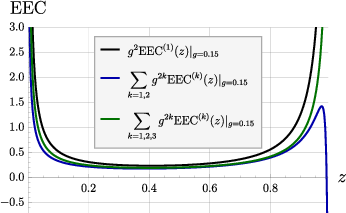
At weak coupling, the EEC is sharply peaked at θ=0,π, reflecting two-particle “jet” configurations, with higher multipoles c2k∼4k+1 and odd ones vanishing. Perturbative corrections are computable to three loops, but fail near endpoints, requiring resummation. At strong 't Hooft coupling (planar, Nc→∞), the EEC becomes nearly flat (energy distributed democratically), with multipoles suppressed as cs∼1/gs, computable via AdS/CFT—bulk shockwave methods and a resummation over stringy operators.
Figure 1: Weak-coupling expansion of the EEC at g=0.15, showing the need for resummation near z→0,1.
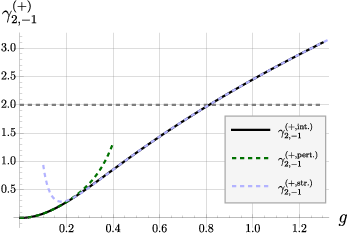
The light-ray OPE analysis determines singular power behavior at small angles, governed by the analytically continued twist-2 anomalous dimension γ2,−1+, yielding a transition at critical coupling gcr≈0.81. Above gcr, the singularity is tamed and the EEC becomes regular, with double-trace dominance analogous to QCD’s parton-hadron transition.
Figure 2: The anomalous dimension γ2,−1(+) tracks the transition from singular to regular collinear EEC as a function of g.
Finite-Coupling Padé Models and Dispersive Analysis
Analytical Padé-type models are constructed for all EEC multipoles and the angular EEC, interpolating between fixed-order data at weak coupling and gravitational (supergravity, string, and $1/g$) corrections at strong coupling. These models accurately track the bootstrap bounds across coupling.
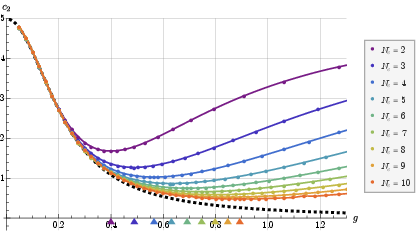
Figure 3: Planar bootstrap bounds on c2(g); Padé models interpolate between perturbative and holographic asymptotics.
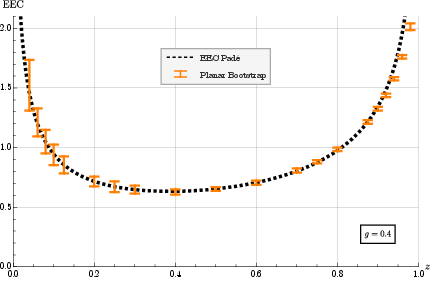
Figure 4: Planar EEC (g=0.4): bootstrap bounds tightly constrain the function, matching Padé approximations not achievable by perturbation or holography alone.
The work also derives and validates a dispersive (Froissart-Gribov) inversion formula connecting discontinuities of the EEC at z=0,1 to the multipoles cs, clarifying how large-spin behavior reconstructs angle singularities and providing a nonperturbative analytic handle at finite coupling.
Bootstrap Implementation: Numerical and Analytic Constraints
Planar Limit (Nc→∞)
In the planar theory, the authors combine:
Dispersive sum rules (Polyakov–Regge/CFT dispersion relations) that decouple double-traces and constrain single-trace OPE data,
Exact spectral input from integrability (quantum spectral curve determines all low-twist single-trace operator data at finite g),
Integral constraints from supersymmetric localization (constraining integrated correlators at all coupling), and
This system enables two-sided bounds on all physically relevant observables: EEC at each angle z, and multipole moments cs, for any g.
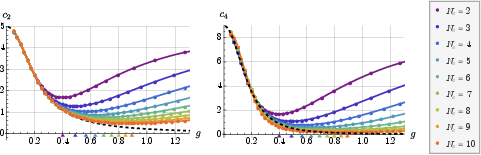
Figure 5: Bootstrap lower bounds for c2 as a function of g, for Nc=2,…,10, as compared to the planar bound.
Finite Nc (2≤Nc<∞)
For finite rank, the combination of crossing symmetry, localization, and a new implementation of the averaged null energy condition (ANEC) yields rigorous lower bounds for even-spin EEC multipoles and, with smoothing, on angularly smeared versions of the EEC. The bounds are shown to approach the planar results as Nc increases, and exhibit notable structure at the S-dual point g=Nc/4π. The analytic–numerical hybrid approach allows for robust extrapolation and rigorous estimation of bounds in regimes inaccessible to direct perturbative or gravitational computation.
Figure 6: Lower bounds on c2 and c4 for Nc=2–10, as a function of coupling. The planar Padé curve provides the asymptotic Nc→∞ target.
Results and Physical Implications
Multipole Structure and Physics Across Coupling
The EEC morphs, as coupling is dialed from weak to strong, from a highly anisotropic event-shape (controlled by low-twist, high-spin single-trace exchanges, i.e., jetty OPE) to an almost isotropic event shape dominated by double-trace or “stringy” operators. The bootstrap bounds show this transition in the vanishing of higher multipoles and rise of the c2 towards zero at self-dual and strong coupling.
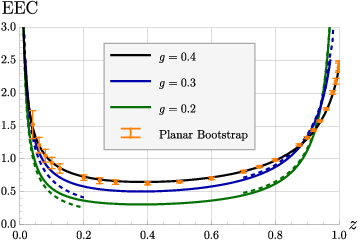
Figure 7: Full EEC reconstruction at g=0.2,0.3,0.4 from inverted bootstrap and OPE data. Agreement with analytic expectations is observed at all angles.
Saturation and Analytic Control
The numeric bounds are shown to be nearly saturated by the analytic superpositions of perturbative and holographic results (i.e., the Padé models). At finite Nc, saturation is observed for even cs bounds; odd multipoles and smeared EEC remain less sharp, indicating the need for further advances in methods or theory for odd-spin constraints.
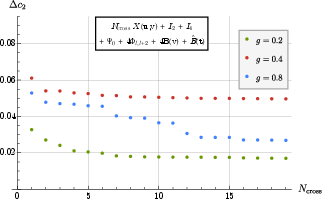
Figure 8: Convergence of upper/lower bounds for c2 as the number of dispersive sum rule functionals is increased—in the planar bootstrap these bounds are tight and robust.
Theoretical and Phenomenological Outlook
This work provides a comprehensive, nonperturbative description of the EEC in N=4 SYM for any coupling and any gauge group rank. The numerical and analytic frameworks constitute a blueprint for treating collider observables in general CFTs (e.g., adapting to QCD, ABJM, or 3d Ising), and highlight the power of integrating dispersive CFTs methods, localization constraints, and integrability with Lorentzian bootstraps.
The analytic structure elucidated here (including the dispersive inversion and the explicit identification of operator families dominating different angular/coupling regimes) indicates future applications for multi-particle collider observables, energy flow in general heavy operator sectors, and potentially for the rigorous construction of flat-space S-matrix limits in strongly coupled holographic CFTs.
Conclusion
The constraints produced on the EEC and its multipoles, and the demonstrated matching to analytic models interpolating between perturbation theory and holography, represent a significant advance in the application of bootstrap and nonperturbative methods to Lorentzian CFT dynamics. This work offers both concrete high-precision results for N=4 SYM and powerful general methodologies of relevance to both formal and phenomenological quantum field theory.
References:
"Conformal collider bootstrap in N=4 SYM" (2512.10796)