- The paper demonstrates plasmon-assisted optical activation of dark trions in ML WS₂, achieving a 45 meV doublet through enhanced coupling of out-of-plane fields.
- It employs disordered gold films to induce localized surface plasmons that drive n-type doping and facilitate elevated temperature operation up to 115 K.
- The study provides a scalable pathway for valleytronic and quantum optoelectronic devices by harnessing intervalley electron-electron scattering and Purcell-enhanced emission.
Brightening of Dark Trions in Monolayer WS2 via Localization of Surface Plasmons
Introduction and Background
The study investigates the optical activation of dark trions in monolayer WS2 (ML WS2) through the use of localized surface plasmons (LSPs) on a disordered gold substrate. In TMD monolayers, strong spin-orbit coupling and reduced dielectric screening give rise to tightly bound excitonic complexes, including bright and dark trions, with spin and valley degrees of freedom that underpin emerging valleytronic and quantum optoelectronic technologies. Dark trions, with lifetimes exceeding those of bright trions by approximately two orders of magnitude, are optically inactive under conventional excitation because of transition selection rules related to their out-of-plane (OUP) dipole orientations.
Accessing and controlling dark trion photoluminescence (PL) at elevated temperatures is critical for applications but remains experimentally challenging. Prior work activated dark excitons/trions using magnetic fields, strain engineering, or nanophotonic structures; however, demonstrations in WS2 at temperatures above cryogenic conditions are conspicuously absent.
Experimental Design and Plasmonic Substrate Configuration
The approach utilizes ML WS2 transferred onto a structurally disordered gold film (with a underlying Si/SiO2 support), enabling charge transfer-driven n-type doping and fostering Anderson-like localization of surface plasmon polaritons. This localization enhances out-of-plane electromagnetic near-fields that can efficiently couple to the OUP dipole moments of dark trions, thus facilitating optical activation and emission.
The experimental geometry is depicted as follows:
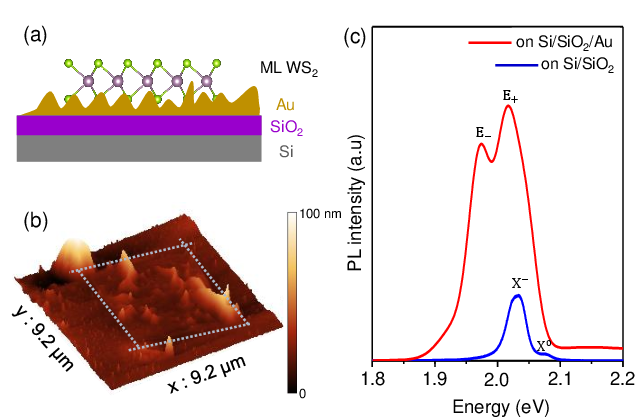
Figure 1: (a) Schematic of ML WS2 on disordered Au/Si/SiO2 substrate; (b) 3D AFM of rough Au surface with ML area highlighted; (c) Comparative PL spectra at 83 K for ML WS2 on Si/SiO2 (blue) and Si/SiO2/Au (red), showing pronounced PL doublet only for the plasmonic substrate.
PL measurements were conducted in back-scattering geometry with excitation at 488 nm, both at fixed and variable power. The rough Au supports LSPs with prominent OUP field components, thus promoting radiative recombination channels ordinarily forbidden for dark trions.
PL Spectral Analysis and Trion Doublet Characterization
A key experimental observation is the emergence of a clear doublet in the PL spectrum for ML WS2 on the disordered Au substrate at 83–115 K, with the two peaks separated by ∼45 meV. No such doublet or comparably strong intensity is observed for ML WS2 on the non-plasmonic reference substrate.
Spatially resolved PL and power-dependence studies exclude strain and defect-bound exciton recombination as origins for the doublet. The linear power dependence (I∝P1.2 and I∝P1.0 for the two peaks) confirms assignment to excitonic complexes.
The temperature evolution of the doublet is summarized below:
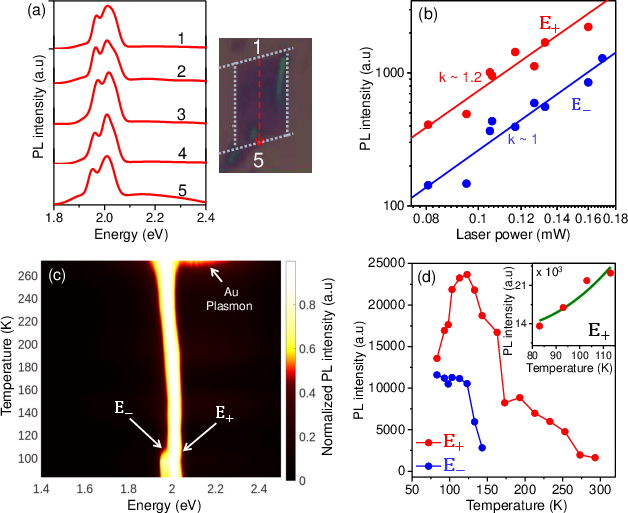
Figure 2: (a) Uniform PL spectra along a sample line scan; (b) Power-dependent integrated PL intensities for bright and semi-dark trion peaks; (c) False color map of normalized PL showing doublet emergence with increasing temperature; (d) Temperature dependence of integrated PL intensity for the two states.
Deconvolution and temperature dependence of the PL spectra reveal the lower (higher) energy peak is dominant at lower (higher) temperatures, consistent with a two-level Boltzmann population model. Fitting yields an energy splitting ΔE≈45 meV, in close agreement with theoretical expectations for intervalley electron-electron (e-e) scattering-induced coupling of bright and dark trion states.
Theoretical Interpretation: Intervalley e-e Scattering and Trion Fine Structure
The observed doublet is rationalized within the framework of the Danovich et al. model, where intervalley e-e scattering mixes bright (∣B⟩) and dark (∣D⟩) trion states, yielding two mixed eigenstates: a semi-dark trion (∣E−⟩, predominantly dark) and a bright trion (∣E+⟩, predominantly bright). The Anderson-like LSP field couples strongly to the OUP dipole of the dark trion, enhancing the emission rate via the Purcell effect.
The interaction of LSPs with the trion fine structure is summarized schematically:
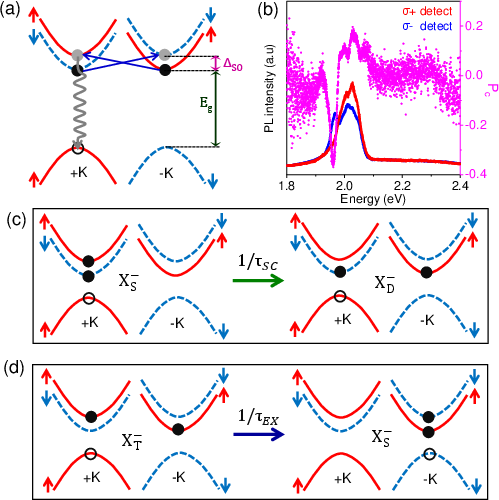
Figure 3: Schematic of intervalley e-e scattering processes that generate coupling between dark and bright trion configurations through both spin-conserving and e-h exchange mechanisms, including valley configurations.
Quantitative analysis yields an effective coupling parameter μ≈18 meV and spin-orbit splitting ΔSO≈12–13 meV, from which the predicted energy gap ΔD matches the measured value of 45 meV.
Fine-structure deconvolution at 83 K further identifies contributions from the dark, semi-dark, spin-singlet, and spin-triplet trions. Comparison of energy shifts between these peaks and previously reported values at cryogenic temperatures supports the assignment, with the enhanced semi-dark trion PL uniquely attributable to LSP-mediated brightening rather than magnetic-field activation.
Valley Polarization and Implications for Valleytronic Applications
Polarization-resolved PL under circularly polarized excitation provides direct insight into the valley-selective dynamics of the trion states. Notably, the degree of circular polarization Pc exhibits a negative value (−35%) for the semi-dark trion (E−) and a positive value (+18%) for the bright trion (E+), consistent with prior studies on WSe2 but in contrast to the usual behavior of bright trions.
This inversion is explained by considering valley-selective population dynamics: efficient spin-conserving and exchange-mediated scattering processes redistribute singlet trion populations between valleys, favoring occupation in the valley with opposite helicity to the excitation. The net result is a negative valley polarization for the semi-dark trion—a feature with direct implications for valleytronic device schemes.
Robustness Across Temperature and Implications for Device Engineering
The plasmonic enhancement strategy supports brightening and detection of dark and semi-dark trions at temperatures up to 115 K, outperforming traditional approaches limited to cryogenic conditions. This extends practical device operability and scalability, as rough plasmonic substrates are amenable to wafer-scale implementation. The electron doping provided via charge transfer from the Au further ensures dominance of charged complex emission, facilitating unambiguous spectroscopic assignment.
Room-temperature PL spectra (Figure 4) confirm that the trion doublet and strong emission are lost in the absence of the plasmonic substrate or at higher temperatures due to thermal ionization.
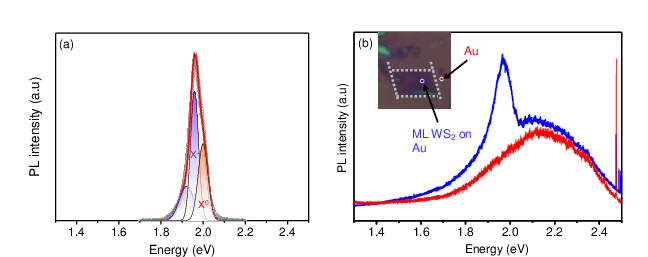
Figure 4: (a) Room-temperature PL of ML WS2 on Si/SiO2 substrate; (b) Room-temperature PL from ML WS2 on disordered Au film and the Au film alone, highlighting plasmonic enhancement effects.
Conclusion
The study conclusively demonstrates that Anderson-like localized surface plasmons in disordered Au films efficiently facilitate the optical activation and enhancement of semi-dark (gray) and dark trions in ML WS2 at elevated temperatures. The observed PL spectral doublet, power-law scaling, temperature robustness, and unique valley polarization signatures are quantitatively consistent with theoretical models based on intervalley e-e scattering and LSP quantum electrodynamics.
These findings underscore a scalable pathway for all-optical access and amplification of forbidden exciton complexes in TMDs, with immediate implications for integrated valleytronic and nanophotonic devices. The plasmonic strategy obviates the need for high magnetic fields or low temperatures, removing key barriers to the deployment of dark-state-based quantum optoelectronic technologies and opening new regimes for the engineering of multi-component valley pseudospins, trion manipulation, and spin-orbitronic architectures.