Two-Dimensional Projective Collapse and Sharp Distortion Bounds for Products of Positive Matrices
Published 11 Dec 2025 in math-ph, math.DS, and math.FA | (2512.10872v1)
Abstract: We introduce an elementary framework that captures the mechanism driving the alignment of rows and columns in products of positive matrices. All worst-case misalignment occurs already in dimension two, leading to an explicit collapse principle and a sharp nonlinear bound for finite products. The proof avoids Hilbert-metric and cone-theoretic techniques, relying instead on basic calculus. In the Hilbert metric, the classical Birkhoff-Bushell contraction captures only the linearized asymptotic regime, whereas our nonlinear envelope function gives the exact worst-case behavior for finite products.
The paper introduces an explicit distortion functional that quantifies misalignment in products of positive matrices, leading to sharp envelope inequalities.
The analysis reveals that worst-case distortion in high dimensions is determined by a two-dimensional submatrix, simplifying complex alignment behavior.
The paper establishes a recursive bound with exponential convergence, offering refined insights over traditional Hilbert metric approaches.
Two-Dimensional Projective Collapse and Sharp Distortion Bounds for Products of Positive Matrices
Introduction and Motivation
The alignment phenomenon in products of positive matrices, initially described by the classical Frobenius–Perron theory, is central to diverse domains including nonnegative matrix theory, Markov processes, dynamical systems, and mathematical physics. Traditional analytic frameworks, particularly those based on the Hilbert projective metric and the Birkhoff–Bushell contraction, provide elementwise and asymptotic control over how rows and columns of such products approach proportionality. The present work departs fundamentally from the metric/cone-theoretic approach, instead distilling alignment into a concrete, coordinate-level mechanism via an explicit "distortion" functional. Crucially, the analysis demonstrates that the essential obstruction to alignment is already present in two dimensions, allowing the derivation of optimal, non-asymptotic distortion bounds ("envelope inequalities") for products of positive matrices in arbitrary dimension.
Distortion Formalism and Envelope Inequality
For a positive matrix A, the distortion R(A) is defined as the maximum ratio
R(A):=i,j,k,ℓmaxaiℓajkaikajℓ,
which precisely quantifies the maximal deviation of rows or columns from being proportional. In the context of 2×2 positive matrices, this reduces to examining the values of F(A)=a12a21a11a22; R(A)=max{F(A),1/F(A)}. Scaling or swapping rows/columns preserves R(A).
The main technical contribution is the explicit computation of the sharp upper bound on the distortion of the product of two such matrices. This is captured by the symmetric envelope function
Φ(α,β)=(α+β1+αβ)2,
yielding the "envelope inequality"
R(AB)≤Φ(R(A),R(B)).
This bound is not just asymptotically tight, but is achieved for suitable choices of extremal matrices. The analysis is elementary and sharp, relying solely on careful manipulation of ratios and basic calculus, entirely eschewing projective-metric or cone theory.
Collapse Mechanism and Reduction to Two Dimensions
A central insight is the identification of a projective collapse: the worst-case distortion for the multiplication of high-dimensional positive matrices is always realized on a 2×2 submatrix. This reduction is formalized by showing that, for any vectors x,y,u,v in R>0d, one can always find two-dimensional compressions (x′,y′,u′,v′) such that the functional Fd(x,y;u,v) is maximized. The argument employs a coordinatewise extremal push and aggregation, leading to a sharp comparison with the two-dimensional case.
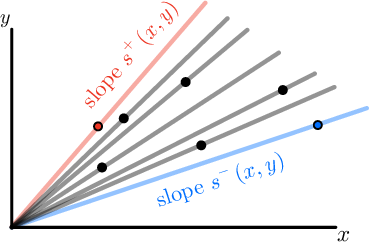
Figure 1: The geometric interpretation of the slopes s+(x,y) and s−(x,y) as extremal rays, capturing the precise projective spread responsible for distortion.
This collapse mechanism is critical, as it implies all nontrivial extremal behavior is completely characterized by the two-dimensional configuration. The extension to arbitrary dimensions thus follows directly from the 2×2 analysis.
Distortion Recurrence and Products of Arbitrary Length
For a sequence of positive matrices (An), the distortion of the product Pn=An⋯A1 can be recursively bounded using the square root transformation S(A)=R(A) and the Mobius iteration
S(Pn+1)≤Ψ(S(An+1),S(Pn)),Ψ(p,q)=p+q1+pq.
With all R(An)≤α, the recursive solution yields exponential contraction in distortion, quantified as:
R(Pn)≤1+(1−κn)24κn,κ=α+1α−1.
Thus, distortion converges exponentially to 1, confirming and sharply quantifying the celebrated alignment effect.
Comparison with the Birkhoff–Bushell Contraction
The Birkhoff–Bushell theory, formulated in terms of the Hilbert metric dH(x,y)=logDist(x,y), yields a linear contraction bound:
dH(Ax,Ay)≤κ(A)dH(x,y),κ(A)=R(A)+1R(A)−1.
However, the envelope inequality provides the nonlinear, sharp upper bound Θ(h), with h=dH(x,y),
Θ(h)=2log(p+eh/21+peh/2),p=R(A).
Unlike the Birkhoff–Bushell linear bound, which grows unbounded with h, the envelope bound saturates at logR(A), showing optimality for non-asymptotic and large-distortion regimes—a regime where Birkhoff–Bushell dramatically overestimates the contraction.
(Figure 2)
Figure 2: Visualization of the nonlinear envelope bound Θ(h) versus the Birkhoff–Bushell linear contraction κ(A)h and the saturation level logR(A); the latter marks the regime of sharpness for the envelope.
Practical and Theoretical Implications
The envelope inequality is dimension-free and foundational. It yields optimal, non-asymptotic distortion bounds for products of positive matrices, with immediate relevance to the non-asymptotic analysis of Markov chains, transfer operators, and random matrix products. Unlike Hilbert-metric contraction constants, the envelope maps and their recursive structure deliver explicit and interpretable dynamics for finite products. This creates new opportunities for precise mixing-time estimates and deterministic/probabilistic hybrid methods.
The collapse mechanism may extend to functionals beyond distortion, suggesting that two-dimensional analysis governs broader projective phenomena. Potential generalizations to infinite-dimensional contexts (positive operators on cones) and further applications in quantitative ergodic theory or stochastic environments are clearly indicated.
Conclusion
This work isolates the exact, sharp mechanism underlying Frobenius–Perron-type alignment in the product of positive matrices, showing that all worst-case misalignment is reduced to a two-dimensional extremal problem. The resulting dimension-free envelope inequality and recursive framework provide the first non-asymptotic, optimal distortion bounds valid in all finite dimensions, subsuming and overtaking traditional Hilbert metric-based approaches in both accuracy and transparency. These results serve as a foundational advancement, with immediate consequences for the theory of positive matrices and stochastic processes, and open pathways for further structural and functional extensions.