- The paper demonstrates that non-uniform acceleration induces non-monotonic detector responses and entanglement revival, challenging standard Unruh effect expectations.
- The analysis uses perturbative methods on Unruh-DeWitt detectors following realistic, piecewise-constant accelerated trajectories to capture peaks and dips in excitation rates.
- The findings suggest practical protocols for quantum sensing and spacetime probing by leveraging vacuum field memory and dynamic entanglement harvesting.
Quantum Twin Paradox: Entanglement Dynamics of Accelerated Detectors
Introduction and Conceptual Framework
The paper "Twin-paradox and Entanglement" (2512.10908) investigates the interplay between relativistic time dilation (as exemplified by the classical twin paradox) and field-mediated quantum entanglement dynamics. The classical twin paradox, which highlights differential aging between inertial and accelerated observers, is recast in quantum theory by equipping each 'twin' with an Unruh-DeWitt detector (a two-level quantum system linearly coupled to a scalar field). The study offers a comprehensive perturbative analysis of detector responses and induced entanglement, focusing on physically realistic, non-uniform accelerated trajectories. The central objectives are: (1) to elucidate how accelerated non-inertial motion modulates the single-detector excitation and decoherence rates, and (2) to analyze the harvest and decay of entanglement and mutual information under a protocol that mimics the classical twin scenario.
Detector Models and Trajectory Construction
The two-level detectors (Alice and Bob) are prepared in ground states and initialized with synchronized clocks. Bob remains inertial, while Alice undergoes a protocolized, piecewise-constant non-uniform acceleration: initial inertial segment, transition to finite acceleration, deceleration (including sign reversals of the applied acceleration), and a return to inertial motion. The worldlines and geodesic separation between simultaneous events play a pivotal role: at any moment, interval σA,B2(τ,τ) traces the causal relationship between the twins as their proper time τ advances.
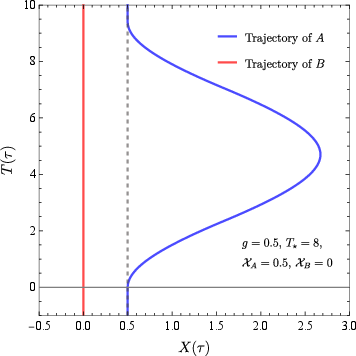
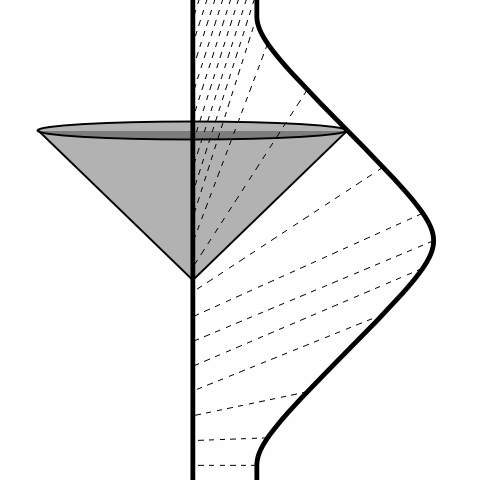
Figure 1: Alice and Bob's trajectories, illustrating spatial separation and Alice's non-uniform acceleration profile mimicking the twin paradox.
The computation of the geodesic interval between the twins for synchronized proper times reveals non-trivial transitions from spacelike to timelike separation, reflecting deep alterations in their causal connectivity as acceleration phases proceed.
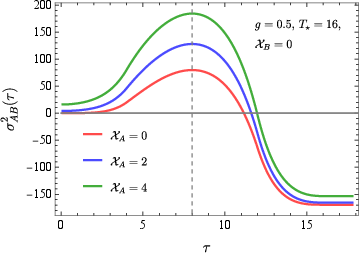
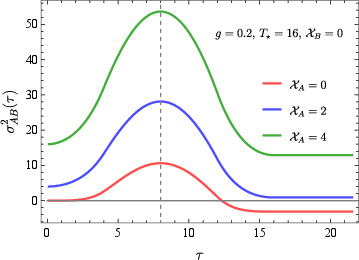
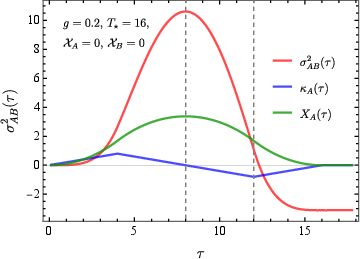
Figure 2: Geodesic separation σA,B2(τ,τ) between Alice and Bob reveals transitions from spacelike to timelike separation during the acceleration profile.
With weak coupling (small μ), single-detector excitation rates are calculated perturbatively, regularizing with the inertial response to isolate genuine vacuum fluctuation effects. For the inertial detector, the excitation probability appropriately vanishes for absorption processes due to the structure of the Wightman function along Minkowski geodesics. In contrast, the non-uniformly accelerating detector's response, computed numerically, displays pronounced non-analytic features: the excitation rate exhibits peaks and dips aligned with abrupt acceleration sign switches (non-adiabatic points).
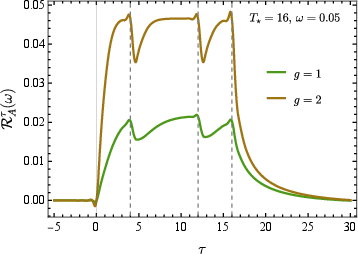
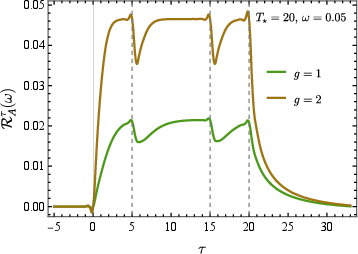
Figure 3: Detector transition probability rate RA(ω) as a function of time. Peaks indicate acceleration direction changes; dips signal non-adiabatic decoherence events.
This dynamical structure emphasizes the sensitivity of the detector's local vacuum sampling to non-uniform trajectories and predicts phenomena beyond the uniform Unruh effect.
Negativity as Entanglement Witness
Entanglement between the twins is quantified using the negativity N, computed directly from the reduced two-detector density matrix after tracing out the field. The evolution of the negativity versus synchronized proper time reveals an initial monotonic decay during Alice's acceleration—attributable to the increased spacelike separation and decoherence induced by the vacuum field. Remarkably, as Alice completes her acceleration cycle and returns toward Bob, negativity recovers, demonstrating partial re-harvesting of entanglement due to the combination of non-uniform acceleration and temporal correlations intrinsic to the Minkowski vacuum.
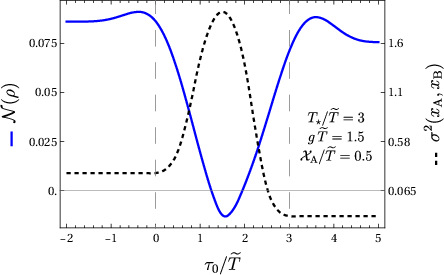
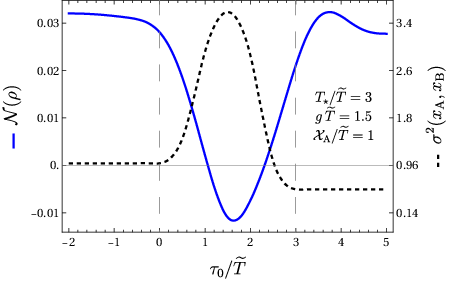
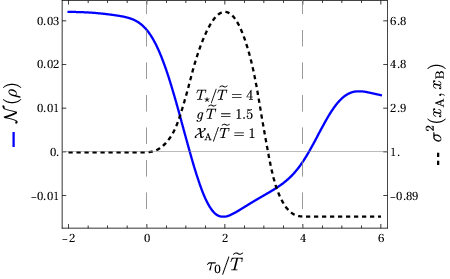
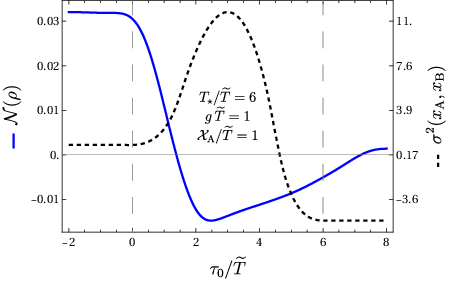
Figure 4: Negativity N as a function of time; the decay and subsequent revival reveal acceleration-imprinted entanglement dynamics.
Careful separation of non-local contributions (genuine entanglement) allows the authors to show that the post-acceleration increase in negativity arises from the dynamical reconnection of field correlations, not merely local mixing effects.
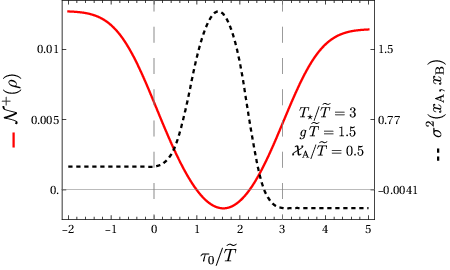
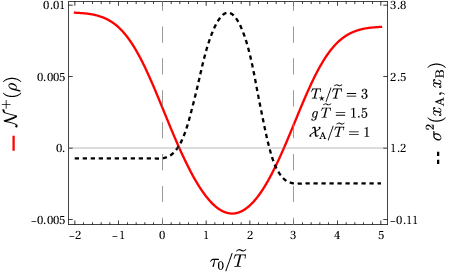
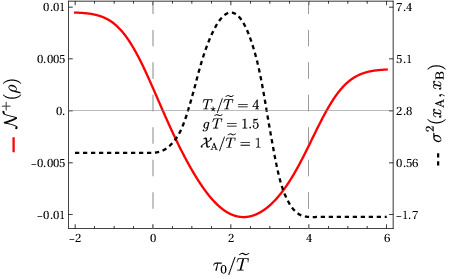
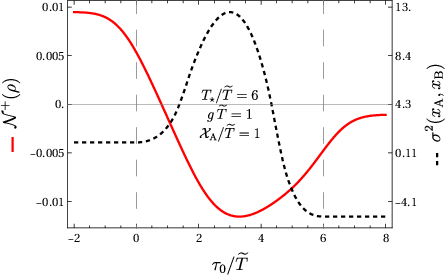
Figure 5: Non-local part of negativity N+ quantifying the genuine field-induced entanglement between Alice and Bob.
The mutual information between Alice and Bob tracks total shared quantum/classical correlations. Its evolution mirrors that of negativity, decaying upon acceleration and partially recovering during inertial reunion. The recovery underscores the field memory effect and persistence of spacetime vacuum correlations, even after transient non-local decoherence.
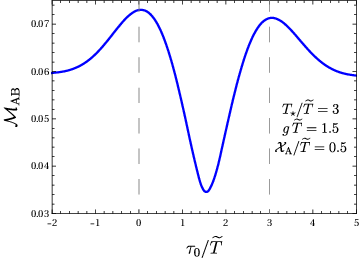
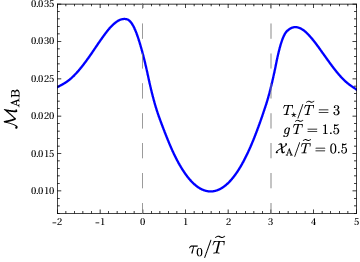
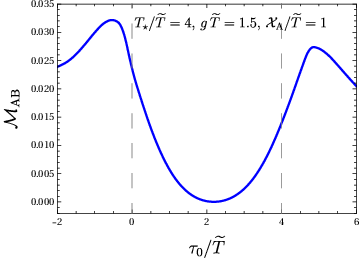
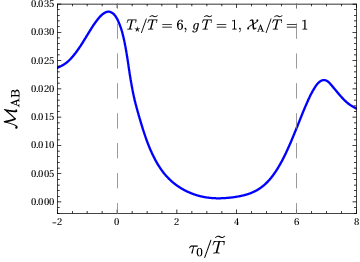
Figure 6: Mutual information MAB exhibits decay during acceleration, with resurgence as Alice returns to an inertial frame, reflecting robust field-mediated quantum correlations.
Implications and Theoretical Significance
This work demonstrates that non-inertial, non-uniformly accelerated motion has a non-trivial and non-monotonic impact on entanglement harvesting from a quantum field. The authors' findings contrast with the standard intuition that acceleration uniformly suppresses entanglement—significant resurgence is possible when the acceleration protocol includes direction changes and eventual inertial reunion. Notably, the signatures of acceleration changes are sharply encoded in the time-dependent transition rates and entanglement measures, providing a high-resolution operational probe of relativistic quantum field effects.
The methodology advanced in this paper opens a framework for addressing questions ranging from black hole information retrieval (in which non-inertial detectors model observers in highly curved backgrounds) to assessing the practical viability of quantum metrological probes for spacetime characterization. The formalism and results also hint at intricate relations between entanglement, causal structure, and the possible existence of closed timelike curves or wormhole-induced correlated histories.
Conclusion
The analysis provided in "Twin-paradox and Entanglement" (2512.10908) establishes that differential aging and non-uniform acceleration produce complex, temporally structured phenomena in quantum field entanglement and detector excitation. The recovery of entanglement following acceleration highlights the nuanced information content of vacuum correlations and suggests protocols for probing spacetime structure using quantum probes. Future extensions could integrate gravity, interactions with curved spacetime, or coupling to measurement backaction, advancing both fundamental understanding and practical quantum sensing applications.