- The paper demonstrates that using nonadditive q-entropy with a specific q_special value regularizes divergent response functions at quantum critical points.
- It employs the Schmidt decomposition theorem to partition spin chains, revealing universal entropic scaling across varying spin magnitudes and interaction ranges.
- The study proposes an experimental photostrictive setup to mimic finite-size effects, bridging theoretical predictions with measurable quantum phenomena.
Universal and Non-universal Features of Quantum Criticality via the Schmidt Decomposition and q-Entropy
Introduction
The investigation of quantum critical points (CPs), particularly in paradigmatic models such as the one-dimensional Ising model in a transverse field (1DIMTF), exposes fundamental constraints of standard Boltzmann-Gibbs (BG) and von Neumann (vN) entropy. The divergence of thermodynamical response functions and associated breakdown of extensivity at CPs—linked to the divergence of the correlation length and ensuing strong long-range quantum correlations—necessitates a reconsideration of statistical mechanical frameworks. The paper "Universal and non-universal facets of quantum critical phenomena unveiled along the Schmidt decomposition theorem" (2512.11093) presents a thorough analysis of quantum criticality using the nonadditive q-entropy Sq and reveals universal and non-universal aspects via the Schmidt decomposition theorem (SDT), incorporating the effects of spin magnitude S and extended spin interactions.
Regularization at Critical Points: q-Entropy and the Grüneisen Parameter
Traditional susceptibilities and response functions, such as the quantum Grüneisen parameter Γ0K, diverge at CPs within conventional entropy formalisms due to logarithmic scaling of the von Neumann entropy with system size. The authors demonstrate that using the nonadditive q-entropy
Sq(ρ^)=kq−11−Trρ^q
with a specific value of the entropic index, %%%%6%%%%, enforces extensivity and regularizes Γ0Kq for the entire Ising universality class—even in the thermodynamic limit.
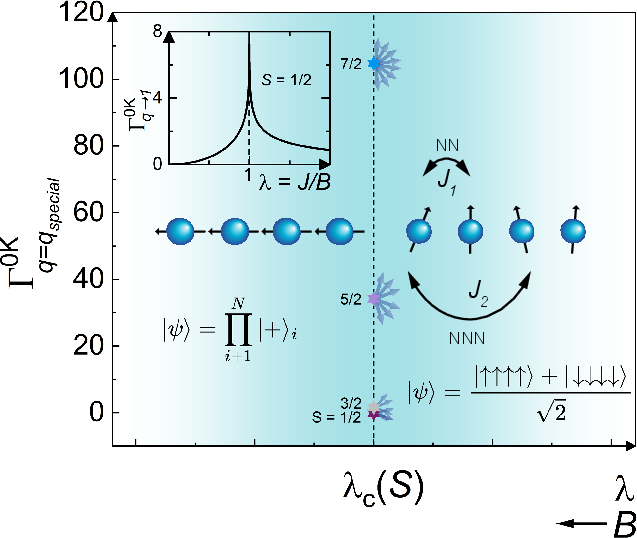
Figure 1: The quantum version of the Grüneisen parameter Γ0Kq=qspecial as a function of the control parameter λ=J/B for several spin projections S at the critical point.
The results indicate that increasing spin quantum number S enhances but does not diverge Γ0Kq=qspecial at CPs, a non-universal signature reflecting the growing Hilbert space dimensionality with S. Contrastingly, for q→1, corresponding to BG/vN entropy, the divergence persists.
Sensitivity of q-Entropy and Spin Dependence
Exact diagonalization for 1DIMTF systems with S=1/2, $3/2$, $5/2$, and $7/2$, as well as next-nearest-neighbor (NNN) interactions for S=1/2, quantifies the impact of spin and interaction range on Sq and its λ-derivative.
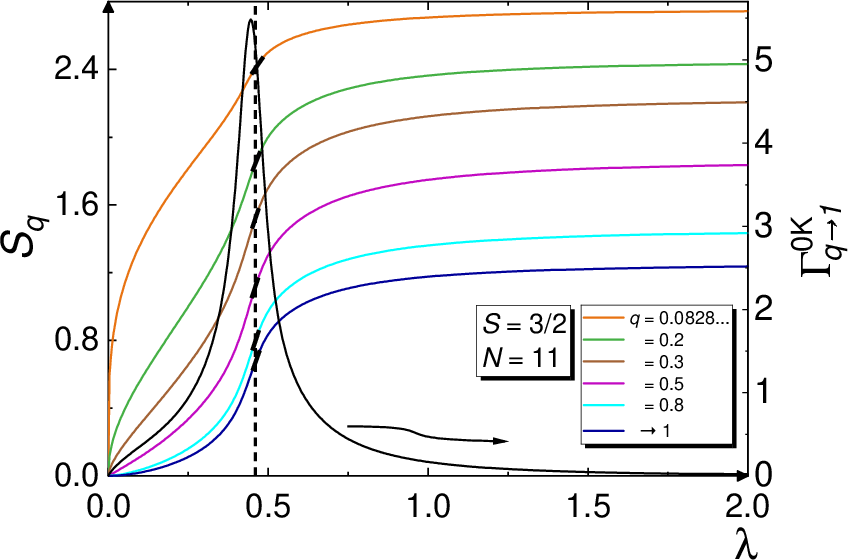
Figure 2: Sq and Γ0Kq→1 versus λ for S=3/2; the enhancement and non-divergence at the critical value λc are evident for appropriate q.
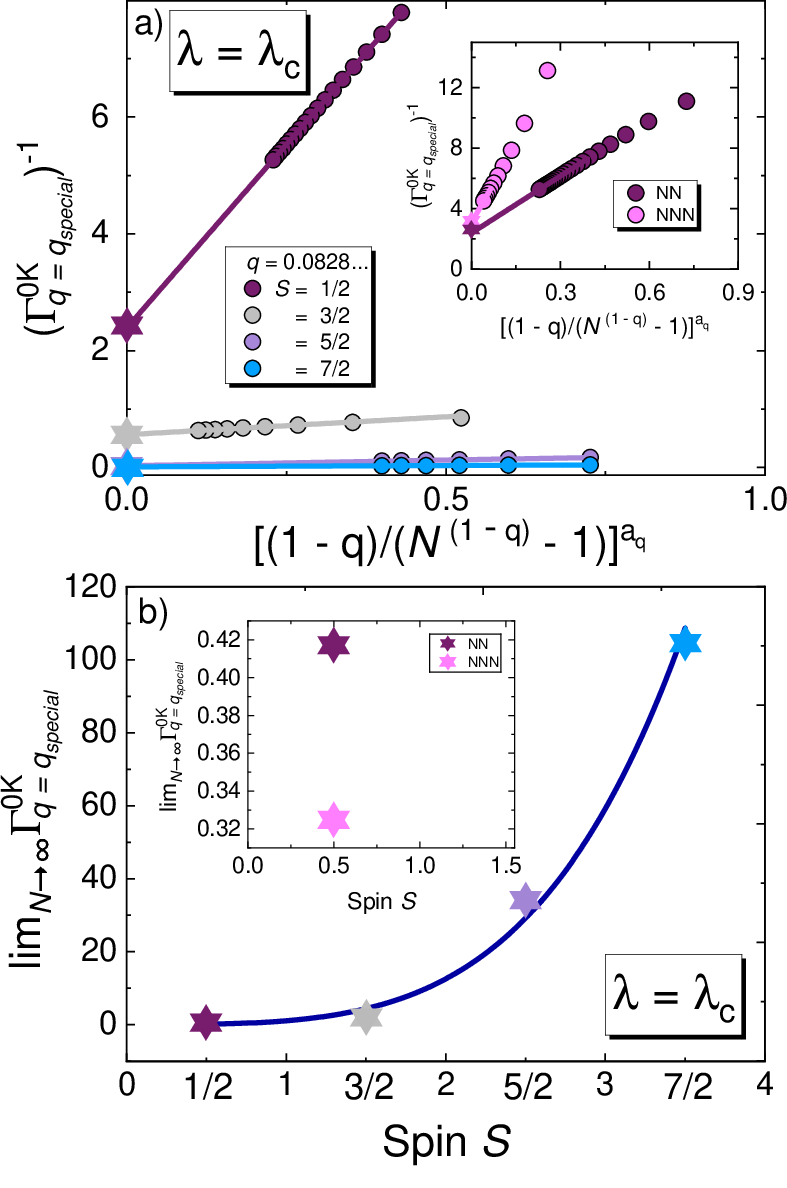
Figure 3: a) (Γ0Kq=qspecial)−1 vs [1/lnqN]aq for various S and NNN couplings; b) scaling of Sq and Γ0Kq=qspecial with S.
Crucially, for fixed qspecial, Γ0Kq=qspecial in the thermodynamic limit is enhanced (but finite) as S increases, scaling nonlinearly as Γ0Kq=qspecial(S)∝[S(S+1)]β with β≈2. The difference between nearest- and next-nearest-neighbor coupling topologies shifts the critical λc but preserves the regularization conferred by qspecial.
Schmidt Decomposition, Block Entropy, and Entropic Extensivity
The analysis exploits the SDT to partition a quantum spin chain into subsystems, computing Sq across varying block sizes L. The extensivity of Sq in subsystem size signals the appropriate description of entanglement at criticality. The critical value qspecial, independent of S within the Ising class, is the unique value that renders Sq(L)∝L in the large L limit at the CP.
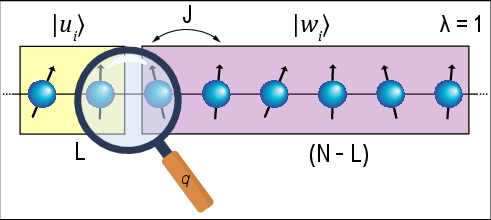
Figure 4: Schematic of SDT partition for a S=1/2 spin chain at CP, where q-entropy is evaluated for subsystem L.
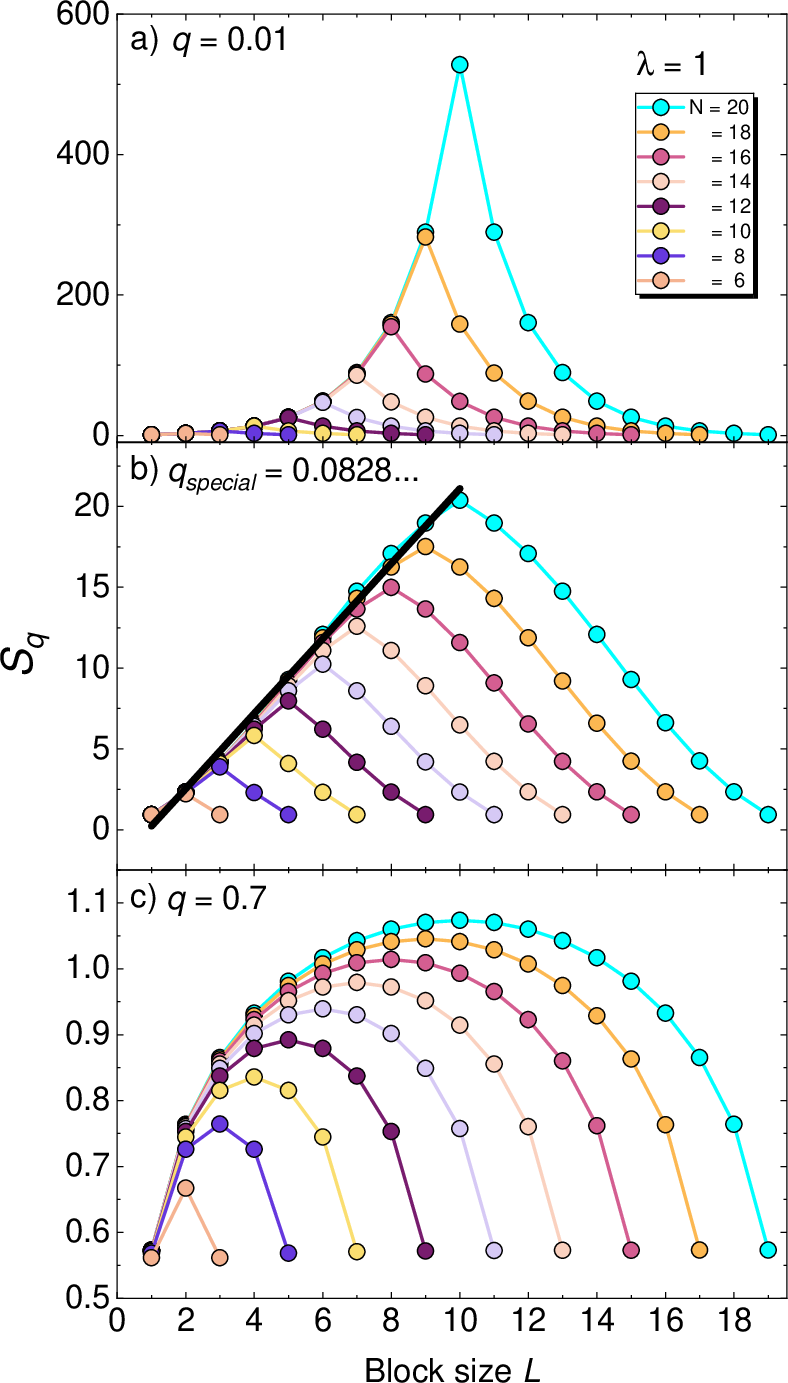
Figure 5: Sq vs block size L for q=0.01<qspecial, q=qspecial, and q=0.7>qspecial; only at qspecial is extensivity recovered.
This property is universal for the Ising symmetry and all S, emphasizing that qspecial regularizes the scaling violations of BG/vN entropy at criticality, in full agreement with earlier predictions for the area-law breakdown. For q<qspecial (q>qspecial), Sq underestimates (overestimates) the effective Hilbert space occupation.
Experimental Proposal for Probing Finite-Size Effects
To probe finite-size effects corresponding to block entropies and Hilbert space occupation, the authors propose a photostrictive experimental setup leveraging ferroelectrics (e.g., SbSI) with entangled dipole degrees of freedom. By systematically varying the illuminated spot size L, one can mimic the variation of subsystem size in theoretical studies, accessing the scaling of Sq and response functions as a function of N in a controlled setting.

Figure 6: Schematic of the photostriction experimental proposal to access finite-size scaling via variable spot size L in SbSI.
Such a protocol, while focusing on ferroelectric systems due to current material limitations, provides a tractable route to experimentally emulate quantum finite-size scaling at CPs, with perspective for quantum magnetic systems as material development progresses.
Theoretical and Practical Implications
The identification that Sq with qspecial regularizes thermodynamic divergences at quantum CPs has several implications:
- The finite Γ0Kq=qspecial at CPs provides a thermodynamically consistent susceptibility and avoids unphysical singularities in the thermodynamic limit, offering a robust diagnostic for universality class and symmetry.
- The precise value of qspecial determines universal entropic scaling and can serve as a benchmark for classifying critical models far beyond the Ising universality class.
- The direct connection established between SDT, Sq, and Hilbert space occupation gives new insight into entanglement structure in many-body systems, informing numerical resource scaling for tensor network or DMRG-based quantum simulation algorithms.
- From an experimental perspective, the photostrictive measurement proposal connects theory with measurable observables in real quantum materials, facilitating further investigation into non-trivial block entropy scaling.
Conclusion
This work provides a rigorous framework for understanding quantum critical phenomena by regularizing thermodynamical divergences at criticality through nonadditive entropy with appropriate entropic index qspecial. The confluence of numerical exact diagonalization, SDT, and entanglement theory yields a comprehensive perspective on universal and non-universal aspects of quantum phase transitions, incorporating arbitrary spin magnitude and extended spin interactions. The explicit scalability of Sq with respect to system parameters and symmetries enables a new class of experimental diagnostics for finite-size effects in quantum-critical and correlated matter, with likely impact on computational quantum many-body physics and quantum information science.