- The paper demonstrates that single-stage silica suspensions can provide adequate isolation under optimistic lunar seismic conditions, with thermal noise as the key limiting factor.
- It develops multi-stage suspension architectures incorporating anti-springs and inverted pendulums to address seismic disturbances under more conservative lunar noise assumptions.
- The study highlights practical engineering challenges, including mechanical survival and lunar dust mitigation, which are crucial for reliable low-frequency gravitational wave detection.
Vibration Isolation Architectures for the Laser Interferometer Lunar Antenna
Scientific Context and Motivation
The Laser Interferometer Lunar Antenna (LILA) is proposed to fill a critical frequency gap in gravitational wave (GW) detection, targeting the 0.1 Hz–10 Hz band that sits between the terrestrial (10 Hz–kHz) and space-based (mHz) observatories. The drastically lower lunar seismic noise environment, compared to Earth, raises the potential for unprecedented low-frequency sensitivity. The design of mechanical suspensions for LILA is driven by both scientific ambition and lunar environmental constraints, with two main modes examined: a fixed-optics approach (LILA Pioneer) and a free-suspended test mass configuration (LILA Horizon). This paper rigorously develops the landscape of suspension solutions for LILA Horizon under a spectrum of plausible lunar seismic conditions.
Fundamental Suspension Requirements
Robust isolation of seismic disturbances in the target band, without introducing limiting thermal or resonant noise, defines the architectural requirements. Quantitatively, test mass seismic motion and suspension thermal noise must both lie beneath the interferometer's design sensitivity across all degrees of freedom. Critical constraints include limiting rigid and flexible-body resonant frequencies to regions outside the detection band, with more stringent demands on the horizontal axis due to intrinsic vertical-horizontal mode coupling imposed by LILA's scale relative to the lunar radius.
One-Stage Room Temperature Suspensions Under Optimistic Seismic Assumptions
Assuming a highly optimistic lunar seismic background—orders of magnitude below the Apollo seismometer upper limits—a simple one-stage suspension architecture emerges as potentially viable. This design (Figure 1) utilizes four room-temperature silica fibers (100 kg mass, up to 1 m fiber length, stress 186 MPa in bending regions, 16 MPa centrally) to support the test mass without vertical springs.
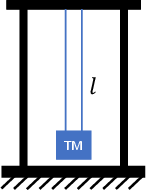
Figure 1: A simple one-stage room temperature suspension model with a 100 kg test mass supported by four silica glass fibers and no cantilever springs for vertical isolation.
Performance analysis reveals that under this optimistic assumption, suspension thermal noise becomes the dominant constraint in the 0.1–10 Hz band. Lowering fiber stress and increasing fiber length can further suppress thermal noise at the lowest frequencies, but at the expense of raising violin and bounce modes into the detection band. The architecture favors low-stress fibers for enhanced mechanical robustness, reversing the traditional Advanced LIGO geometry by employing thinner fiber ends and a wider core, in order to optimally place mechanical resonances outside the detection region.
Multi-Stage Suspensions for Conservative Seismic Assumptions
When analyzed using a more conservative seismic background, simple one-stage suspensions rapidly lose relevance: seismic, not thermal, noise dominates, and increasing test mass or fiber parameters yields no mitigation. The design focus shifts towards complex, multi-stage architectures integrating vertical anti-springs and inverted pendulum (IP) stages (Figure 2).
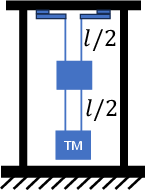
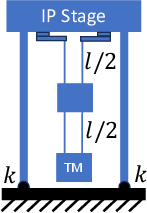
Figure 2: Conceptual multi-stage lunar suspension architectures incorporating vertical anti-springs and, for option (b), a base IP stage, to address high seismic backgrounds.
Two key multi-stage designs are developed:
- Two-Stage Suspension: The upper stage provides vertical isolation via metal (maraging steel) anti-springs, the lower stage maintains a silica fiber test mass.
- Three-Stage Suspension: Adds a massive base stage with IP support, enhancing horizontal isolation.
Detailed noise budgeting shows that traditional high-loss metallic flexures in anti-springs and IPs constrain vertical and horizontal isolation, analogously to post-limited regimes in current terrestrial detectors. Substitution of silica for all flexures in these stages yields significant reductions in suspension thermal noise, conditional on developing sufficiently low-loss, robust silica anti-springs and IP components. The loss magnification due to anti-spring dilution is analyzed, indicating that stiffening without dramatically increasing internal losses is non-trivial and technologically demanding.
Practical Engineering and Environmental Risks
Multiple nontrivial risks must be mitigated:
- Mechanical Survival: Suspensions, especially silica fibers, must withstand launch and landing loads. Mitigation approaches include tension-relief during transit and potential on-site lunar fabrication or assembly.
- Lunar Dust: Electrostatic dust may degrade fiber strength or noise performance. Shielding and contamination control are mandatory.
- Electrostatic Charging: Dielectric charging may impact alignment, actuator function, and noise. Possible fixes include conductive coatings or UV discharge systems.
- Silica Technology Limitations: The non-existence of low-loss, robust, large-scale silica anti-springs and IPs necessitates precursor technology development.
- Fault Tolerance and Redundancy: All critical systems (sensors, actuators, electronics) must be robust to single-point failures and tailored to the lunar environment.
Implications and Forward-Looking Perspective
The seismic background on the Moon remains a central uncertainty. If the ultra-quiet environment is realized, a minimal, robust one-stage suspension with only horizontal isolation suffices, streamlining deployment and risk. If not, the path towards high-performance lunar GW detection requires substantial advances in seismically isolated, low-loss, high-mass suspension systems—a regime distinct from both terrestrial and space missions.
Key architectural choices—number of stages, mass distribution, flexure material—directly affect not only suspension performance but also launch/installation complexity and opportunities for lunar resource utilization (e.g., in-situ regolith for upper stage masses). The research highlights the direct dependence of theoretical science reach and technical/operational feasibility on these detailed engineering decisions.
Conclusion
This study systematically analyzes suspension strategies for LILA, offering a direct correspondence between lunar seismicity, suspension complexity, and achievable GW sensitivity. It shows that if lunar seismic noise is sufficiently low, thermal noise-limited single-stage silica suspensions are adequate; otherwise, advanced multi-stage silicon-based isolation, with associated technology development, is required. The findings underscore that realization of transformative low-frequency lunar GW astronomy is inextricably linked to precise characterization of the lunar environment and, where necessary, ambitious advances in robust, low-loss suspension technology.