- The paper introduces a fluctuating Darcy model that couples dynamic matrix properties to hydrodynamic dissipation, revealing systematic permeability enhancement.
- It employs perturbative and diagrammatic methods to derive the hydrodynamic Green's function and quantify renormalized friction and minor viscosity effects.
- Case studies on breathing, phononic, and actively driven matrices demonstrate practical strategies to tune permeability in nanofluidic and membrane applications.
Hydrodynamic Permeability Modulation by Fluctuating Porous Membranes
Introduction and Motivation
The permeability of porous membranes is foundational to myriad applications in chemical engineering, energy storage, desalination, and nanofluidics. Traditionally, permeability is determined under the assumption of static matrix geometry. However, at the nanoscale, where thermal and active fluctuations become significant, the impact of dynamic matrix configurations on hydrodynamic transport properties demands rigorous assessment. The work reported in "Hydrodynamic permeability of fluctuating porous membranes" (2512.11368) constructs a framework to quantitatively address how spatial and temporal fluctuations of the matrix modulate fluid permeability. By embedding a fluctuating Darcy friction term into the hydrodynamic description, the authors provide a perturbative and diagrammatic theory elucidating fluctuation-induced permeability renormalization, revealing both quantitative and qualitative departures from static theories.
Fluctuating Darcy Model and Theoretical Framework
Central to the analysis is the generalization of the coarse-grained Navier-Stokes-Darcy equation to incorporate a stochastic, space-time-dependent friction coefficient, ξ(X(r,t)), where X is a dynamical parameter encoding internal fluctuations of the matrix porosity or density. This leads to a stochastic hydrodynamic equation of the form
ρm∂t∂v=−∇P+ηΔv−ρmξ(X)v+δf
where v is the fluid velocity, δf is a Gaussian noise term (obeying FDT), and η is the viscosity. The key innovation is the explicit modeling of ξ(X), enabling the direct coupling between matrix dynamics and hydrodynamic dissipation.
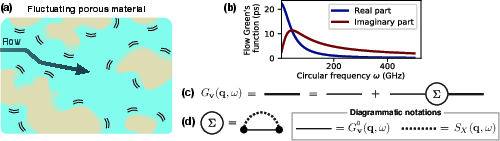
Figure 1: Schematic of fluctuating porous medium, analysis of the Green's function in the static case, diagrammatic Dyson equation for hydrodynamic response, and representation of the fluctuation-induced self-energy Σ.
A perturbative expansion in the stochastic coupling (ξ1) yields, via the Dyson equation, the Green’s function for hydrodynamic response in the presence of matrix fluctuations:
G(q,ω)=q2ν+ξ0−Σ(q,ω)−iω1
Here Σ is the self-energy accounting for fluctuation-induced corrections, formally expressed in terms of the correlation spectrum SX(q,ω) of the internal matrix variable X. This apparatus enables calculation of both the renormalized friction and an apparent viscosity.
Permeability Renormalization: General Results
A primary result is that, under the considered Gaussian, linearly-coupled fluctuation models, the permeability of the fluctuating system is always enhanced relative to the static matrix with the same average properties, i.e., K>K0 for the renormalized permeability K relative to the mean-field prediction K0. This enhancement arises due to quadratic (convex) averaging when friction fluctuates, and is further amplified if the solid’s fluctuation spectrum SX(q,ω) overlaps with the spectrum of hydrodynamic modes (“frequency matching”).
The dimensionless permeability increase is described by
K0K=1−Δξ/ξ01
where Δξ is calculated via an explicit integral over SX and the static Darcy Green's function. The result generalizes previous quasi-static convexity-based enhancements, but crucially shows that the full dynamic spectrum is required: quasi-static estimates are not generally sufficient for realistic fluctuation spectra.
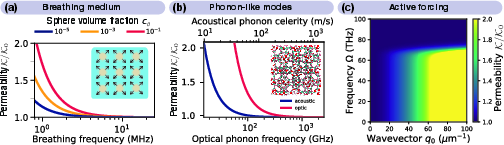
Figure 2: Fluctuation-induced permeability enhancement K/K0 for multiple fluctuation spectra: (a) breathing matrix, (b) phonon-like modes, (c) actively driven matrix.
Case Studies: From Breathing Spheres to Phononic and Active Matrices
Breathing Array of Spheres
A model system of fluctuating spherical inclusions in a matrix, each executing overdamped breathing oscillations, provides a canonical example. The analytical result shows that, for slow fluctuations, permeability enhancement is proportional to the variance of sphere radius fluctuations. For high-frequency breathing, the effect vanishes as the correlation decouples from hydrodynamics—a nontrivial dynamical limit.
Membranes with Phononic Fluctuations
Matrix fluctuations with acoustic or optical phonon-like spectral features are modeled using a continuum elastic field, with X(r,t) linked to local strain. Calculations indicate that “soft” matrices (low sound velocity or low-frequency phonons) strongly enhance permeability, with K/K0 scaling inversely with the square of sound velocity in the low-frequency regime, and quantitative corrections arising from dynamic matching of phonon and hydrodynamic frequencies. The dynamic theory strongly overshoots the quasi-static result in the regime where the spectra overlap.
Active Forcing
Externally driven matrices, modeled via structure factors sharply peaked at chosen (q0,Ω), allow for active permeability modulation. Enhancement peaks in regions of frequency-wavevector space where the induced matrix dynamics synchronizes with fluid hydrodynamics, and is suppressed at high excitation frequency. This points to the feasibility of externally tuning hydrodynamic permeability via targeted active forcing in designed nano-membranes.
Viscosity Renormalization
Beyond permeability, the formalism yields a correction Δν to the apparent fluid viscosity via the q2-expansion of the self-energy. However, numerical estimates and analytical scaling show this effect is negligible in most regimes of interest (Figure 3).
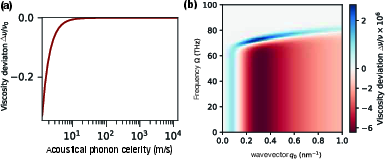
Figure 3: Fluctuation-induced viscosity deviation Δν/ν0 for fluctuating-phonon and actively-driven matrices, demonstrating the minor role of viscosity corrections.
Implications and Future Directions
The theory has immediate implications for the design and optimization of nanofluidic and membrane-based separation technologies. The finding that permeability can be controllably enhanced—by tailoring matrix fluctuation spectra, “softening” the matrix, or even applying external active drives—suggests an unexplored route for disrupting established permeability-selectivity tradeoffs, which are fundamental in filtration and energy conversion applications [Marbach & Bocquet, Chem. Soc. Rev. 2019; Elimelech et al., Science 2017]. Furthermore, the methodology—rooted in hydrodynamic Green's function resummation and diagrammatic expansions—enables systematic inclusion of higher order fluctuation effects and may be extended to non-Gaussian statistics and correlated solid-fluid fluctuations.
On a more fundamental level, the results prompt new theoretical questions regarding permeability reduction for large, non-Gaussian fluctuations, as well as the role of anisotropic or glassy matrix dynamics, which are not covered by the minimal linear, isotropic model.
Possible future research avenues include:
- Numerical molecular dynamics incorporating complex solid dynamics and correlation with fluid flow [Coasne et al., in preparation].
- Extension to solid-liquid coupling including nonlinear hydrodynamics, active noise, and strong deviations from linear response.
- Exploiting active matrix control for on-the-fly permeability tuning in separation membranes or energy harvesting devices.
Conclusion
This work establishes a diagrammatic, dynamical theory for hydrodynamic permeability in fluctuating porous media, demonstrating that matrix fluctuations—especially those that are spectrally matched to the fluid’s hydrodynamics—produce systematic and sometimes dramatic permeability enhancement beyond conventional static expectations. The formalism provides a unified perspective for understanding experimental anomalies (e.g. unexpectedly high fluxes in flexible membranes, nanostructured soft carbons, or biological channels) and supplies a foundation for engineering next-generation, actively-tunable, high-efficiency membranes. The interplay and “frequency matching” between matrix and hydrodynamic fluctuations emerges as a keystone principle for rational nanofluidic design.
References:
- "Hydrodynamic permeability of fluctuating porous membranes", (2512.11368)
- Marbach S, Bocquet L. "Osmosis, from molecular insights to large-scale applications." Chem. Soc. Rev. 2019
- Elimelech M et al. "Maximizing the right stuff: The trade-off between membrane permeability and selectivity." Science 2017