- The paper demonstrates that Kerr-type nonlinearity robustly preserves quantized soliton transport in disordered Thouless pumps by maintaining an energetic spectral gap.
- It employs a combination of discrete nonlinear Schrödinger equation analysis and experimental waveguide array studies to quantify soliton displacement and transport fidelity.
- The study reveals critical disorder thresholds where nonlinear bifurcations trigger the breakdown of quantized transport, highlighting enhanced operational speeds and robustness.
Quantized Soliton Transport in Disordered Nonlinear Thouless Pumps
Introduction and Background
Quantized transport phenomena, originating from the theoretical foundations of the integer quantum Hall effect, are paradigmatic for topological phases of matter. The Thouless pump—a one-dimensional system with an adiabatically modulated periodic potential—naturally realizes quantized charge transport per cycle, governed by the Chern number of the associated Bloch band. While topological pumping in the linear regime for both fermionic and bosonic systems has been extensively studied, quantized transport in linear bosonic Thouless pumps is intrinsically fragile to disorder due to band mixing. However, recent theoretical developments have highlighted that nonlinearity, specifically Kerr-type interactions supporting soliton formation, enables robust quantized transport, which remarkably persists even in the presence of moderate disorder.
This work presents a comprehensive theoretical and experimental investigation into the robustness of quantized Thouless pumping for nonlinear (soliton-supporting) photonic waveguide arrays under disorder. It demonstrates that nonlinearity fundamentally enhances the topological protection of quantized transport, enabling operation beyond the adiabatic regime and outperforming traditional linear implementations.
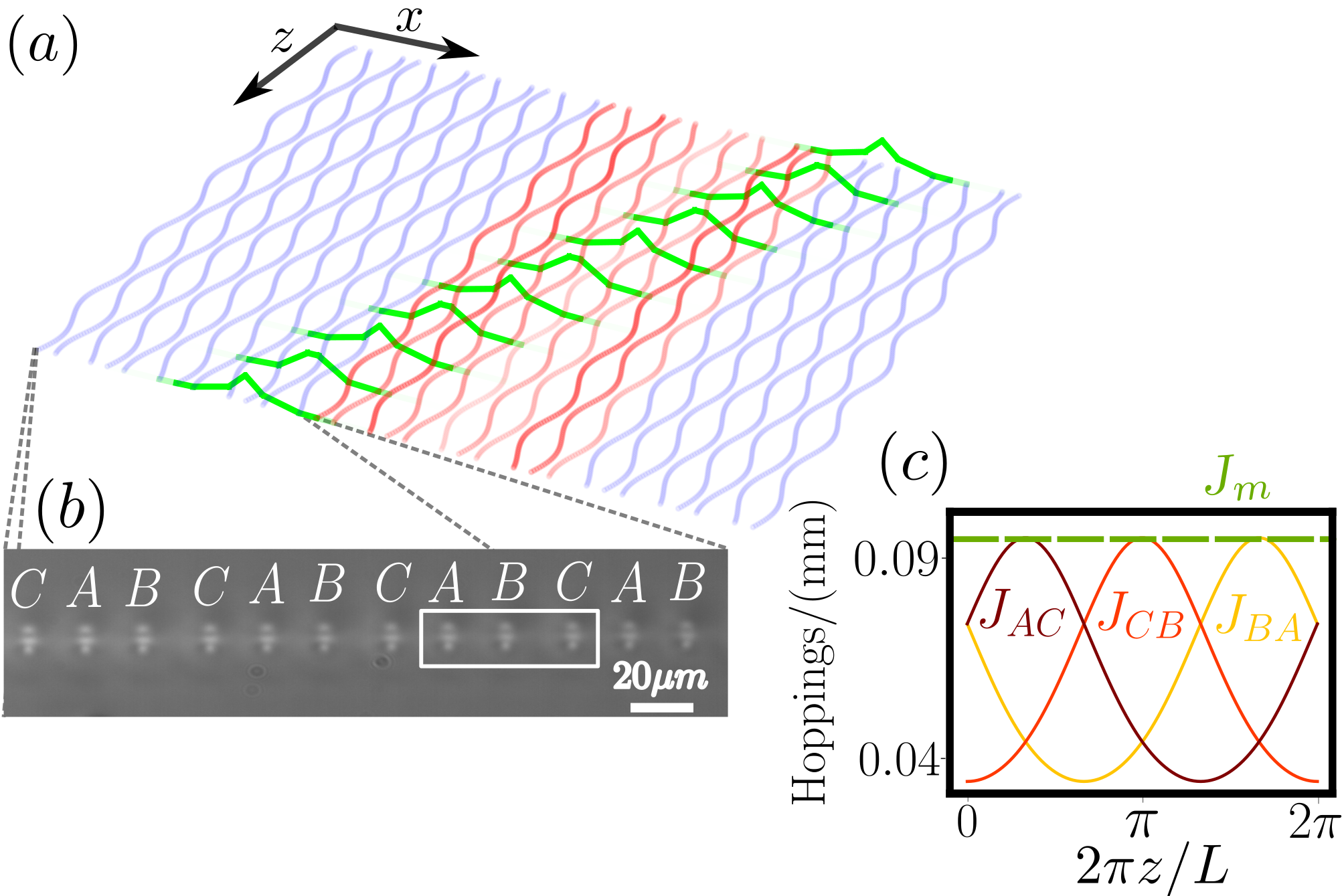
Figure 1: Nonlinear Thouless pumping in an optical waveguide array. (a) Schematic of a disordered Thouless pump, (b) image of waveguide array output facet, (c) spatial modulation of hopping strength over one period.
Theoretical Model and Numerical Analysis
The physical system is an array of coupled single-mode optical waveguides, with the modulation and disorder encoded in the inter-site hopping strength and on-site energies, respectively. The evolution along the propagation direction z is governed by the discrete nonlinear Schrödinger equation (DNLSE):
i∂zϕn(z)=Jn(z)ϕn+1(z)+Jn−1(z)ϕn−1(z)−g∣ϕn(z)∣2ϕn(z)+Vnϕn(z)
where g denotes Kerr nonlinearity strength and Vn captures both single-site defects and multi-site disorder. The modulation profile implements the Thouless pump, with three-site unit cells and periodic hopping variation, generating nontrivial band Chern numbers.
Numerical simulations begin with the computation of stationary solitons in the absence and presence of disorder, followed by time-dependent propagation under adiabatic modulation and varying disorder strengths.
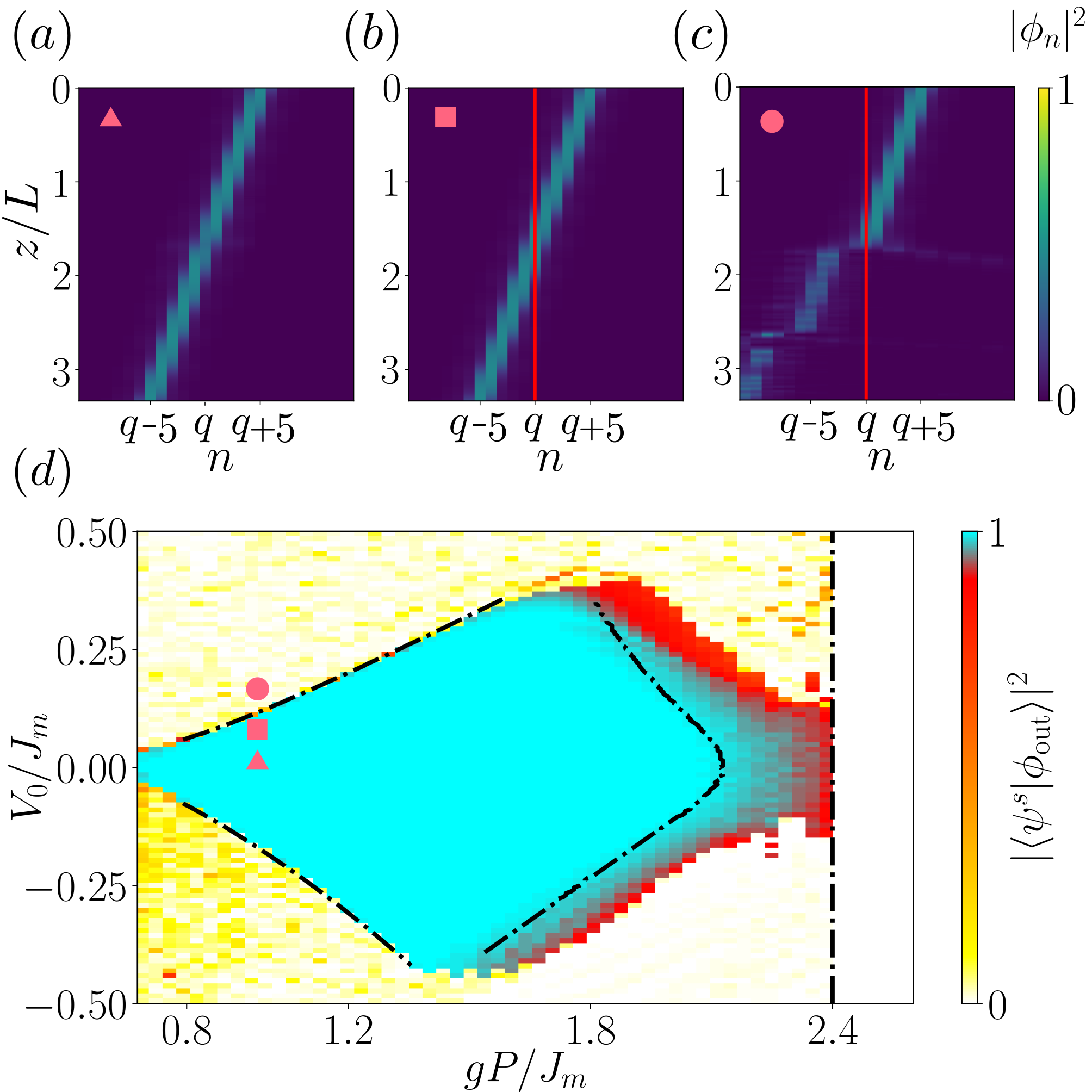
Figure 2: Numerical simulations of soliton pumping across a single defect for increasing defect strengths, and phase diagram of transmission versus nonlinearity and defect strength.
These studies reveal a sharply defined regime in which the soliton displacement per pump cycle is perfectly quantized and robust against disorder. Breakdown of quantized transport occurs at critical defect or disorder strengths, accompanied by nonlinear bifurcations of the stationary soliton states. Both low-power and high-power regimes exhibit distinct mechanisms for this breakdown, including gap closures in the soliton linearized spectrum and pitchfork-type bifurcations.
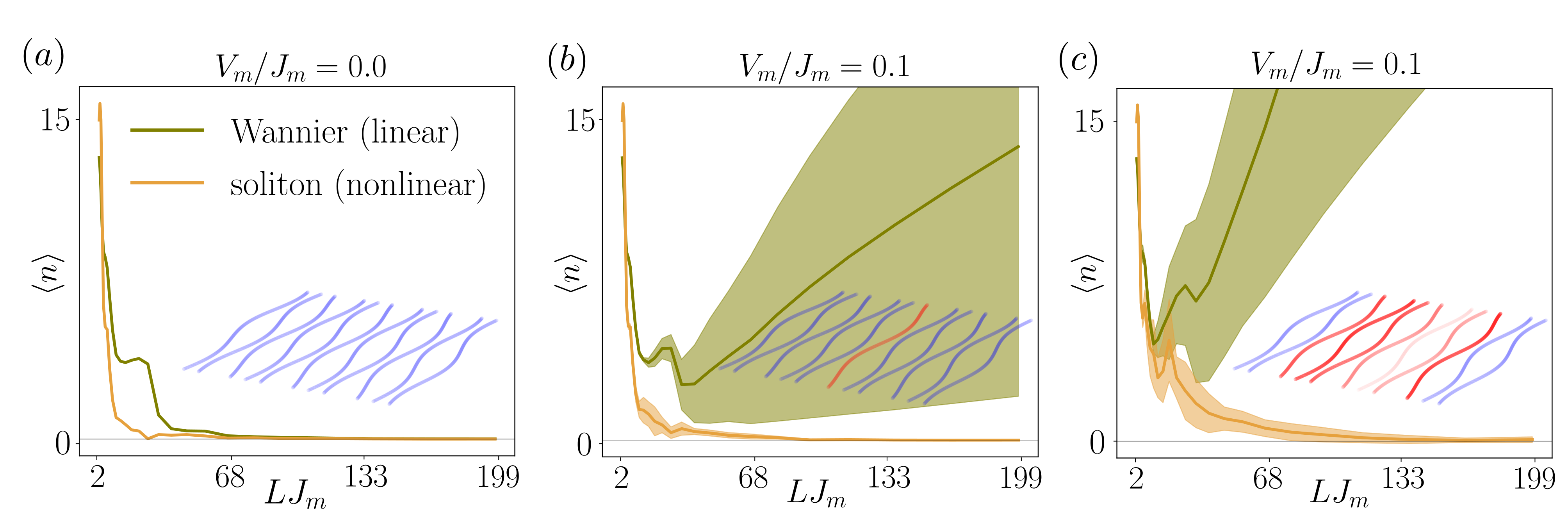
Figure 3: Deviation from perfect pumping for Wannier functions (linear) and solitons (nonlinear) in clean, singly-defected, and disordered regions; solitons exhibit robust quantization even in disorder.
A direct comparison shows that while Wannier functions (linear regime) lose quantized displacement with minimal disorder or non-adiabaticity, solitons maintain near-ideal quantized transport due to the nonlinearly induced energetic spectral gap.
Experimental Implementation and Results
Experimental realization uses femtosecond-laser-written waveguide arrays with precisely engineered spatial modulations and controlled defect/disorder introduction by varying the laser writing speed. Solitons are excited using stretched femtosecond pulses, and transport is monitored by imaging the output facet.
Phase diagrams are obtained by measuring the fraction of soliton power transferred to the target waveguide, as a function of both defect/disorder strength and input power (nonlinearity). The experiments confirm the theoretical predictions, displaying a robust regime of quantized soliton transport through both single defects and extended disordered regions, in agreement with numerical results.
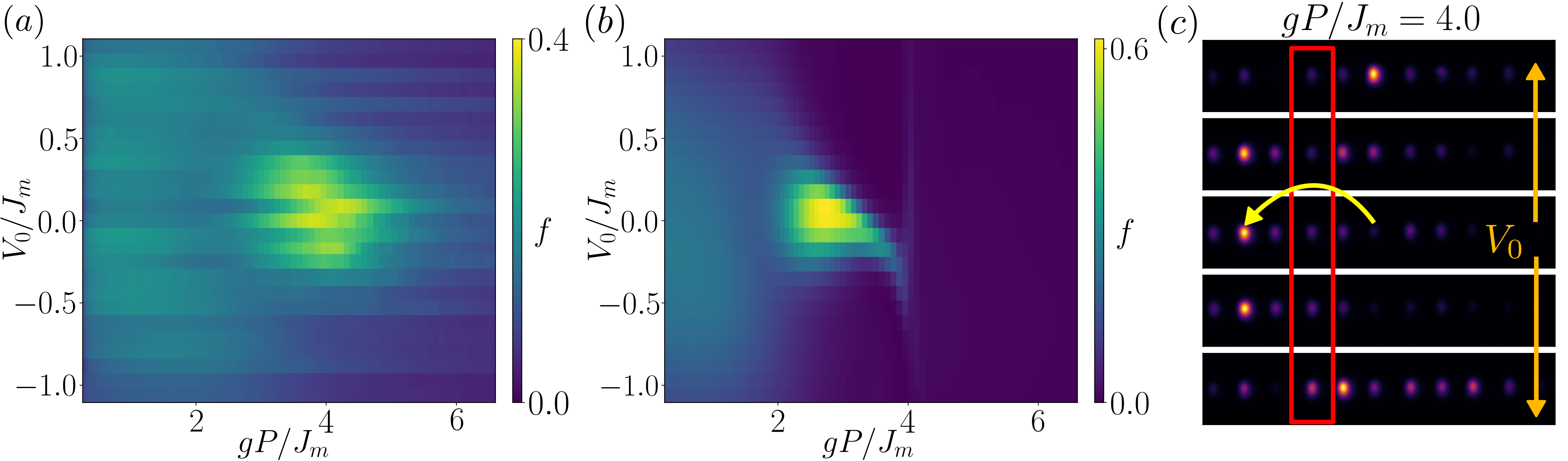
Figure 4: Experimental observation of soliton transfer through a single defect—a clear regime of quantized pumping consistent with simulation.
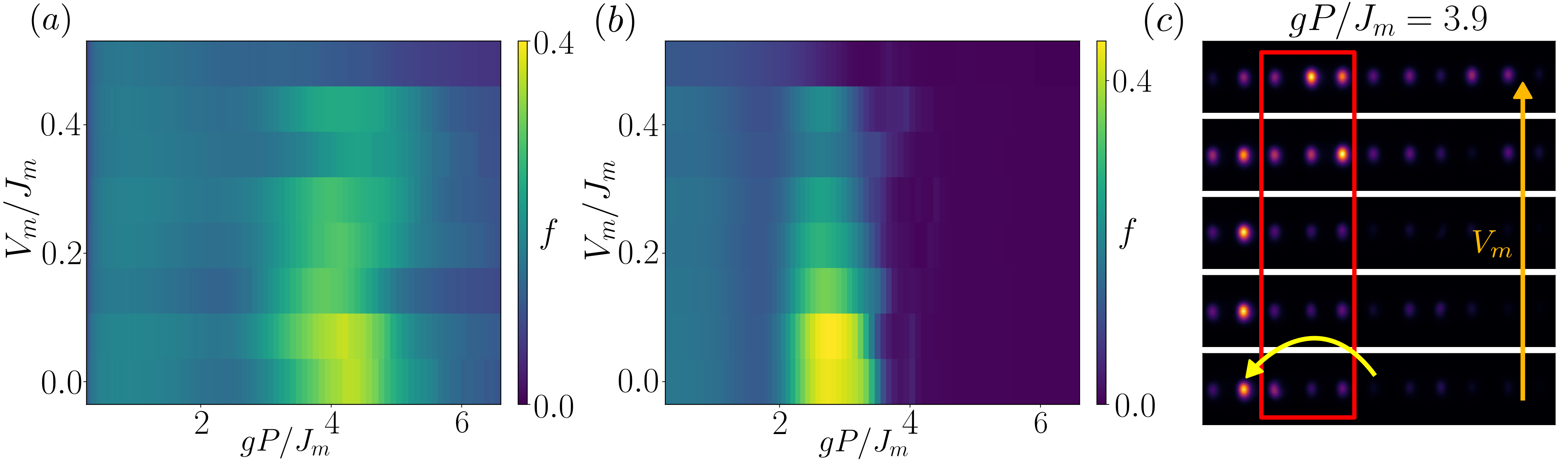
Figure 5: Experimental results for soliton pumping through a three-site disordered region; robust transport persists up to significant disorder strengths.
The data demonstrate that increasing the input power enhances the robustness of the soliton transport, while sufficiently large defect or disorder strength induces abrupt breakdown, in correspondence with nonlinear bifurcation theory.
Bifurcation Analysis and Topological Protection
Detailed bifurcation analysis reveals that quantized transport persists as long as the instantaneous soliton branch remains gapped from the extended states during the pump cycle. At the critical disorder, the soliton state coalesces with an unstable branch or undergoes pitchfork bifurcation (depending on power regime), beyond which the correspondence between topological winding and quantized transport fails.
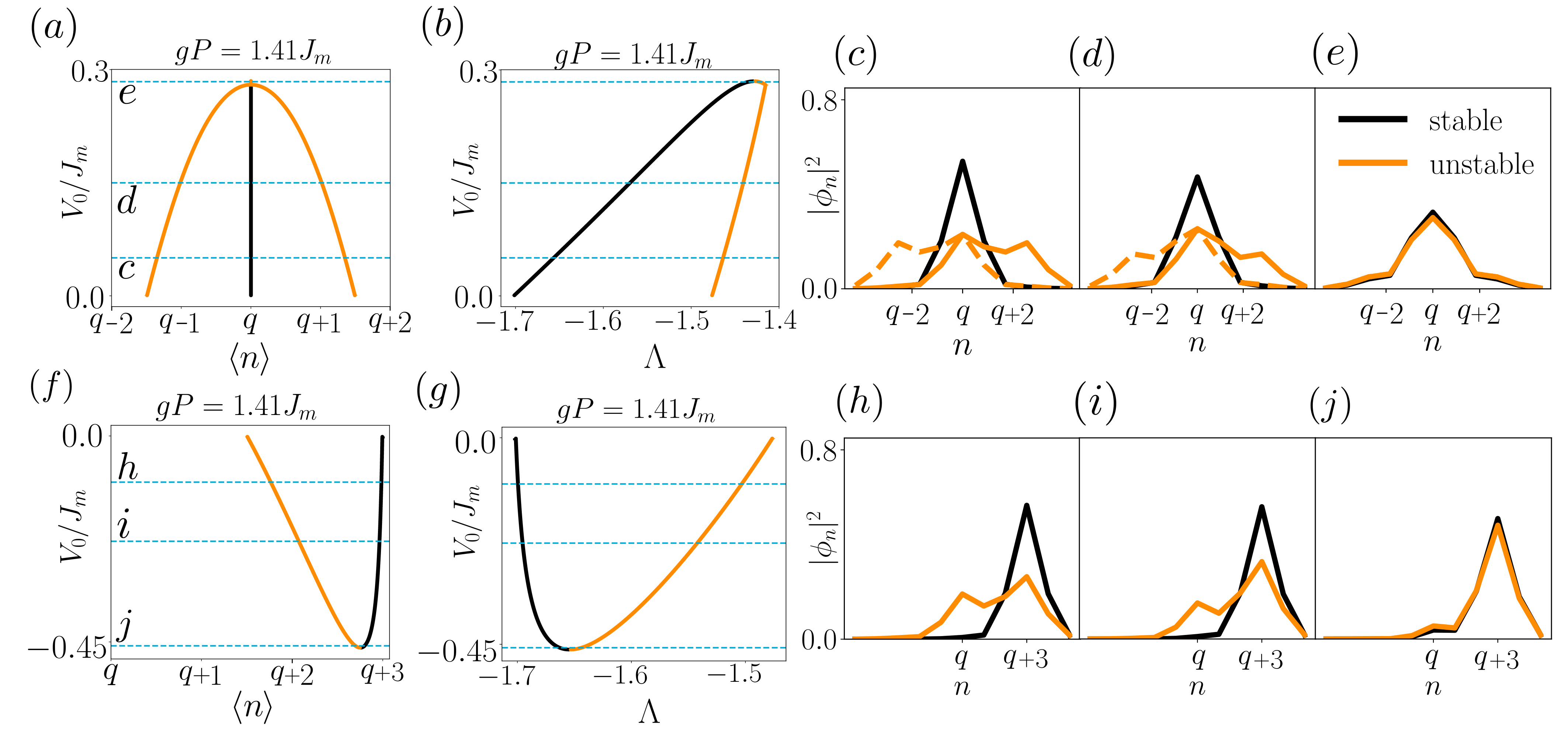
Figure 6: Bifurcation diagrams showing soliton center of mass and eigenvalue evolution as a function of defect strength, for both positive and negative defects.
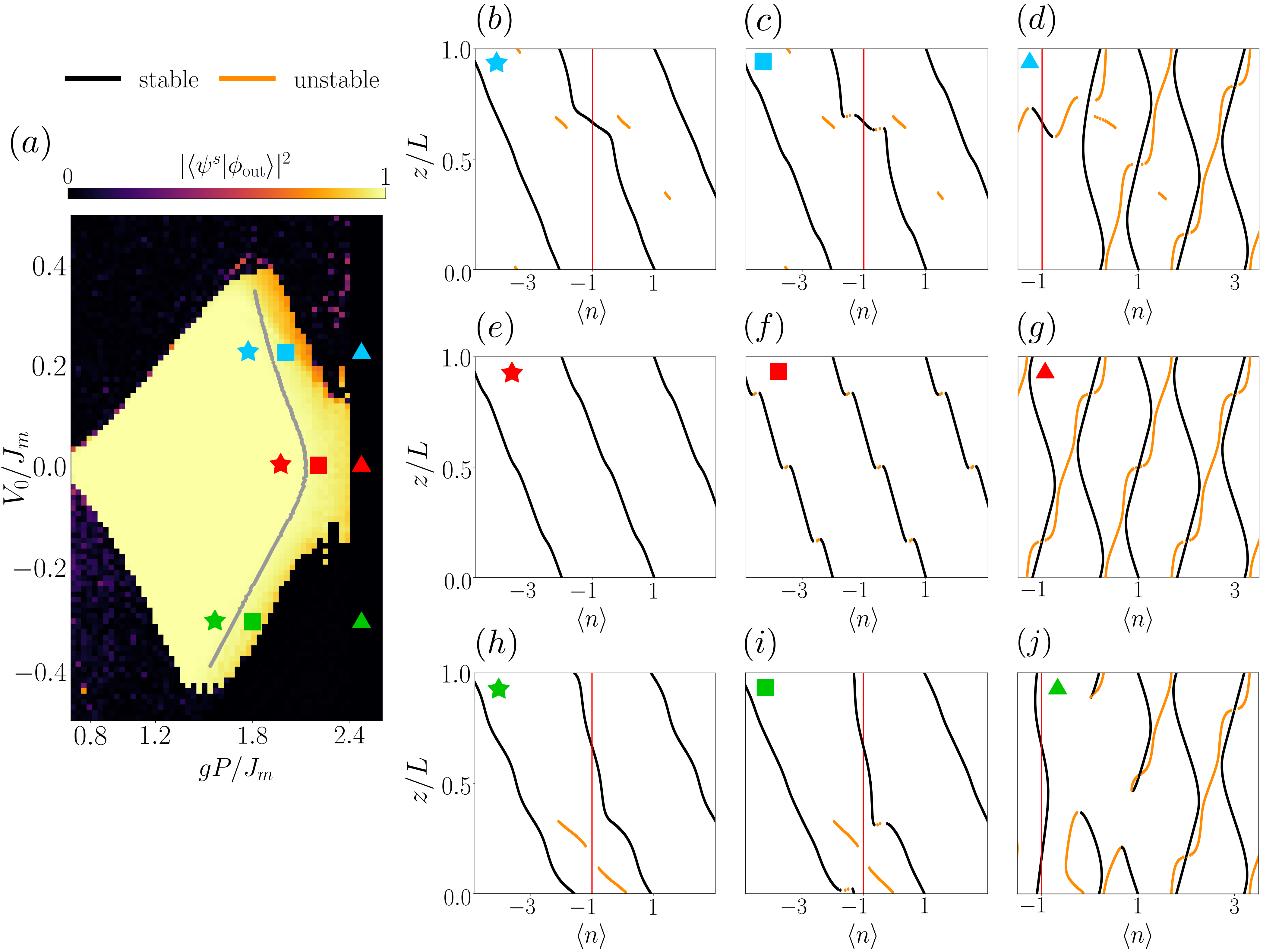
Figure 7: High-power regime pitchfork bifurcations and real-space trajectories of the soliton center of mass for different disorder conditions.
These nonlinear transitions are singular to the strongly interacting (nonlinear) regime and play a key role in protecting transport up to a well-defined threshold of disorder and enabling operation with shorter pump periods (i.e., non-adiabatically).
Implications and Future Perspectives
The results demonstrate that soliton-based Thouless pumps represent a class of topological transport systems wherein nonlinearity acts not as a perturbation but as a fundamental enhancer of quantized transport robustness and operational speed. The practical implications are broad:
- Integrated Non-Reciprocal Photonics: The robustness against disorder and potential for non-adiabatic operation establish design principles for time-modulated, highly miniaturized photonic isolators and circulators.
- Generalization to Interacting Topological Phases: The observed phenomena invite further study into the interplay of topology and nonlinearity, including fractional quantization and the role of many-body gap closures in classical and quantum engineered systems.
- Extension to Higher Dimensions and Non-Abelian Band Structures: The methodologies may be adapted to study quantized pumping in higher-dimensional and more complex topological bands, including non-Abelian pumping protocols.
Conclusion
This paper presents a detailed theoretical and experimental study of quantized soliton transport in disordered nonlinear Thouless pumps. Soliton-based topological pumps are shown to fundamentally outperform their linear counterparts in robustness to both disorder and finite modulation speed. The quantized transport persists up to a well-characterized critical disorder/bifurcation threshold determined by the nonlinear spectrum. These findings elevate nonlinear topological photonics as a promising direction for both fundamental studies and practical device applications in robust classical and quantum transport (2512.11394).