Numerical investigation of kinetic instabilities in BGK equilibria under collisional effects
Published 12 Dec 2025 in physics.plasm-ph | (2512.11478v1)
Abstract: An unstable one-dimensional Bernstein-Greene-Kruskal (BGK) mode has been studied through high-precision numerical simulations. The initial turbulent, periodic equilibrium state is obtained by solving a Vlasov-Poisson system for initially thermalized electrons, with the addition of an external electric field able to trigger undamped, high-amplitude electron acoustic waves (EAWs). Once the external field is turned off, resonant particles are trapped in a stationary two-hole phase-space configuration. This equilibrium scenario is perturbed by some large-scale density noise, leading to an electrostatic instability with the merging of vortices into a final one-hole state. Numerical runs investigate several features of this regime, focusing on the dependence of the instability trigger time and growth rate on the rate of short-range collisions and grid resolution. According to Landau theory for weakly inhomogeneous equilibria, we observe that the growth rate of the instability depends only on the slope of the distribution function in the resonant region. Conversely, the onset time of the instability is affected by the collisional rate, which is able to postpone the onset of the instability. Moreover, by extending the simulations to a long-time scale, we investigate the saturation stage of the instability, which can be analyzed through the Hermite spectral analysis. In collisionless simulations where grid effects are negligible, the Hermite spectrum follows a power law typical of a constant enstrophy flux scenario. Otherwise, if collisional effects become significant, a cutoff is observed at high Hermite modes, leading to a decaying trend.
The paper demonstrates that collisionality delays vortex merging without significantly altering the instability growth rates (<10% suppression).
It employs high-resolution Vlasov–Poisson simulations with Hermite spectral diagnostics to resolve fine-scale velocity-space structures and enstrophy cascades.
The findings indicate that weak collisions modulate nonlinear phase-space dynamics, offering practical insights for plasma modeling and turbulence analysis.
Numerical Investigation of Kinetic Instabilities in BGK Equilibria under Collisional Effects
Introduction
This study provides a comprehensive numerical analysis of kinetic instabilities emerging in 1D Bernstein–Greene–Kruskal (BGK) equilibria, focusing on the interplay between nonlinear phase-space dynamics and collisional dissipation using high-resolution Vlasov-Poisson simulations. The research targets the turbulence-driven energy transfer and enstrophy cascade in both collisionless and weakly collisional plasma, exploiting Hermite spectral diagnostics to elucidate the evolution and dissipation of fine-scale velocity-space structures.
Physical Model and Simulation Methodology
The core physical system is governed by the 1D-1V Vlasov–Poisson equations for kinetic electrons and static ions, with dimensionless normalization. Collisions are incorporated through a nonlinear Dougherty operator, with the plasma collisionality parameterized via g. The simulation framework employs Nx=8192 and Nv=8001 grid points, ensuring spectral convergence and negligible numerical dissipation up to the highest accessible velocity-space Hermite modes. The equilibrium is generated by saturating electron acoustic waves (EAWs), leading to a two-vortex BGK structure, perturbed by ultra-weak large-scale density noise. The Hermite decomposition, with M=800 modes, resolves the velocity PDF structure with high accuracy for both core and tail populations, supporting robust spectral analysis.
Phase-Space Evolution: Vortex Merging and Collisional Delay
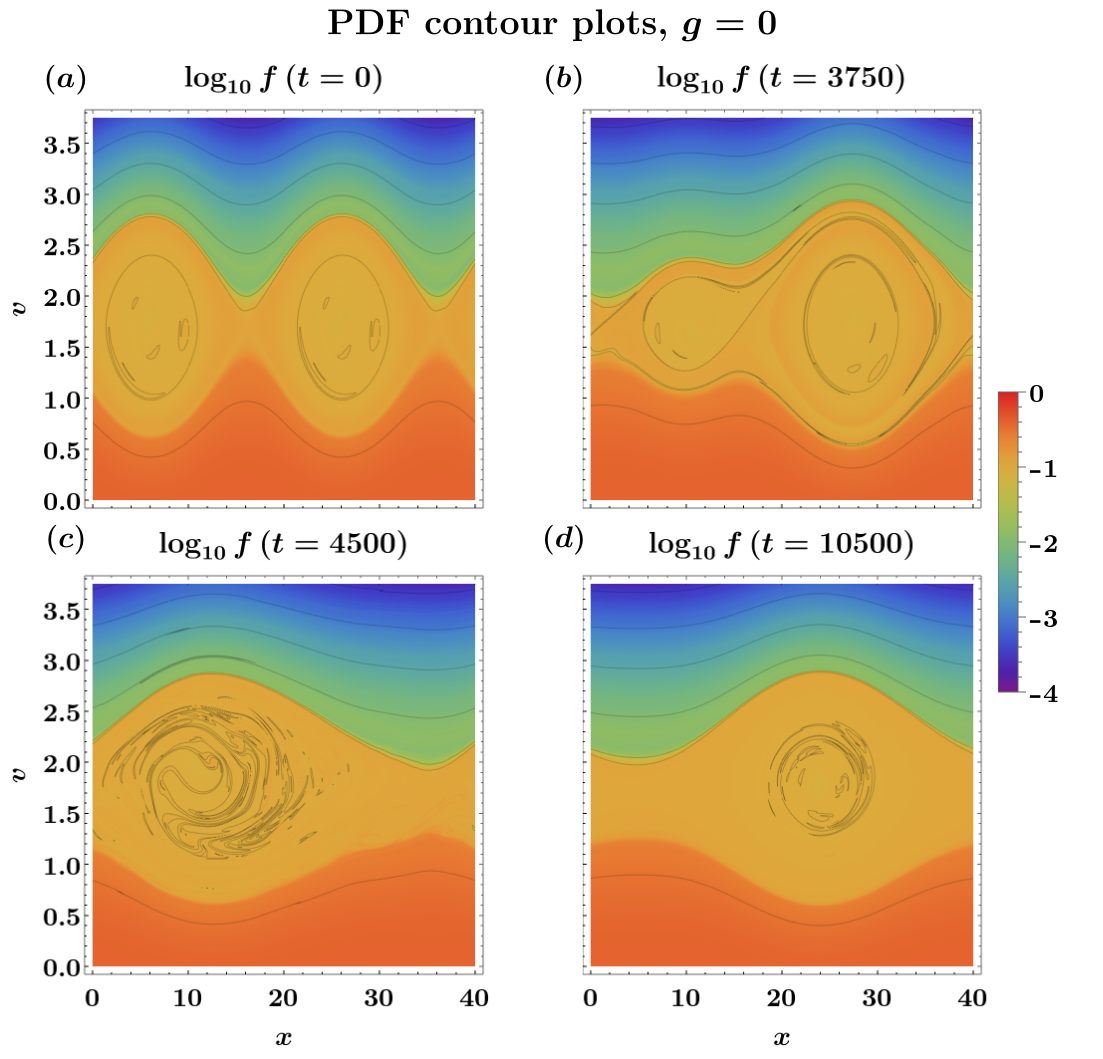
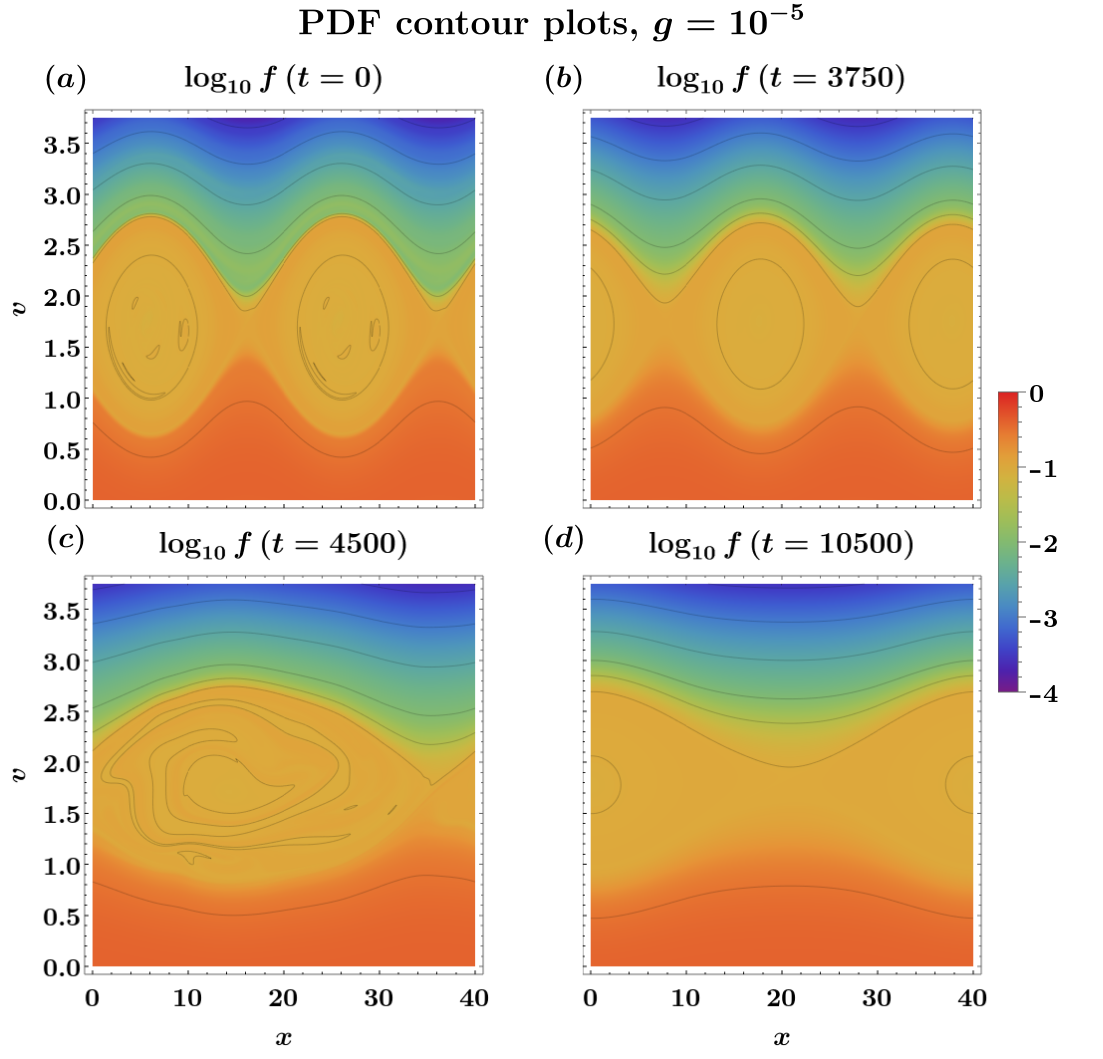
The nonlinear dynamics, after perturbation to the BGK equilibrium, are driven by phase-space trapping and de-trapping processes. The prominent feature is the slow merging of two phase-space vortices into a single persistent electron hole, corresponding to the nonlinear saturation of the instability. Collisional effects, even for g≪1, manifest principally as a delay in the non-linear onset: the vortex merging phase is appreciably postponed in collisional runs compared to the collisionless case.
Figure 1: Phase-space electron distribution contours reveal the initial two-hole BGK state and ensuing merging/relaxation in the collisionless case.
Figure 2: With g=10−5, the vortex merging is delayed, but the final state converges to a single electron hole as in the collisionless regime.
The comparative analysis of Figures 1 and 2 quantitatively demonstrates how collision-mediated velocity-space diffusion suppresses and delays the nonlinearity associated with phase-space fine structures, consistent with Landau theory for weakly inhomogeneous equilibria.
Growth Rate and Trigger Time: Dependency on Collisionality
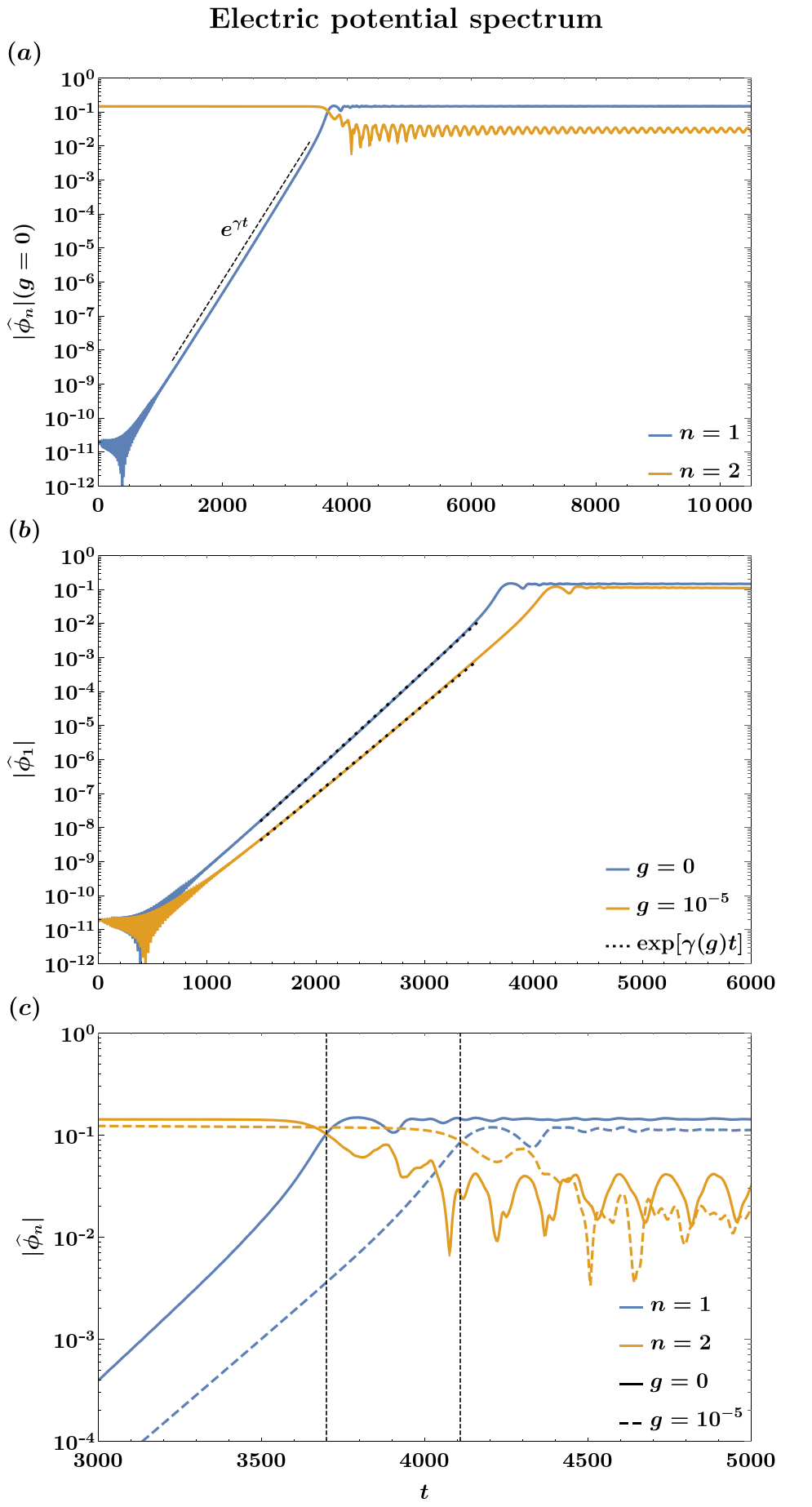
The spectral evolution of electric potential Fourier modes (∣ϕn∣ for n=1,2) is analyzed to extract both the instability growth rate γ and the trigger/crossing time τcross. The key findings are:
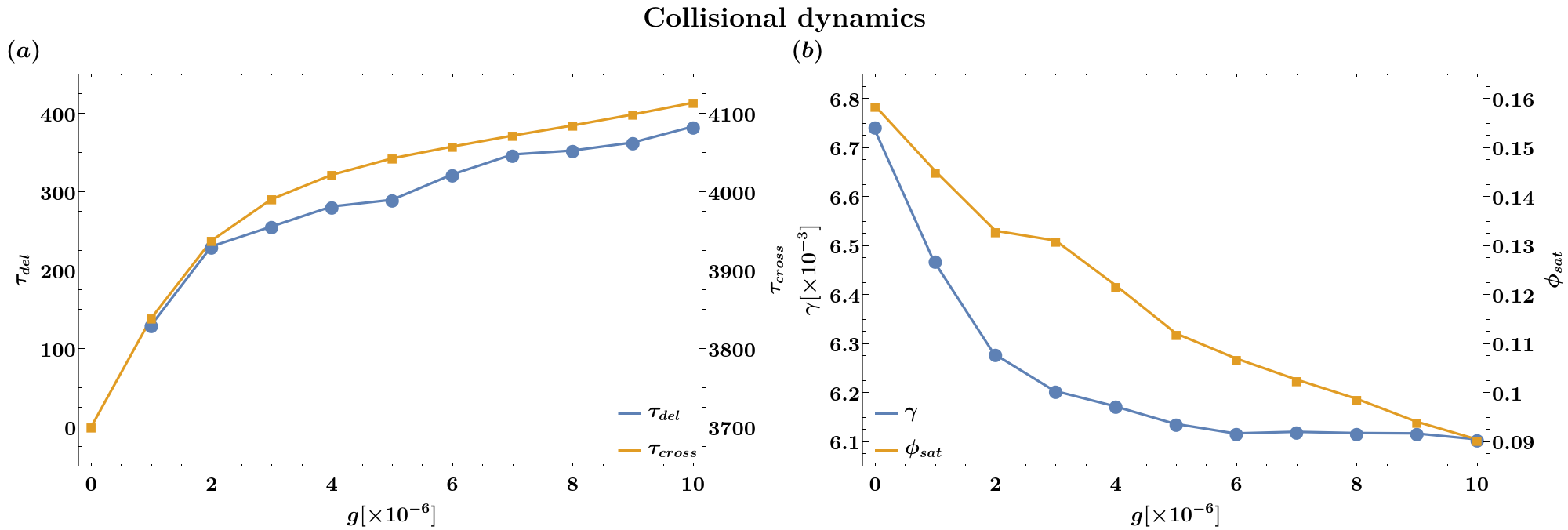
The nonlinear growth rate γ displays weak sensitivity to the collisional parameter g, with <10% suppression relative to the collisionless value.
The onset time τcross—when the fundamental mode overtakes the second harmonic—is robustly delayed as g increases.
Figure 3: Fourier mode amplitudes and their crossings elucidate collisional effects on growth and trigger times.
Figure 4: Delay time τdel and instability growth rate γ as functions of collisionality, illustrating the selective sensitivity of onset time versus mode amplitude.
These results reinforce that collisionality tunes the temporal window for nonlinear phase-space rearrangement without substantially altering the instability drive set by the local slope of the distribution function at resonance.
Hermite Spectral Diagnostics and Enstrophy Cascades
A velocity-space Hermite decomposition is employed to quantify the enstrophy spectrum during and after nonlinear evolution. The key Hermite diagnostics include:
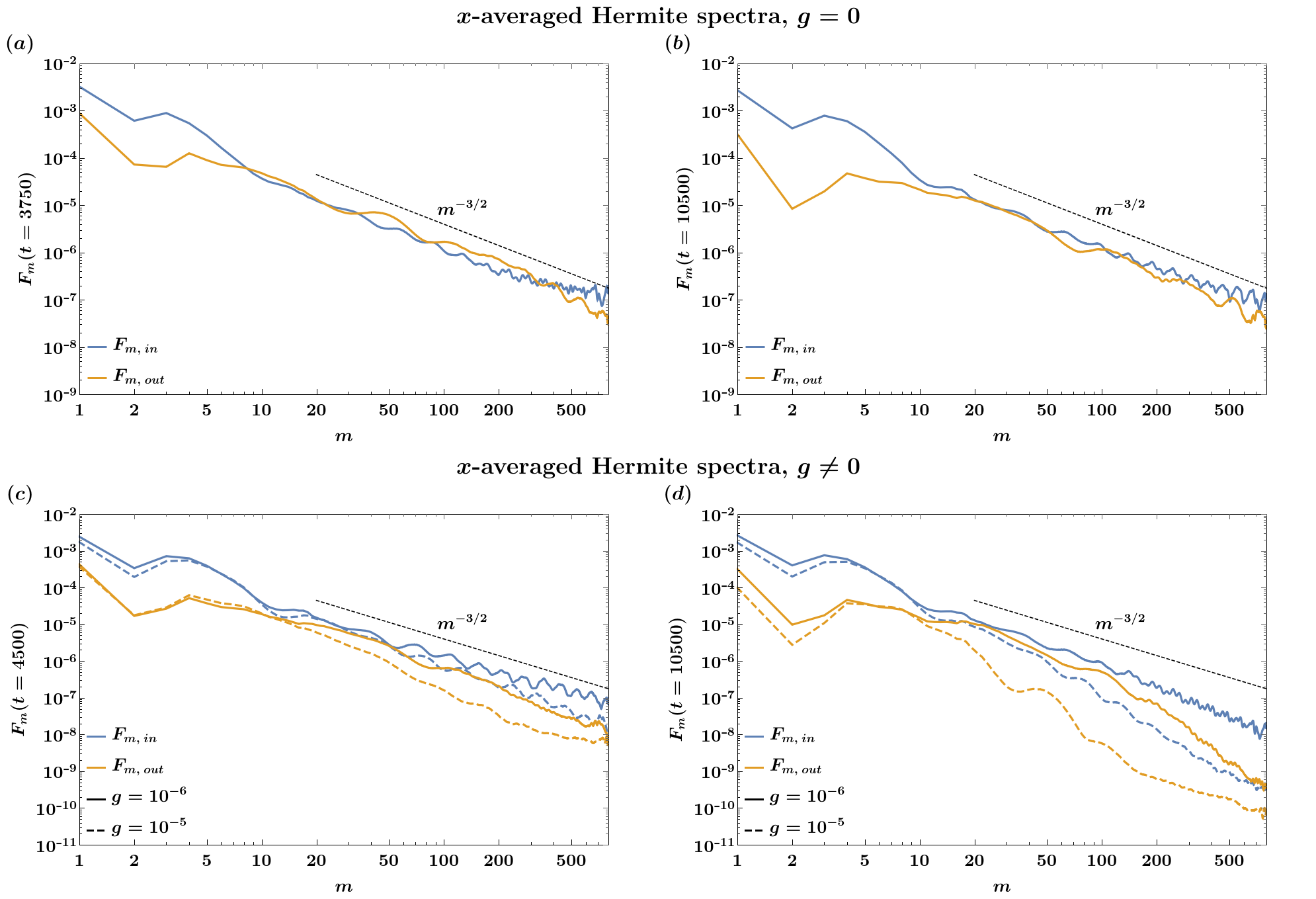
Fm(t)=⟨fm2⟩x: spatially-averaged Hermite energy spectrum,
Fm,in, Fm,out: energy within/outside the vortex region.
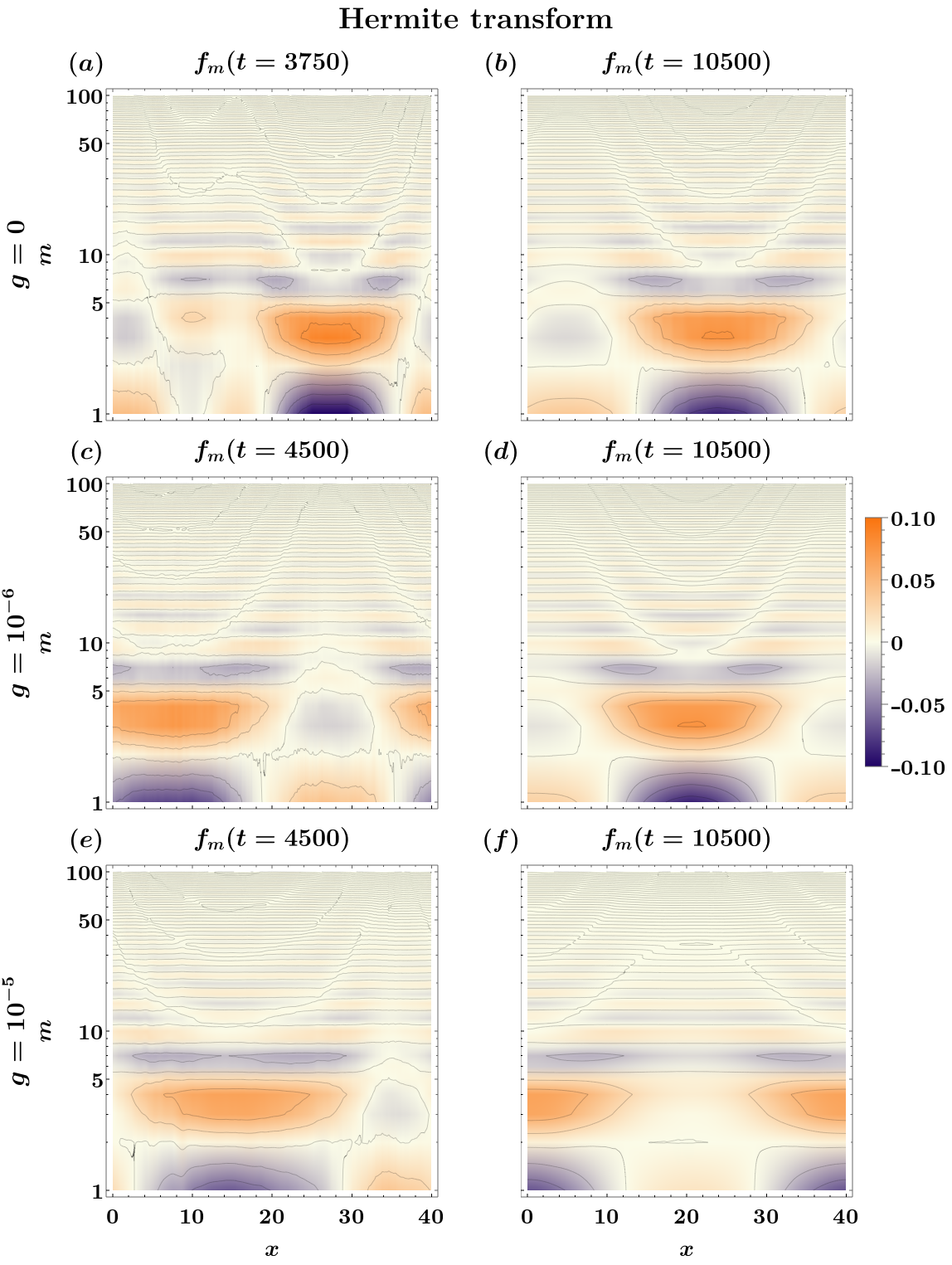
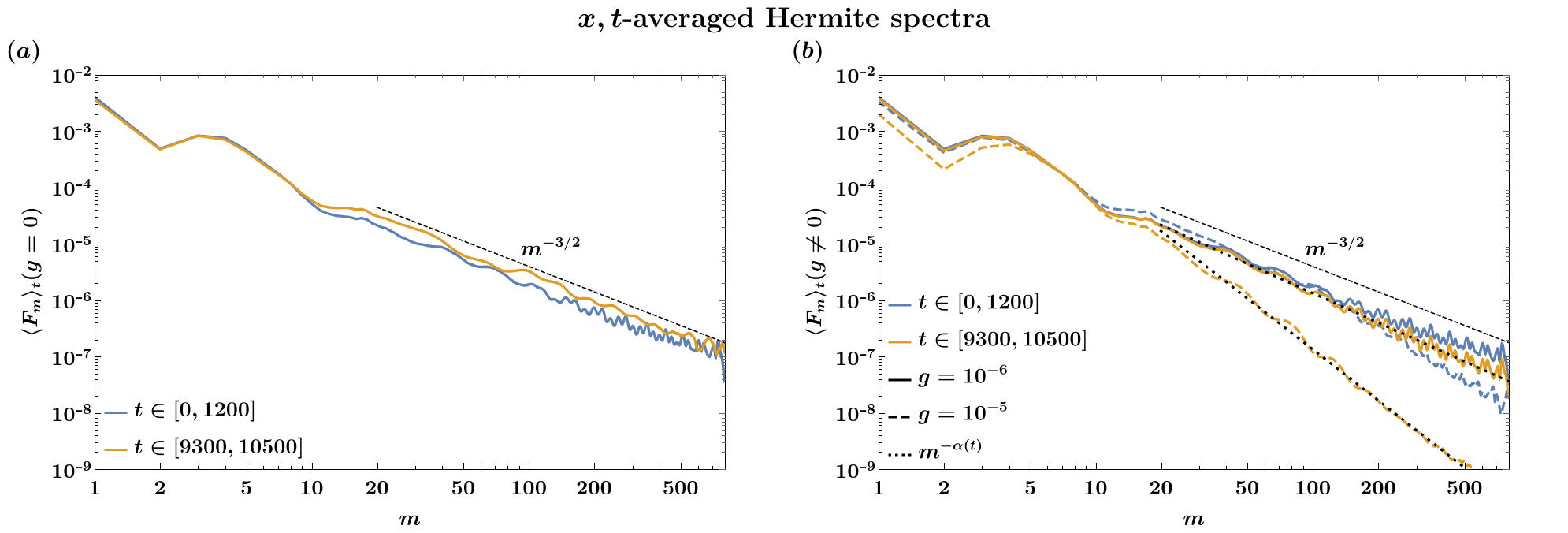
In the collisionless regime, the Hermite enstrophy spectrum exhibits a robust m−3/2 power law, confirming a constant-flux inertial cascade as predicted analytically for plasma turbulence.
Figure 5: Hermite transform contours display the redistribution of enstrophy across scales, contrasting collisionless and collisional dissipation.
Figure 6: Hermite spectra inside and outside the vortex, showing that collisional dissipation selectively attenuates small-scale enstrophy outside the trapped region.
When collisions are significant, the Hermite spectrum transitions from a power-law scaling to an exponential cutoff after a critical mode m∗, marking the dominance of collisional relaxation over nonlinear phase mixing. The selective suppression of high-m energy is more pronounced outside the phase-space vortex, indicating enhanced dissipation where the distribution function is closer to Maxwellian.
Figure 7: Temporally and spatially averaged Hermite spectra at early/late times, quantifying the transition from inertial cascade to collisional dissipation.
High-Collisionality Regime and Dissipative Cut-off
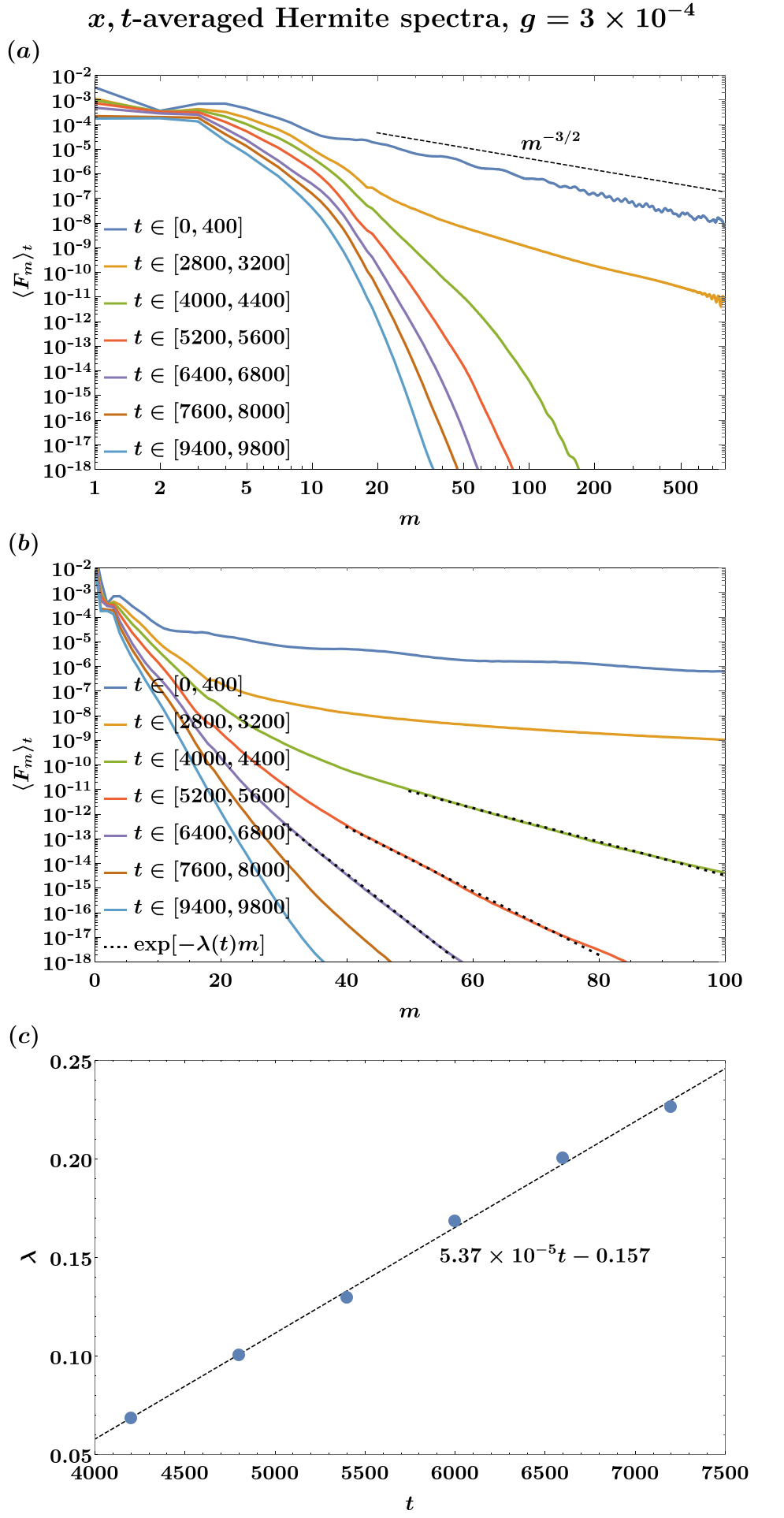
At elevated collisionality (g=3×10⁻⁴), the Hermite spectrum cutoff develops sooner, and the small-scale energy exhibits a clear exponential decay in m, consistently modeled by theory via diffusive annihilation operators in Hermite space. The measured decay rate matches the collision frequency, demonstrating theoretical and numerical consistency.
Figure 8: Emergence of the exponential spectral cutoff in high-g runs, signifying Dougherty operator dominance and the end of the inertial range.
Implications and Future Directions
The identification of a regime where the instability growth rate is set primarily by the local distribution gradient, while collisionality only delays nonlinear development, has direct implications for the modeling of weakly collisional plasmas in both laboratory and astrophysical contexts. The validated Hermite-cascade diagnostics provide a framework for quantifying kinetic turbulence dissipation and its spatial-temporal localization, which is critical for a range of processes including anomalous transport, heating, and phase-space entropy generation.
Practically, these results imply that turbulence-driven relaxation and coherent structure merging in plasmas can persist even with weak collisionality, but the kinetic cascade to fine velocity-space structures—and hence true entropy production—remains bottlenecked by collisional timescales. The observed selective dissipation of small-scale Hermite fluctuations outside trapping regions suggests distinct heating and entropy production patterns, likely relevant for understanding nonlinear wave damping, Landau damping onset, and the kinetic scales responsible for irreversible plasma behavior.
Further extension to higher-dimensional phase space, magnetized regimes, or more realistic collision operators (Fokker-Planck-Landau) will enable probing the universality and anisotropy of these findings. Additionally, cross-comparison with in situ spacecraft data or laboratory experiments on BGK turbulence and EAW excitation would strengthen the link between theory, simulation, and natural plasma systems.
Conclusion
This study advances the numerical understanding of kinetic instabilities in BGK equilibria by elucidating the distinct roles of collisional diffusion versus nonlinear trapping/merging, leveraging high-resolution spectral diagnostics enabled by Hermite analysis. The principal findings are:
Instability growth rates are substantially independent of collisionality in the considered regime, being set by ∂vf at resonance.
Collisional effects primarily delay instability onset and suppress the development and persistence of high-mode velocity-space fluctuations, especially outside phase-space holes.
The Hermite spectrum robustly follows an m−3/2 power law in the inertial range, with exponential cutoff at high g, confirming theoretical predictions for kinetic plasma turbulence.
The spectral crossover and spatial localization of dissipative effects have implications for both fundamental kinetic theory and applications in controlled and natural plasmas.
The work establishes a reference point for future studies on kinetic turbulence, phase-space cascades, and the interplay between collisions and nonlinearity in weakly collisional systems.