A Global Isometric Embedding of the Reissner-Nordström Metric into Pseudo-Euclidean Spacetime
Published 12 Dec 2025 in gr-qc | (2512.11554v1)
Abstract: The event horizon of the Schwarzschild black hole has been well studied and the singular behavior of the Schwarzschild metric on horizon is understood as a coordinate singularity rather than an essential singularity. One demonstration of this non-singular behavior on horizon was provided by Fronsdal in 1959, by finding a global isometric embedding of the Schwarzschild metric into a six-dimensional pseudo-Euclidean spacetime. Isometric embeddings for the Reissner-Nordström metric have also been constructed, but they only embed the region external to the inner horizon or in a single Eddington-Finkelstein patch. This paper presents a global isometric embedding for the maximally extended Reissner-Nordström spacetime into a nine-dimensional pseudo-Euclidean spacetime. We present the solution in terms of explicit local four-dimensional coordinates, and also as a level-set of functions of the higher-dimensional embedding spacetime. While the Reissner-Nordström embedding presented has several similarities to the Fronsdal embedding of the Schwarzschild metric, the presence of the second horizon requires additional embedding coordinates and terms not found in the Fronsdal embedding, in order that the embedding is defined and finite on each horizon.
The paper presents a global isometric embedding of the non-extremal RN spacetime into a 9D pseudo-Euclidean space, overcoming divergences at both inner and outer horizons.
It extends Fronsdal’s method using complex exponentials and level-set formulations to achieve analytic continuity across multiple coordinate patches.
The embedding provides a new framework for analyzing the global geometric and causal properties of charged black holes with implications for quantum gravity.
Global Isometric Embedding of the Reissner-Nordström Metric in Pseudo-Euclidean Spacetime
Introduction
This work provides an explicit construction of a global isometric embedding for the maximally extended Reissner-Nordström (RN) spacetime into a nine-dimensional pseudo-Euclidean space. While the Fronsdal embedding of the Schwarzschild metric is a well-established analytic embedding mapping the entire maximally extended Schwarzschild manifold into R5,1, previous embeddings for the RN metric have been strictly local or suffered from divergences at the horizons, failing to capture the full analytic structure and topology of the maximally extended RN spacetime. The present construction resolves these deficits by generalizing the Fronsdal mechanism to accommodate the more intricate causal structure occasioned by two non-degenerate horizons.
Background and Prior Approaches to RN Embeddings
The isometric embedding program seeks to realize a pseudo-Riemannian manifold as a submanifold within a higher-dimensional flat space, preserving the metric tensor. For static spherically symmetric spacetimes, the minimum dimensional requirements are encoded in the Janet-Cartan and Nash embedding theorems, but constructing global embeddings is nontrivial due to coordinate singularities at horizons.
For the Schwarzschild solution, a six-dimensional global embedding is optimal and analytic everywhere outside the central singularity. Earlier attempts for the RN metric generally relied on six-dimensional constructions tailored after the Schwarzschild precedent. Rosen [Rosen, Rev. Mod. Phys. 1965] constructed local embeddings valid only in select patches (typically outside the outer horizon), while other embeddings (e.g., Plazowski, Ferraris-Francaviglia, Paston-Sheykin) become singular on one or both horizons due to nontrivial behavior of the metric function at r=r1 and r=r2. The additional internal (Cauchy) horizon in the RN case introduces a branch structure that generically leads to divergent embedding coordinates.
Thus, previous findings either do not extend globally or require additional pathological dimensions with divergent components. This paper establishes for the first time a regular, global, analytic embedding covering the full Kruskal-Szekeres maximal extension for RN black holes.
Construction of the Global Embedding
The embedding is constructed as a map from the four-dimensional RN manifold into a flat pseudo-Euclidean space of signature (5,4), i.e., five space-like and four time-like dimensions, thus requiring nine embedding coordinates. The method uses both explicit coordinate representations and coordinate-independent (level-set) formulations.
Structure of the RN Metric and Coordinate Charts
The RN metric is given by
ds2=−(1−r2M+r2Q2)dt2+(1−r2M+r2Q2)−1dr2+r2dΩ2,
where Q2=q2+p2 includes electric and magnetic charge. For non-extremal parameters, the metric admits two horizons, located at r1=M+M2−Q2 and r2=M−M2−Q2.
To properly cover the full manifold, coordinate transitions between Boyer-Lindquist (t,r,θ,ϕ) and multiple Kruskal-Szekeres-like charts are required. Each coordinate patch covers a specific causal region determined by the causal structure of the RN spacetime.
Figure 1: The Kruskal diagram for the maximally extended Reissner-Nordström manifold, highlighting the region structure and horizon geometry.
Embedding Map: Explicit Construction
The embedding consists of the following components:
Spherical coordinates, mapping (r,θ,ϕ) to (X,Y,Z), trivially embedding each constant-r 2-sphere.
Two pairs of null-like coordinates (V1,U1) and (V2,U2), each regular across their associated horizon, constructed to avoid divergences by appropriate choice of local normalization and analytic continuation.
Two additional coordinates (R+,R−), each defined via integrals over strictly non-singular functions of r, designed so that their derivatives capture the nontrivial behavior associated with the embedding constraints and the metric's radial part.
Together, these coordinates yield an induced metric of exactly the RN form. Critical algebraic identities required for the embedding to be isometric and regular follow from the careful design of exponents, choice of branch cut, and horizon normalization parameters.
Complex exponentials are used to ensure smoothness of the V,U coordinates across horizons and each chart's analytic continuation is enforced by matching transition functions. The embedding is thus globally analytic on r>0 except at the curvature singularity r=0, which is not part of the manifold covered.
Coordinate-Free (Level-set) Formulation
The embedding admits a level-set description, generalizing Fronsdal's coordinate-free representation for Schwarzschild. All constraints can be expressed in terms of the embedding coordinates alone, with r being a function of (R+) and all other embedding coordinates then functions of r via explicit relations. This realization allows any intrinsic or extrinsic geometric quantity of the RN manifold to be computed within the nine-dimensional ambient space without recourse to the original four-dimensional coordinates.
Comparison to Prior Global and Local Embeddings
Unlike the embeddings of Rosen, Plazowski, Ferraris-Francaviglia, or Paston-Sheykin, the present embedding is regular at both the outer and inner horizons. Specifically, the design of the embedding ensures that:
For r→r1 (outer horizon) and r→r2 (inner horizon), all embedding coordinates are finite and analytic, and no coordinate blows up or becomes undefined.
Transition functions glue together the causal diamonds of the maximally extended diagram without discontinuity or divergence, matching the structure of the analytic extension.
For example, previous six-dimensional embeddings were necessarily local because they failed to analytically continue through both horizons simultaneously—an obstruction ultimately connected to the structure of the isometric immersion theorem and the higher local codimension of the Reissner-Nordström maximal extension. This construction circumvents those limitations with sufficient dimensional augmentation and analytic continuation.
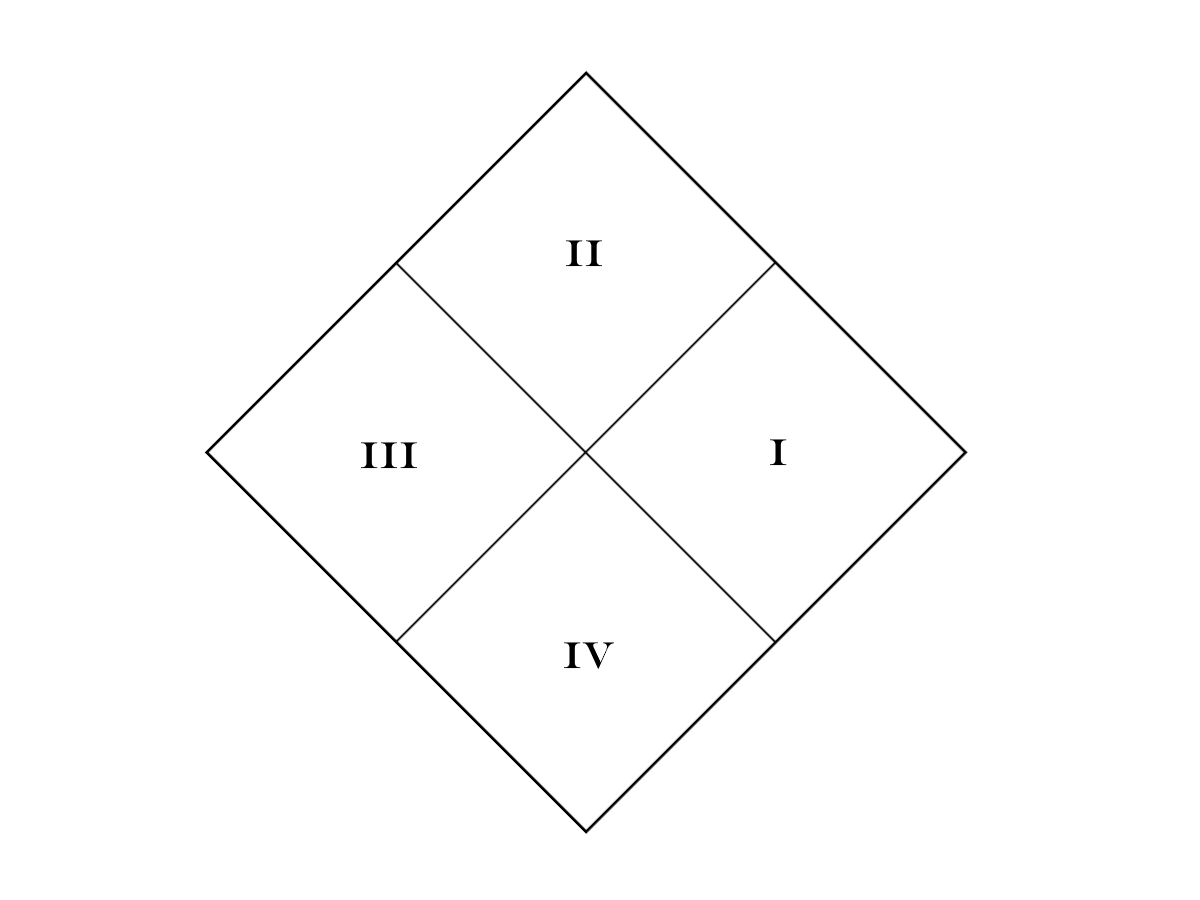
Figure 2: The Kruskal diagram for the maximal analytic extension of the Schwarzschild metric, included for comparison to illustrate the increase in complexity when transitioning from Schwarzschild to Reissner-Nordström spacetimes.
Theoretical and Practical Implications
The existence of the global isometric embedding for maximally extended RN spacetime allows a translation of questions in black hole geometry, causal structure, and singularity theory into questions about submanifolds in flat pseudo-Euclidean geometry. In principle, all global properties—such as geodesic completeness, causal relationships, Penrose process structure, and the behavior of fields—can be analyzed in the embedding space, bypassing coordinate singularities and patching ambiguities.
A key implication of the work is that for non-extremal charged black holes, their global geometry can be faithfully represented in a flat space of moderate dimension, without encountering divergences at the horizons.
Further, this embedding provides a blueprint for constructing global embeddings for other Lorentzian metrics with multiple horizons, such as Schwarzschild–de Sitter, Reissner-Nordström–de Sitter, and possibly for higher-dimensional or axisymmetric metrics. The general methodology—dimensional augmentation, analytic continuation through complex exponents, and level-set embedding—can be adapted to any metric with nontrivial causal structure provided the appropriate regularity and branch-matching can be realized.
On a practical level, isometric embeddings are central to the "embedding approach" for semi-classical quantum gravity (e.g., mapping Hawking into Unruh effects), analysis of global geometric invariants, and have utility in mathematical relativity for classifying spacetimes by embeddings rather than coordinate invariants.
Limitations and Future Directions
The construction presented does not directly apply to the extremal RN case (r1=r2), where the metric function acquires a double root, and the embedding strategy outlined here fails. The extension to degenerate horizons remains open, as does reduction to minimal embedding dimension.
It remains an open theoretical question whether a global embedding into R5,1 or yet lower dimension is possible with alternative techniques, or whether nine dimensions is optimal for global non-extremal RN spacetimes. The adaptation to metrics with more than two horizons, axisymmetry (Kerr/Kerr-Newman), or explicit time-dependence (e.g., FLRW, Vaidya) is also a promising direction, as noted by the authors.
Conclusion
This essay has outlined the analytic construction and theoretical significance of a global isometric embedding for the maximally extended Reissner-Nordström black hole in nine-dimensional pseudo-Euclidean space. The embedding is regular on both horizons, analytic everywhere except for the essential singularity at r=0, and may serve as a template for future work on embeddings of other spacetimes with complex horizon structures. The results here fill a key gap in the literature on isometric embeddings in mathematical relativity, enhancing the toolkit for both geometric and physical investigations.
References:
"A Global Isometric Embedding of the Reissner-Nordström Metric into Pseudo-Euclidean Spacetime" (2512.11554)