- The paper demonstrates that incorporating multi-cut saddle points is crucial to prevent exponential decay at late times in the spectral form factor of ABJM theory.
- It develops a microcanonical framework using the superconformal index in the Cardy-like limit to isolate high-energy black hole saddle contributions.
- The work illustrates how distinct regimes, including an emergent ramp and absence of an observable plateau, illuminate quantum chaos in holographic duals.
Introduction
The spectral form factor (SFF) is a critical diagnostic in quantum many-body systems, quantum chaos, and holography, revealing detailed temporal features of spectral statistics such as the dip-ramp-plateau structure. The current work systematically analyzes the SFF in the supersymmetric context of ABJM theory at large N by constructing a microcanonical SFF using the superconformal index (SCI) in the Cardy-like β→0 limit. A microcanonical formulation is necessary to eliminate spurious thermal AdS dominance at late times in the canonical ensemble and to gain access to fine-grained spectral information in the high-energy regime. In this setting, the dominant contribution at early times arises from a single-cut (black hole) saddle, but at late times, multi-cut saddle-point configurations become crucial, qualitatively altering the SFF behavior and precluding its decay. The analysis leverages recent progress on supersymmetric indices and saddle structures, yielding precise statements about spectral rigidity, correlational plateaus, and the emergence of "ramp" dynamics in holographic duals of AdS4 BPS black holes.
The canonical SFF, constructed as ∣Z(β+it)∣2, rapidly loses sensitivity to the microstructure of the spectrum due to contamination from low-energy states and inadequate early-time decay. The microcanonical SFF ∣YE,Δ(t)∣2, by introducing a Gaussian window in energy centered at high energy E with width Δ, sharply accelerates the initial decay and isolates black-hole-like states. Within this framework, the destructive interference due to phase oscillations after analytic continuation in time causes the early-time regime to be dominated by the black hole saddle, generically leading to an exponential suppression.
However, in the large-N limit of systems such as ABJM theory, the semi-classical prediction from the single-cut saddle is insufficient at late times, as the microcanonical SFF should not decay to zero in a discrete spectrum theory. To resolve this, one must incorporate contributions from multi-cut saddle points, which become dominant at intermediate and late times and correspond holographically to ZK-orbifolded Euclidean black hole geometries.
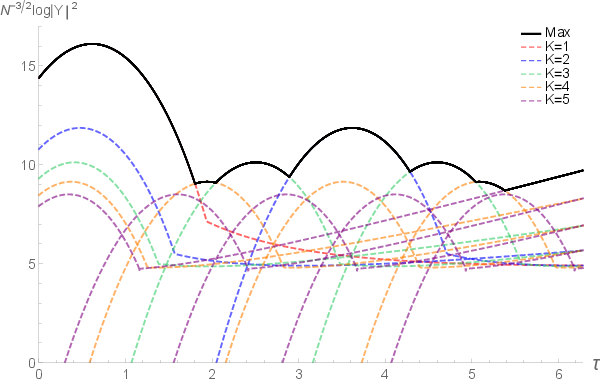
Figure 1: The normalized spectral form factor in ABJM theory for K=1,…,5 saddles, illustrating the initial rise, rapid decay (slope), and the stabilization due to multi-cut saddles with increasing K.
The SCI for the ABJM theory on S2×S1—which enumerates $1/12$-BPS states—is computed using supersymmetric localization, yielding a Coulomb branch matrix model. In the large-N and Cardy-like limit, the matrix integral admits a saddle-point expansion where multi-cut solutions are introduced via discrete shifts in the eigenvalue distribution, allowing the construction of a family of K-cut solutions parameterized by cluster number K.
For K=1, the saddle reproduces the usual AdS4 BPS black hole. Increasing K leads to solutions interpreted as eigenvalues condensing into K clusters, and the corresponding free energies are modified with intricate dependence on shifted chemical potentials. Crucially, these multi-cut saddles contribute nontrivially to the Legendre transform controlling the density of states and, by extension, effect the late-time SFF through their distinct time and energy scaling.
Temporal Evolution and Absence of Plateau
Evaluating the microcanonical SFF through saddle-point approximation, the time evolution is found to progress through distinct dynamical regimes. Immediately after a short transient, the SFF exhibits rapid exponential decay ("slope"). At intermediate times, the SFF stabilizes: the K>1 multi-cut saddles, undetectable at early times, take over and arrest further decay. This precludes the SFF from vanishing at late times—even at the semiclassical level—and signals the underpinning of spectral rigidity.
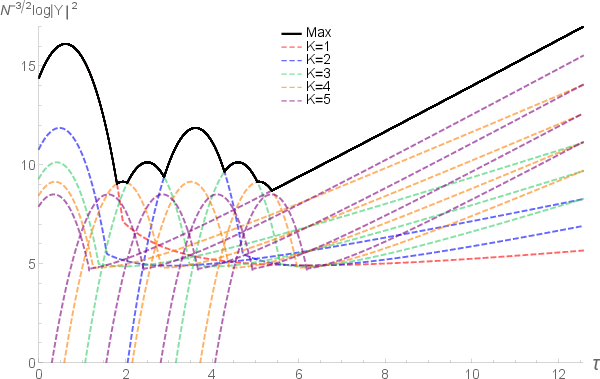
Figure 2: The SFF at extended times, highlighting the dominance of higher K saddles and the associated ramp; the absence of a visible plateau is due to exponentially large timescales in N3/2/β2.
For sufficiently large times, the SFF manifests a "ramp"—a sharply increasing function—before any sign of a plateau emerges. The anticipated plateau, present in quantum chaotic systems with a fully discrete spectrum, would only set in at times tp∼eN3/2/β2, vastly exceeding accessible times. In ABJM, the late-time SFF is thus controlled by saddles with large K, and the formation of a true plateau is inaccessible at analytic and numerical reach in large N.
Implications and Outlook
The analysis demonstrates that the inclusion of multi-cut saddle points is necessary for capturing the correct late-time behavior of the SFF and for resolving the fine structure of spectral correlations consistent with a discrete spectrum. The multi-cut configurations also have a natural interpretation in terms of ZK-orbifolded geometries in the bulk, indicating a holographic correspondence between nontrivial index saddles and intricate supergravity configurations. This mechanism is robust and is mirrored in both free gauge theories and N=4 SYM, suggesting its generality in large-N gauge/gravity duals.
From a theoretical perspective, the absence of a plateau at accessible times is a tangible distinction from established SYK/random matrix models and exposes the necessity of incorporating more supersymmetric states (beyond the $1/12$-BPS subsector) and perhaps finite-N effects to expose the plateau. Practically, these results clarify the limitations of semiclassical gravity in fully capturing quantum spectral statistics and delineate the role of higher topological saddles in the Euclidean path integral. Open questions involve the precise field-theoretic mechanism for the ramp, clarifying the bulk dual interpretation of multi-cut saddles (are they half-wormholes, Euclidean networks, or something novel?), and generalizing the SFF analysis to other AdS4 black holes and higher dimensions.
Conclusion
The paper provides a rigorous account of the microcanonical SFF in ABJM theory, showing that multi-cut saddle configurations are essential for preventing late-time decay and that the emergent ramp is a consequence of an infinite hierarchy of such saddles. The absence of a plateau on observable timescales is explained by exceedingly long times required at large N, aligning with expectations for holographic CFTs with a discrete but high-density spectrum. These findings advance the understanding of spectral fine structure and quantum chaos in supersymmetric gauge theories and their gravitational duals, and point to key directions for further investigation in quantum black hole microphysics and nontrivial gravitational path integral saddles.