- The paper demonstrates that a liar agent can drive consensus through bang-bang control, achieving rapid opinion convergence under ideal conditions.
- It reveals how classic, consistency, and temporal regularizations modulate the effectiveness and smoothness of the liar's influence.
- The study bridges microscopic agent dynamics with macroscopic kinetic models, providing insights into opinion distribution under bounded confidence.
Optimal Strategies for Lying: From Microscopic Agent Control to Kinetic Consensus Models
Overview
The paper "What is the optimal way to lie? From microscopic to kinetic descriptions of consensus control" (2512.11617) systematically formulates and analyzes the problem of consensus control in opinion dynamics by introducing a "liar" agent capable of strategic misinformation. Distinct from traditional optimal control approaches that apply exogenous controls or leverage designated leaders, this work considers endogenous controls—specifically, the explicit construction of agent-wise lies subject to various regularizations modeling psychological or social constraints. It further connects the microscopic agent-based model to macroscopic Boltzmann-type and Fokker-Planck descriptions, thereby providing a comprehensive multiscale framework.
Microscopic Lie Control Models
The foundation of the analysis is a generalized Hegselmann-Krause opinion dynamics framework where all but one agent ("the liar") update their true opinions through ordinary averaging, while the liar interacts by presenting lies (apparent opinions) to others. The central mathematical problem is the construction of timestamped, agent-specific lies yi(t) designed to drive the global consensus toward the liar's own goal opinion xd.
Unregularized Controls
In the case without regularization, the optimal lying strategy is bang-bang: when interacting with an agent i, the liar presents the most extreme admissible opinion (either maximal or minimal) to maximize the speed of opinion convergence toward xd, only reverting to the true opinion as opinions become sufficiently close:
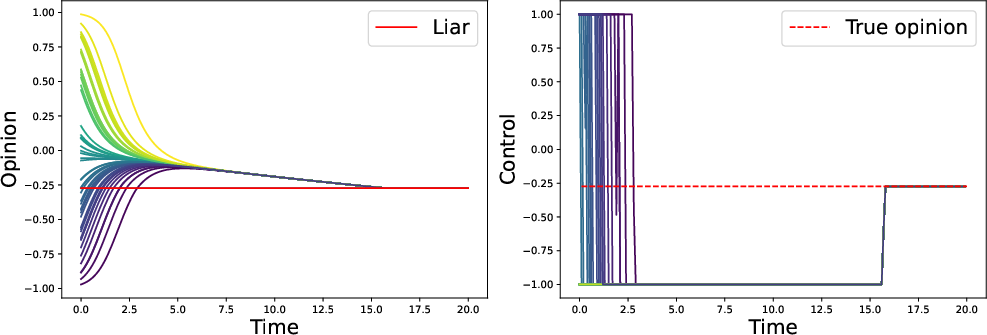
Figure 1: Trajectories (left) show truth-telling agents reaching consensus at the liar's goal opinion under unregularized bang-bang control; controls (right) highlight the extremal values of lies over time.
This bang-bang structure generally achieves consensus in finite time, provided the network is sufficiently connected.
Regularized Controls
The paper introduces multiple forms of regularization, each encoding different social or psychological costs:
- Classic Regularization: Penalizes deviations from the liar's true opinion to model the psychic cost of lying.
- Consistency Regularization: Penalizes variance among lies told to different agents—a formalization of the cognitive dissonance in telling many different stories.
- Temporal Regularization: Penalizes large time-derivatives of the lie function, thus preferring slow or smooth opinion changes.
The result is a richly parameterized control law where the magnitude, directional structure, and duration of lies can be tightly modulated. Increasing the regularization generally reduces the liar's impact on consensus, lengthens convergence time, and enforces lie consistency.
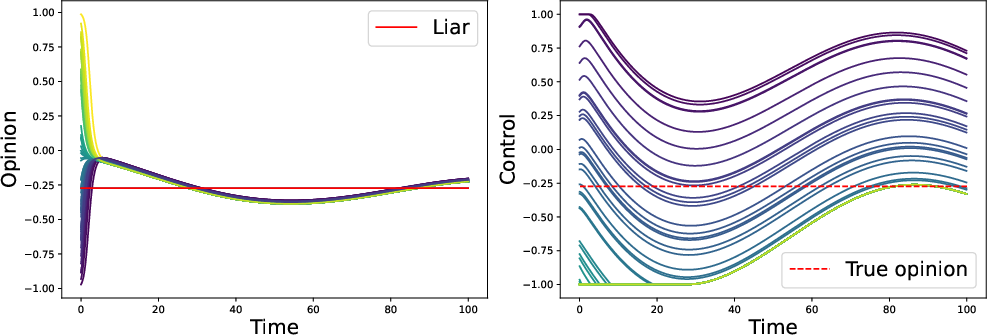
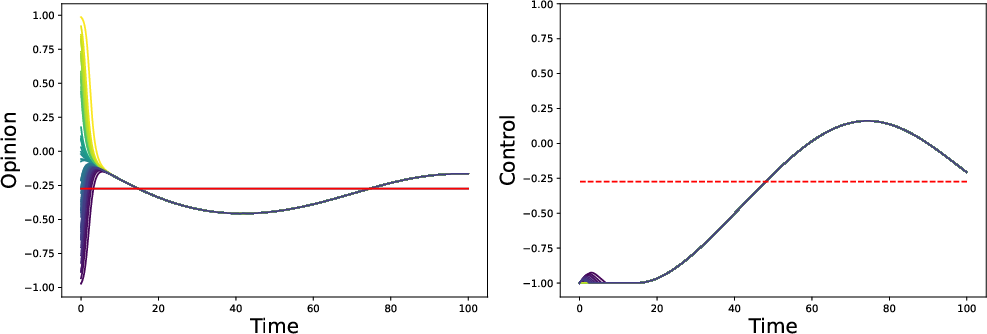
Figure 2: Imposition of quadratic regularization compels the liar to moderate their lies, leading to slower, more homogeneous convergence to consensus.
In cases where regularization is very strong, the liar is effectively constrained to truth-telling—yielding dynamics analogous to standard, uncontrolled HK consensus.
Sparse and Nonlinear Controls
The paper also investigates settings where the liar wishes to minimize the number of lies, formulated as l1-regularized optimal control, and solves the resulting non-differentiable problems numerically via nonlinear model-predictive control with particle-swarm optimization. This approach is able to identify minimal and temporally/economically efficient lying strategies that still achieve global influence.
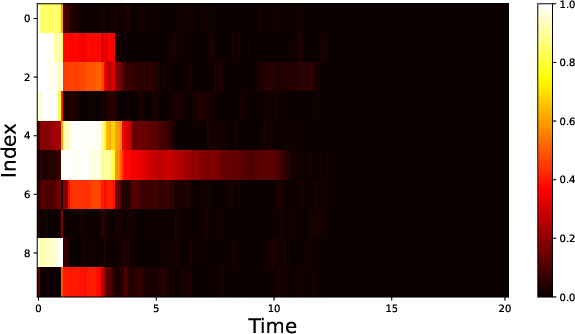
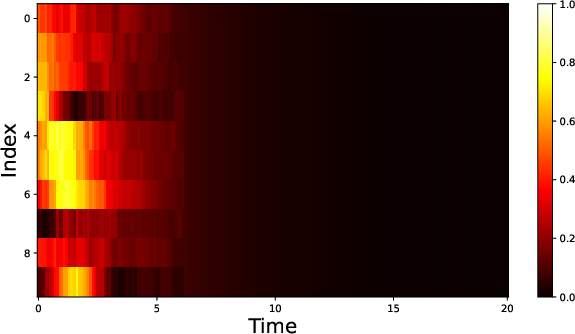
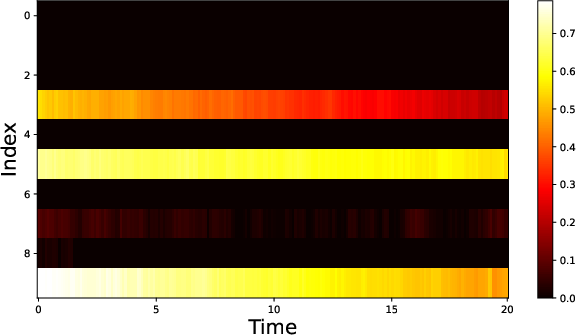
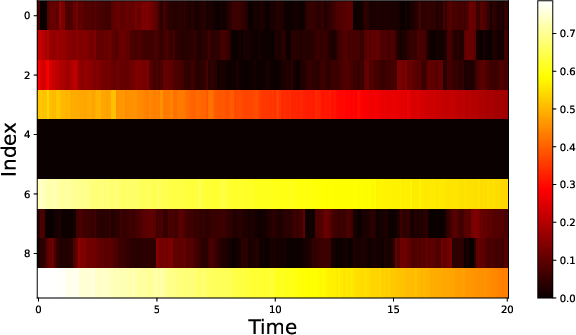
Figure 3: Sparse control heatmaps reveal that concentrated, high-magnitude lies to a few agents outperform ubiquitous small-magnitude lies for consensus steering.
Macroscopic and Kinetic Descriptions
To analyze the large-population limit and study the distributional effects of lying at scale, the authors derive kinetic (Boltzmann-type and Fokker-Planck) descriptions for the time evolution of the opinion density fT(x,t). The formal derivation proceeds via binary interactions and the quasi-invariant opinion limit, linking to mean-field approximations used in kinetic theory.
The kinetic equations retain the essential structure of the microscopic controls via the appearance of regularized drift terms reflecting the liar's influence, as well as convolution terms encoding peer-to-peer averaging. Diffusion accounts for exogenous uncertainties or noise in opinion changes.
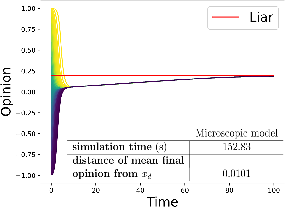
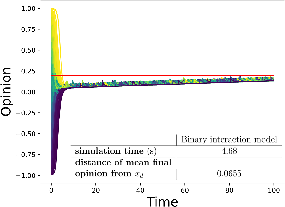
Figure 4: Schematic of the microscopic model, distinguishing between truth-tellers' HK interactions and agent-wise liar-induced apparent opinion shifts.
The stationary solutions to these equations can be explicitly characterized in the case of constant interaction kernels, showing that—under weak regularization—the population generically converges toward the liar's goal opinion. As the regularization increases, consensus formation can become slower, and multimodal or polarized distributions can arise.
Bounded Confidence and Topology Effects
The paper extends the analysis to "bounded confidence" models where agents only interact with others within a threshold opinion distance. The main consequence is that a single liar may be unable to influence the most extreme agents unless their lies reach within the bounded confidence range, introducing critical thresholds for both the required regularization and the radius of confidence.
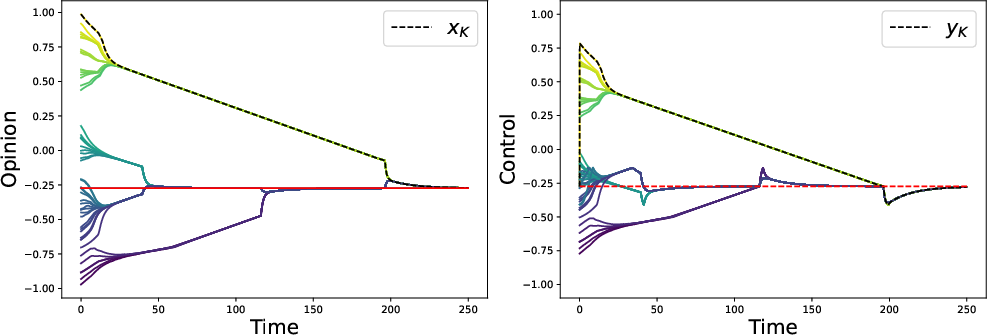
Figure 5: Liar’s inability to influence outlying individuals under bounded confidence constraints delays or prevents full consensus at the target opinion.
The analysis provides constructive upper bounds on the regularization parameters and explicit conditions for consensus reachability under these topological constraints.
Multiple Liar Populations
The framework admits generalization to multiple liar populations, each with distinct goals and influence weights. The kinetic equations extend to include superpositions of liar-induced drift terms, leading to steady-state densities that are weighted averages (when the interaction kernel is constant) or polarized multi-modal mixtures (for bounded confidence kernels).
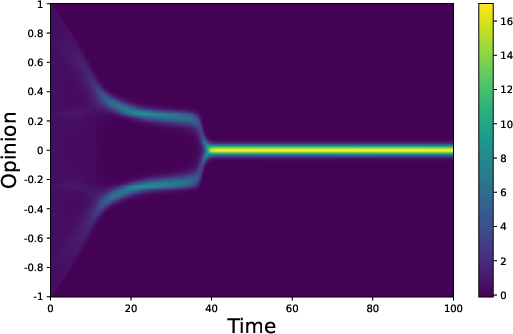
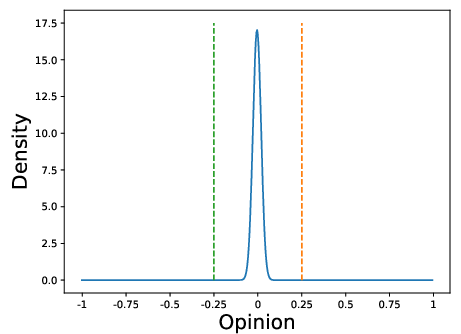
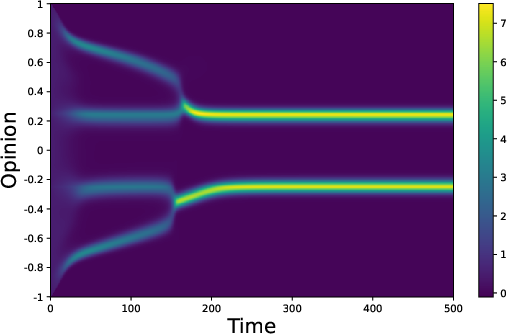
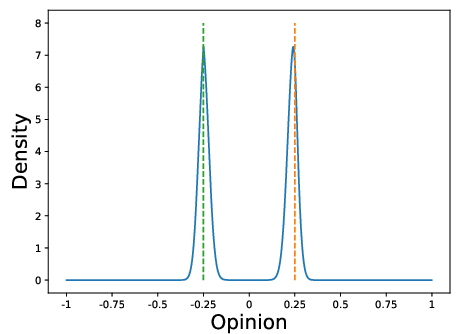
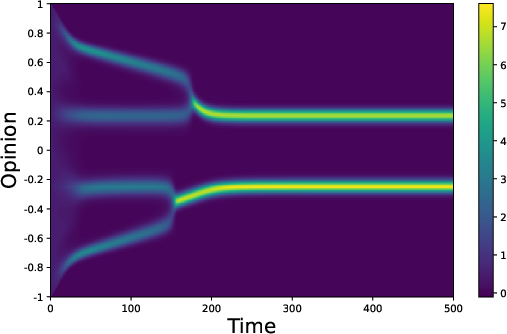
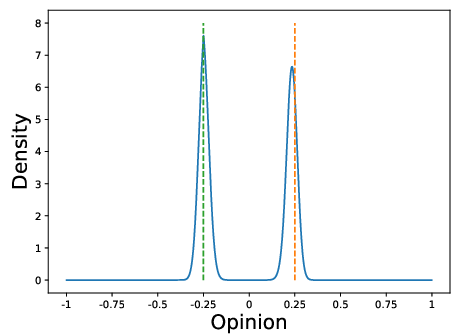
Figure 6: With two liar populations, the opinion density can polarize between the goal opinions, with cluster formation governed by regularization and influence weights.
Theoretical Implications and Future Directions
This work formally establishes that endogenous and distributed optimal lying strategies—subject to realistic cognitive, social, or economic constraints—can be rigorously analyzed and implemented in both agent-based and macroscopic frameworks. The results provide multiple new insights:
- Efficient Lie Structures: In unconstrained settings, bang-bang lying achieves fast consensus, while social or psychological constraints yield smooth, slow, or globally consistent lies.
- Threshold Phenomena: Bounded confidence and regularization parameters create critical phenomena—sharp thresholds where consensus becomes unattainable.
- Macroscopic Predictiveness: The kinetic and Fokker-Planck methodologies enable the prediction of entire opinion distributions and stationary states, allowing for statistical analysis of the effects of varying lying strategies at scale.
- Multimodal Consensus: Multiple liars can produce stable polarized or multi-peaked opinion distributions, formalizing the emergence of persistent disagreement.
From a practical perspective, the results prompt new techniques for designing efficient (or, conversely, robust-to-manipulation) population-level interventions in information spread, social influence, or misinformation mitigation.
Future work should address learning dynamics for liars, the interplay with detection/trust evolution, multi-modal opinion spaces, and the incorporation of more complex social network topologies.
Conclusion
The paper provides a technically thorough and mathematically rigorous treatment of strategic lying for consensus control, establishing analytical connections between agent-level decision-making, control theory, and kinetic models. The inclusion of regularization enables the formal study of lie consistency, temporal smoothness, and sparsity, and the multiscale approach permits efficient simulation and qualitative analysis of large-population effects. This work lays a foundation for further studies in adversarial information control and robust opinion dynamics in complex systems.