On the physical running of the electric charge in a dimensionless theory of gravity
Published 12 Dec 2025 in hep-th and hep-ph | (2512.11742v1)
Abstract: We revisit the renormalization of the gauge coupling in massless QED coupled to a scaleless quadratic theory of gravity. We compare two alternative prescriptions for the running of the electric charge: (i) the conventional $μ$-running in minimal subtraction, and (ii) a ''physical'' running extracted from the logarithmic dependence of amplitudes on a hard scale $Q{2}$ (e.g., $p{2}$ or a Mandelstam invariant) after removing IR effects. At one loop, using dimensional regularization with an IR mass regulator $m$, we compute the photon vacuum polarization. We find a clean separation between UV and soft logarithms: the former is gauge and process independent and fixes the beta function, whereas the latter encodes nonlocal, IR-dominated contributions that may depend on gauge parameters and must not be interpreted as UV running. In the quadratic-gravity sector, the photon self-energy is UV finite--the $\lnμ{2}$ pieces cancel--leaving only $\ln(Q{2}/m{2})$ soft logs. Consequently, quadratic gravity does not modify the one-loop UV coefficient and thus does not alter $β(e)$. Therefore, the physical running coincides with the $μ$-running in QED at one loop. Our analysis clarifies how to extract a gauge and process independent running in the presence of gravitational interactions and why soft logs from quadratic gravity should not contribute to $β(e)$.
The paper demonstrates that quadratic gravity leaves the one-loop QED beta function unchanged by separating UV and IR log contributions.
It utilizes dimensional regularization with an infrared regulator to cleanly isolate soft, gauge-dependent logs from ultraviolet ones.
The study clarifies that only UV logarithms drive the physical running of the electric charge, resolving controversies over gravitational corrections.
The Physical Running of the Electric Charge in Dimensionless Gravity
Introduction and Motivation
Quadratic (dimensionless) gravity theories, incorporating curvature-squared terms, furnish UV-complete, renormalizable frameworks extending beyond the nonrenormalizable Einstein-Hilbert action. These theories, however, are known to introduce complications related to unitarity, notably the presence of ghostlike degrees of freedom. A pivotal question in this context is whether and how quantum corrections from such gravity sectors modify the running of the electric charge when matter (e.g., QED) is coupled to gravity.
A particular point of contention in recent literature is the "physical running" of couplings—extracted from the logarithmic dependence of amplitudes on hard scales, such as external momenta—versus the standard μ-running defined in minimal subtraction (MS) through UV counterterms. Works suggesting that gravitational contributions induce nontrivial running for charge, even at one loop, have relied on schemes that may fail to disentangle UV from IR effects and that feature gauge dependencies. Addressing these ambiguities requires a careful separation of UV and IR log contributions.
Model Framework
The action considered is QED (massless), coupled to quadratic gravity, with the Lagrangian:
where f0,f2 are dimensionless gravitational couplings. The metric is expanded around flat space: gμν=ημν+hμν. Feynman rules are derived for gravitons, photons, and fermions, with explicit form of propagators; the graviton propagator scales as 1/p4, improving the UV behavior but implying higher-derivative interactions and associated ghosts.
To regulate IR divergences, a mass parameter m is introduced for all propagators, while calculations are performed in dimensional regularization. Gauge-fixing terms (for gravity and the photon) and associated gauge parameters are included.
One-Loop Photon Self-Energy: QED and Gravity Sectors
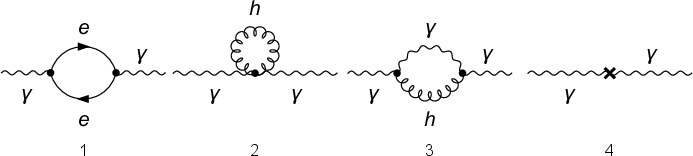
The one-loop self-energy of the photon is computed including (i) the canonical QED diagram and (ii) gravitational corrections arising from the exchange of a graviton. The relevant Feynman diagrams are displayed in Figure 1.
Figure 1: Feynman diagrams for the one-loop photon self-energy, including photon, fermion, and graviton lines.
For the standard QED contribution, the calculation yields (in the high-energy limit p2≫m2)
ΠQED(p2)=−12π2ie2(ϵ1+ln4πμ2e5/3−γE−p2)
where ϵ=(4−D)/2.
The gravitational sector produces only UV-finite terms. The explicit result involves scalar integrals such as B0(p2,m2,m2), but their combination in the self-energy
B0(0,m2,m2)−B0(p2,m2,m2)
is UV-finite, with no residual lnμ2 dependence: only ln(−p2/m2) remains. These IR logarithms are generally gauge-parameter dependent.
Beta Function Extraction: μ-Running Versus "Physical Running"
The beta function can be computed in two renormalization schemes:
μ-Running (Minimal Subtraction): Defined as βμ(e)=μdμde, where the UV counterterm is isolated via divergent pieces in dimensional regularization.
Physical Running: Defined by the dependence of amplitudes on large external momentum (Q2), i.e., via the log-enhanced terms ln(Q2/M2), after removing IR effects.
Both procedures, if properly implemented, produce the canonical one-loop QED result
β(e)=12π2e3
This equivalence, however, requires clean separation of UV (gauge- and process-independent) logs from IR-sensitive, gauge-dependent soft logs. The latter may contaminate naive "physical" running prescriptions if not isolated.
Quadratic Gravity Correction: UV-IR Separation
After a full one-loop integration, including IR regulation and gravitational corrections:
All lnμ2 UV logs in the photon vacuum polarization cancel in the gravity sector. The only logs left are of soft (IR) origin, e.g., ln(Q2/m2).
These IR logs may depend on gauge parameters and do not reflect renormalization group (RG) evolution; they instead encode nonlocal, soft/collinear enhancement.
The UV running of the charge parameter is unaffected by quadratic gravity at one loop: there are no modifications to the one-loop QED β-function.
The analytic structure of the amplitude is thus:
A(Q2)=AUVlnμ2Q2+Asoftlnm2Q2+finite
with only AUV contributing to RG running.
Implications and Theoretical Significance
The analysis demonstrates that quadratic gravity does not alter the running of the electric charge at one loop, contrary to claims relying on naive physical running prescriptions that do not distinguish between UV and IR logarithms. The UV/IR separation is essential to establishing this result and must be reflected in any physically meaningful definition of coupling running, particularly in effective field theories with both massless and higher-derivative sectors.
Gauge dependence of the IR logs additionally proves that their coefficients cannot be assimilated into a physically meaningful RG flow. This insight applies beyond the present model, cautioning against misinterpretations of log-momentum dependence in other settings—especially those featuring higher-derivative or nonlocal terms.
At a more general level, this work clarifies methodologies for extracting beta functions in effective gravity-matter theories and resolves apparent contradictions in the literature regarding the physical meaning of momentum-dependent logs in the presence of gravity.
Prospects for Future Research
Potential avenues for extension include:
Explicit computation at higher loops to test whether quadratic gravity might introduce nontrivial effects beyond one loop.
Examination of other coupling constants (Yukawa, quartic scalar) within this formalism.
Application of the separation scheme to theories with dynamical mass generation or when mass thresholds are present.
Deeper analysis of the consequences for asymptotic safety scenarios and possible UV completion paradigms.
Investigation of IR log structure in inclusive observables to quantify soft/collinear cancellation mechanisms in this context.
Conclusion
This study rigorously establishes that, for massless QED coupled to renormalizable quadratic gravity, the one-loop running of the electric charge is unmodified by the gravitational sector, whether one employs the traditional μ-running or a properly defined physical running extracted from amplitude logarithms. The equivalence of these procedures is preserved only after a strict separation of UV and IR effects, particularly the discarding of soft, gauge-dependent infrared logarithms. The results furnish a robust framework for calculating physical RG flows in effective theories of gravity coupled to matter fields and inform future work on gravity-induced interactions and their observable consequences.