Quantum Krylov algorithm using unitary decomposition for exact eigenstates of fermionic systems using quantum computers
Abstract: Quantum Krylov algorithms have emerged as a useful framework for quantum simulations in quantum chemistry and many-body physics, offering a favorable trade-off between potential quantum speedups and practical resource demands. However, the current primary approach to building Krylov vectors in these algorithms is to use real or imaginary-time evolution, which is not exact, require an arbitrary time-step parameter ($Δt$), and degrade the Krylov vectors quickly with increasing $Δt$. In this paper, we develop a quantum Krylov algorithm without time evolution and with an exact formulation of the Krylov subspace, named ``Quantum Krylov using Unitary Decomposition'' (QKUD), along with implementation proposals for quantum computers. Not only is this algorithm exact in the limit $ε\to 0$ of the error parameter $ε$, but it also produces more accurate Krylov vectors at $ε\neq 0$ than conventional time evolution due to more favorable error scaling (O($ε2$) vs O($Δt$)). Through simulations, we demonstrate that these theoretical benefits yield numerical advantages: (i) QKUD provides numerically exact results at small $ε$, (ii) it remains stable across a broad range of $ε$ values, indicating low parameter sensitivity, and (iii) it can solve problems unreachable by conventional time evolution. This development resolves a central limitation of quantum Krylov algorithms, namely their inexactness and sensitivity to the time-step parameter, and paves the way for new and powerful quantum Krylov algorithms for quantum computers with a stronger promise of quantum advantage.
Paper Prompts
Sign up for free to create and run prompts on this paper using GPT-5.
Top Community Prompts
Explain it Like I'm 14
What this paper is about (overview)
This paper introduces a new way to use quantum computers to solve hard physics and chemistry problems about electrons (called “fermions”). The authors create a quantum algorithm named QKUD (Quantum Krylov using Unitary Decomposition) that aims to find the lowest-energy states of these systems more accurately and more reliably than existing methods. Their key idea: build the “Krylov subspace” exactly, without relying on time evolution steps that can introduce errors and sensitivity to a tricky tuning parameter.
What questions the paper tries to answer (objectives)
The paper focuses on three simple questions:
- Can we design a quantum algorithm that builds the Krylov subspace without using time evolution (so it avoids the usual time-step problems)?
- Can this new algorithm be exact (or extremely close) when we push its error setting toward zero?
- In practice, does it work better—more accurate, more stable, and able to solve tougher cases—than current time evolution methods?
How the method works (approach, explained simply)
Think of solving a molecule’s behavior like trying to find the “best notes” in a huge music library. The Krylov subspace is a smart “playlist” of special tracks you build by repeatedly applying the main rulebook of the system (the Hamiltonian, which tells you how energy behaves) to a starting song (the initial state). From this playlist, you can pick out the best notes (lowest energy states).
- On classical computers, building this playlist exactly gets too big too fast.
- On quantum computers, you need to use operations called “unitaries” (they’re like perfectly reversible, safe moves).
The challenge: the Hamiltonian itself isn’t a unitary. QKUD solves this by using “unitary decomposition,” which cleverly rewrites the Hamiltonian as a combination of unitary operations that a quantum computer can perform.
Here’s the everyday analogy:
- Imagine you want to do a complicated move that isn’t allowed directly. Instead, you split it into two “safe” moves you can do on the device, then combine them so the result mimics the complicated move you wanted.
- QKUD uses a small adjustable number, ε (epsilon), to control how closely this combined move imitates the original. Smaller ε means a closer match.
Instead of stepping forward in time (which needs a time-step Δt, like choosing how far to walk each step), QKUD builds the Krylov playlist by repeatedly applying sums of these safe unitary moves. This produces Krylov vectors with errors that scale nicely as O(ε²). In simple terms: if you make ε half as big, the error drops by about four times—much better than the linear error from time-step methods (which scale like O(Δt)).
The authors also propose two ways to run QKUD:
- A more exact version suited to advanced quantum hardware (it uses sums of unitary operations and some extra qubits).
- A more hardware-friendly version that reuses measurement tricks similar to standard time evolution methods, and pushes the heavier math to the classical computer afterward.
What they found (results and why it matters)
The authors tested QKUD on small hydrogen systems (like H₄ and H₆ in different shapes and bond lengths) and compared it to a popular time evolution method (QRTE).
Here’s what they saw:
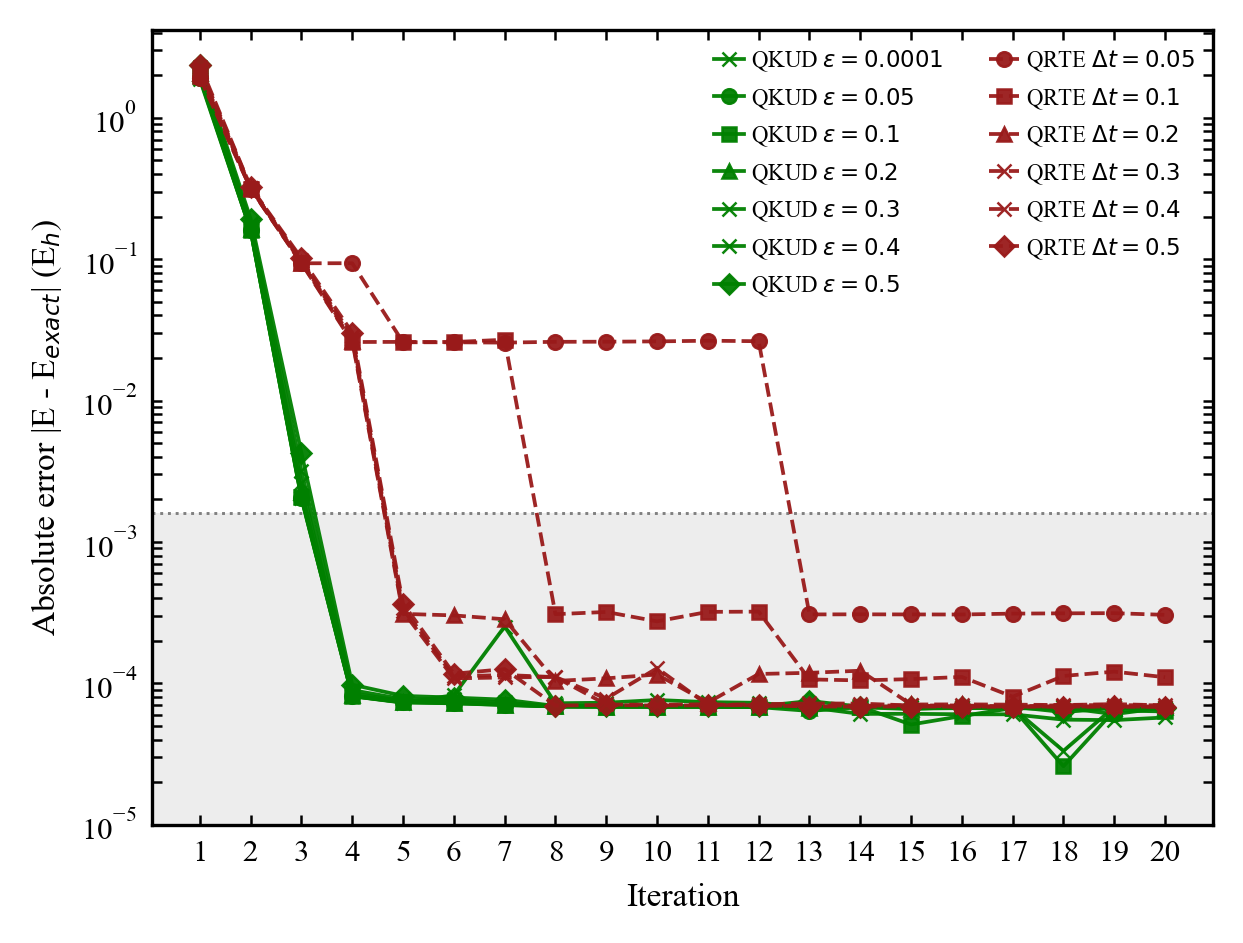
- Exact in the limit: When ε is very small, QKUD reaches numerically exact answers. Time evolution methods can’t reach exact answers by shrinking Δt (they become too similar to “do nothing,” causing problems).
- Stable across settings: QKUD gives almost the same good results across a broad range of ε values, meaning it’s less sensitive to tuning. In contrast, time evolution results depend heavily on choosing the “just right” Δt.
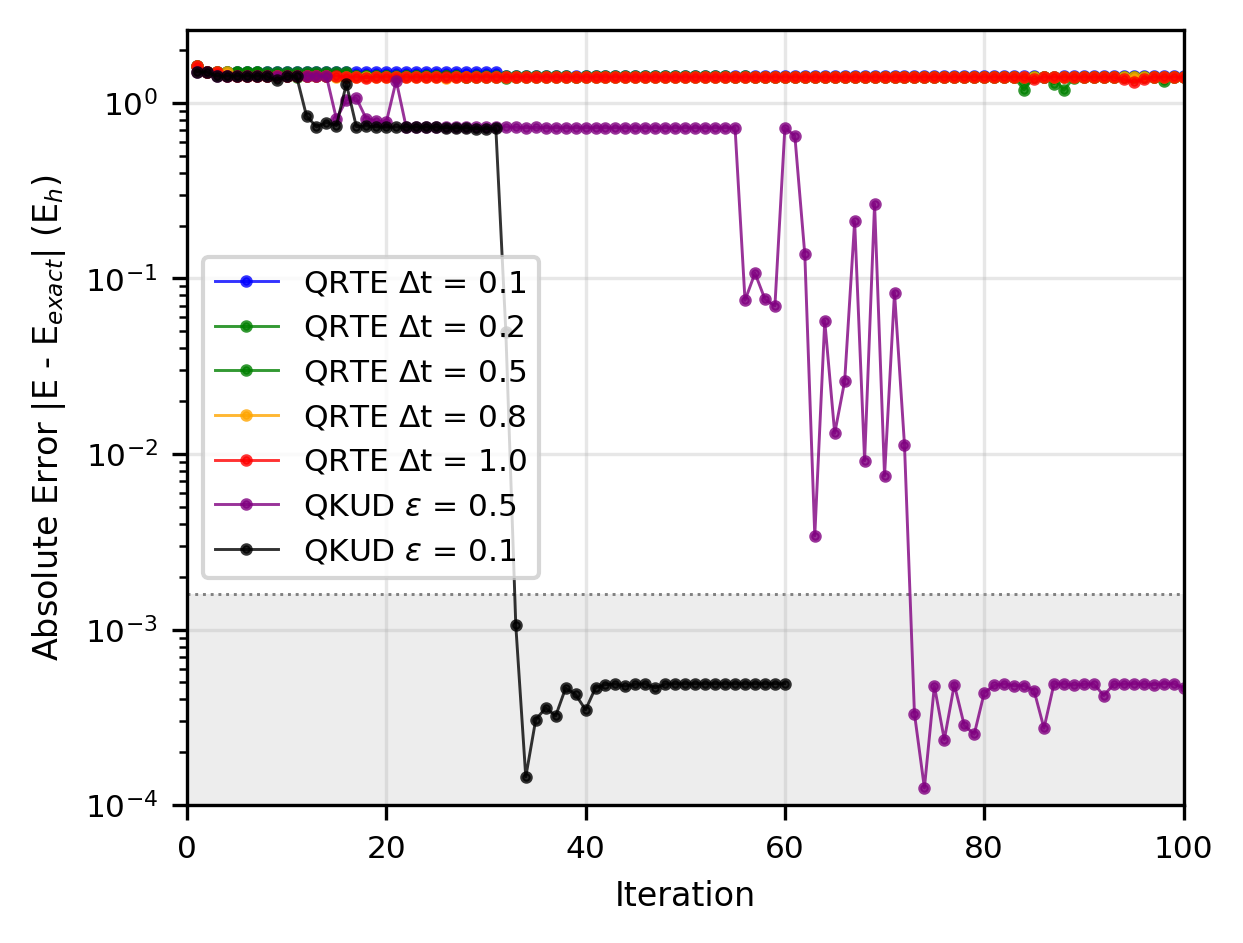
- Solves tougher cases: QKUD solved an H₆ example to chemical accuracy at ε = 0.1 and 0.5, while the time evolution method didn’t reach the target within many iterations.
- Often faster convergence: Because QKUD builds more accurate Krylov vectors, it tends to reach the correct energy in fewer steps.
Why this matters:
- Less guesswork: You don’t have to spend time finding the perfect Δt.
- Better accuracy: Errors shrink faster with ε in QKUD.
- More powerful: It can tackle problems that standard methods struggle with.
What this could change (implications)
QKUD strengthens the case for using Krylov-based algorithms on quantum computers by removing a key pain point: dependence on time-step tuning and the inexactness it causes. If developed further, QKUD could:
- Help demonstrate real quantum advantage on meaningful chemistry and physics problems.
- Inspire new, more powerful Krylov algorithms that are both accurate and practical.
- Reduce resources compared to some near-term methods (it doesn’t need big parameter optimizations), while staying compatible with current measurement techniques.
In short, QKUD is a promising step toward making quantum computers better at finding the energies of complex electron systems—more exact, more stable, and sometimes simply capable of solving problems other methods can’t.
Knowledge Gaps
Knowledge gaps, limitations, and open questions
Below is a concise list of concrete gaps and open questions that remain unresolved and could guide future research:
- Resource scaling and complexity
- Absence of rigorous gate-count and circuit-depth estimates for both QKUD implementations as functions of system size N, error tolerance, ε, spectral properties of H, and the chosen Hamiltonian simulation method (Trotter, qubitization, QSVT).
- No quantitative analysis of how the required number of iterations i scales with system size, correlation strength, and spectral gap, nor a comparison of total runtime (quantum plus classical) versus QRTE, Chebyshev-Krylov, or QLanczos under matched error budgets.
- Lack of head-to-head resource and accuracy comparisons with the “exact” Chebyshev/block-encoding Krylov methods to substantiate the claimed practicality advantages.
- Noise and hardware effects
- No robustness analysis under realistic device noise (decoherence, SPAM, coherent errors) for building M and S; impact on conditioning, bias, and variance remains uncharacterized.
- Missing treatment of Hamiltonian-simulation errors (e.g., Trotterization) that arise when implementing e{±iεH}; unclear how these errors interplay with the O(ε2) Krylov-vector error and how to co-tune ε and simulation parameters.
- Unspecified ancilla overhead and success probability for the LCU-based version; no concrete resource estimates for block-encoding/QSVT to prevent probability loss.
- No optimized measurement strategy for U† O U-type observables: grouping, shadow tomography, low-rank factorization, and error-mitigated estimators are not developed beyond the O(i2 N4) shot-count claim.
- Numerical stability and generalized eigenproblem
- The ill-conditioning of the generalized eigenvalue problem (MC = SCE) is acknowledged but not addressed: no quantum-compatible orthogonalization schemes, subspace stabilization, or robustification (e.g., Gram–Schmidt variants, purification, deflation).
- No regularization procedures for S (e.g., Cholesky repair, Tikhonov, pivoted factorizations) under shot noise; no guidelines for symmetrization or ensuring S is positive definite.
- Lack of reliable stopping/acceptance criteria under finite sampling and noise (beyond E_n − E_{n−1} < δ), including uncertainty quantification for convergence signals.
- Algorithm design and parameter choices
- No systematic or adaptive strategy to select ε (trade-offs between circuit depth, simulation error, and iteration count are not quantified); no online parameter tuning methods.
- Initial-state dependence is not explored: how overlap with the target subspace affects convergence, and how to prepare effective |Ψ0⟩ (single- vs multi-reference, block-Krylov variants).
- Extension to excited states is not demonstrated: handling near-degeneracies, conical intersections, and root-tracking stability is unaddressed.
- Symmetry handling (spin, particle number, point-group) and qubit-tapering within QKUD are not developed; no protocol to enforce symmetry in M and S to improve stability and efficiency.
- No preconditioning or spectral scaling (e.g., normalization, shifts, shift-invert variants) to improve convergence; their compatibility with QKUD is unexplored.
- Concrete integrations with MRSQK/ADAPT-VQE (as suggested) are not specified; protocols and benefits of such hybrids remain to be designed and tested.
- Theoretical guarantees
- Only a first-order Taylor argument supports the O(ε2) Krylov-vector error; there are no non-asymptotic, operator-norm bounds linking ε, Hamiltonian-simulation error, and sampling error to final eigenvalue/eigenvector error.
- No formal proof of convergence rate (versus classical Lanczos) in terms of spectrum, gaps, and condition numbers; no guarantees that linear dependence is avoided in the presence of hardware/simulation errors.
- Error propagation from measured M and S (statistical and systematic) to eigenvalues/eigenvectors is not analyzed; sample complexity for a target energy error is unknown.
- Benchmarking scope
- Validation is limited to small hydrogen chains under statevector simulation; scaling to larger, chemically relevant systems (transition metals, strongly correlated materials) and to excited states is untested.
- No benchmarks on hardware (or realistic noise models) and no comparison under equalized resource budgets (depth, shots, runtime) to established alternatives (QRTE, Chebyshev, QLanczos).
- Sensitivity to fermion-to-qubit mappings (JW vs BK), Hamiltonian sparsity/density, and basis choice is not investigated.
- Practical implementation details
- The “hardware-friendly” scheme requires measuring many correlators indexed by (m, n); strategies to curb the O(i2) growth (e.g., linear-combination circuits, randomized estimators, reuse of unitaries) are not provided.
- As iterations grow, the required evolutions e{±i m ε H} increase effective simulation time (m ε); how to control simulation error and cost as m increases is not analyzed.
- Precision management for classical post-processing (cancellation, scaling factors, conditioning) is not specified; mixed-precision or numerically stable formulations are needed.
- Reproducibility: no public code or full parameter tables are provided for independent verification of the reported statevector results.
- Extensions and generalizations
- Generalization to non-Hermitian problems (open systems/Liouvilleans), imaginary-time or dissipative variants, and time-dependent Hamiltonians is not addressed.
- Application to Green’s functions, response properties, and spectral densities (e.g., via moments from QKUD) is not developed.
- Exploration of block-Krylov, multi-start, or adaptive basis-enrichment strategies on quantum hardware (to improve conditioning and convergence) remains open.
Practical Applications
Below, we translate the paper’s findings into concrete applications for industry, academia, policy, and daily use. For each item, we indicate the sector, what can be done, potential tools/workflows, and key dependencies or assumptions that affect feasibility.
Immediate Applications
- Software/Quantum Computing — Drop-in replacement for time-evolution-based quantum Krylov (QRTE) in small-scale eigensolver studies:
- What: Use QKUD to construct Krylov subspaces for ground/low-lying excited states of small fermionic systems (e.g., H2, H4, H6, small Hubbard clusters) with reduced parameter sensitivity and improved accuracy at comparable resources.
- Tools/Workflows: Implement the “hardware-friendly” QKUD (Eq. set around ψn via combinations of e±iεH) in OpenFermion, Qiskit Nature, PennyLane, or Cirq, using existing Trotterized time-evolution primitives; classical generalized eigenvalue solver; standard fermion-to-qubit mappings (JW/BK).
- Dependencies/Assumptions: Access to NISQ devices or statevector/noisy simulators; reasonable initial state overlap; shot scaling O(i2N4) manageable for toy systems; basic error mitigation; careful handling of ill-conditioned overlap matrices.
- Quantum Hardware Vendors/Cloud Platforms — Reduced calibration/tuning overhead:
- What: Replace time-step tuning (Δt) with ε, leveraging O(ε2) error scaling to stabilize subspace quality across device conditions; offer QKUD as a “robust mode” in cloud quantum chemistry services.
- Tools/Workflows: Pre-packaged circuits for e±iεH identical to QRTE primitives; auto-selection of ε schedules; measurement reuse and grouping; backend-aware transpilation.
- Dependencies/Assumptions: Gate-level access to time-evolution circuits; stable compilation of short-depth evolutions; minimal ancilla (for overlap-type measurements).
- Materials/Chemistry R&D — Prototype calculations to chemical accuracy on small testbeds:
- What: Rapid screening of strongly correlated model systems (e.g., stretched bonds, spin chains) where QRTE is unstable; use QKUD to reach solutions otherwise unreachable by QRTE for benchmarking catalysts, bond-breaking profiles, or molecular fragments.
- Tools/Workflows: Hybrid pipeline: classical integral generation (PySCF), mapping (OpenFermion), QKUD measurements, classical subspace diagonalization; chemical accuracy monitoring.
- Dependencies/Assumptions: Small to medium basis sets; careful numerical stabilization (regularization/orthogonalization) of the generalized eigenproblem; shot budgets consistent with O(i2N4).
- Academic Research — Algorithm benchmarking and reproducibility baselines:
- What: Establish QKUD vs QRTE head-to-head benchmarks to decouple algorithmic advances from step-size effects; use QKUD as a standard in algorithmic comparisons for Krylov-based methods.
- Tools/Workflows: Public benchmark suites (Hubbard ladders, stretched H-chains); open-source reference implementations; standardized reporting of ε, iteration counts, shot budgets, and overlap conditioning.
- Dependencies/Assumptions: Community agreement on metrics; access to reference classical solutions for small systems.
- Education/Training — Teaching exact Krylov subspace construction on quantum hardware:
- What: Use QKUD to demonstrate how non-unitary operators are emulated via linear combinations of unitaries and how subspace diagonalization works without Δt tuning pitfalls.
- Tools/Workflows: Course modules, Jupyter notebooks, simulators; side-by-side Taylor-expansion error analyses (O(ε2) vs O(Δt)).
- Dependencies/Assumptions: Simulator access; small examples; curated datasets.
- Quantum Software/Middleware — Workflow modularization and reuse of QRTE measurement primitives:
- What: Reuse existing “left-right” expectation value routines from QRTE (⟨ψ0|e+iεH O e−iεH|ψ0⟩, etc.) to construct QKUD’s M and S matrices via classical recombination with different coefficients.
- Tools/Workflows: Measurement batching, caching, and classical post-processing; adaptive ε schedules; shot allocation heuristics that prioritize most informative terms.
- Dependencies/Assumptions: Middleware support for heterogeneous left/right states; robust floating-point handling to mitigate precision loss in S-matrix assembly.
- Error-Mitigation Pipelines — Subspace-based stabilization:
- What: Combine QKUD with subspace expansion/error-mitigation heuristics (e.g., VQSE/QSE) to improve robustness under noise by leveraging more accurate Krylov vectors at similar circuit depth.
- Tools/Workflows: Post-selection, Richardson extrapolation, symmetry checks; adaptive selection of Krylov orders; integration with virtual subspace expansion tools.
- Dependencies/Assumptions: Additional shots; noise models/detectors; stable conditioning of the expanded overlap matrix.
- Standards/Policy (Research Infrastructure) — Benchmark and reporting protocols:
- What: Encourage journals/funders to require reporting of ε sensitivity, overlap conditioning, and convergence behavior for quantum Krylov studies; include QKUD-based “exactness checks” (ε → 0 limit) where feasible.
- Tools/Workflows: Benchmark repositories; metadata standards for ε, iteration counts, conditioning metrics.
- Dependencies/Assumptions: Community buy-in; support from program managers and consortia.
Long-Term Applications
- Pharma/Chemistry/Materials — Large-scale, fault-tolerant quantum eigensolvers:
- What: Use fault-tolerant QKUD (with block-encoding/QSVT) to compute ground and excited states of pharmaceutically relevant targets, heterogeneous catalysts, battery cathodes, and photovoltaics at scale.
- Tools/Workflows: Fault-tolerant e±iεH using qubitization; robust Krylov space growth with on-chip orthogonalization; domain workflows (QM/MM, reaction paths, photochemistry); automated active-space selection.
- Dependencies/Assumptions: Fault-tolerant hardware; scalable block-encoding; effective initial states; classical-quantum co-design for large generalized eigenproblems.
- Strongly Correlated Materials and Condensed Matter — Embedded solvers:
- What: Use QKUD as an impurity solver inside DMFT/DMET and as a high-accuracy engine for spectral functions and Green’s functions; investigate phase diagrams near criticality where small parameter errors are fatal.
- Tools/Workflows: Self-consistent embedding loops; Krylov-based moments and response functions; stable generalized eigen-solvers (preconditioning/regularization).
- Dependencies/Assumptions: Efficient measurement of higher-order moments; scalable shot budgets; hardware-native support for long sequences of e±iεH.
- Excited-State Methods and Spectroscopy — Quantum EOM and spectroscopic prediction:
- What: Extend QKUD to qEOM-like frameworks to predict UV-vis/X-ray spectra, nonadiabatic dynamics near conical intersections, and photochemical reaction paths with higher stability than QRTE.
- Tools/Workflows: QKUD-generated subspaces as bases for EOM operators; analytic continuation for spectra; coupling to surface-hopping/quantum dynamics packages.
- Dependencies/Assumptions: Efficient evaluation of transition properties; variance reduction; scalable overlap conditioning.
- Energy Sector — Catalysis and electrochemistry design:
- What: Predict energetics for oxygen reduction/evolution, nitrogen reduction, CO2 conversion on realistic clusters/slabs using QKUD as a robust eigensolver when time-evolution schemes fail or are too parameter-sensitive.
- Tools/Workflows: Embedded cluster models; active space selection; QKUD-based workflows integrated into materials discovery pipelines (screening + refinement).
- Dependencies/Assumptions: Fault-tolerant scale and accurate embeddings; reliable initial states; integration with classical DFT/ML pre-screeners.
- Financial Services/Optimization (indirect) — General Hermitian eigenproblems:
- What: Apply QKUD principles beyond fermionic Hamiltonians to Hermitian operators arising in risk models, graph Laplacians, or kernel methods (eigendecompositions), exploiting the exactness in the ε → 0 limit.
- Tools/Workflows: Reformulate problems as suitable Hermitian operators; block-encoding for non-sparse cases; hybrid Krylov acceleration.
- Dependencies/Assumptions: Problem encodability into efficient unitaries; access to block-encoding; competitive resource counts relative to classical solvers.
- Quantum Platforms — Native LCU/Block-encoding hardware support:
- What: Co-design hardware and compilers to natively support linear combinations of unitaries and block-encoding primitives, reducing ancilla count and depth for QKUD at scale.
- Tools/Workflows: Firmware-level LCU; QSVT libraries; optimized ancilla management; amplitude-estimation-based readout to reduce shot counts.
- Dependencies/Assumptions: Mature fault tolerance; compiler-hardware co-optimization; stable qubit connectivity.
- Robust Quantum Krylov Ecosystem — New algorithms and stabilizations:
- What: Build next-gen Krylov algorithms atop QKUD (e.g., MRSQK-QKUD, Davidson-like variants, adaptive Krylov growth), with on-chip orthogonalization and conditioning control to address generalized eigenproblem instabilities.
- Tools/Workflows: Quantum orthogonalization protocols; quantum SVD/preconditioners; adaptive Krylov selection heuristics; error-aware stopping criteria.
- Dependencies/Assumptions: Additional ancilla and coherent depth; error-corrected regimes; high-precision readout and classical post-processing.
- Standardization and Policy — Interoperability and procurement criteria:
- What: Define procurement benchmarks (ε-insensitivity bands, convergence vs. iteration, conditioning metrics) for evaluating quantum clouds; standardize reporting across providers to enable fair comparisons and informed funding decisions.
- Tools/Workflows: Cross-vendor benchmark suites; open test harnesses; data schemas for ε, Krylov orders, shot allocations, conditioning.
- Dependencies/Assumptions: Industry coordination; neutral benchmarking bodies; long-term programmatic support.
Notes on feasibility across all items:
- The most immediate wins come from the hardware-friendly implementation that reuses QRTE-like measurements with classical recombination, avoiding deep LCU circuits while retaining better error scaling.
- Practical performance depends on initial-state quality, measurement variance, and conditioning of the generalized eigenproblem; regularization and orthogonalization strategies will be essential, especially as systems scale.
- The exactness in the ε → 0 limit means that advances in fault tolerance directly translate into higher-fidelity Krylov subspaces without pathological linear-dependence issues that hamper small-Δt time-evolution approaches.
Glossary
- ADAPT-VQE: An adaptive variational quantum eigensolver that builds an ansatz iteratively by selecting operators based on gradients to efficiently approximate molecular eigenstates. "Other promising algorithms include a class of near-term-friendly algorithms, such as ADAPT-VQE~\cite{grimsley2019adaptive,ramoa2025reducing}, which have a higher-than-ideal shot count scaling."
- Ancilla qubit: An extra helper qubit used to facilitate operations such as linear combinations of unitaries or controlled measurements. "which requires an ancilla qubit for each iteration to be implemented~\cite{childs2012hamiltonian}."
- Block encoding: A technique to embed (generally non-unitary) matrices into larger unitary matrices so quantum circuits can manipulate them efficiently. "uses Chebyshev polynomials and Block encoding to construct exact Krylov vectors on a quantum computer; however, it can be resource-intensive."
- Chemical accuracy: A target precision (~1 kcal/mol or ~1.6 mHa) commonly used in quantum chemistry to denote practically useful energy accuracy. "QRTE at various values of are plotted till 100 iterations, which cannot reach chemical accuracy for the system."
- Chebyshev polynomial Krylov: A Krylov approach that constructs subspaces via Chebyshev polynomials, enabling exact mappings with block encoding. "The only other exact formulation of quantum Krylov subspace that we are aware of before our work is the Chebyshev polynomial Krylov~\cite{kirby2023exact}."
- Dissipative engineering: Designing system-environment interactions to drive quantum states toward desired targets (e.g., ground states). "New algorithms are desired in promising directions using dissipative engineering~\cite{lin2025dissipative}"
- Fault-tolerant quantum computing: Quantum computation with error correction that can run arbitrarily long algorithms reliably. "The flagship algorithm for fault-tolerant quantum computing is Quantum Phase Estimation (QPE)~\cite{kitaev1995quantum,bauer2020quantum,lee2023evaluating}"
- Fermionic systems: Quantum systems composed of fermions (e.g., electrons) that obey antisymmetric exchange statistics. "for finding the lowest eigenstates of fermionic quantum systems without time evolution."
- Gaussian power quantum Krylov: A Krylov variant that uses Gaussian-weighted powers to build the subspace. "Gaussian power quantum Krylov~\cite{zhang2024measurement}"
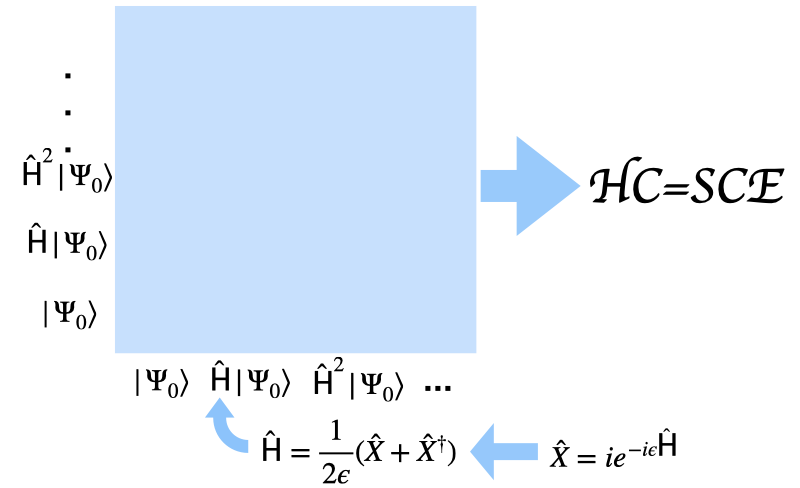
- Generalized eigenvalue problem: A matrix equation of the form MC = SCE, often arising in non-orthogonal bases, requiring specialized solvers. "ill-conditioning of the generalized eigenvalue problem produced in both QRTE and QKUD in that system."
- Hermitian operator: An operator equal to its own adjoint; in physics, ensures real expectation values and spectra (e.g., Hamiltonians). "For hermitian operators, such as the case of the molecular Hamiltonian, , this can be further simplified."
- Ill-conditioning: Numerical instability where small perturbations in input cause large changes in output, making computations unreliable. "Ill-conditioning of the generalized eigenvalue problem in quantum Krylov algorithms is a shortcoming of quantum Krylov algorithms"
- Imaginary time evolution: Evolution under e{-τH} that projects states toward lower-energy eigenstates; used to approximate ground states. "Almost all of the quantum Krylov methods use real or imaginary time evolution to consctruct Krylov vectors."
- Initial state problem: The challenge of preparing a good overlap initial state for algorithms like QPE so the desired eigenvalue can be extracted efficiently. "requires solving challenges such as the `initial state problem'~\cite{lee2023evaluating}"
- Krylov subspace: The span {ψ0, Hψ0, H2ψ0, …} used to approximate eigenstates by projecting the Hamiltonian onto this iteratively built subspace. "The Krylov subspace method aims at finding the ground state of a quantum system by diagonalizing the Hamiltonian within a subspace"
- Linear combination of unitaries: Expressing non-unitary operators as weighted sums of unitary operators to enable implementation on quantum hardware. "as a linear combination of unitaries."
- Linear dependency: When generated vectors become nearly collinear, reducing the effective rank of the subspace and hindering convergence. "Since time evolution starts to become linearly dependent at , these quantum Krylov methods are not exact."
- Many-body physics: The study of systems with many interacting particles where collective behavior and correlations dominate. "quantum chemistry and many-body physics"
- MRSQK (Multi-reference selected quantum Krylov subspace): A variant of quantum Krylov methods that builds the subspace from multiple reference states with selected contributions. "multi-reference selected quantum Krylov subspace (MRSQK)~\cite{stair2020multireference}"
- Orthogonalization: The process of making vectors mutually orthogonal to improve numerical stability and conditioning. "The way to solve it in classical Krylov algorithms is to use orthogonalization of each new Krylov vector to the previous ones"
- Overlap matrix: The matrix of inner products S_ij = ⟨ψ_i|ψ_j⟩ for a non-orthogonal basis; appears in generalized eigenvalue problems. "to avoid ill-conditioning of the overlap matrix."
- QDavidson: A quantum adaptation of the Davidson method that iteratively refines approximate eigenpairs in a subspace. "QDavidson~\cite{qdavidson}."
- QITE (Quantum Imaginary Time Evolution): A quantum algorithm that approximates imaginary-time evolution to project onto low-energy states. "Quantum Imaginary time evolution (QITE)~\cite{mcardle2019variational,motta2020determining,yeter2020practical}"
- QKUD (Quantum Krylov using Unitary Decomposition): The proposed algorithm that builds exact Krylov subspaces via unitary decomposition rather than time evolution. "QKUD provides numerically exact results at small "
- QLanzcos: A quantum version of the Lanczos algorithm for building Krylov subspaces and approximating eigenvalues. "QLanzcos~\cite{motta2020determining}"
- QPE (Quantum Phase Estimation): A core fault-tolerant algorithm that estimates eigenphases/eigenvalues of unitary or Hamiltonian evolutions. "The flagship algorithm for fault-tolerant quantum computing is Quantum Phase Estimation (QPE)"
- QRTE (Quantum Real Time Evolution): A Krylov approach that uses short-time real-time evolution steps to span the subspace. "Quantum Real Time Evolution (QRTE)~\cite{parrish2019quantum,cohn2021quantum,oumarou2025molecular,klymko2022real}"
- QSVT (Quantum Singular Value Transformation): A framework for transforming singular values of block-encoded operators using polynomial filters. "Block encoding with QSVT ~\cite{gilyen2019quantum} can be explored."
- Qubitization: A Hamiltonian simulation technique that uses block-encoding oracles to implement controlled evolutions with optimal scaling. "which can be implemented using Trotter or qubitization~\cite{motta2024subspace}."
- Sampling diagonalization: A method to estimate effective Hamiltonians via sampled expectation values and then diagonalize classically. "Implementation of QRTE using sampling diagonalization has also been developed and implemented recently"
- Shot count scaling: How the number of circuit repetitions (measurements) grows with problem size/iterations; a key cost metric on NISQ devices. "Compared to leading near-term algorithms, the QKUD algorithm ... has much lower shot count scaling requirements of O(iN)"
- Statevector simulation: Classical simulation that stores the full quantum state vector to emulate ideal quantum circuit outcomes. "Statevector simulations of QKUD and QRTE at various parameter values for H 3."
- Time evolution operator: The unitary e{-iΔtH} that advances a quantum state in real time under Hamiltonian H. "as the time evolution operator $e^{-i\Delta t \hat{H}$ starts to mimic an identity operator."
- Trotter: A decomposition (Suzuki–Trotter) that approximates e{-iHt} by splitting H into simpler parts; used for Hamiltonian simulation. "using Trotter or qubitization~\cite{motta2024subspace}."
- Unitary decomposition: Writing a non-unitary operator as a sum of unitaries so it can be implemented on a quantum computer. "One of the ways non-unitary operators can be mapped onto unitary operators is through a unitary decomposition of operators"
- Unitary operator: An operator U with U†U = I; preserves norms and represents valid quantum evolutions or transformations. "a unitary operator analogous to time-evolution operator with a small time-step, $\exp^{-i\epsilon \hat{H}$,"
Collections
Sign up for free to add this paper to one or more collections.