- The paper shows that effective field theory corrections shift the ISCO and MBO radii, altering the orbital angular momentum around black holes.
- The study employs a Hamiltonian formalism to reveal that modified effective potentials generate complex zoom-whirl periodic orbits, deeply influencing gravitational wave signatures.
- Quantitative waveform analysis indicates measurable phase shifts and amplitude modulations, offering a robust diagnostic to test extensions of general relativity.
Gravitational Wave Signatures from Periodic Orbits in EFT Extensions of General Relativity
Introduction and Theoretical Framework
This work explores the orbital and gravitational wave (GW) phenomenology associated with periodic orbits of test bodies around black holes (BHs) in the effective field theory extension of general relativity (EFTGR) (2512.11911). EFTGR incorporates higher-curvature corrections into the gravitational action, modifying the spacetime geometry primarily in the strong-field regime while leaving weak-field predictions virtually indistinguishable from standard GR. The effective action considered includes terms quadratic in Riemann invariants, controlled by dimensionless coupling constants ϵi (notably ϵ1 for spherically symmetric backgrounds).
The authors focus on non-rotating (static, spherically symmetric) black hole solutions, in which the line element is parametrized via two independent metric functions whose expressions include explicit EFTGR corrections. Importantly, even at first order in ϵ1, the spacetime exhibits horizon shifts and modified effective potentials for geodesic motion, affecting fundamental observables such as the location of the innermost stable circular orbit (ISCO) and marginally bound orbit (MBO).
Geodesic Motion and Effective Potential Analysis
The geodetic analysis is performed via the Hamiltonian formalism, restricting to equatorial plane motion. The modified effective potential Veff(r) governs the dynamics, and deviations from the Schwarzschild case become prominent close to the horizon. The EFTGR parameter ϵ1 systematically increases both the ISCO and MBO radii and their corresponding angular momenta. This modification is crucial for signals from extreme mass ratio inspirals (EMRIs) in which the smaller body closely probes the strong-gravity region.
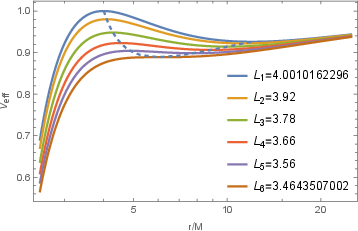
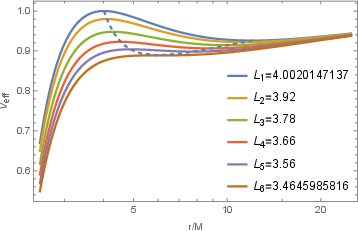
Figure 1: The effective potential Veff as a function of r/M for several values of ϵ1, highlighting the shift in potential extrema with increasing curvature corrections.
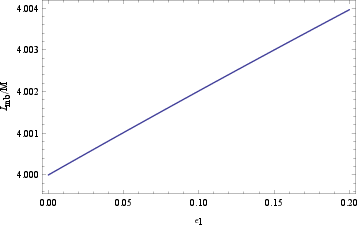
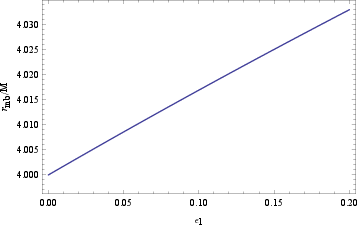
Figure 2: The angular momentum LMBO as a function of ϵ1, quantifying the influence of EFTGR corrections on marginally bound orbits.
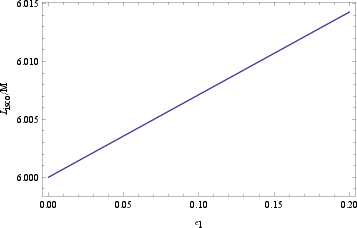
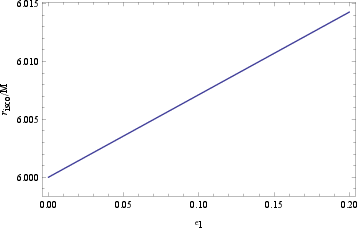
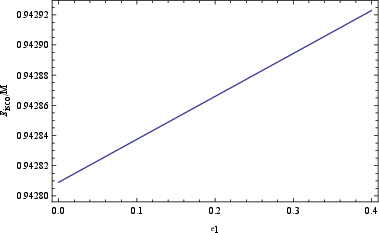
Figure 3: The angular momentum LISCO as a function of ϵ1, indicating the EFTGR-driven increase in the ISCO location and its associated constants of motion.
Numerical scans of Veff reveal that as ϵ1 increases, the critical radii permit wider stable orbits, which have direct implications for the morphology and energetics of GWs from EMRIs.
Classification and Structure of Periodic Orbits
Orbit taxonomy is conducted using the (z,w,v) approach, where z is the zoom number (number of leaf-like excursions away from pericenter between successive periapses), w is the number of whirls (full azimuthal rotations near periapsis), and v encodes additional topological information (such as vertex index or parity). The condition for periodicity is given by a rational ratio of azimuthal to radial frequencies, which is manifestly affected by both the orbital parameters (E,L) and the EFTGR parameter ϵ1.
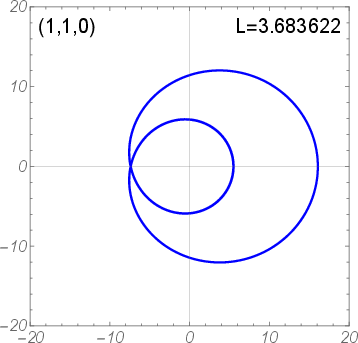
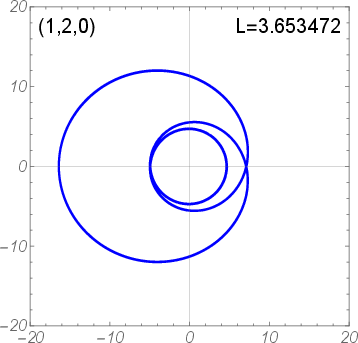
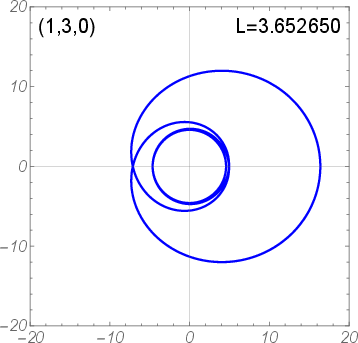
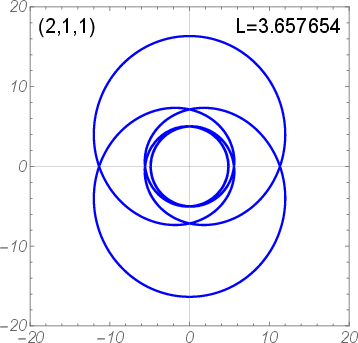
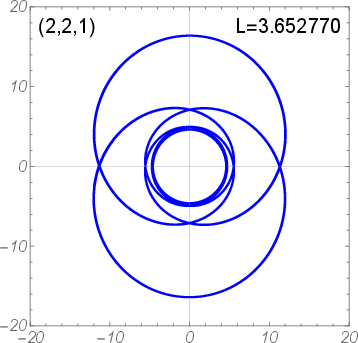
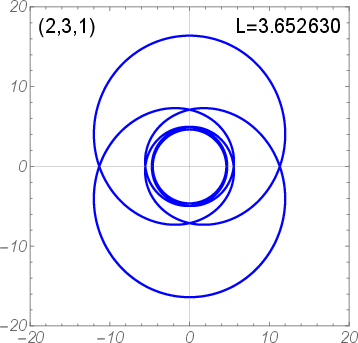
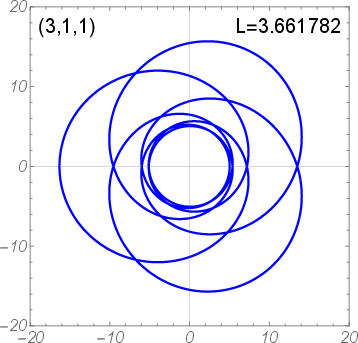
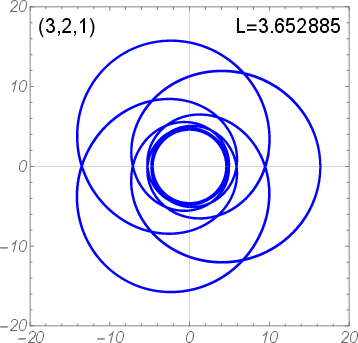
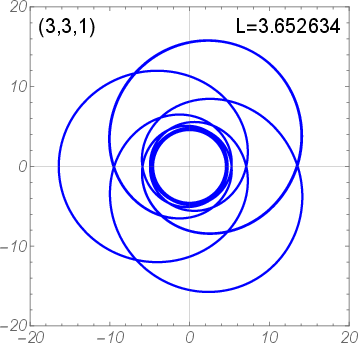
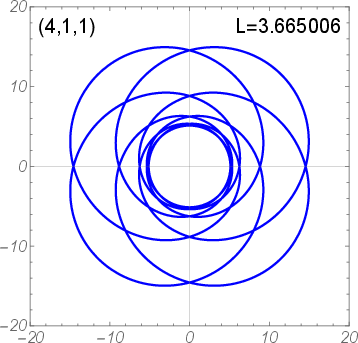
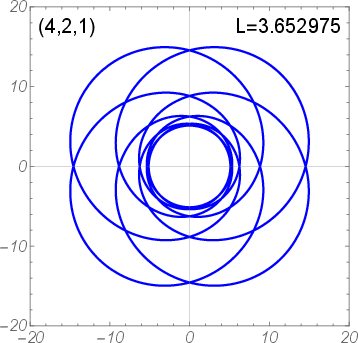
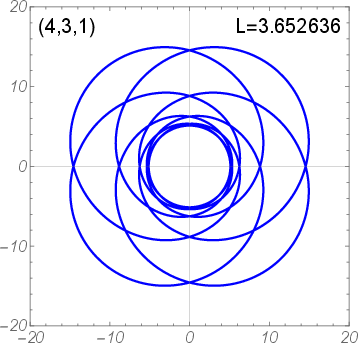
Figure 4: Periodic orbits around a black hole in EFTGR for various combinations of (z,w,v) at fixed energy, demonstrating the increasing trajectory complexity with higher z and w for nonzero ϵ1.
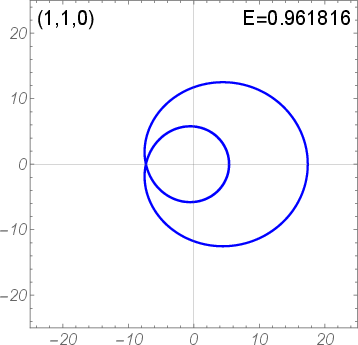
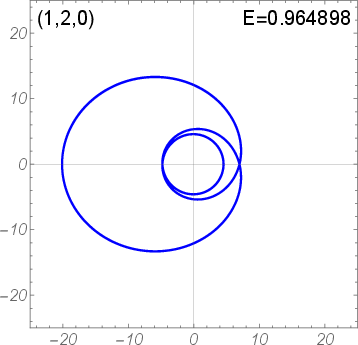
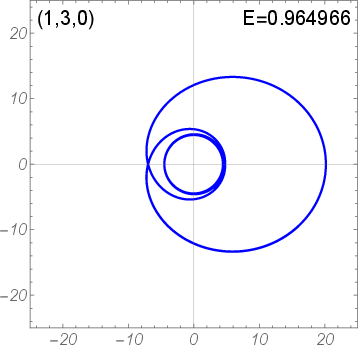
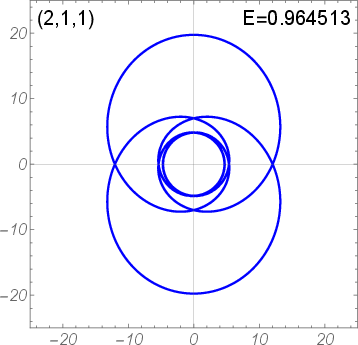
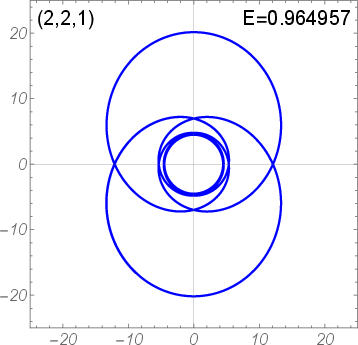
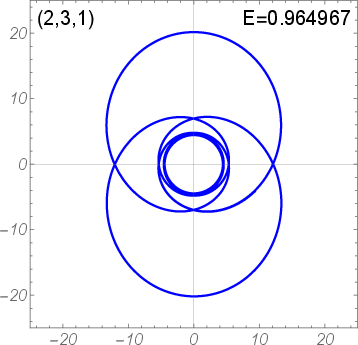
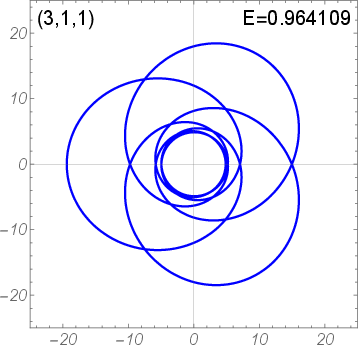
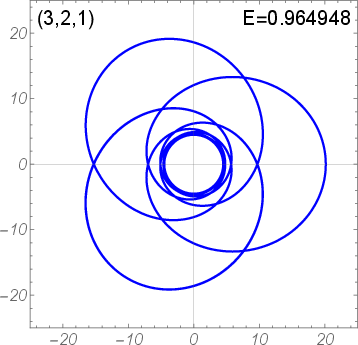
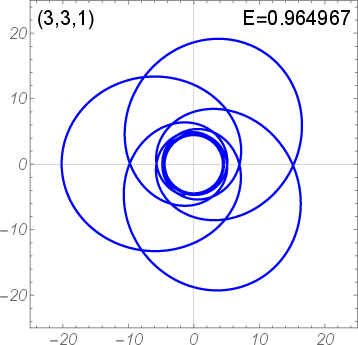
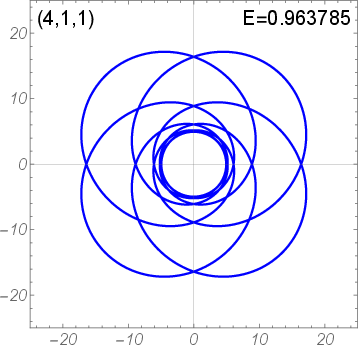
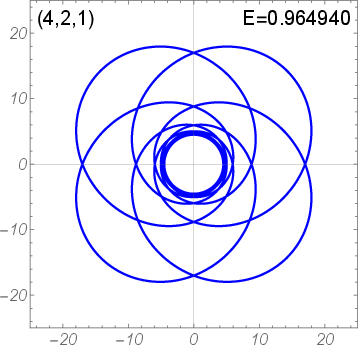
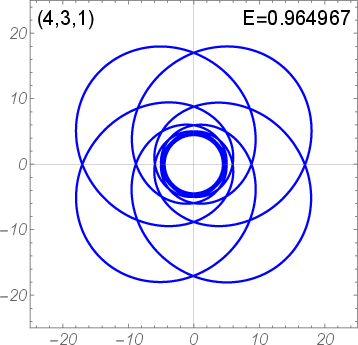
Figure 5: Periodic orbits at fixed angular momentum, illustrating analogous complexity in the orbital topologies, and explicit dependence on the choice of conserved quantities.
Compared to the GR case, the enhanced effective potential in EFTGR supports orbits with higher zoom and whirl numbers, resulting in intricate spatial structures. This complexity is expected to generate richer GW emission patterns, especially in the strong-field regime.
GW emission is computed within the quadrupole approximation, valid for EMRIs with mass ratios m≪M. The radiative multipoles are evaluated using numerically-integrated geodesics as source trajectories. Waveforms, both in h+ and h× polarisations, display a direct imprint of the underlying zoom-whirl topological behavior: zoom phases yield broad, low-amplitude signal segments, while whirls cause sharp, amplitude-enhanced oscillations.
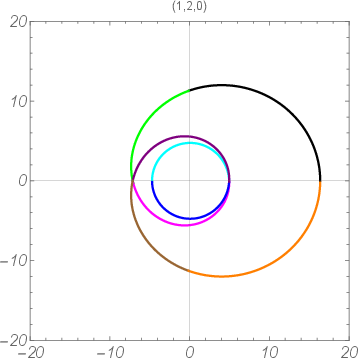
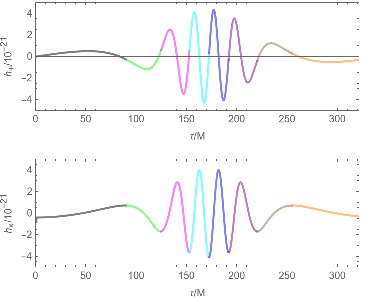
Figure 6: Left: A typical (z,w,v)=(1,2,0) orbit in EFTGR; Right: Associated h+ and h× waveform modes, highlighting the correspondence between orbital phase and GW feature.
Notably, the waveform substructure becomes increasingly elaborate for orbits with higher zoom numbers, where each "leaf" in the spatial trajectory corresponds to a distinct modulation in GW amplitude and frequency. Color-coding in the figures further clarifies the connection between specific orbital path segments and the resulting GW signal features.
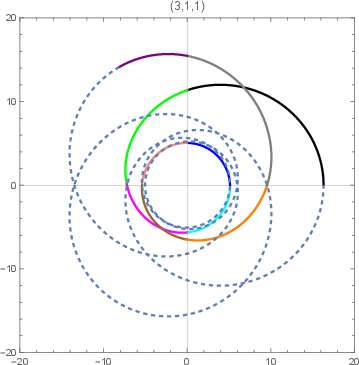
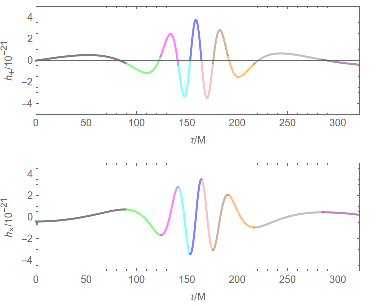
Figure 7: Left: A (z,w,v)=(3,1,1) orbit in EFTGR; Right: Associated GW waveform with three-leaf periodicity, exhibiting the nontrivial mapping of orbital geometry to GW time series.
The phase evolution of the waveform is sensitive to EFTGR corrections. For fixed orbital parameters, increasing ϵ1 primarily induces phase shifts and minor amplitude modulations in the GW signal.
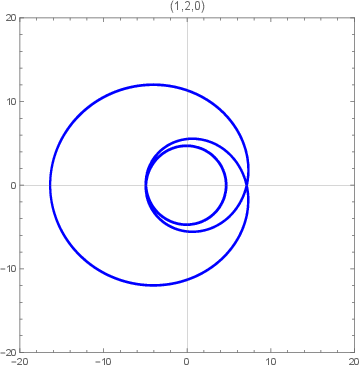
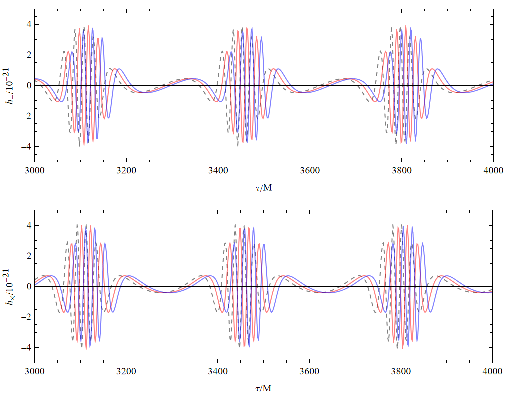
Figure 8: Left: Representative (1,2,0) orbit for different ϵ1; Right: h+ and h× waveforms, where colored lines indicate phase dephasing as a function of EFTGR parameter strength.
Quantitative analysis finds that while amplitude differences with respect to the Schwarzschild cases are subdominant, cumulative phase shifts can accrue measurably over many orbits. Thus, the detection of waveform dephasing or drifting features by future space-based GW detectors (e.g., LISA, TianQin, Taiji) presents a potential avenue to constrain or detect beyond-GR corrections parameterized by ϵ1.
Implications, Limitations, and Outlook
The primary practical implication is that GWs from EMRIs serve as sensitive diagnostics of strong-field gravity. The explicit imprint of higher-curvature corrections on the orbital and radiative properties can, in principle, break degeneracies with astrophysical parameter uncertainties, provided sufficiently high SNRs and long inspiral segments are observed. Furthermore, the adoption of a consistent EFT framework—rather than a phenomenological parameterization—ensures that signals remain physically admissible and that constraints on ϵi encapsulate a broad swath of gravitational physics beyond GR.
Theoretically, results support the assertion that periodic orbit classification and corresponding GW features form a robust "spectroscopy" tool for theory testing. The formalism can be extended to slowly-rotating or spinning BHs, where additional EFTGR parameters (ϵ2, ϵ3) and potentially Z2-violating "twists" become manifest.
Future directions include incorporating self-force corrections, going beyond the adiabatic and quadrupole approximations, and statistical inference of EFTGR parameters from synthetic EMRI waveform catalogs. For rapidly spinning BHs or in scenarios with further symmetry reductions, spectral features in the ringdown phase could provide complementary constraints.
Conclusion
The analysis presented systematically connects the modifications to black hole spacetime introduced by EFTGR with distinctive features in periodic timelike orbits and the gravitational waves they generate. The work demonstrates that the EFTGR parameter ϵ1 alters the spacetime's effective potential, influencing the ISCO, MBO, and periodic orbit structure. This, in turn, imprints observable phase and, to a lesser extent, amplitude differences in GW signals from EMRIs, offering a direct, quantitatively robust way to probe or constrain high-curvature extensions to GR. The formalism and results lay substantial groundwork for both the theoretical modeling and future observational interpretation of GW signatures from the regime where classical general relativity may begin to break down.