- The paper introduces RMPS to model gravitationally prepared states arising from gravitational path integrals, capturing key nonperturbative quantum features.
- It employs random matrix theory to establish entropy bounds and diagnose bra-ket wormhole phase transitions through a spectral gapping criterion.
- The study numerically verifies off-shell wormhole contributions and extends the RMPS framework to continuous space and de Sitter quantum gravity settings.
Random Matrix Product State Models of Gravitationally Prepared States
Overview and Objectives
The paper "Random matrix product state models of gravitationally prepared states" (2512.11966) introduces a formal modeling framework for quantum field theoretic states arising from gravitational path integrals, termed gravitationally prepared states (GPS). These states encode the quantum gravitational past evolution of closed universes, relevant in cosmological and black hole contexts. The core proposal is to represent GPS in two dimensions using random matrix product states (RMPS), exploiting the analytical tractability and nonperturbative capabilities of random matrix theory to precisely characterize higher topologies and replica geometries in these states.
The work analyzes the physical properties of this construction, notably the bra-ket wormhole phase transition and entropy bounding, establishes spectral criteria for physically realistic GPS models, and demonstrates the computation of off-shell wormhole effects—contributions beyond semiclassical saddlepoints—using RMPS. It extends the RMPS formalism to continuous-space limits and explores connections to de Sitter quantum gravity.
Gravitationally Prepared States and Path Integral Construction
The gravitationally prepared state ∣ψ⟩ is constructed from a functional gravitational path integral over geometries g subject to fixed boundary conditions for gravity, but not for matter, yielding a wavefunctional on a spatial boundary Σ. Formally,
∣ψ⟩=∫Dg∣∂g=Σi∏Dφiexp(−S[g,φi])∣φi,Σ⟩
where S[g,φi] is the action of gravity coupled to matter. This setup naturally includes contributions from all spacetime topologies, and, critically, allows for the inclusion of replica effects—geometries that connect multiple copies of ∣ψ⟩ via wormholes.
In two dimensions, this construction is made explicit in the AdS JT+CFT model, with JT gravity coupled to CFT matter. Notable physical features of the resulting state include (i) a bra-ket wormhole phase transition at a critical boundary length Lcrit, which fundamentally changes correlation decay law, and (ii) entropy bounding, with entanglement entropy of any subsystem constrained by the topological term ϕ0 associated with black hole/dS entropy.
The modeling of GPS with RMPS leverages the following motivations:
- Topological Expansion: Matrix product state observables admit an expansion in the 't Hooft parameter N, with coefficients matched to surface Euler characteristics, reproducing the suppression factors for higher genus/topology as in 2D gravity.
- Entropy Bounding: The bond dimension N of the MPS enforces an entropy bound for spatial subregions, S[R]≤∣∂R∣lnN, matching gravitational entropy bounds if N=eϕ0.
- Holographic Argument: AdS/CFT duality suggests mapping the gravitational boundary path integral to a quantum mechanical system of dimension ∼eϕ0 interacting with boundary matter degrees of freedom, naturally yielding a matrix product structure.
The RMPS is explicitly constructed by sampling k random Hermitian N×N matrices {Ai} and defining
∣ψ⟩=i0,…,iL−1∑Tr(AiL−1⋯Ai0)∣iL−1⋯i0⟩
with the ensemble for Ai governed by a probability distribution ∝exp[−NTrV({Ai})], with V a polynomial in the Ai.
Bra-Ket Wormhole Phase Transition and Spectral Gapping
A key physical signature of GPS is the transition in the dominant topology contributing to the state's inner product ⟨ψ∣ψ⟩, from disconnected disks to a topology with a wormhole connecting the bra and ket. This phase transition exhibits as a switch from power-law to exponential decay in long-range correlators.
The paper rigorously ties this property to spectral features of the RMPS transfer matrix M=∑i=1kAi∗⊗Ai:
- Spectral Gapping Property: For an RMPS to correctly model the phase transition, M must have a gapped highest eigenvalue in the full ensemble average, while the disconnected transfer matrix (with independent Ai for bra/ket) has an ungapped spectrum.
This criterion is formalized for O(k)-symmetric models, where k is the local Hilbert space dimension, and the transfer matrix self-averages at large k, showing that a class of potentials V guarantee the desired phase structure.
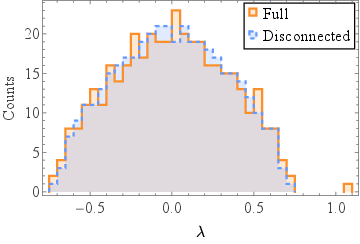
Figure 1: Eigenvalue distribution of a sample transfer matrix in the quadratic + quartic model (k=8, N=20), exhibiting a gapped highest eigenvalue for the full transfer matrix.
Numerical Verification of Physical Properties
The authors numerically implement several random matrix ensembles (quadratic, quartic, mixed potentials) and verify:
- Spectral Gapping: Ensembles show continuous spectra for disconnected M, and an isolated gapped eigenvalue for the full M.
- Phase Transition: The ratio ⟨ψ∣ψ⟩conn/⟨ψ∣ψ⟩disc scales as N−2exp(αL), matching theoretical expectation. Correlators exhibit exponential decay above Lcrit.
- Entropy Bounds: Entanglement and Rényi entropies of intervals saturate the bound 2lnN up to O(k−1) corrections at large k.
Off-Shell Wormholes and Nonperturbative Effects
A principal finding is that RMPS allows calculation of off-shell wormhole contributions—topologies that exist only beyond semiclassical solutions. These are responsible for nonzero "long-distance" contributions to correlators and lead to cumulant scaling in the log of the transfer matrix's largest eigenvalue. Numerically, the n-point cumulants scale as N2(1−n), and the effect is interpreted as arising from n-point wormholes connecting operator insertions (or boundary points) on the underlying geometry.
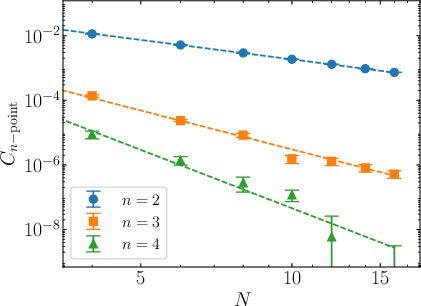
Figure 2: N dependence of n-th log-eigenvalue cumulants in the quadratic + quartic model; N2(1−n) scaling evidences the contribution of n-point off-shell wormholes.
Extensions: Continuous RMPS and de Sitter Quantum Gravity
The framework is generalized to continuous-space RMPS (cRMPS), which employ bosonic field creation operators in a cMPS formalism. Analytical expressions for correlators and entanglement entropy are obtained via a transfer Hamiltonian, and the same spectral and entropic properties as the discrete case are preserved. Off-shell wormhole contributions and the role of spectral gapping are validated in the continuum limit.
Additionally, gravitationally prepared states in two-dimensional de Sitter space are analyzed. The paper discusses the dS JT+CFT model, analytic continuation issues, and the divergence of the bra-ket wormhole solution for physical choices of dilaton boundary conditions, highlighting a divergence problem that is not present in AdS.
Implications and Directions
The RMPS modeling of gravitationally prepared states rigorously captures nonperturbative quantum gravitational effects beyond saddlepoint geometries, enabling computation of replica and off-shell contributions. The spectral gapping criterion provides an explicit, ensemble-independent diagnostic for phase structure in quantum gravity models.
Practical implications include:
- The operational determination of nonzero long-range correlations in cosmological backgrounds, with potential observability in e.g. CMB power spectra.
- A systematic framework for imposing entropy bounds in quantum gravitational effective theories, directly linked to microscopic model parameters.
- The ability to generalize to higher dimensions via cluster state analogs, potentially illuminating entropy-area laws and quantum chaos in gravitational contexts.
Future developments may encompass:
- Identification of RMPS ensemble potentials realizing specific gravitational duals (e.g. via SYK-like generalizations).
- Analytical resolution of the de Sitter bra-ket wormhole divergence, perhaps by extending RMPS to non-Hermitian ensembles.
- Extension of RMPS to include relativistic local structure, possibly reconciling with modular field theory approaches.
Conclusion
This work provides a robust, nonperturbative approach to modeling quantum states prepared by gravitational path integrals, marrying random matrix theory with tensor network structures to encapsulate essential quantum gravitational features—topological suppression, phase transitions, entropy bounds, and off-shell effects. The RMPS framework is both analytically tractable and numerically accessible, offering fertile ground for theoretical advances in quantum gravity, holography, and cosmology.