- The paper introduces a novel holographic isoTNS framework that overcomes MPS limitations by efficiently representing 1D quantum states with volume-law entanglement.
- It employs a (1+1)D lattice of isometric tensors and maps these to quantum circuits, enabling scalable computation and simulating complex quantum dynamics.
- The approach leverages TEBD with the Moses move for efficient orthogonality surface shifts, although practical challenges arise from error accumulation during long-time evolution.
Holographic isoTNS: Extending Tensor Networks for Highly Entangled 1D Quantum States
Introduction
The paper "Holographic Representation of One-Dimensional Many-Body Quantum States via Isometric Tensor Networks" (2512.11967) introduces a novel tensor network ansatz, termed holographic isoTNS, designed to efficiently represent 1D quantum many-body states with high entanglement entropy and low complexity. Originating from the isoTNS framework successfully developed for 2D systems, the approach focuses on balancing expressivity and computational tractability by enforcing isometric constraints, and extends the scope of tractable quantum states beyond the area- and log-law regimes accessible to traditional MPS and MERA schemes.
Conventional Tensor Networks and Their Limitations
Matrix Product States (MPS) form the practical foundation for numerically studying gapped local Hamiltonians in 1D, efficiently representing area-law states through a linear scaling in parameters and supporting stable, fast algorithms under canonicalization (i.e., isometric form) (Figure 1).
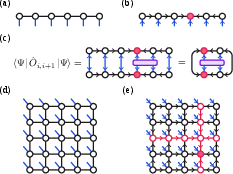
Figure 1: Tensor network and isometric notation, showing MPS, 2D PEPS/isoTNS, and the contraction advantages conferred by isometries.
However, MPS and their extensions (such as tree tensor networks and MERA) are fundamentally limited in their ability to encapsulate states with volume-law entanglement or high circuit complexity. PEPS generalize tensor networks to 2D but contractibility becomes computationally prohibitive due to loops. isoTNS, by incorporating isometric conditions, provide a manageable submanifold within PEPS for 2D simulation.
Holographic isoTNS Ansatz: Architecture and Circuit Mapping
Network Topology
The holographic isoTNS ansatz distinguishes itself by employing a (1+1)-dimensional lattice of isometric tensors for a 1D quantum system, where one axis encodes real physical space and the orthogonal axis represents an auxiliary or "holographic" direction analogous to virtual time. Bulk tensors above the physical layer interact solely via virtual indices; only the bottom row features physical legs coupled to the quantum system.
Shifting the orthogonality surface (the "gauge" axis where contractions are efficient) through the network defines the adaptive structure of the ansatz. The isometric constraints are enforced globally toward this surface, enabling efficient computation of observables and local updates despite the increased geometric complexity (Figure 2).
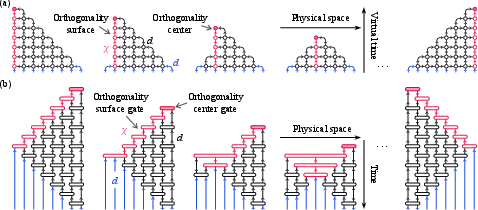
Figure 2: (a) Diagram of a holographic isoTNS for L=8 showing bulk (black) and orthogonality-surface (pink) tensors; (b) equivalent unitary circuit mapped from the network.
Quantum Circuit Interpretation
The mapping of holographic isoTNS to quantum circuits reveals each isometric tensor as a (multi-)qudit unitary with ancilla qudits, rendering the ansatz particularly compatible with quantum simulation and circuit complexity frameworks. The circuit depth scales as O(L) for fixed bond dimension χ, highlighting the ability to generate volume-law entanglement at modest depth—a property in stark contrast to MPS.
Entanglement Structure and Expressive Capacity
Volume-Law Entanglement
Randomly initialized holographic isoTNS states generically exhibit volume-law scaling of Rényi-2 entropy, as demonstrated numerically for various bond dimensions and system sizes (Figure 3). This extensive entanglement is unattainable in MPS, where a single spatial bond limits the entanglement at a cut; in holographic isoTNS, the number of cut horizontal bonds at a bipartition grows linearly with system size and these are never truncated, supporting arbitrarily extensive entropy.
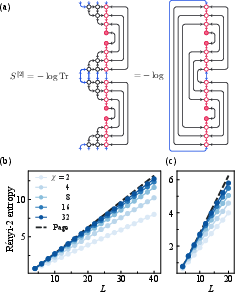
Figure 3: (a) Efficient contraction scheme for half-chain Rényi entropy; (b) volume-law scaling with system size at various χ; (c) confirmation for orthogonality surface at boundary.
Exact and Efficient Representability
Holographic isoTNS strictly generalize MPS, being able to encode any MPS of bond dimension χ using a bond dimension χ2 and the appropriate orthogonality surface placement. Furthermore, the architecture allows exact construction of canonical volume-law states—such as rainbow states formed from entangled pairs across the chain—through a permutation of qubits implemented by SWAP and identity gate patterns in the network.
Gaussian and Clifford States
Through both analytic circuit correspondence and variational optimization, it is confirmed that:
- All Fermionic Gaussian States (FGS) can be exactly encoded as holographic isoTNS with fixed χ=2 for arbitrary orthogonality surface placements.
- Clifford states, produced by depth-O(L) local circuits of Clifford gates on product states, are similarly exactly representable with χ=2.
These results underline the capacity for efficient representation of highly entangled but structurally low-complexity quantum states, circumventing the exponential bottleneck plaguing conventional tensor network descriptions for such classes.
Time Evolution and Complexity Limitations
Holographic isoTNS are shown to variationally and efficiently represent short-time-evolved states, even those developing volume-law entanglement under unitary evolution (e.g., for the Kicked Ising Chain or starting from rainbow initial states). However, as dynamics proceeds and the computational complexity (depth, not just entanglement) of the state increases, the ansatz's ability to faithfully represent the state diminishes—not primarily because of entanglement, but due to growing circuit complexity. This is a clear departure from the MPS paradigm, where entanglement sets the main representational bottleneck.
Results (Figure 4) demonstrate that, for a fixed χ, holographic isoTNS capture dynamical entanglement growth and local observables accurately for timescales and states well beyond the regime where MPS breaks down, but ultimately are limited by circuit complexity growth.
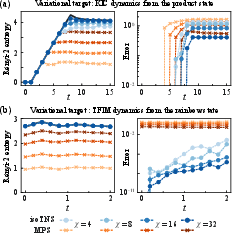
Figure 4: Variational optimization error and Rényi entropy for time-evolved states under (left) KIC from a product state and (right) TFIM from a rainbow state, compared for MPS and holographic isoTNS.
Algorithms: TEBD and Orthogonality Surface Shifts
The paper develops a TEBD (Time-Evolving Block Decimation) algorithm adapted to holographic isoTNS, exploiting the isometric structure for efficient local updates (Figure 5). However, a core challenge arises: shifting the orthogonality surface, needed for gate application, is only approximate for finite bond dimension due to localized tensor optimizations. This causes cumulative errors, with the main practical effect of the TEBD being a (potentially rapid) loss of entanglement and deviation from exact dynamics, even for target states theoretically exactly representable by the ansatz.
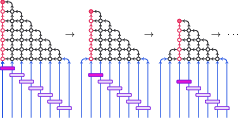
Figure 5: TEBD workflow for holographic isoTNS: gate application and orthogonality surface shifting for each local two-body gate.
Simulations (Figure 6) confirm that error accumulation tied to orthogonality surface shifts, not the intrinsic network representability, sets the principal runtime limitation; reducing Trotter step size increases, rather than alleviates, this error as it multiplies the number of surface shifts per simulated time unit.
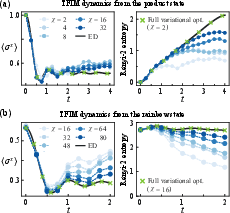
Figure 6: Dynamics of average magnetization and Rényi entropy under the TFIM for (a) a product FGS and (b) a rainbow initial state; holographic isoTNS (blue) are validated by variational results (green) but show loss of fidelity for long-time TEBD evolution.
To address surface shift limitations, the Moses move algorithm is described and diagrammed (Figure 7), enabling more reliable but still locally approximate movement of the orthogonality surface.
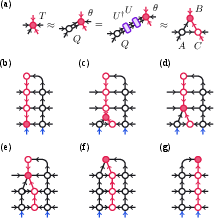
Figure 7: Stages of the Moses move for shifting the orthogonality surface rightward by one column; repeated tripartite decompositions and contractions reconstruct the network structure.
Implications and Extensions
Practical implications are immediate for simulating highly entangled quantum systems in one dimension, particularly when the relevant physical states remain low in circuit depth (e.g., short-time evolution, non-equilibrium steady states, quantum information processing with Clifford or Gaussian circuits). The quantum circuit correspondence opens a direct connection to variational quantum algorithms and quantum hardware simulations, suggesting that holographic isoTNS-inspired architectures may guide the design of shallow-depth, noise-robust quantum circuits targeting entangled state preparation.
Theoretical implications are multifaceted:
- The boundary between entanglement and computational complexity is clarified: for holographic isoTNS, complexity rather than entropy sets the limit of representational power.
- The (1+1)D architecture introduces a new way to interpolate between fixed-geometry tensor networks and general quantum circuit variational classes.
Future extensions are outlined, including:
- Generalizations to (2+1)D holographic isoTNS for volume-law entangled 2D states, requiring networks on a cubic lattice.
- Adapting the Moses move and tensor optimizations to infinite and translationally invariant systems.
- Incorporation of fermionic statistics in higher dimensions.
- Exploring nonlocal/multiqudit/mid-circuit measurement variants, enhancing flexibility for quantum circuit mapping.
Conclusion
The holographic isoTNS framework extends the range of efficiently characterized 1D quantum many-body states to encompass high-entanglement, low-complexity families inaccessible to standard tensor networks. By leveraging a (1+1)D architecture and global isometric constraints, the ansatz supports scalable computation of observables, efficient variational optimizations, and a direct mapping to quantum circuits, with expressivity far beyond MPS or TTN in the regime of practical quantum complexity. Algorithmic bottlenecks remain—focused on shifting the orthogonality surface for TEBD-style simulations—but the approach provides robust new tools and conceptual insights at the interface of many-body physics, quantum computing, and tensor network theory (2512.11967).