Cavity Mediated Two-Qubit Gate: Tuning to Optimal Performance with NISQ Era Quantum Simulations
Published 12 Dec 2025 in quant-ph, physics.atom-ph, and physics.optics | (2512.12030v1)
Abstract: A variety of photon-mediated operations are critical to the realization of scalable quantum information processing platforms and their accurate characterization is essential for the identification of optimal regimes and their experimental realizations. Such light-matter interactions are often studied with a broad variety of analytical and computational methods that are constrained by approximation techniques or by computational scaling. Quantum processors present a new avenue to address these challenges. We consider the case of cavity mediated two-qubit gates. To investigate quantum state transfer between the qubits, we implement simulations with quantum circuits that are able to reliably track the dynamics of the system. Our quantum algorithm, compatible with NISQ (Noisy Intermediate Scale Quantum) era systems, allows us to map out the fidelity of the state transfer operation between qubits as a function of a broad range of system parameters including the respective detunings between the qubits and the cavity, the damping factor of the cavity, and the respective couplings between the qubits and the cavity. The algorithm provides a robust and intuitive solution, alongside a satisfactory agreement with analytical solutions or classical simulation algorithms in their respective regimes of validity. It allows us to identify under-explored regimes of optimal performance, relevant for heterogeneous quantum platforms, where the two-qubit gate can be rather effective between far-detuned qubits that are neither resonant with each other nor with the cavity. Besides its present application, the method introduced in the current paper can be efficiently used in otherwise untractable variations of the model and in various efforts to simulate and optimize photon-mediated two-qubit gates and other relevant operations in quantum information processing.
The paper maps the Tavis-Cummings Hamiltonian onto a qubit register to simulate photon-mediated two-qubit gates including non-RWA and dissipative effects.
It employs Suzuki-Trotter decomposition to simulate state transfer dynamics accurately, achieving infidelity below 10⁻³ in both resonant and dispersive regimes.
Results identify optimal detuning and coupling settings, offering actionable insights for implementing robust NISQ-era quantum gate operations.
Cavity-Mediated Two-Qubit Gates: Optimal Tuning with NISQ Quantum Simulations
System Model and Motivation
This study addresses the fidelity and parameter-dependence of photon-mediated two-qubit gates, employing quantum circuits compatible with NISQ devices to simulate light-matter interactions in a cavity QED setting. Conventional analytical and numerical techniques are limited by the necessary use of approximations (e.g., RWA, Markovian assumptions, perturbative treatments via SW transformation), or by the exponential classical cost imposed by bosonic degrees of freedom. The quantum algorithms proposed here map the Tavis-Cummings Hamiltonian, including non-RWA terms and dissipation, onto qubit networks, enabling systematic exploration of gate performance beyond prior analytical reach.
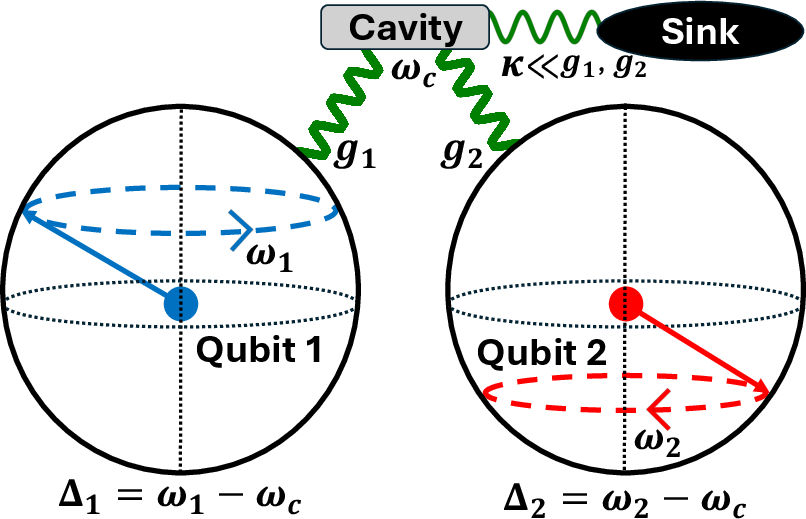
The canonical physical system comprises two qubits at tunable detunings Δ1, Δ2 relative to a damped cavity mode, each with coupling strengths g1, g2. The study’s focus is on quantum state transfer, with fidelity evaluated as a function of all relevant system parameters, both in the ideal (nondissipative) and lossy regimes.
Figure 1: Schematic of the two-qubit cavity system, showing detunings, couplings, and dissipation via environmental coupling.
Quantum Algorithm and Qubitization
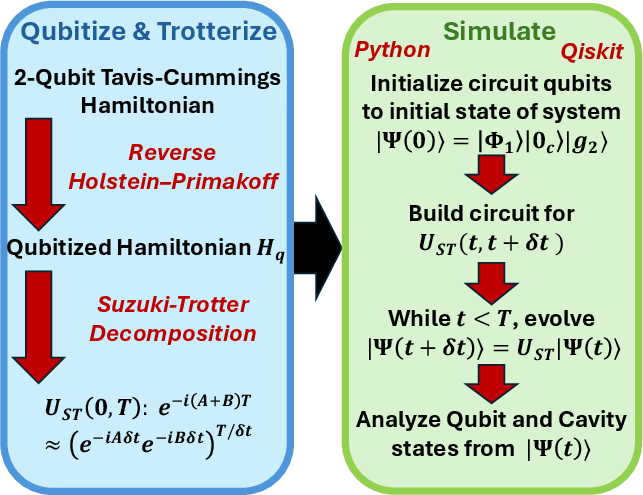
Hamiltonian mapping proceeds via a reduction of the Tavis-Cummings (TC) model to a Pauli operator representation, explicitly constructing the minimal qubit register needed to capture the dynamics for a restricted excitation manifold (justified in the absence of repeated drive or multi-excitation preparation). The bosonic mode is represented via binary encoding onto multiple qubits, as required when analyzing the breakdown of the RWA in the ultra-strong coupling regime.
Time evolution is approached via Suzuki-Trotter product formulas, enabling digital simulation with a controllable systematic error, benchmarked and bounded as a function of δt, g, and detuning parameters. For open quantum system dynamics (finite κ), amplitude damping channels are implemented with ancilla qubits and Kraus operator representation, thus capturing the essential decoherence pathways relevant for experimental platforms.
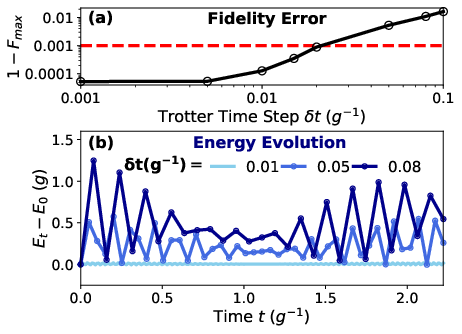
The decomposition of trotter errors and energy non-conserving contributions is systematically analyzed, and the protocols are benchmarked to enforce infidelity below 10−3—matching thresholds relevant for error mitigation discussions.
Figure 3: Systematic Suzuki-Trotter error analysis. Fidelity deviation from ideal transfer as a function of δt.
State Transfer Dynamics and Parameter Dependence
Resonant and Dispersive Regimes
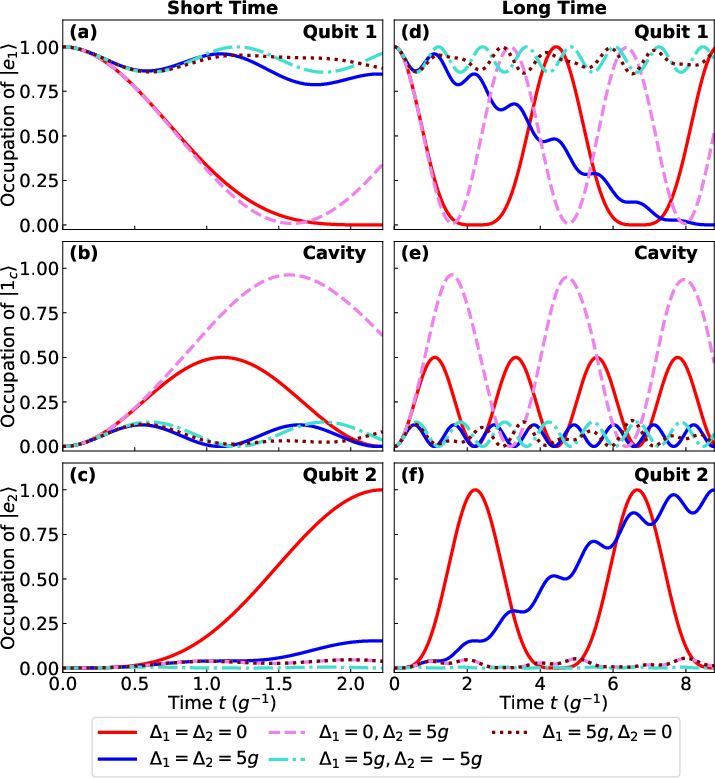
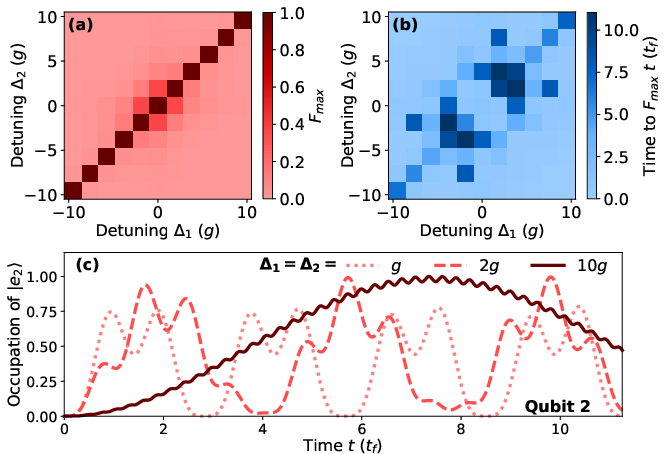
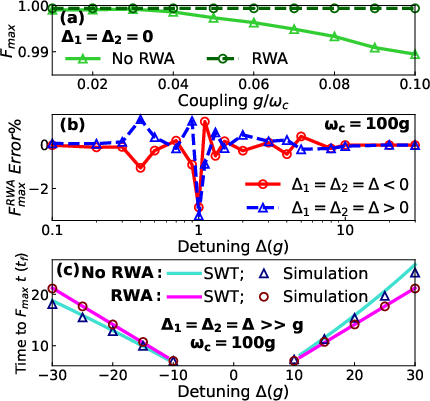
In the regime Δ1=Δ2=0, dynamics are analytically tractable, and complete state transfer can be achieved at tf=π/(2g) with unit fidelity. In the large detuning regime, an effective exchange J∼g1g2/Δ emerges, with transfer time scaling as tf′=πΔ/2g2. Quantum simulations confirm the RWA for g/ωc≪1, but show clear deviations at larger coupling (see Section RWA). Numerical results reveal transfer breakdowns for strongly asymmetric detunings, and for configurations where only virtual exchanges are allowed.
Figure 4: Time evolution of state occupations (qubits and cavity) for diverse detuning regimes, showing both resonant and dispersive behavior.
High-fidelity transfer is observed exclusively along the Δ1=Δ2 manifold, with temporal scales dictated by the underlying regime (resonant vs. dispersive). For large detuning asymmetry, population oscillates only partially, and cavity occupation can become non-negligible.
Figure 5: Maximum state transfer fidelity and corresponding optimal switching time, visualized as heatmaps in the Δ1,Δ2 plane.
Effect of Dissipation
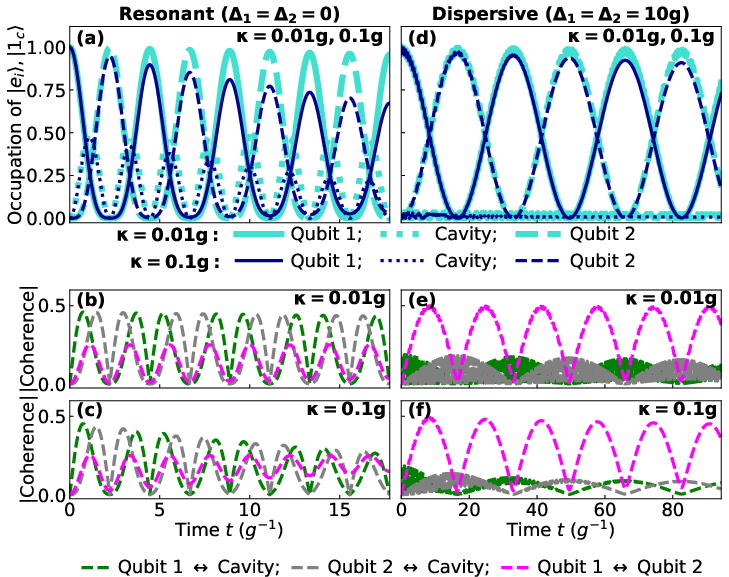
The quantum circuit approach allows explicit tracking of open-system effects. Dissipation suppresses overall transfer efficiency, but the fidelity loss is substantially less pronounced in the virtual-photon limit—dispersive coupling enables near-unit transfer while populating the lossy cavity only minimally. This selectivity provides an operational guide for robust gate operation in realistic devices.
Figure 6: Time evolution of populations and subsystem coherences for both low (κ=0.01g) and high (κ=0.1g) damping rates, juxtaposed for resonant and dispersive cases.
Superposition States and Coherence Transfer
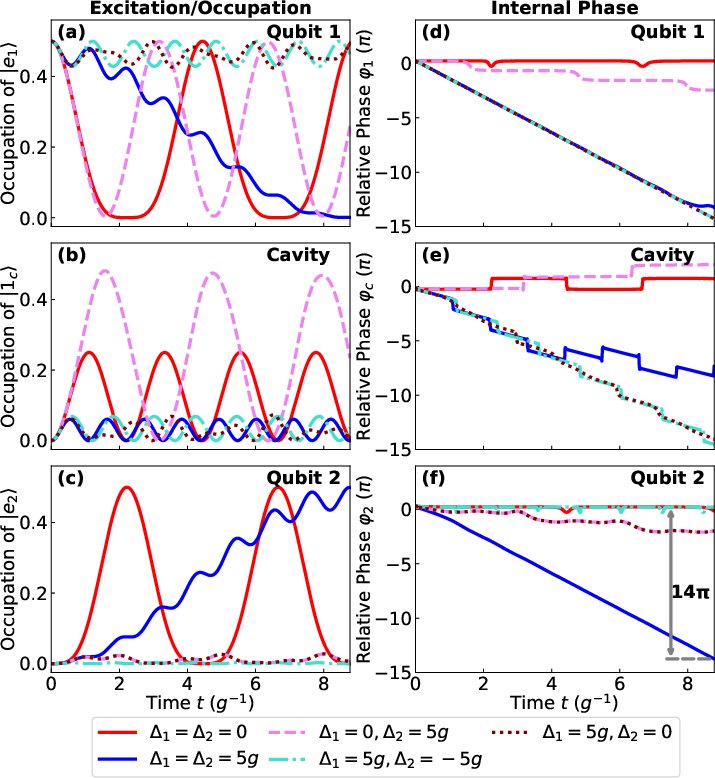
The transfer protocol is analyzed for both pure and superposed initial qubit states. For superpositions, the decoupled ground state component acts as a decoherence-free subspace, while the excited-state dynamics mirror the fully polarized case. Evolution preserves phase information (up to a predictable π shift), and quantum simulations resolve both fidelity and phase transfer as a function of Δ1, Δ2.
Figure 7: Time evolution of both occupation probabilities and relative phase for qubit and cavity subsystems, tracking transfer of an initial superposition state.
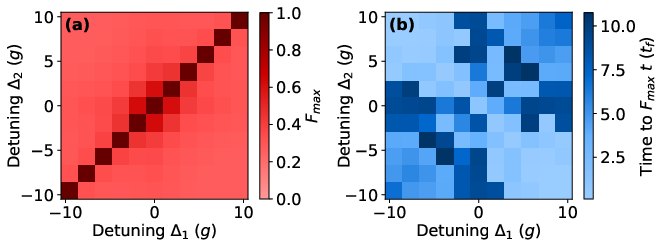
Heatmap analyses confirm that the structural dependence of transfer fidelity for superposition states closely tracks that of fully polarized states, with slightly increased minimal fidelity due to preserved ground-state contributions.
Figure 8: Heatmaps of maximal fidelity and transfer time for superposition state transfer across detuning parameter space.
Unequal Coupling and Inhomogeneous Systems
When g1=g2, complete state transfer is generically impossible, both in the RWA and for the full TC Hamiltonian; the population transfer is limited by the degree of inhomogeneity. Off-diagonal regions in the detuning matrix can, in special cases, partially ameliorate this via matching effective Rabi frequencies, but cannot recover the symmetry-protected perfect transfer attainable for g1=g2.
Regimes Beyond the Rotating Wave Approximation
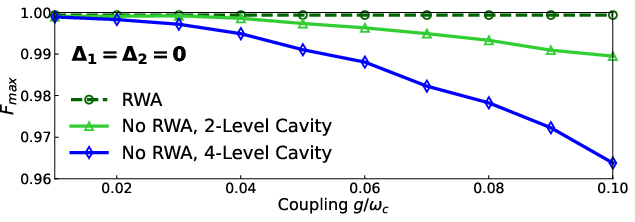
Non-RWA effects are quantified by direct quantum circuit simulation of the full Hamiltonian. For g/ωc≳0.1, significant population of multi-photon Fock states appears; these are mapped via multi-qubit binary encoding of the cavity. This manifests as a systematic reduction of maximal fidelity and introduces an asymmetry in the transfer time and fidelity between positive and negative detuning, directly attributable to non-energy-conserving terms as predicted by beyond-SWT effective Hamiltonians.
Figure 9: Comparison of maximal fidelity, RWA error, and transfer time for RWA vs. full TC Hamiltonian, highlighting breakdown of RWA symmetry in nonperturbative parameter regimes.
Figure 10: Maximal fidelity vs. coupling strength for RWA, two-level, and four-level cavity encodings, emphasizing degradation with increasing g/ωc.
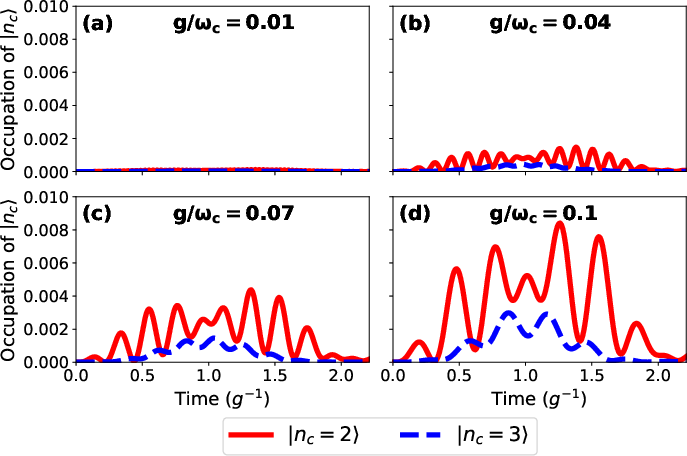
The impact of higher bosonic levels is particularly pronounced in the ultra-strong coupling regime, where even for single-excitation initial conditions, non-RWA-induced virtual transitions pollute transfer fidelity.
Figure 11: Time evolution of second and third excited-state occupation in the cavity for a range of coupling strengths; higher levels contribute nontrivially as g/ωc grows.
Implications and Outlook
The comprehensive quantum circuit protocol developed here enables explicit and systematic fidelity landscape mapping for cavity-mediated gate or transfer operations in both present and anticipated quantum hardware architectures. The methodology is sufficiently generic to incorporate realistic features — including inhomogeneous couplings, parametric detuning, and dissipation — for two- or multi-qubit operations mediated by bosonic channels. By directly simulating the physical model without analytical approximations, the approach can nonperturbatively validate or falsify the regimes of relevance of SW transformations, RWA constructions, or master equation truncations.
Practically, these results guide the optimal experimental allocation of detuning, coupling, and dissipation parameters for heterogeneous quantum processors. The identification of robust, high-fidelity transfer regimes far from resonance and minimal cavity occupation points towards hybrid system architectures (e.g., spin ensembles, superconducting qubits, trapped ions) where inhomogeneities and decoherence are inevitable. The explicit mapping of transfer error versus parameter space is directly useful for error correction code design and system calibration under realistic NISQ constraints.
Theoretically, the work highlights the critical importance of moving beyond RWA and effective operator treatments when tuning for optimal fidelity at higher coupling or in multimode/overcoupled regimes. The full quantum circuit approach provides a scalable framework for studying many-body extensions, entanglement routing, and cross-platform gate designs, with possible future generalization to more complex quantum error correction primitives and optimization of photonic QIP channels.
Conclusion
This work systematically characterizes cavity-mediated two-qubit state transfer using digital quantum simulation protocols that faithfully reproduce both closed and open system dynamics, with or without the traditional analytical approximations. The approach provides detailed maps of operation fidelity, exposes the limitations of perturbative and rotating wave treatments, and enables the identification of non-trivial, optimal parameter regimes inaccessible to traditional methods. The generality and scalability of the quantum circuit mapping open avenues for the simulation and design of a broad class of light-matter-mediated QIP operations relevant to quantum networking and scalable quantum computation.