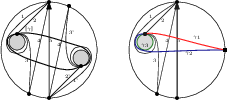
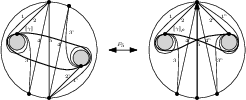
- The paper introduces an explicit construction of skew-symmetrizable cluster algebras by folding marked surfaces with an orientation-preserving involution.
- It develops modified snake graph technology to derive detailed combinatorial formulas for cluster expansion, clarifying the role of symmetry.
- The work categorifies the algebra using symmetric gentle algebras, establishing a bijection between cluster variables and orthogonal indecomposable modules.
Skew-Symmetrizable Cluster Algebras from Surfaces with Involution and their Categorification
Introduction and Context
The paper introduces a comprehensive framework for constructing and analyzing skew-symmetrizable cluster algebras A derived from marked unpunctured surfaces (S~,M~) equipped with an orientation-preserving involutive automorphism σ. By integrating concepts from surface topology, combinatorics of triangulations, and the representation theory of symmetric gentle algebras, it generalizes the classical Fomin–Shapiro–Thurston approach for skew-symmetric cluster algebras to the skew-symmetrizable case. The construction encompasses surfaces folded by a Z2-action, ultimately encoding cluster data as orbits under the involution σ.
Skew-Symmetrizable Cluster Algebras from Surfaces
Let (S~,M~) be an unpunctured marked surface with a global orientation-preserving involution σ. The principal objects are:
- Cluster variables: Indexed by σ-orbits of arcs of the surface.
- Clusters: Correspond to admissible σ-invariant ideal triangulations, i.e., maximal sets of compatible arcs stable under σ, satisfying strong regularity constraints (unique σ-invariant arc and symmetric separation properties).
The cluster algebra A∙(T~)σ with principal coefficients is defined via the initial seed determined by such an admissible triangulation T~. The exchange matrix is obtained by folding the surface along σ and adjusting the weights via a diagonal matrix D with a unique entry $2$ to reflect the presence of an orbifold point of weight $2$ in the quotient (in alignment with the orbifold formalism of Felikson, Shapiro, and Tumarkin).
An important step is the restriction operation Res: for any σ-orbit of arcs [γ], one passes to the collapsed quotient surface (along the unique σ-invariant arc), producing either one or two arcs in the quotient. This operation is central to the algebraic and representation-theoretic formulas that follow.
A primary achievement of the paper is the derivation of explicit cluster expansion formulas for the cluster variables labeled by σ-orbits. These generalize the well-known explicit combinatorial formulas in the classical (skew-symmetric) setting to the folded context via:
To model the combinatorics of the Laurent expansions, the paper develops a generalization of the snake graph technology:
The main combinatorial result asserts that the cluster expansion (i.e., the F-polynomial and g-vector) of x[γ] is recovered as, respectively, the perfect matching generating function and a monomial degree statistic attached to G[γ]. The explicit formation of these graphs is described in detail and illustrated for general cases, clarifying how the folding is captured at the level of perfect matchings.
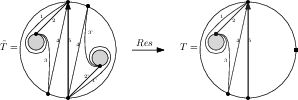
Figure 5: On the left, an admissible σ-invariant ideal triangulation of a surface; on the right, its restriction, visualizing the combinatorial effect of folding.
Representation-Theoretic Categorification
A further layer is added by associating, to every admissible seed, a symmetric gentle algebra A constructed from the folded triangulation. The algebra comes equipped with an involutive automorphism ρ mirroring the geometric symmetry. The notion of orthogonal indecomposable modules over A is central: there is a bijection between the set of non-initial cluster variables and the set of isomorphism classes of such modules.
The categorification is enriched by a representation-theoretic Caldero-Chapoton map from the orthogonal module category to the cluster algebra, generalizing classical cluster character formulas. Theorems establish that for each indecomposable orthogonal A-module N, the corresponding cluster variable has F-polynomial and g-vector determined by explicit operations—restriction, rescaling, and extension computations—purely in the module category. These connect the module-theoretic structure tightly to the combinatorics of the surface and its folding.

Figure 7: Illustration of the proof of the module-to-cluster correspondence, as developed in Theorem \ref{cat_interpr}.
Key Structural and Numerical Results
- Explicit Cluster Variable Expansions: Theorems provide formulas for F[γ] and g[γ] depending on the nature of the σ-orbit restriction, reflecting both the Laurent phenomenon and the effect of folding.
- Perfect Matching Formula: The modified snake graph construction yields a direct combinatorial formula for all skew-symmetrizable cluster variables, unifying the combinatorics for arbitrary surfaces with Z2-action.
- Representation-Theoretic Realization: The bijection between cluster variables and orthogonal indecomposables is supported by a character formula, incorporating the extension structure and leading to explicit F-polynomial decomposition in terms of module-theoretic invariants.
- Categorical Reflection: The correspondence is robust under surface reflection operations, ensuring well-definedness in the presence of symmetry and yielding symmetric gentle algebras whose module categories realize the cluster structure.
Implications and Perspectives
This work establishes a unified and explicit mechanism for constructing and understanding skew-symmetrizable cluster algebras tied to symmetric surfaces, making crucial advances in the combinatorial technology (through modified snake graphs) and in the algebraic categorification (via symmetric gentle algebras and orthogonal module categories). These insights provide a direct avenue to study the categorification and explicit computations of cluster variables in contexts beyond classical skew-symmetric types—especially cluster algebras from orbifolds, surfaces with group actions, and their associated moduli spaces.
Practically, these constructions allow computations of canonical bases, F-polynomials, and g-vectors in settings previously inaccessible to explicit combinatorics. The representation-theoretic translations open a path to advanced categorification scenarios, relating cluster phenomena to symmetric representation theory, and may have consequences in the understanding of quantum cluster algebras, wall-crossing, and higher Teichmüller theory.
Future research directions include the extension to surfaces with punctures, higher group actions, or non-orientable cases, as well as investigations of the associated derived and stable categories, compatibility with potentials, and the implications for mirror symmetry and gauge-theoretic moduli spaces in mathematical physics.
Conclusion
The paper achieves an overview of geometric, combinatorial, and algebraic methods to extend cluster algebra machinery to the skew-symmetrizable regime dictated by involutive symmetries of surfaces. By making the expansion of cluster variables both explicit and tractable, and by establishing a deep representation-theoretic categorification for this setting, the work provides both a toolkit and a conceptual framework which will serve as a foundation for further development of the theory of cluster algebras and their categorifications in the presence of symmetry.