- The paper introduces a progressive framework that leverages short-term buyer activities for dynamic search ranking in e-commerce.
- It employs heuristic autoregressive features, intent-aware contextualization, and sequential attention models to capture immediate user intent.
- Empirical results from offline and online experiments confirm significant Mean Reciprocal Rank improvements, validating session-level personalization.
Progressive Refinement of E-commerce Search Ranking Based on Short-Term Buyer Activities
Context and Motivation
High-velocity user preference drift and context specificity pose significant challenges to search ranking in e-commerce. Unlike traditional personalization, which relies heavily on broad user profiles aggregated over extended interaction histories, e-commerce platforms need to rapidly align search outcomes with a buyer's short-term, sessional intent. This necessity emerges from buyers frequently switching intents, sparse individual behavioral data, and account sharing, all of which diminish the effectiveness of long-term profiling. The work presents a systematic, progressive framework for contextual ranking using only the buyer's immediate interaction sequence to dynamically optimize search result relevance on platforms such as eBay.
Hierarchical Contextualization Methodology
The core methodological innovation is the design and empirical evaluation of a series of contextual features, incrementally increasing in expressivity, all constructed from immediate session behavior (typically N=5 previous clicks):
- Heuristic Autoregressive Features: Simple contextualization is anchored in the most recent or last five user clicks on the SERP. Both textual similarity (based on NCD) and semantic similarity (based on eBert cosine) are computed between current results and recent clicks. These features inject short-term preference signals into the ranking model.
- Intent-Aware Contextualization: Recognizing the limitations of naive recency, the methodology introduces query-dependent conditioning. For each incoming query, the clicked item most similar (textually or semantically) to the query is retrieved as a context anchor; subsequent features measure alignment between candidate SERP items and this anchor. This method targets the root cause of intent misalignment prevalent in session-drift scenarios.
- Sequential Attention Models:
Moving beyond static heuristics, the approach integrates transformer and Perceiver-like architectures, trained with lambdaRank loss, over short user click histories (omitting the current query for the transformer; integrating it via cross-attention for the Perceiver). These networks generate context embeddings encoding nuanced, attention-weighted representations of buyer activity.
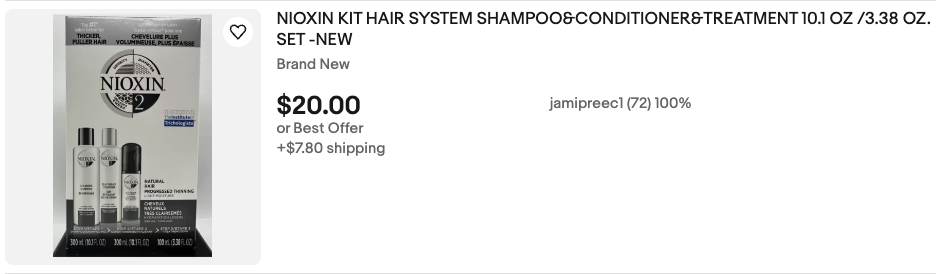


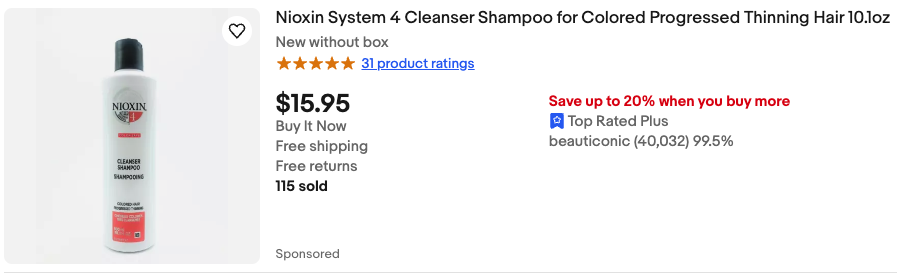
Figure 1: Diverse contextualization strategies produce distinct search result reorderings for the query "Nioxin system 4 colored hair progressed thinning kit".
Empirical Results and Analysis
Comprehensive offline and online A/B experiments, with Mean Reciprocal Rank (MRR) as the principal metric, quantify the impact of progressively refined contextual signals:
- Incorporating the cosine similarity between SERP items and the last click embedding yields a 1.84% MRR lift offline over the baseline.
- Utilizing the NCD between the current SERP items and the concatenated titles of the last five clicks yields only a 0.60% MRR lift, exposing the degradation due to noise from older, less-relevant interactions.
- Intent-aware reference selection (minimum NCD or maximum embedding similarity to query over last five clicks) produces a 1.08% MRR lift (embeddings). This supports the claim that disambiguating intent within-session is more salient than brute recency aggregation.
- Sequential attention methods further refine context signals: the Perceiver variant achieves a 1.01% MRR lift over the best prior contextual variant, outperforming the transformer baselines. This suggests an advantage to the two-stage Perceiver process of cross-attention (query-to-history) followed by self-attention refinement.
- Online, statistically significant “in-the-wild” improvements confirm these trends, with the best simple contextualization yielding a 1.30% absolute improvement in MRR on sales.
These systematic lifts demonstrate the orthogonality and additivity of session-bounded context features to typical aggregate personalization.
Theoretical and Practical Implications
From a theoretical standpoint, the work affirms that granular session-awareness, even over very short histories, can substantially outperform traditional long-term personalization in environments with high intent drift. The progression from static heuristics to attention-based sequential models points to the underexploited potential of lightweight session modeling for real-time retrieval ranking.
Practically, these findings validate the following design strategies for e-commerce search systems:
- Embedding-based contextual features are more robust and less brittle than textual distance-based heuristics, especially under session drift.
- Feature selection and context induction must be intent-aware, with query-coupled conditioning offering clear improvements over naive recency.
- Efficient architectures (lightweight Perceiver adaptation without latent arrays) can be deployed for real-time reranking without prohibitive computational expense.
Future Directions
Potential areas for future exploration include:
- Leveraging a richer taxonomy of session activities: integrating explicit signals such as cart additions, wishlisting, and micro-conversions beyond clickstreams.
- Expanding from pointwise or pairwise relevance signals to listwise objectives integrating broader session outcomes (e.g., session-length sales optimization).
- Domain adaptation to multilingual and multimodal settings, exploiting image or structured attribute representations in addition to titles and queries.
- Real-time, continual learning and online adaptation for session models under rapidly evolving inventory and user behaviors.
Conclusion
This paper presents a rigorous, incremental investigation into sessional context refinement for e-commerce search ranking, showing that immediate, intent-aware, and attention-weighted representations of buyer activity yield consistent gains in MRR. The results confirm that in-session behavioral signals, when harnessed through sequential and query-aware context modeling, significantly enhance search alignment with buyer intent, suggesting a principled alternative or complement to traditional long-term personalization for session-volatile e-commerce applications (2512.13037).