A homological approach to (Grothendieck's) completeness problem for regular LB-spaces
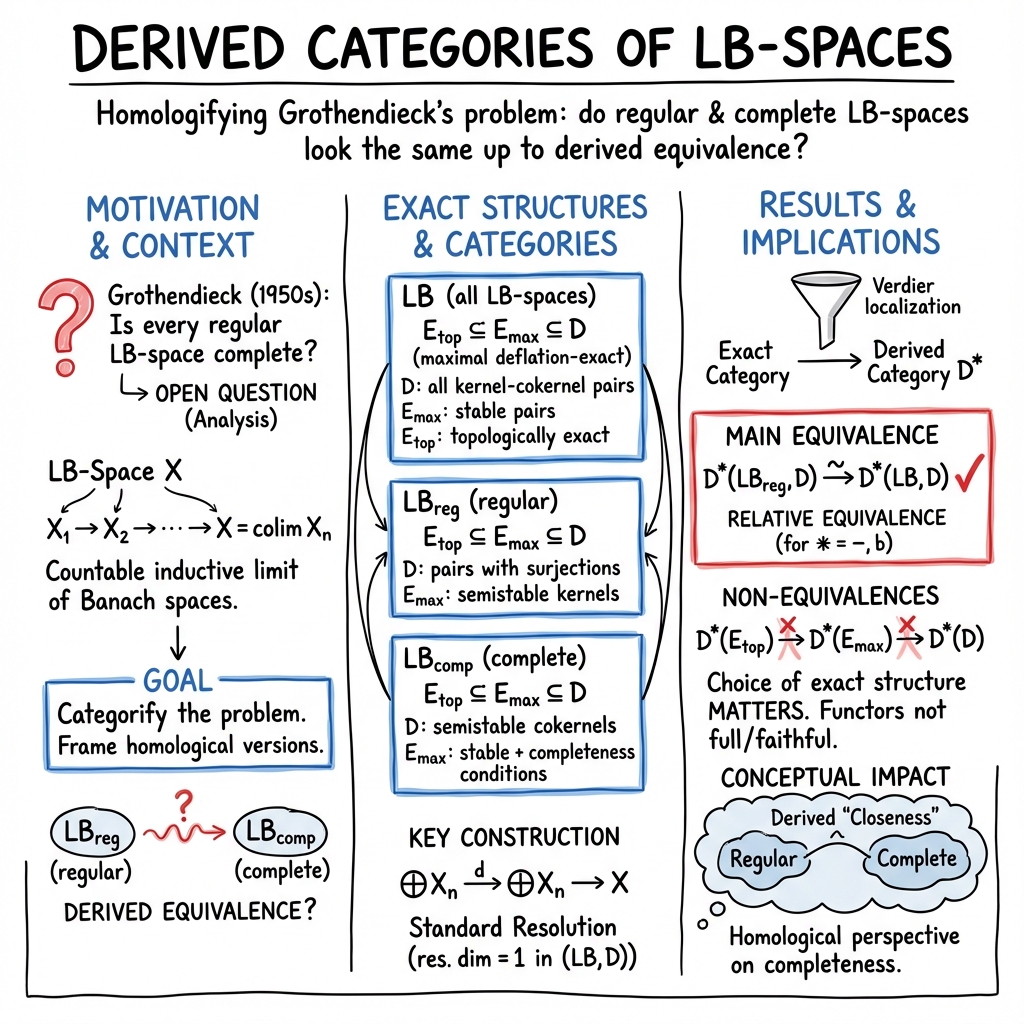
Abstract: We consider the long-standing question of whether every regular LB-space is complete. The latter is open since the 1950s and is based on Grothendieck's early work in functional analysis. Rather than looking for a proof or counterexample, we categorify the question and formulate homological versions in terms of derived categories with respect to several natural exact structures. In one case we establish a bounded derived equivalence between the categories of regular and complete LB-spaces.
Paper Prompts
Sign up for free to create and run prompts on this paper using GPT-5.
Top Community Prompts
Explain it Like I'm 14
Overview
This paper looks at a classic open problem from functional analysis that dates back to the 1950s: Are all “regular” LB-spaces complete? Instead of trying to prove “yes” or find a counterexample, the author takes a different path. He “categorifies” the problem, meaning he studies it using tools from modern algebra (homological algebra and category theory). By doing so, he shows that, in certain precise senses, regular LB-spaces and complete LB-spaces behave the same at a deeper, structural level.
Think of this as comparing two kinds of buildings. Even if we don’t know whether every “regular” building is fully finished (complete), the paper shows that if you look at the blueprints of how their rooms connect (the homological viewpoint), the two classes of buildings can be indistinguishable in some important ways.
What is an LB-space, and what is the problem?
- An LB-space is a kind of infinite-dimensional space you build by stacking an increasing sequence of “well-behaved” spaces called Banach spaces (think of putting floors on top of each other). The top floor is the whole LB-space.
- A space is complete if it has no “holes” for limits to fall through: any sequence that should converge actually does.
- A space is regular if every bounded bunch of points in it already lies inside one of the earlier floors (one of the Banach spaces) and is bounded there too.
Grothendieck asked: If an LB-space is regular, must it also be complete? This is still unanswered in general.
Goals in simple terms
The paper does not try to directly solve the original yes/no question. Instead, it asks:
- Can we translate the question into the language of homological algebra (a kind of “X-ray” that detects how parts fit together) and then compare regular and complete LB-spaces at that level?
- Do these “X-rays” show that, even if regular spaces might not all be complete, their deeper structure is essentially the same?
More concretely, the paper:
- Builds several “rules of the game” (exact structures) that say which short building steps (short exact sequences) are considered good.
- Forms derived categories, which collect all the ways objects can be assembled and compared up to harmless adjustments.
- Constructs natural comparison maps (called triangle functors) between the derived categories of regular LB-spaces and complete LB-spaces.
- Asks: Are these comparisons actually equivalences (i.e., do the categories look the same at this level)?
How the methods work (with analogies)
- Exact structures: Think of a “short construction step” A → B → C that is perfectly fitted. An exact structure is a rulebook saying which short steps count as perfectly fitted. The paper studies several natural rulebooks for LB-spaces.
- Derived categories: Imagine simplifying a complicated machine into a blueprint that only records how parts connect, ignoring tiny changes or removable defects. A derived category is that simplified record: it captures “how objects are built from each other” in a way that’s stable under repairs.
- Functors: These are translation devices that move blueprints from one world to another while preserving structure.
In this setting:
- The author defines the categories of all LB-spaces, regular LB-spaces, and complete LB-spaces.
- He equips them with different exact structures (different rulebooks for “good” short steps), including:
- A “topological” one tied to classical continuity and openness,
- A “maximal” one that includes all stable good steps,
- A one-sided version focused on quotients (deflation-exact).
- Then he builds triangle functors between the corresponding derived categories and asks if they are equivalences (meaning: after simplifying to blueprints, the categories match).
Main findings and why they matter
- The author proves an equivalence in a key “relative” setting: using a relative derived category (a refined blueprint that focuses on a chosen class of good steps), the derived categories of regular and complete LB-spaces are equivalent. In plain terms: at this homological level, “regular” and “complete” look the same.
- He also shows that, measured in a standard homological way (resolution dimension), regular and complete LB-spaces have the same complexity inside the chosen exact structure.
- The paper identifies and carefully compares several natural exact structures on LB-spaces, including:
- A maximal exact structure built from “stable” short steps,
- A maximal one-sided (deflation-exact) structure,
- A topological exact structure restricted from a larger, well-known category of topological vector spaces.
- In the category of regular LB-spaces, a map is a “semistable cokernel” exactly when it’s surjective. This helps classify which short steps are “good” and ensures the one-sided exact structure is as large as possible.
- The paper analyzes projective objects and global dimension (homological measures of how easy it is to build objects from very simple pieces) and shows equivalences with suitable subcategories generated by projective objects.
Why this matters:
- Even though the original completeness question remains open, we now know that from a homological perspective, regular and complete LB-spaces cannot be told apart in at least one strong, precise sense. That narrows where the true difficulty lies: in fine topological properties, not in the large-scale homological structure.
Implications and potential impact
- Conceptual progress: The work reframes a long-standing functional analysis question using modern homological tools. This gives new viewpoints and suggests which features are essential and which are artifacts of the viewpoint.
- Guidance for future work: Since the derived categories coincide in a relative sense, any future attempt to distinguish regular from complete LB-spaces must use tools more sensitive than these homological ones, or focus on subtle topological behavior.
- Bridges between fields: The paper strengthens connections between functional analysis and category theory, continuing a successful trend where homological methods help organize and understand complex infinite-dimensional structures.
In short, the paper shows that while we still don’t know if every regular LB-space is complete, homologically they can be made to “look the same.” This is a powerful structural result that reshapes how mathematicians might tackle the problem next.
Knowledge Gaps
Knowledge gaps, limitations, and open questions
The paper deliberately refrains from resolving Grothendieck’s completeness problem and instead proposes homological analogues. The following points summarize what remains missing, uncertain, or unexplored, with concrete directions for future work:
- Determine whether the triangle functors between bounded derived categories
- ,
- , and
- are equivalences. Concretely, test full faithfulness and essential surjectivity on explicit LB-space spectra (e.g., coechelon spaces, Moscatelli-type LB-spaces), or construct counterexamples.
- Extend the “one case” where a bounded derived equivalence is established (the relative derived category via ) to the non-relative derived categories associated with the natural exact structures and . Precisely identify why relative equivalence holds and isolate conditions that can be propagated to the standard derived categories.
- Analyze the unbounded derived categories and : establish existence, triangulated structure, and whether analogues of , , extend to unbounded settings and remain (or fail to be) equivalences.
- Compute the resolution dimensions explicitly in for concrete classes of LB-spaces. The paper proves the resolution dimensions of and coincide, but does not provide bounds or exact values.
- Clarify the global dimension of and . The results indicate strong projective control (equivalences with derived categories of projectives), but do not give explicit global dimensions; compute sharp bounds and identify whether global dimension is finite or infinite.
- Classify projective objects in and concretely (beyond existence). Provide intrinsic criteria (in terms of the inductive spectrum of Banach steps) that detect projectivity.
- Investigate the existence and structure of injective objects in and . Determine whether these categories have enough injectives and whether injective resolutions exist and have finite length.
- Establish whether the mackeyfication functor is exact with respect to the considered conflation structures (e.g., preserves -conflations and -deflations), and whether it induces the proposed triangle functors on derived categories. Precisely characterize its derived adjoints and their properties.
- Provide a full characterization of the maximal exact structure on (analogous to the stable kernel–cokernel description on ). The paper details on , but a complete description for is not spelled out.
- Address the lack of admissible kernels in : identify subclasses or modified exact structures where kernels become inflations, or develop techniques for derived functors and dimension shifting in the absence of admissible kernels.
- Develop criteria to recognize “well-located” subspaces in regular LB-spaces (beyond the abstract identification via semistable kernels). Provide actionable tests on inductive spectra to detect well-locatedness.
- Compare and relate the two natural exact structures introduced on each of the three categories (complete, regular, all LB-spaces): explicitly map inclusions and strictness ( in ) and determine whether analogous strict inclusions (or collapses) occur in and in complete LB-spaces.
- Evaluate how homological equivalences (e.g., derived equivalence of regular vs complete LB-spaces) relate back to the analytic property of completeness. Precisely identify what a derived equivalence would imply (or not imply) about completeness and regularity at the level of objects.
- Explore t-structures, hearts, and abelian realizations on and , and whether the proposed functors preserve these structures. Determine whether these derived categories are compactly generated and identify their compact objects.
- Compute invariants (e.g., -theory, Ext-groups) of and and test whether they are preserved by , , . Use these invariants to detect non-equivalence or obstructions.
- Generalize the framework beyond countable inductive limits (LB) to broader Ind-Banach or LF settings, and assess whether the homological constructions and equivalences carry over or fail (with explicit counterexamples or necessary modifications).
- Provide systematic example-based tests: compute the effect of , , , on classical nonregular LB-spaces (e.g., Köthe’s coechelon spaces), and on classes where regularity implies completeness (Montel steps, Moscatelli-type LB-spaces), to build evidence for or against equivalence.
- Clarify extension-closedness issues: since is not extension-closed in , identify precise consequences for the restriction of the maximal exact structure and for constructing derived categories; characterize when extension-closedness can be restored (e.g., by passing to suitable subcategories).
- Assess the robustness of the “relative derived category” construction: determine when the relative derived category recovers the standard derived category, and when equivalence can be upgraded or fails to upgrade to the non-relative setting.
Practical Applications
Immediate Applications
The points below distill practical uses that can be adopted now, based on the paper’s homological reframing of LB-spaces, its exact/one-sided exact structures, and concrete technical results (e.g., mackeyfication, characterizations of (co)kernels, and derived-category constructions). Each item notes relevant sectors and feasibility assumptions.
- Research workflow optimization in functional analysis and related fields
- Application: Use the paper’s “homologification” of Grothendieck’s completeness problem to transport results between regular and complete LB-spaces when the established bounded relative derived equivalence applies. This enables proving statements in the more manageable category and transferring them back via the equivalence.
- Sectors: Academia (functional analysis, operator theory, PDE, distribution theory).
- Tools/workflows: Adopt the triangle functor that is shown to be an equivalence in the relative derived setting; employ diagram-chasing under the conflation structures defined; use the “semistable cokernel iff surjection” classification to streamline pullback/pushout arguments.
- Assumptions/dependencies: The equivalence is proven for a specific relative derived category and exact structure; results depend on karoubian (idempotent complete) settings and on the chosen one-sided exact structure.
- Safe construction of regular LB-spaces via mackeyfication
- Application: When modeling function spaces as countable inductive limits of Banach spaces (LB-spaces) in analysis (e.g., test functions, distributions, real-analytic or holomorphic function germs), apply the mackeyfication functor to pass to regular LB-spaces. This reduces pathological boundedness behavior and aligns with Mackey completeness.
- Sectors: Academia; Engineering/physics (PDE-based modeling), Energy (simulation), Healthcare (imaging models using distribution spaces), Finance (functional term-structure models).
- Tools/workflows: Insert mackeyfication as a standard pre-processing step for LB-space constructions; use the adjunction to the inclusion of regular LB-spaces to simplify mapping properties and duals.
- Assumptions/dependencies: Mackeyfication may change the topology; the completeness question remains open; existing PDE/numerical workflows must accept the possibly refined topology.
- Immediate categorical simplifications in LB-settings
- Application: Exploit explicit formulas for pullbacks/pushouts in LB and the result that, in the regular LB category, semistable cokernels coincide with surjections to reduce technical burden in proofs and constructions that involve exact sequences.
- Sectors: Academia; Software (symbolic mathematics, theorem proving).
- Tools/workflows: Use the paper’s constructions to verify exactness conditions in non-quasiabelian contexts; rely on the maximal deflation-exact structure for consistent reasoning.
- Assumptions/dependencies: Non-abelian phenomena persist (parallels not necessarily mono/epi); care needed when moving between LB and regular LB categories.
- Educational integration at the graduate level
- Application: Incorporate conflation categories, one-sided exact structures, and derived-category methods for non-quasiabelian settings into courses/seminars on functional analysis and category theory; use the paper’s examples and counterexamples to illustrate pitfalls of inductive limits.
- Sectors: Education (graduate programs in mathematics and theoretical CS).
- Tools/workflows: Lecture modules on exact vs. deflation-exact structures; problem sets using LB-space pushouts/pullbacks and Mackey completeness.
- Assumptions/dependencies: Requires instructors and students comfortable with homological algebra and topological vector spaces.
- Curation and citation hygiene in the literature
- Application: Adjust bibliographies and editorial practices to avoid propagating incorrect claims from 1989–2002 about Grothendieck’s problem; reference verified sources (e.g., Wengenroth’s and Bonet–Dierolf–Kuß results, Kucera’s gap identifications).
- Sectors: Academia, Policy (journal editorial standards).
- Tools/workflows: Update review articles, repository annotations, and automated literature checks.
- Assumptions/dependencies: Community adoption; editorial policies must be enforced.
- Foundational implementations in proof assistants and CAS
- Application: Encode exact structures for LB and regular LB, mackeyfication as a functor left adjoint to inclusion, and the characterization of semistable cokernels into proof assistants (Lean/Coq/Agda) and CAS libraries to support formalized functional analysis.
- Sectors: Software (formal methods), Academia.
- Tools/products: Libraries for one-sided exact categories, derived categories over non-quasiabelian settings, LB-space constructors with mackeyfication.
- Assumptions/dependencies: Existing support for topological vector spaces is limited; formalizing inductive limits and LB-specific topologies requires significant development.
Long-Term Applications
The following items require further theoretical development, scaling, or software engineering before broad deployment. Each includes sector linkage and feasibility caveats.
- Robust numerical frameworks guided by categorical semantics
- Application: Design PDE solvers and operator-theoretic numerical schemes that “lift” problems from non-regular LB-spaces to regular or complete ones via functors, aiming for stability and well-posedness rooted in homological properties (e.g., resolution dimensions).
- Sectors: Engineering, Energy (grid simulation), Healthcare (image reconstruction), Robotics (control in infinite-dimensional spaces).
- Tools/products: Derived-equivalence-aware solver backends that track space transformations; diagnostic tools that flag non-regular constructions and propose mackeyfication.
- Assumptions/dependencies: Requires computational representations of LB-spaces and their duals; the transfer of analytic properties via derived functors must be proven for specific classes relevant to numerics.
- Advanced functional-analytic libraries in CAS and scientific computing
- Application: Build software layers that natively support LB/LF-spaces, mackeyfication, conflation structures, and derived categories—enabling safe manipulation of test-function/distribution spaces and inductive limits.
- Sectors: Software, Academia, Industry R&D.
- Tools/products: “LB-space toolkit” with automatic checks for regularity, surjectivity/semistability detection, and pushout/pullback constructors.
- Assumptions/dependencies: Significant engineering and math formalization; performance issues with infinite-dimensional constructions; user education.
- Methodological advances in machine learning on function spaces
- Application: Extend learning frameworks beyond Hilbert/RKHS settings to LB-spaces (e.g., for signals, distributions), using mackeyfication to ensure regularity and homological techniques to design stable feature maps and training objectives.
- Sectors: Software/AI, Healthcare (signal-based diagnostics), Finance (functional time series).
- Tools/products: ML toolkits that treat inputs as elements of regular LB-spaces and enforce categorical consistency in transformations.
- Assumptions/dependencies: Theory of generalization and optimization in non-reflexive, non-complete locally convex spaces is nascent; substantial research needed.
- Cross-disciplinary modeling improvements in physics, signal processing, and control
- Application: Recast models that rely on spaces of distributions, analytic functions, or holomorphic germs in regular LB frameworks to mitigate pathological inductive-limit behavior; use derived approaches for systematic resolution and dualization.
- Sectors: Physics, Signal Processing, Robotics (PDE-based control).
- Tools/products: Modeling standards and libraries specifying when and how to regularize LB constructions; homological diagnostics for model robustness.
- Assumptions/dependencies: Domain-specific validation; collaboration between theorists and practitioners to ensure physical fidelity.
- Standardization of categorical semantics for functional analysis
- Application: Establish community standards for exact/one-sided exact structures on categories of topological vector spaces, including guidance on when extension-closedness fails and how to work safely with kernel-cokernel pairs.
- Sectors: Academia, Policy (standards bodies, journal guidelines).
- Tools/products: Best-practice documents, reference implementations, and test suites.
- Assumptions/dependencies: Broad consensus and sustained effort; harmonization with existing quasiabelian frameworks.
- Progress toward resolving Grothendieck’s completeness problem (LB/LF)
- Application: Pursue equivalences of derived categories in broader settings (beyond the relative case shown here) to either prove or construct counterexamples to “regular implies complete.”
- Sectors: Academia.
- Tools/workflows: Systematic search guided by homological invariants (global dimension, projectives/resolutions) to detect obstructions or equivalences.
- Assumptions/dependencies: New ideas extending current equivalences; handling non-quasiabelian phenomena; careful construction of examples.
- Computational homological analysis of function spaces
- Application: Use projective objects and global dimension results to design algorithms that compute resolutions and derived invariants of LB-space-based complexes, aiding analysis and verification in large analytic systems.
- Sectors: Software (computational mathematics), Academia.
- Tools/products: Homological computation packages tailored to one-sided exact categories and LB-spaces.
- Assumptions/dependencies: Efficient data structures for infinite-dimensional settings; algorithmic tractability of resolutions.
In summary, the paper’s homological framework and exact-structure analysis of LB/regular LB categories provide immediately useful conceptual tools for researchers and educators, and point toward longer-term software and methodological innovations that could influence computational analysis, engineering, and ML in function-space contexts. The feasibility of broader deployment hinges on formalizing LB-space operations in software, extending derived equivalences, and carefully validating domain-specific models.
Glossary
- Admissible kernels: Kernels that are inflations in a conflation category, with every morphism possessing a kernel. "with admissible kernels"
- Auxiliary normed space: For a disk B in a locally convex space, the span of B endowed with its Minkowski functional. "the so-called auxiliary normed space"
- Bornological: A property of a locally convex space where bounded sets control the topology (inductive limits of Banach spaces are bornological). "the Mackey completion is then bornological"
- Bounded derived equivalence: An equivalence between bounded derived categories of two exact or conflation categories. "a bounded derived equivalence between the categories of regular and complete LB-spaces"
- Conflation category: An additive category equipped with a distinguished class of kernel-cokernel pairs (conflations). "a conflation category"
- Deflation-exact: A one-sided exact structure where deflations satisfy axioms R0–R2 (and possibly R3). "is deflation-exact"
- DF-space: A locally convex space that is (typically) the strong dual of a Fréchet space; LB-spaces are DF-spaces. "is a DF-space"
- Derived category: The category obtained from complexes by inverting quasi-isomorphisms, used in homological algebra. "derived categories were considered"
- Exact category: An additive category endowed with a class of short exact sequences satisfying Quillen’s axioms. "exact categories in the sense of Quillen"
- Global dimension: The supremum of projective resolution lengths in a category. "the global dimension"
- Grothendieck's factorization theorem: A theorem ensuring certain maps factor through Banach steps, used to relate regularity and completeness in inductive limits. "Grothendieck's factorization theorem"
- Idempotent complete: A category in which every idempotent splits (equivalently, has a kernel), also called karoubian. "idempotent complete"
- Karoubian category: An idempotent-complete additive category. "karoubian category"
- Kernel-cokernel pair: A pair (f, g) with f = ker g and g = cok f, forming exact sequences in additive settings. "kernel-cokernel pair"
- LB-space: A Hausdorff locally convex space that is a countable inductive limit of Banach spaces. "LB-space"
- Left quasiabelian: A category where pullbacks of cokernels are cokernels (left almost abelian), but not necessarily right semiabelian. "left quasiabelian"
- LF-space: A countable inductive limit of Fréchet spaces. "LF-spaces"
- Mackey complete: A locally convex space in which every Mackey Cauchy sequence converges. "Mackey complete"
- Mackeyfication: The Mackey completion process producing a Mackey complete envelope of a locally convex space. "mackeyfication of "
- Maximal deflation-exact structure: The largest deflation-exact structure on a given additive category. "the maximal deflation-exact structure on "
- Maximal exact structure: The largest exact (Quillen) structure on a given additive category. "the maximal exact structure on "
- Minkowski functional: The gauge function associated with an absolutely convex, bounded set in a locally convex space. "Minkowski functional"
- Montel: A property of spaces where bounded sets are relatively compact; important for completeness results. "whose steps are Montel"
- Moscatelli-type LB-spaces: A specific class of LB-spaces introduced by Moscatelli, notable in counterexamples and completeness results. "Moscatelli-type LB-spaces"
- One-sided exact structures: Exact structures satisfying axioms only on one side (deflations or inflations), generalizing Quillen exactness. "one-sided exact structures"
- Parallel: The canonical map from coimage to image in a preabelian category, measuring failure of exactness. "the parallel of a morphism "
- Preabelian: An additive category in which every morphism has both a kernel and a cokernel. "The category is preabelian."
- Projective objects: Objects with the lifting property against epimorphisms, used to compute resolutions and dimensions. "projective objects"
- Quillen exact structure: The notion of exactness in additive categories defined by Quillen via kernel-cokernel pairs. "in the sense of Quillen"
- Reflective subcategory: A full subcategory whose inclusion has a left adjoint (a reflector). "a reflective subcategory"
- Relative derived category: A derived category constructed relative to a chosen exact structure or class of morphisms. "relative derived category"
- Resolution dimensions: Measures of the minimal lengths of resolutions by (e.g., projective) objects within a chosen exact structure. "resolution dimensions"
- Semistable cokernel: A cokernel whose pullback along any morphism exists and remains a cokernel. "semistable cokernel"
- Semistable kernel: A kernel whose pushout along any morphism exists and remains a kernel. "semistable kernel"
- Stable kernel-cokernel pair: A kernel-cokernel pair where the kernel is semistable and the cokernel is semistable. "stable kernel-cokernel pair"
- Triangle functor: A functor between triangulated categories preserving distinguished triangles. "triangle functors"
- Ultrabornological topology: The topology associated with inductive limits of Banach spaces, making the space ultrabornological. "ultrabornological topology"
- Well-located subspace: A subspace of an LB-space where the induced and flat topologies have the same dual (equivalently, the same weak topology). "well-located subspace"
Collections
Sign up for free to add this paper to one or more collections.