Convergence of covariance and spectral density estimates for high-dimensional functional time series
Published 15 Dec 2025 in math.ST | (2512.13310v1)
Abstract: Second-order characteristics including covariance and spectral density functions are fundamentally important for both statistical applications and theoretical analysis in functional time series. In the high-dimensional setting where the number of functional variables is large relative to the length of functional time series, non-asymptotic theory for covariance function estimation has been developed for Gaussian and sub-Gaussian functional linear processes. However, corresponding non-asymptotic results for high-dimensional non-Gaussian and nonlinear functional time series, as well as for spectral density function estimation, are largely unexplored. In this paper, we introduce novel functional dependence measures, based on which we establish systematic non-asymptotic concentration bounds for estimates of (auto)covariance and spectral density functions in high-dimensional and non-Gaussian settings. We then illustrate the usefulness of our convergence results through two applications to dynamic functional principal component analysis and sparse spectral density function estimation. To handle the practical scenario where curves are discretely observed with errors, we further develop convergence rates of the corresponding estimates obtained via a nonparametric smoothing method. Finally, extensive simulation studies are conducted to corroborate our theoretical findings.
The paper introduces a novel non-asymptotic framework for covariance and spectral density estimation in high-dimensional, non-Gaussian functional time series.
It leverages L2-based dependence measures and Nagaev-type concentration inequalities to control estimation errors in dynamic FPCA and sparse recovery.
Empirical simulations validate the theoretical rates, demonstrating robust performance even with discrete, noisy observations in practical settings.
Convergence Analysis for High-Dimensional Functional Time Series: Covariance and Spectral Density Estimation
Introduction and Motivation
The analysis of high-dimensional functional time series (HDFTS) is critical for modern applications involving multivariate and longitudinal functional data, where both the number of processes (p) and the function dimension can be large, possibly exceeding the sample size. Examples include high-frequency financial curves, environmental monitoring, and large-scale biomedical recordings. While substantial progress has been made on low-dimensional and Gaussian/sub-Gaussian functional time series, theoretical guarantees for second-order statistics such as covariance and spectral density estimation in non-Gaussian and nonlinear HDFTS, especially in non-asymptotic regimes, were notably lacking.
This paper introduces a novel theoretical framework for non-asymptotic covariance and spectral density estimation in high-dimensional, non-Gaussian, and potentially nonlinear stationary functional time series. The authors systematically develop new functional dependence measures suited to infinite-dimensional objects, derive Nagaev-type concentration inequalities for second-order functionals, and demonstrate the impact of these results on both “static” and “dynamic” functional dimension reduction as well as sparse regularized estimation.
Functional Dependence and Non-Asymptotic Theory
Novel Dependence Measures
The authors generalize the notion of physical/functional dependence by considering “L2-difference-based” metrics across coupled function-valued processes. This approach differentiates the work from prior metrics, such as the functional Rayleigh quotient and maximum-difference-based metrics in discretized spaces, yielding measures that can be explicitly controlled for a broad class of HDFTS—including nonlinear/non-Gaussian cases. These dependence norms, parameterized by a decay rate α, control the rate at which the influence of past noise innovations decays across time, thus quantifying long-range dependence.
Non-Asymptotic Concentration Inequalities
The paper’s technical core is the derivation of Nagaev-type concentration inequalities for estimators of the (auto)covariance and spectral density functions under the proposed dependence measures. Unlike prior work focused on Gaussian functionals ([fang2022], [guo2023consistency]), these results do not require sub-Gaussian tail assumptions and provide explicit dependence on the process dimension p and dependence parameters.
For covariance estimation, the maximal elementwise error is shown to satisfy
where Mq,α is the dependence norm and Dn,h is a function of temporal dependence.
The framework further extends to spectral density estimation using lag-windowed type kernel smoothing with explicit oracle inequalities for uniform error over frequencies.
Visual Illustration: Finite-Sample Behavior
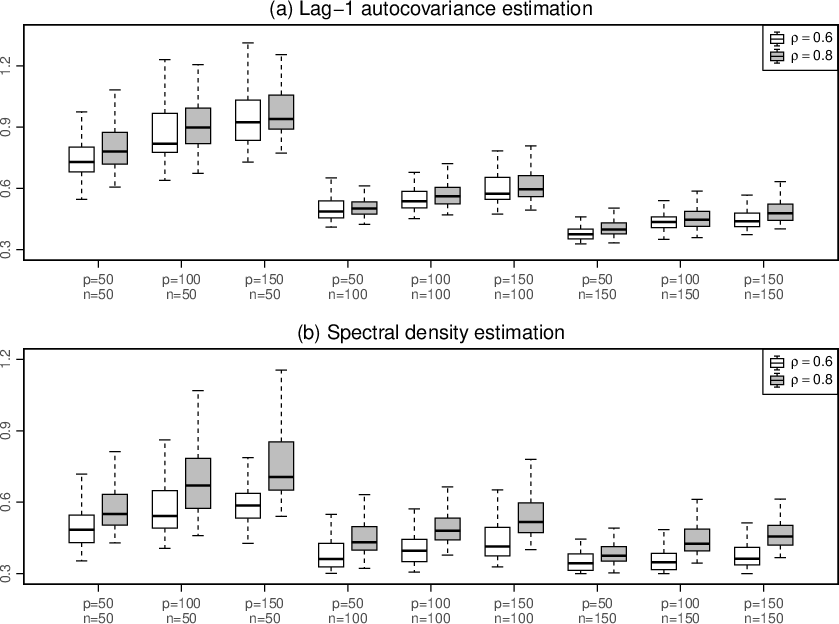
The theoretical rates are confirmed through extensive simulation studies.
Figure 1: Boxplots of MaxErr(Σ) and MaxErr(fθ) in increasing (n,p), showing dependence of maximum error on dimensionality and sample size.
The plot exhibits modest but systematic increases in error as p is increased, and the impact of dependence strength parameter ρ is explicit.
Application: Dynamic FPCA and Regularized Estimation
Theoretical Results for Dynamic FPCA
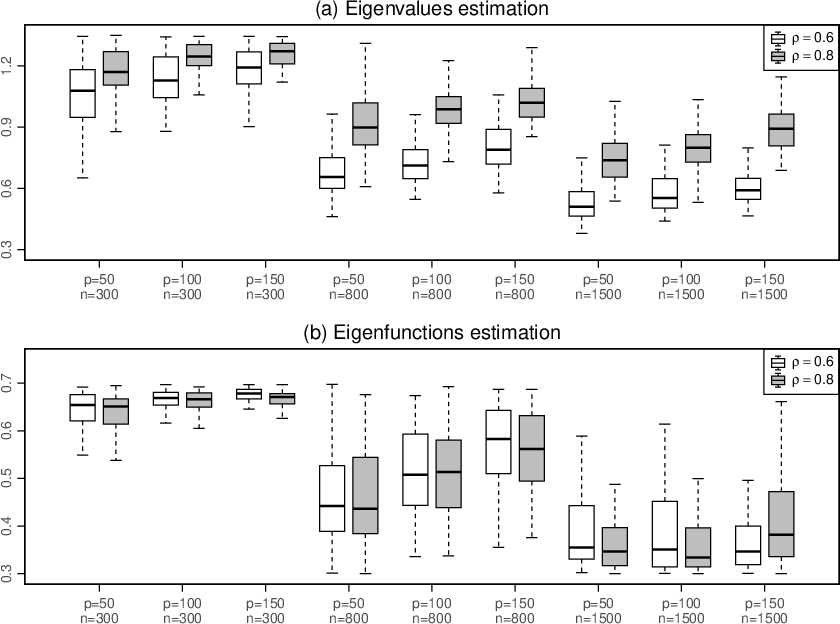
Standard functional principal component analysis fails to accommodate temporal dependence inherent in functional time series. The authors leverage their spectral convergence results to derive explicit rates for the estimation of dynamic eigenvalues, eigenfunctions, and dynamic FPC scores as functions of the upper bounds on covariance and spectral density errors. They further establish the uniform rates of regularized spectral estimators under sparsity assumptions, offering guarantees for both consistent estimation and exact support recovery in the spectral domain.
Figure 2: Boxplots of MaxErr(λ) and MaxErr(φ), showing estimation accuracy as a function of sample size and dimension.
The displayed decrease in error rates corroborates the predicted scaling behaviors as n grows or dependency decays.
Sparse Functional Spectral Density: Thresholding and Support Recovery
A uniform thresholding estimator is proposed for sparse spectral density matrices, with non-asymptotic rates for the spectral analog of the ℓ1-norm error. The results imply that, under appropriate signal strength conditions, exact support recovery of the generalized correlation structure of HDFTS is feasible with high probability.
Practical Observation Scheme: Discrete and Noisy Curves
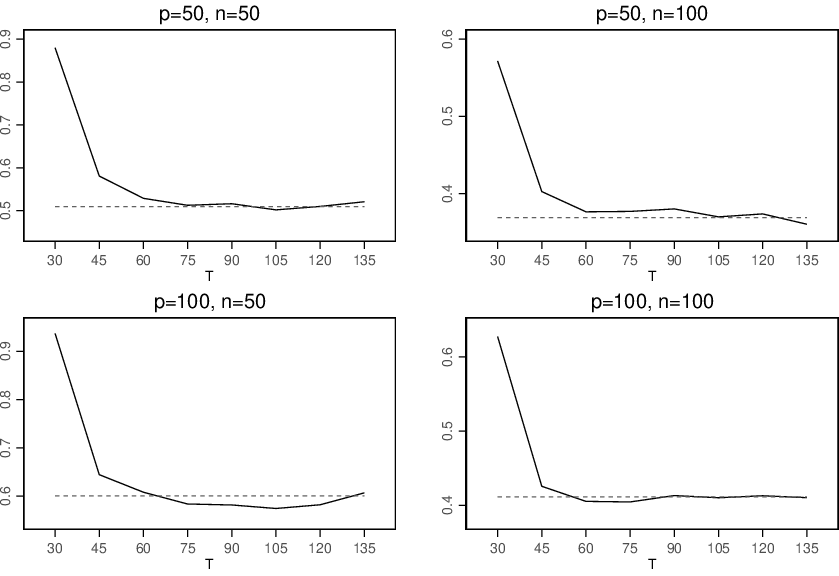
Recognizing that real-world functional data are only observed discretely (and contaminated with measurement noise), the paper extends all main results through detailed analysis of the double-regularization induced by local smoothing and the high-dimensional spectral estimation process. A phase transition in the estimation error is established, which is determined by the relative density of functional observation points T and sample size n.
Figure 3: Plots of average MaxErr(fθ) versus T for both discrete and fully observed settings, showing sharp decrease and phase transition in error rate as T grows.
As T increases rapidly, the error rate matches that of the ideal, fully observed case.
Discussion and Implications
The theoretical framework developed in this paper yields the first unified, non-asymptotic convergence rates for second-order characteristic functionals (covariance and spectral density) in high-dimensional, potentially nonlinear and non-Gaussian functional time series under minimal conditions. These advances enable rigorous justification for the use of regularization techniques (e.g., thresholding, sparse covariance estimation, dynamic FPCA) in HDFTS settings where prior results were strictly asymptotic or required restrictive assumptions.
On the practical side, the demonstrated results imply that spectral-domain regularization, including support recovery and dynamic dimension reduction, is theoretically sound even in regimes of diverging dimension and with finite, potentially small sample sizes, provided that the dependence decay is well-characterized.
Future developments will likely focus on further generalization to nonstationary and locally stationary processes, analysis of higher-order inference (e.g., adaptive testing, bootstrap), and extension of the framework to nonlinear, causal inference for functional networks or graphical modeling in high dimensions.
Conclusion
This work establishes a foundation for non-asymptotic analysis of second-order functionals in high-dimensional non-Gaussian functional time series, providing the requisite tools for both theoretical understanding and practical implementation of dynamic and regularized methods for functional data analysis (2512.13310). The results set new benchmarks for high-dimensional efficiency and open avenues for robust, theoretically justified functional inference in contemporary large-scale applications.