On the Dynamics of Local Hidden-Variable Models
Abstract: Bell nonlocality is an intriguing property of quantum mechanics with far reaching consequences for information processing, philosophy and our fundamental understanding of nature. However, nonlocality is a statement about static correlations only. It does not take into account dynamics, i.e. time evolution of those correlations. Consider a dynamic situation where the correlations remain local for all times. Then at each moment in time there exists a local hidden-variable (LHV) model reproducing the momentary correlations. Can the time evolution of the correlations then be captured by evolving the hidden variables? In this light, we define dynamical LHV models and motivate and discuss potential additional physical and mathematical assumptions. Based on a simple counter example we conjecture that such LHV dynamics does not always exist. This is further substantiated by a rigorous no-go theorem. Our results suggest a new type of nonlocality that can be deduced from the observed time evolution of measurement statistics and which generically occurs in interacting quantum systems.
Paper Prompts
Sign up for free to create and run prompts on this paper using GPT-5.
Top Community Prompts
Explain it Like I'm 14
Overview: What is this paper about?
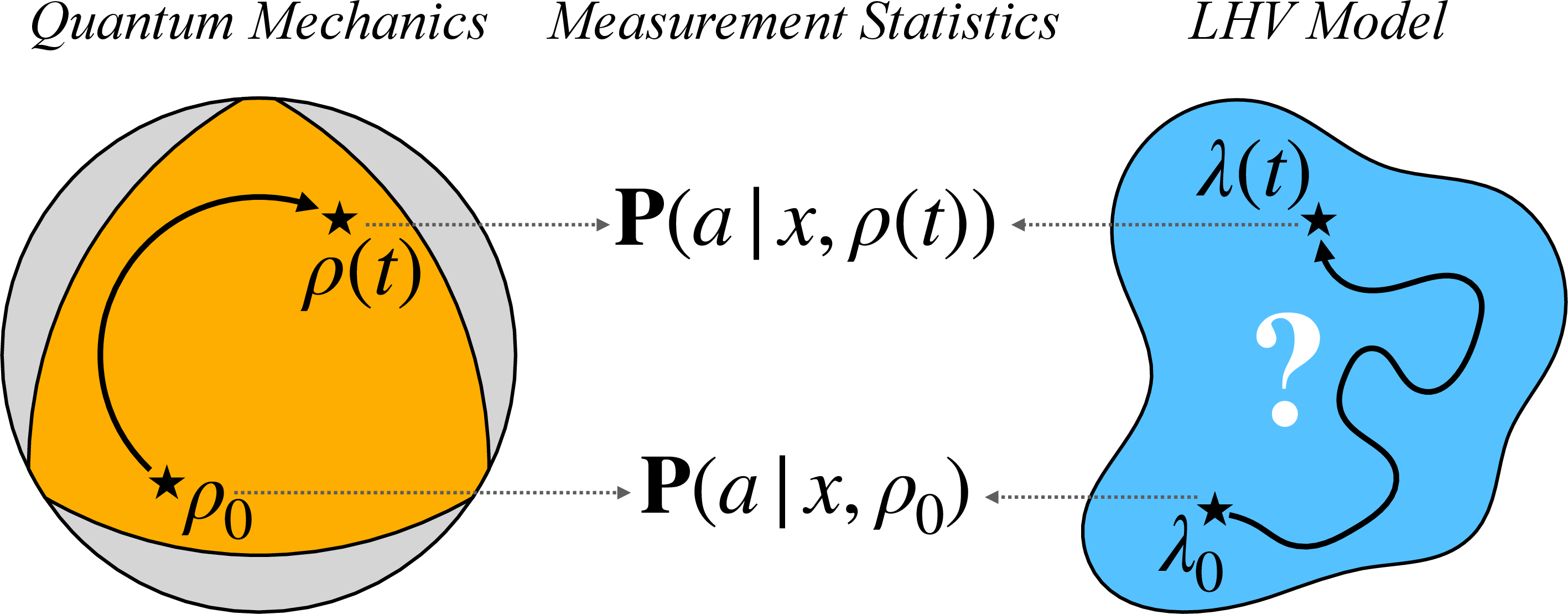
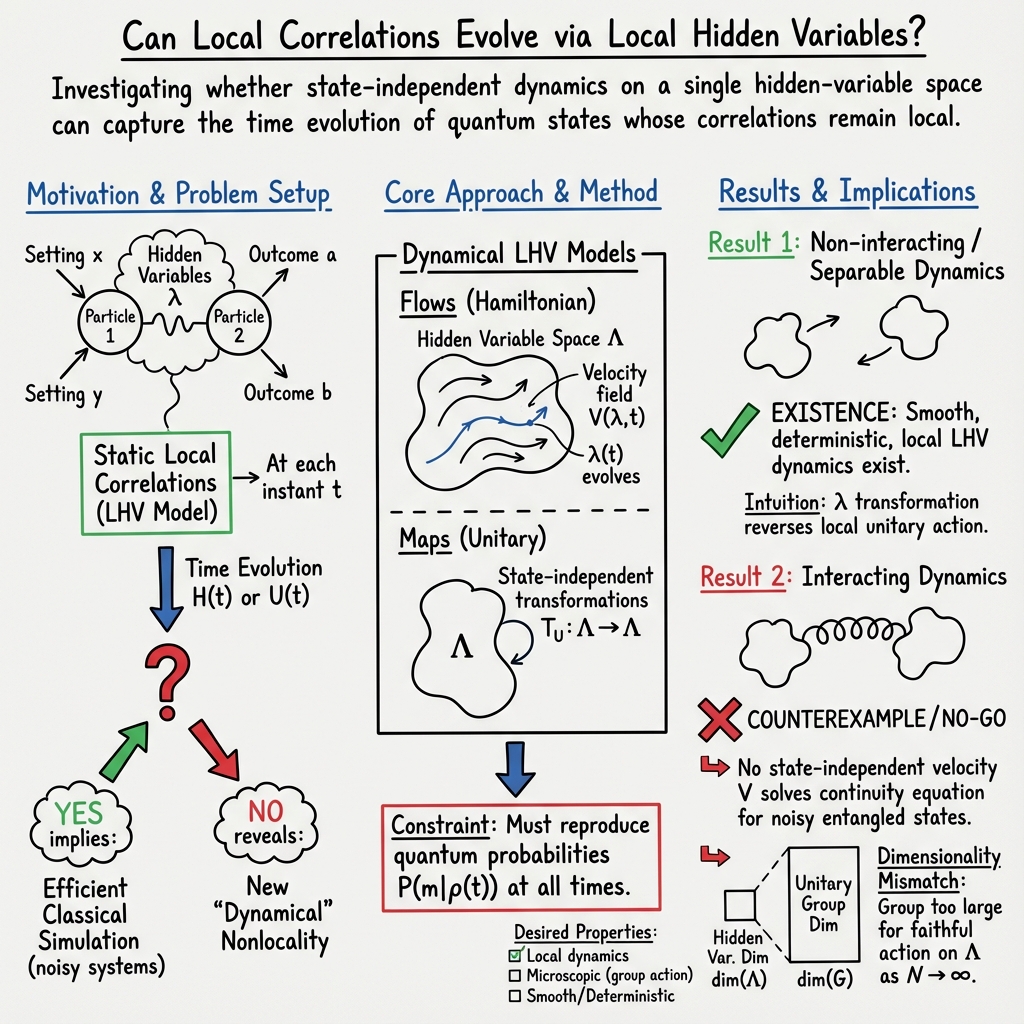
This paper asks a simple-sounding question: if a quantum system looks “local” at every moment in time (meaning its measurement results can be explained by hidden, local facts about each particle), can we describe its whole time evolution by just letting those hidden facts move or change in a consistent, local way?
In other words, it takes the familiar idea of local hidden variables (LHV) from Bell’s work—usually used to explain one snapshot of measurements—and extends it to motion: can those hidden variables “flow” over time to track how the system changes?
The authors define what such “dynamical LHV models” would look like, explore when they can exist, build examples where they work, and prove limits that show when they cannot.
Key questions the paper asks
- If a system’s measurement statistics are local at all times, can one single set of hidden variables, evolving in time by the same rules for every state, explain the entire time evolution?
- What extra properties would make such a dynamical model “physically reasonable” (for example, only local influences, no randomness in the rule, smooth changes, and consistent composition when you apply several operations in a row)?
- Do such models always exist for realistic (interacting) quantum systems, or are there fundamental barriers?
How did the authors approach the problem?
First, they generalize the usual LHV idea from one state to a whole set of states:
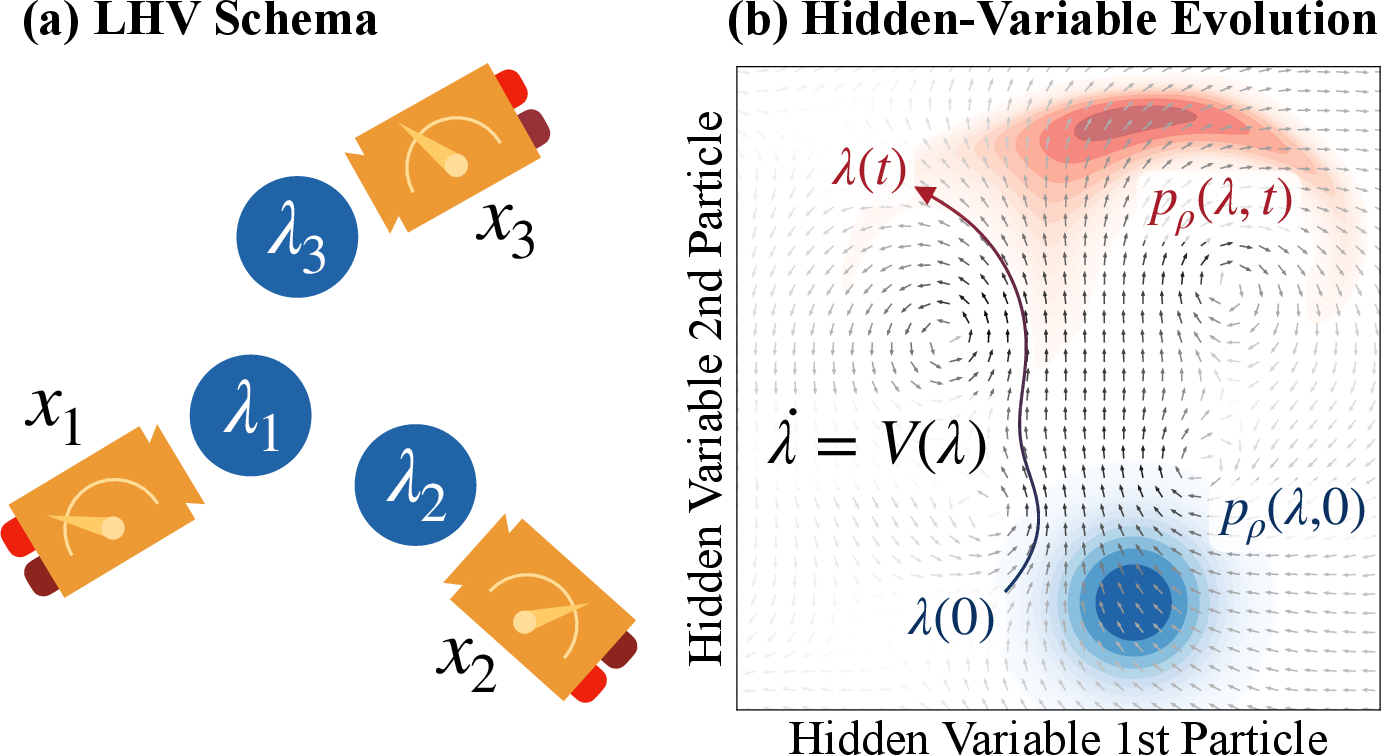
- They insist on the same single-particle hidden-variable space (think: the “type” of secret info each particle can carry) and the same local measurement rule (how a hidden variable produces a measurement outcome) for all states in the set.
- The only thing that changes from state to state is the probability distribution over those hidden variables (like different crowds having different mixes of people).
Then they define “dynamical LHV models”:
- Imagine each run of the experiment picks a specific hidden-variable point λ (like a person in a crowd). Over time, λ moves according to a fixed “velocity field” (a rule that tells every λ how to move, like a wind that pushes everyone around in the same way). This motion reshapes the whole distribution of λ’s as time passes (just as wind moves a crowd’s pattern).
- Crucially, this motion rule must be:
- state-independent (the hidden variables don’t “know” which quantum state they came from),
- the same whenever the underlying quantum evolution is the same,
- and, for a time-independent Hamiltonian, also time-independent.
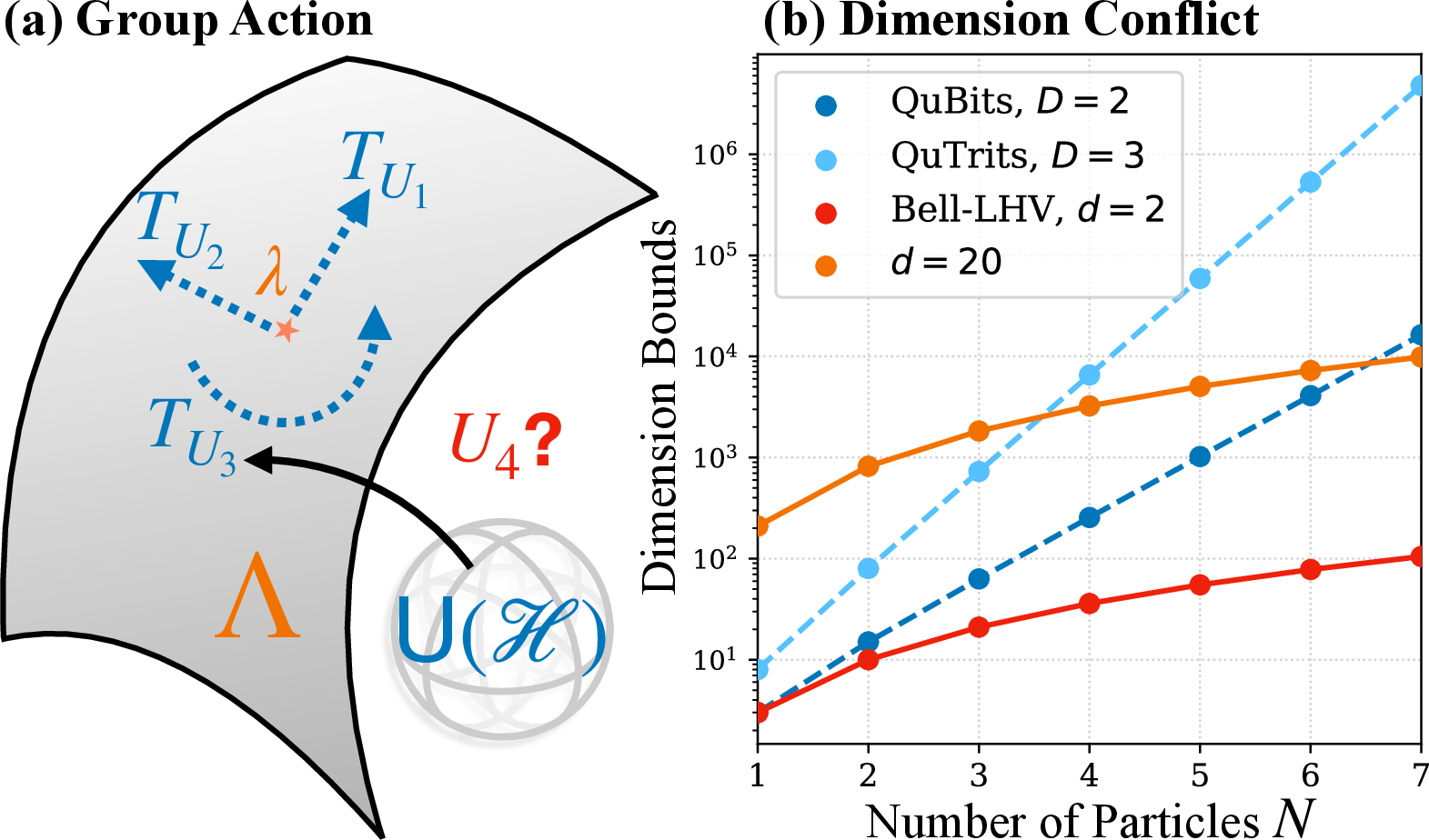
- They also consider a more general viewpoint where each unitary operation (a kind of quantum “move”) corresponds to a hidden-variable transformation T_U. Doing two unitaries in a row should correspond to doing the two hidden-variable moves in a row (this is their “microscopic” composition rule).
To make this physically meaningful, they discuss optional properties one might want:
- Local: only directly interacting particles influence each other in the hidden-variable motion.
- Deterministic: no extra randomness in how λ moves.
- Microscopic (group action): composing quantum operations corresponds exactly to composing hidden-variable transformations.
- Smooth: tiny changes in the quantum operation cause tiny, continuous changes in hidden-variable motion.
- Consistent gauge: the “hidden-variable picture” of a state doesn’t depend on how you reached that state.
They then:
- Construct “nice” dynamical LHV models for noninteracting systems (each particle evolves independently).
- Present a counterexample for an interacting system.
- Prove a broad “no-go” theorem that rules out such dynamics in many-particle settings.
Main findings (what they discovered)
- Dynamical LHV models exist for noninteracting dynamics
- When each particle evolves on its own (no interactions), the authors build explicit models where:
- the hidden variables move locally and deterministically,
- the transformations follow the same composition rules as the quantum unitaries,
- and everything depends smoothly on the operations.
- Intuition: if a quantum operation just rotates each particle’s measurement axes, you can equivalently “rotate” each particle’s hidden variable. This cleanly matches the changing measurement statistics over time.
- When each particle evolves on its own (no interactions), the authors build explicit models where:
- A simple counterexample for interacting dynamics
- They take a well-known hidden-variable model for qubits (Bell’s model using points on a sphere as hidden variables) and evolve two qubits under a Heisenberg interaction (a standard, symmetric coupling between spins).
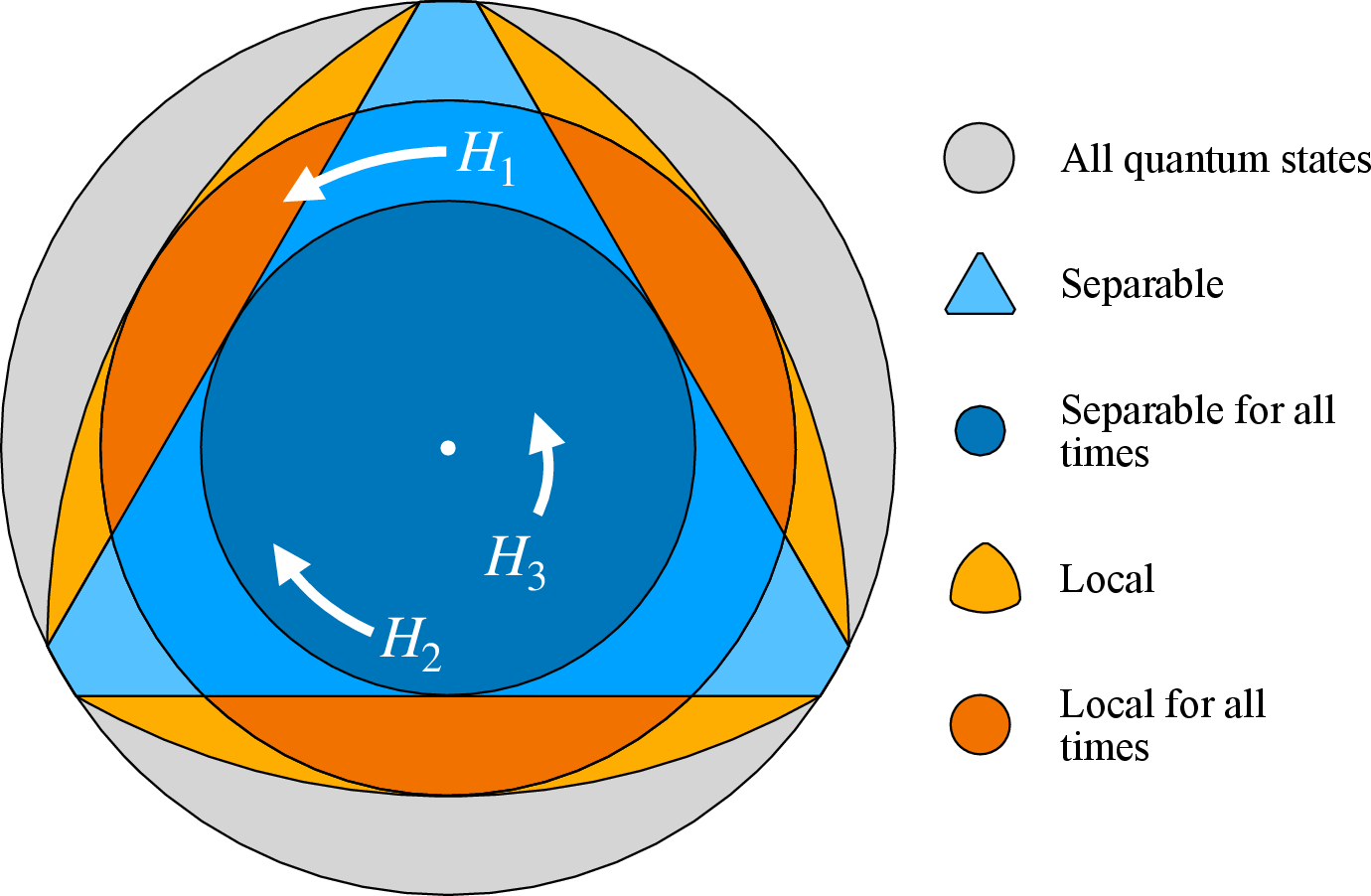
- They construct time-dependent hidden-variable distributions that match the quantum predictions at each time for many (separable) states close to the fully mixed state.
- However, they show there is no single, state-independent “velocity field” (no single wind) that moves the hidden variables to produce all those evolving distributions for all those states. In short, the distributions fit the data at each time, but you can’t get them all from one shared rule of motion.
- This suggests that for interacting systems, it can be impossible to have a state-independent, local, deterministic hidden-variable dynamics—even when everything looks local at every time.
- A no-go theorem for many particles
- They prove a general limit: if you demand smooth, deterministic, microscopic hidden-variable dynamics for a set of unitaries on many particles, the hidden-variable space needs to be “big enough” to host a faithful action of those unitaries.
- The big picture: the number of ways a many-particle quantum system can be moved around (the unitary group) grows extremely fast with the number of particles (exponentially), but if your hidden-variable space is built from the same single-particle space repeated N times, its total dimension only grows linearly with N. That mismatch eventually becomes too large to “fit.”
- Consequence: for sufficiently many particles, there cannot be a smooth, deterministic, microscopic hidden-variable dynamics that works for all those unitaries—even if you only care about states near the fully mixed (noisy) state.
- This rules out a very broad class of dynamical LHV models for large systems.
Why this is important
- A new angle on “nonlocality”: Bell’s theorem usually talks about static snapshots of correlations. This work points to a different kind of limitation tied to time evolution itself: even if each instantaneous snapshot looks local, the way those snapshots change over time can reveal a kind of “dynamic nonlocality” (you can’t sew together all those snapshots with a single, local, state-independent hidden-variable motion).
- Limits on classical simulation: If dynamical LHV models always existed for local states, we might simulate certain quantum systems efficiently by tracking hidden variables. The counterexample and the no-go theorem show that, especially with interactions and many particles, such a simple classical picture often cannot exist.
- Foundations: The results clarify how “local realism” struggles not just with static correlations but also with consistent, state-independent explanations of how those correlations evolve. This connects to interpretations like Bohmian mechanics, which can track all states but needs nonlocal dynamics.
Takeaway
- For systems without interactions, the authors build clear examples where hidden variables can move in a neat, local, and consistent way to match quantum evolution.
- For interacting systems and especially for many particles, they show strong barriers: in general, you cannot always find one shared, local, deterministic rule that moves hidden variables to match all the observed time evolution.
- This suggests a new kind of nonlocal behavior that shows up in how things change over time, not just in what you see at a single moment.
Knowledge Gaps
Knowledge gaps, limitations, and open questions
The following points summarize what remains missing, uncertain, or unexplored, and suggest concrete directions for future work:
- Gauge-independence of the counterexample: Prove (or refute) that no state-independent velocity field exists for the two-qubit Heisenberg interaction across all valid hidden-variable distributions (i.e., independent of gauge choice), or construct such a field explicitly.
- Core conjecture unresolved: Establish a rigorous proof (or a counterexample) of the conjecture that certain interacting Hamiltonians and state sets admit no local, deterministic LHV dynamics.
- Tightness of the dimensionality bound: Determine whether the constraint is tight for relevant hidden-variable spaces (e.g., product manifolds ), and whether stronger bounds can be obtained by exploiting the product structure or additional geometric constraints.
- Small-N thresholds: Precisely characterize the minimal single-particle hidden-variable dimension required for LHV dynamics under the full unitary group for small (e.g., qubits/qutrits), and determine exactly rather than asymptotically.
- Beyond projective measurements: Extend existence and no-go results to general POVMs; assess whether allowing POVMs changes expressivity or dimensional constraints for LHV dynamics.
- Smoothness/manifold assumptions: Analyze whether relaxing smoothness (to measurable or piecewise-smooth transformations), or allowing non-manifold or stratified hidden-variable spaces, can evade the isometry-based dimension bound.
- Microscopic vs local dynamics: Clarify the relationship between “microscopic” (group action) and “local” (interaction-structure-preserving) LHV dynamics; identify conditions under which local (but not microscopic) dynamics can or cannot exist.
- Deterministic vs stochastic dynamics: Develop a formal framework for stochastic LHV dynamics and test whether randomness in hidden-variable evolution can bypass the no-go result while retaining physical desiderata (locality, particle-number independence).
- Particle-number independence: Quantify the impact of relaxing the particle-number independence of (i.e., allowing ) on the feasibility of LHV dynamics and evaluate whether such models remain physically compelling.
- Time-dependent Hamiltonians: Provide general criteria or constructive methods to certify that a state set remains local under , and analyze LHV dynamics for time-dependent interaction graphs and drive schedules (beyond the group setting).
- Constructive algorithms: For noninteracting unitaries, supply efficient, explicit algorithms to compute and velocity fields for broad measurement sets (including POVMs), with complexity guarantees.
- Consistent gauge requirement: Determine when a consistent gauge (path-independent assignment ) exists; assess whether imposing consistency helps or hinders the existence of LHV dynamics.
- Experimental witnesses: Design operational protocols that witness “dynamical nonlocality” from time-resolved local statistics in regimes where static Bell inequalities are not violated; analyze robustness to noise and finite sampling.
- Open-system dynamics: Extend the framework to CPTP maps and quantum channels (Lindbladian semigroups and general processes); derive analogues of the dimensionality constraint and existence/no-go results for nonunitary evolution.
- Classification of admissible groups: Identify and classify subgroups (e.g., -local control groups, Clifford group, matchgate circuits) whose dimension growth permits faithful actions on realistic ; determine existence or impossibility of LHV dynamics on a case-by-case basis.
- Measurement-set dependence: Determine the minimal measurement family required for faithfulness of the group action argument; explore whether restricting (thus reducing distinguishability) can relax the constraints.
- “Generic” interacting dynamics claim: Formalize and prove (or refute) the claim that interacting quantum dynamics generically precludes LHV dynamics; specify the sense of genericity (measure-theoretic, Baire category) and the relevant topology.
- Many-body explicit counterexamples: Construct explicit interacting Hamiltonians and invariant local state sets (remaining local at all times) for which no state-independent velocity field exists, ideally under only the locality assumption.
- Resource-theoretic formulation: Develop a resource theory of dynamical nonlocality (free operations, monotones, convertibility) and relate it to entanglement/nonlocality resources in static scenarios.
- Links to temporal nonlocality: Establish precise relationships (or separations) between the absence of LHV dynamics and violations of temporal Bell/Leggett–Garg inequalities or process tensor nonlocality.
- Geometry of : Explore whether specific choices of (e.g., Lie groups, homogeneous spaces, curved manifolds) improve prospects for LHV dynamics; assess how curvature/topology affects the isometry-group bound.
- Infinite-dimensional hidden-variable spaces: Investigate whether allowing (e.g., Banach/Fréchet manifolds) can support faithful actions of large without losing physical plausibility; adapt or replace the isometry-based proof in infinite dimensions.
- Discrete gate sets: For finite groups (Clifford, stabilizer-preserving, etc.), test existence of faithful actions on small-dimensional ; provide explicit constructions or impossibility proofs.
- Measurement dependence/contextuality: Examine whether allowing measurement-dependent response functions or contextual HV models could enable dynamics while preserving local outcome structure, and at what physical cost.
- Optimization-based certification: Formulate the existence of or a common as feasibility/optimization problems; develop numerical certificates (or refutations) for compatibility with LHV dynamics (e.g., via PDE constraints for the continuity equation).
- Entangling power thresholds: Relate the (im)possibility of LHV dynamics to entangling power/operator Schmidt rank of unitaries; identify thresholds below which dynamics might still be possible.
- Expressivity vs dynamics trade-off: Quantify how the hidden-variable dimension must scale with to represent all local states under a given , and how this scaling interacts with the dynamical no-go constraints.
- Dependence on : Determine minimal invariant state sets (possibly smaller than a full ball) that still enforce faithfulness and the dimension bound; assess whether carefully chosen can avoid the no-go.
- Regularity of distributions: The counterexample uses continuous ; test whether allowing discontinuous or singular distributions can enable a common velocity field without violating physical plausibility.
- PDE characterization: Derive necessary and sufficient conditions (in terms of continuity equations and compatibility constraints) for when a family admits a single state-independent velocity field .
- State-independence assumption: Provide an operational justification (or limitations) for requiring to be state-independent; identify scenarios where partial state-dependence might be acceptable and whether it restores dynamics.
- Bohmian comparison: Clarify under what restrictions (e.g., to local states, limited interactions) Bohmian-like velocity fields could become local, or demonstrate that nonlocality is unavoidable even on such restricted domains.
- Measurement coarsening: Analyze whether coarse-graining measurements enlarges the class of dynamics admitting LHV models and quantify the trade-off between measurement resolution and dynamical locality.
- Threshold constructions for two qubits: At the inferred threshold for two qubits under the full unitary group, explicitly construct (or rule out) a dynamical LHV model to sharpen the boundary case.
Collections
Sign up for free to add this paper to one or more collections.