Slowly rotating Black Holes in DHOST Theories
Abstract: We study slowly rotating black hole solutions within Degenerate Higher Order Scalar Tensor (DHOST) theories. Starting from a static, spherically symmetric metric solution of a DHOST theory, we employ the Hartle-Thorne ansatz to model a slowly rotating spacetime. We show that the differential equation governing the frame-dragging function $ω$ (which is supposed to depend on the radial coordinate only) is integrable for any DHOST theory allowing us to obtain its explicit form. We also consider angular dependence in $ω$ and show that regularity at the horizon and at infinity forbids it, as in General Relativity. As an illustration of the formalism introduced here, we study the slowly-rotating version of black hole solutions with primary hair obtained recently, examining the influence of the rotation on the Innermost Stable Circular Orbit (ISCO) and on the circular light trajectories in the equatorial plane.
Paper Prompts
Sign up for free to create and run prompts on this paper using GPT-5.
Top Community Prompts
Explain it Like I'm 14
Overview
This paper studies how black holes spin in a broad class of gravity theories called DHOST (Degenerate Higher‑Order Scalar‑Tensor) theories. These are “modified gravity” theories that add a new ingredient—a scalar field—to the usual spacetime of General Relativity (GR). The authors focus on black holes that rotate slowly and show how to describe the “frame dragging” effect (the way spinning black holes twist nearby spacetime) in these theories. They also test whether the rotation can depend on angle, and they explore how rotation changes the orbits of matter and light around such black holes.
Key questions the paper asks
- If we start from any static (non-spinning), spherically symmetric black hole in a DHOST theory and spin it up slowly, how does the frame dragging behave?
- Is there a simple, general equation we can use for the frame dragging function ω(r) (which measures how spacetime gets dragged around the black hole)?
- Can ω depend on angle (θ) as well as radius (r), or must it depend on r only (like in GR)?
- In common subclasses of DHOST theories—especially those with “shift symmetry”—does slow rotation look just like it does in GR?
- How does slow rotation change key observable features, like the innermost stable circular orbit (ISCO) for matter and the circular light paths (photon rings)?
Methods and approach
Modeling slow rotation: the Hartle–Thorne ansatz
To avoid the full complexity of a fast-spinning black hole, the authors use a standard approximation called the Hartle–Thorne ansatz. Think of it like gently nudging a non-spinning black hole so it rotates slightly. In this setup:
- The spacetime starts from a known static metric (the “shape” of spacetime when the black hole isn’t spinning).
- They add a small term that represents frame dragging, controlled by a function ω(r) that depends on radius.
An analogy: imagine stirring a very thick syrup slowly. The syrup near the spoon twists more strongly than farther away—that twisting pattern is what ω(r) describes for spacetime around a spinning black hole.
A remarkably simple equation for frame dragging
The heart of the paper is a compact differential equation that works across DHOST theories:
- The combination of Einstein-like field equations yields a single, integrable equation for ω(r):
- In math terms: d/dr [Q(r) ω′(r)] = 0
- This immediately integrates to ω(r) = k ∫ dr / Q(r), where k is set by the black hole’s spin J.
Here, Q(r) is a function built from the original static solution (it depends on the metric functions and the scalar field). You don’t need to know its detailed form to use the main result: once you know the static solution, you can compute Q(r) and then get ω(r) by a simple integral.
Why is it so simple? There’s a symmetry: adding a constant to ω (corresponding to a small change of angular coordinates) doesn’t change the physics at first order. This symmetry implies a conservation rule, which makes the equation integrable.
Special case: shift‑symmetric theories
In “shift‑symmetric” DHOST theories, the scalar field appears only through its derivatives. In this common subclass, the authors show that at first order in spin:
- Q(r) simplifies so much that ω(r) becomes identical to the GR (Kerr) result:
- ω(r) = 2J / r3
- This holds even if the static (non-spinning) black hole isn’t the same as Schwarzschild (the standard GR solution).
Disformal transformations
A “disformal transformation” changes the metric using the scalar field in a controlled way (it’s like re-labelling spacetime in a way that depends on the scalar’s gradient). The authors show how slowly rotating solutions transform under such changes:
- The slow‑rotation structure is preserved.
- ω in the transformed theory is related to ω in the original theory by a simple mapping of the radial coordinate.
- The integrable nature of the ω equation survives the transformation.
Can ω depend on angle?
They also consider whether ω might depend on θ (latitude) as well as r. Using regularity (smoothness) requirements at the event horizon and at infinity, they show:
- Any θ‑dependence leads to solutions that misbehave (become irregular) at the horizon or far away.
- Therefore, ω must depend on r only—just like in GR.
Example: “primary hair” black holes
The paper applies the method to a class of DHOST black holes with “primary hair,” meaning they carry an extra scalar charge independent of mass. For these:
- The static metric differs from Schwarzschild.
- But the slow‑rotation frame dragging is still ω(r) = 2J / r3 (the same as Kerr at first order).
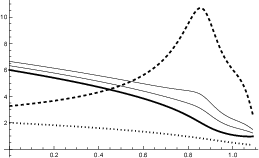
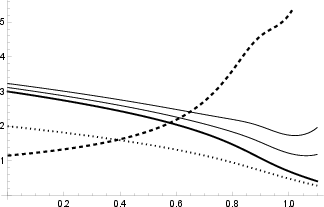
- They compute how rotation shifts the ISCO (the smallest stable circular orbit for matter) and the circular light paths in the equatorial plane. Rotation pushes the retrograde ISCO outward and pulls the prograde ISCO inward, as in Kerr; the details depend on a deformation parameter in the theory.
Main findings and why they matter
- There is a universal, easy‑to‑integrate equation for the frame dragging function ω(r) across DHOST theories. This makes constructing slow‑rotation solutions straightforward once you know the static solution.
- In shift‑symmetric DHOST theories (a widely studied subclass), the first‑order rotational effect is the same as in GR: ω(r) = 2J / r3. So, even if the non‑spinning black hole looks different from Schwarzschild, the leading rotational correction looks Kerr‑like.
- Allowing ω to depend on angle leads to irregular behavior at the horizon or infinity, so ω must depend on radius only—again matching the GR expectation.
- Under disformal transformations, slow‑rotation solutions map cleanly to each other, and the integrability of the ω equation is preserved.
- In “primary hair” DHOST black holes, rotation shifts the ISCO and light rings similarly to Kerr, but the amount of shift depends on the theory’s parameters. This gives concrete predictions for how matter and light behave near such black holes.
Implications and potential impact
- Practical modeling: The simple ω(r) equation is a powerful tool. It lets researchers build slowly rotating black hole solutions in complex gravity theories without solving the full, hard problem of axisymmetric field equations.
- Observations: Features like the ISCO and photon rings affect accretion disk behavior and black hole shadows. With the Event Horizon Telescope (images of M87* and Sgr A*) and gravitational wave detectors (LIGO/Virgo/KAGRA, and future missions like LISA), these predictions can be compared against data to test for deviations from GR.
- Theory guidance: The result that first‑order rotation often looks Kerr‑like suggests that many modified gravity effects may only show up beyond leading order in spin or in other observables (like strong‑field scalar signatures). This narrows where to look for differences and helps design better tests of gravity.
In short, the paper shows that the leading effect of slow rotation in many DHOST theories is surprisingly simple and often indistinguishable from GR at first order, while still allowing differences in the static background and in higher‑order or more detailed features. This balance makes the work both theoretically elegant and practically useful for confronting modified gravity with observations.
Knowledge Gaps
Knowledge gaps, limitations, and open questions
Below is a concise list of what remains missing, uncertain, or unexplored in the paper, organized to guide future research:
- Beyond first order in spin: The analysis is restricted to linear order in angular momentum (Hartle–Thorne approximation). A second-order treatment (including O(J2) corrections to h(r), f(r), the scalar field, and the quadrupole moment) is needed to assess departures from Kerr multipole structure and observable signatures.
- General proof of θ-independence: The claim that regularity forbids any θ-dependence of ω is demonstrated for GR and specific quadratic DHOST subclasses, but not proven across the full DHOST landscape (including generic cubic terms, non–shift-symmetric cases, U-DHOST, and non-asymptotically flat spacetimes). A general theorem (or counterexample) is missing.
- Conditions for integrability and regularity of ω: The “conserved current” argument yields d(Qω')/dr=0, but the global existence and regularity of ω depend on the behavior of Q(r). A systematic analysis is needed to identify when Q(r) changes sign, vanishes, or diverges (e.g., near horizons or potential singularities), and how boundary conditions fix the integration constant k in terms of ADM angular momentum J for non-standard asymptotics.
- Scalar-field response to rotation: The assumption that the scalar field remains unchanged at O(J) (because scalar quantities depend only on even powers of J) is not rigorously validated for generic DHOST couplings beyond shift symmetry. One should explicitly check whether mixed metric–scalar source terms induce O(J) corrections in non–shift-symmetric theories.
- Non-circular stationary spacetimes: Disformal transformations can produce non-circular metrics; the Hartle–Thorne ansatz may miss additional O(J) components (e.g., gtr, grφ). A comprehensive analysis is needed to classify all allowed O(J) metric corrections in non-circular DHOST solutions and test whether the integrability property survives.
- Mapping k ↔ J in general DHOST: The identification of the integration constant k with ADM angular momentum J is only asserted “whenever possible.” A general definition (e.g., via Komar integrals adapted to DHOST) and matching conditions at infinity/horizon for various asymptotics (flat, (A)dS, nontrivial F0(X) acting like Λ) are needed.
- Disformal transformation subtleties: The result ω(r)=𝜔̃(R(r)) relies on invertibility and monotonicity of R(r)=r√C(X(r)). A full classification of when this mapping fails (e.g., non-monotonic C(X), multiple branches, or turning points) and the resulting physical implications is missing.
- Matter coupling effects: Since disformal equivalence holds only in vacuum, the influence of matter (e.g., accretion flows, EM fields, test fluids) on ω, on integrability, and on observable predictions is not addressed. A framework for incorporating matter and assessing deviations from Kerr-like ω is needed.
- Extension beyond scalar–tensor: The symmetry-based integrability argument is “likely not exclusive” to scalar–tensor theories, but no demonstration is provided for other modified gravities (vector–tensor, bimetric, nonlocal). Testing integrability and identifying the analogue of Q(r) in those frameworks is open.
- Stability and causal structure: The rotating solutions’ dynamical stability (ghost/gradient instabilities, superradiance, ergoregion instabilities) and causal structure (propagation speeds of tensor/scalar modes) are not analyzed. Conditions on Q(r) and related background functions for stability in the rotating case are needed.
- Universality of Kerr-like ω in quadratic, shift-symmetric DHOST: The paper shows ω=2J/r3 for quadratic Horndeski and beyond-Horndeski (C=1) cases. It remains open whether cubic DHOST models (or more general disformal choices with C≠const, D≠0) can produce radially different ω(r) at O(J), and under what precise conditions.
- Observational links beyond equatorial ISCO and photon rings: The phenomenology is illustrated only for equatorial circular orbits in one specific model (p=2, λ=M), without systematic exploration across parameter space (p, λ) or inclusion of prograde vs retrograde families beyond simple derivatives. Predictions for Lense–Thirring precession, QPOs, shadow shape, and GW ringdown deviations are not derived.
- Cosmological constant and asymptotics: The GR result ω=2J/r3+JΛ/3 for Kerr–(A)dS is quoted, but corresponding ω(r) asymptotics in DHOST with effective cosmological terms (via F0(X), etc.) are not worked out. Boundary conditions at infinity in non-flat DHOST spacetimes merit explicit treatment.
- Numerical continuation to fast rotation: No pathway is provided to build fully rotating (non-perturbative) solutions from the slow-rotation seed, nor is the radius of convergence of the J-expansion assessed. Numerical studies seeded by the O(J) solutions could test existence, uniqueness, and hair persistence at large spins.
- Multipole moments and deviations from Kerr: Since quadrupole and higher moments appear at O(J2) and beyond, the paper cannot assess DHOST-specific multipole structure. Computing Geroch–Hansen moments for these theories is an open task essential for comparing with Kerr.
- Gauge invariance and coordinate dependence: The integrability is connected to a symmetry under ϕ → ϕ + ω0 t and a modified ansatz. A fully gauge-invariant formulation of the ω equation and observable frame-dragging (e.g., via invariant precession frequencies) would clarify coordinate artifacts.
- Constraints from Q positivity: The expression of Q(r) involves DHOST functions (F2, A1, F3X, B2, B6) and background profiles. Conditions ensuring Q>0 outside the horizon (to avoid sign changes in ω') are not provided; this is crucial for regularity and physical frame dragging.
- Angular dependence in non-flat or exotic asymptotics: The argument excluding θ-dependence uses regularity at the horizon and flat infinity. It is not examined for asymptotically non-Minkowski spacetimes (e.g., (A)dS) or for nontrivial topologies/exotic compact objects within DHOST.
- Impact of disformal transformations on light cones and shadows: Since disformal changes alter causal cones and matter couplings, the mapping of photon rings/shadows and their observational degeneracies across disformally related frames is not analyzed.
- Superradiance and scalar hair under rotation: Whether primary hair persists nonperturbatively with rotation and whether rotating scalar hair triggers superradiant instabilities (due to modified dispersion) in DHOST backgrounds is unknown.
- Parameter estimation prospects: No quantitative framework is provided to translate the computed ω(r), ISCO shifts, and photon ring changes into constraints from LIGO/Virgo/KAGRA, EHT, or future detectors (LISA/ET). Building Fisher forecasts or Bayesian pipelines based on these signatures remains to be done.
Glossary
- ADM angular momentum: The conserved angular momentum parameter in the Arnowitt–Deser–Misner formalism characterizing a rotating spacetime at infinity. "where is the Arnowitt–Deser–Misner (ADM) angular momentum of the black hole"
- axial perturbations: Odd-parity (axial) metric perturbations on a spherically symmetric background, relevant for analyzing stability and wave propagation. "equations governing axial perturbations in DHOST theories"
- Beyond Horndeski theories: Extensions of Horndeski scalar–tensor theories with higher-order interactions that remain ghost-free due to degeneracy. "these theories belong to the quadratic Beyond Horndeski theories"
- cubic Galileon theory: A scalar–tensor model featuring Galileon interactions up to cubic order in second derivatives, often yielding modified gravity effects. "for instance in the cubic Galileon theory"
- Degenerate Higher Order Scalar-Tensor (DHOST) theories: The most general class of scalar–tensor theories with higher-order derivatives whose degeneracy conditions ensure only three propagating degrees of freedom. "Degenerate Higher Order Scalar-Tensor (DHOST) theories"
- degeneracy conditions: Constraints on the Lagrangian functions ensuring elimination of pathological extra modes (ghosts) and preservation of a healthy degree-of-freedom count. "must satisfy degeneracy conditions"
- disformal transformation: A field redefinition of the metric involving both a conformal factor and a term proportional to scalar-field gradients, mapping between different scalar–tensor theories. "applying a disformal transformation to the metric"
- Einstein–Gauss–Bonnet (4D-Einstein-Gauss-Bonnet): A modification of GR including the Gauss–Bonnet invariant; in four dimensions it appears via scalar–tensor (DHOST-like) constructions. "4D-Einstein-Gauss-Bonnet (which is another particular case of DHOST theories)"
- frame dragging: The rotation-induced effect where spacetime drags inertial frames, encoded by the function ω in a slowly rotating metric. "characterizes the frame dragging effect"
- Hartle–Thorne ansatz: A perturbative metric form for slowly rotating bodies, expanding around a static spherical solution to first order in angular momentum. "we employ the Hartle–Thorne ansatz to model a slowly rotating spacetime"
- Innermost Stable Circular Orbit (ISCO): The smallest-radius stable circular orbit for massive particles around a compact object; below it, circular orbits are unstable. "Innermost Stable Circular Orbit (ISCO)"
- Kerr metric: The exact rotating black hole solution of GR characterized by mass and angular momentum. "the metric is identical to the Kerr metric"
- Kerr-(A)dS: The rotating black hole solution in GR with a nonzero cosmological constant (de Sitter or Anti–de Sitter). "for Kerr-(A)dS slowly rotating metric"
- Legendre polynomials: Orthogonal polynomials used to expand angular dependence on the sphere in separable perturbative analyses. "decompose on a basis of Legendre polynomials"
- Lovelock’s theorem: A uniqueness result stating that, in four dimensions and under certain assumptions, the only second-order metric theory is GR (possibly with a cosmological constant). "assumptions of Lovelock’s theorem in four dimensions"
- Noether current: The conserved current associated with a continuous symmetry (e.g., shift symmetry) of the action. "can be written as the divergence of a Noether current "
- no-hair theorem: The GR result that stationary, axisymmetric vacuum black holes are fully specified by mass and angular momentum (and charge), with no additional “hair.” "no-hair theorem \cite{Carter:1971zc}"
- parity symmetry: Invariance under spatial inversion; in scalar–tensor models, combined with shift symmetry can constrain allowed terms. "possessing shift and parity symmetry"
- primary hair: A scalar charge (hair) that is independent of the black hole’s mass and spin, adding an extra parameter to the solution. "black hole solutions with primary hair"
- scalar hair: A nontrivial scalar-field profile around a black hole that modifies the spacetime relative to GR solutions. "non-trivial scalar hair"
- scalar–Gauss–Bonnet theories: Scalar–tensor theories where the scalar couples to the Gauss–Bonnet invariant, producing rotating solutions beyond GR. "scalar–Gauss–Bonnet theories"
- shift symmetry: Invariance of the action under constant shifts of the scalar field, often allowing time-dependent scalar profiles without breaking stationarity. "global shift symmetry const"
- stealth Kerr solution: A configuration where the scalar field is nontrivial but the spacetime metric remains exactly Kerr. "stealth Kerr" solution
- U-DHOST theories: A class of DHOST models that are degenerate when expressed in unitary gauge. "U-DHOST theories which are degenerate in the unitary gauge"
- unitary gauge: A gauge choice where the scalar field defines the time coordinate, simplifying the form of the action and degrees of freedom. "unitary gauge where the scalar field is used to define the time coordinate"
Practical Applications
Immediate Applications
The results below translate the paper’s findings into concrete uses that can be pursued now, primarily in astrophysics and data analysis.
- Sector: Gravitational-wave astronomy
- Use case: Rapid generation of slow-rotation black-hole metrics in DHOST theories for waveform systematics studies
- Basis in paper: Integrable first-order equation for the frame-dragging function ω(r): d/dr[Q(r) ω′(r)] = 0 ⇒ ω(r) = k ∫dr/Q(r); specialization shows ωKerr = 2J/r³ for broad shift-symmetric quadratic subclasses even when the static metric differs from Schwarzschild
- Tools/workflows: Implement a lightweight module that ingests static metric functions f(r), h(r), scalar profile ψ(r), and DHOST coefficients (F2, A1, F3X, B2, B6) to compute Q(r) and ω(r); plug into parameterized-test pipelines (e.g., Bilby, PyCBC, RIFT) for inspiral/ISCO-related systematics studies and spin–orbit couplings at first order
- Assumptions/dependencies: Slow-rotation regime (linear in J), axisymmetry, stationary solutions; known static background solution; viability limited to DHOST parameter space consistent with cGW = c and other constraints
- Sector: Black-hole imaging (EHT/ngEHT) and X-ray spectroscopy
- Use case: Update ray-tracing and spectral codes to predict shadow/photon-ring size and disk emission using DHOST static metrics with Kerr-like first-order frame dragging
- Basis in paper: ISCO and circular light orbits computed for a primary-hair solution; universality of ω(r)=2J/r³ in shift-symmetric quadratic beyond-Horndeski and Horndeski implies first-order spin signatures mimic Kerr while static geometry can differ
- Tools/workflows: Integrate computed f(r), h(r), ω(r) into existing codes (GYOTO, RAPTOR, IPOLE, KORAL/HARM post-processing) to generate images/spectra; perform MCMC fits to EHT and X-ray (continuum-fitting, Fe Kα) data prioritizing static-metric deviations
- Assumptions/dependencies: Emission modeling uncertainties dominate; slow-rotation approximation; asymptotic flatness; matter couplings may break disformal equivalences
- Sector: Numerical relativity and initial data
- Use case: Construct improved initial data for slowly rotating, hairy black holes in DHOST theories
- Basis in paper: General integrability of ω(r) for any static DHOST background provides controlled first-order rotating extensions
- Tools/workflows: Generate BH backgrounds (f,h,ψ) from known static solutions; compute ω(r) and seed NR or perturbation solvers with consistent axisymmetric seeds
- Assumptions/dependencies: Linear-in-spin regime; extensions to dynamical evolutions may require gauge and constraint handling beyond the current ansatz
- Sector: Parameterized tests of GR
- Use case: Refine observational strategies by recognizing degenerate spin signatures
- Basis in paper: For shift-symmetric quadratic (beyond-)Horndeski, ω(r) = ωKerr at O(J) despite non-Schwarzschild static metrics; θ-dependence of ω excluded by regularity
- Tools/workflows: Reweight test catalogs to focus on observables sensitive to static deviations (e.g., shadow size, ISCO shift, periastron precession) rather than first-order frame-dragging; build priors reflecting this degeneracy
- Assumptions/dependencies: Applies to the specified subclasses; higher-order spin effects may lift degeneracy
- Sector: Theory/modeling
- Use case: Port the symmetry/conservation-law method to other modified gravity frameworks
- Basis in paper: Integrability traced to a continuous symmetry under ω → ω + const in the refined ansatz, yielding a conserved current and a first integral
- Tools/workflows: Apply the same ansatz and Noether-current construction to vector–tensor or higher-curvature theories for odd-parity, dipolar perturbations
- Assumptions/dependencies: Existence of a comparable symmetry at linear order; careful check of degeneracy/health of extra modes
- Sector: Software engineering for astrophysics
- Use case: Open-source “SlowRot-MG” library
- Basis in paper: Plug-and-play integral for ω(r) plus disformal mapping ω(r)=𝛚̃(R(r)), R=r√C(X)
- Tools/workflows: Python/C++ APIs that (i) parse DHOST functions; (ii) compute Q(r), ω(r); (iii) export to ray-tracers and GW pipelines; (iv) provide ISCO and photon-ring calculators
- Assumptions/dependencies: End users supply static solutions and viable DHOST parameters; documentation must flag slow-spin limits
- Sector: Research planning/observational strategy
- Use case: Proposal guidance to prioritize measurements constraining static metric deviations over first-order frame-dragging in target subclasses
- Basis in paper: First-order frame dragging is Kerr-like for a broad, observationally allowed class; ISCO and photon ring shift with DHOST hair
- Tools/workflows: Observation planning focusing on spectral-timing, shadow size, and stellar orbit precession rather than linear-in-spin frame-dragging tests
- Assumptions/dependencies: Subclass-dependent; astrophysical systematics (inclination, accretion geometry) must be jointly modeled
Long-Term Applications
These require further research, higher-order modeling, or advanced instrumentation/scaling.
- Sector: Gravitational-wave astronomy (LISA/ET/CE)
- Use case: Full-spin waveform models and ringdown beyond O(J) for DHOST black holes
- Basis in paper: First-order framework provides a foundation; higher-order spin and non-circular metrics (possible under disformal maps) need development for precise tests
- Tools/products: EOB/PN models extended with DHOST-informed potentials; black-hole perturbation codes for quasinormal modes in non-Schwarzschild static backgrounds
- Dependencies: Second-order-in-spin calculations; stability and hyperbolicity of the theory; constraints from cGW = c and binary-pulsar bounds
- Sector: Black-hole imaging and plasma astrophysics
- Use case: GRMHD simulations in modified spacetimes to disentangle metric vs plasma degeneracies
- Basis in paper: ISCO and photon-orbit shifts quantified for primary-hair solutions; ω universal at O(J) in key subclasses
- Tools/products: Modified HARM/KORAL in non-Schwarzschild metrics; synthetic libraries for ngEHT; joint inference frameworks combining EHT, X-ray, and GW datasets
- Dependencies: High-fidelity radiative transfer; uncertain electron heating/acceleration; need higher-spin metrics for rapidly rotating SMBHs
- Sector: Pulsar timing and stellar dynamics (SKA, ELT)
- Use case: Precision tests near SMBHs targeting static-metric effects rather than first-order frame dragging
- Basis in paper: Predicts where deviations hide (static sector) given Kerr-like ω at O(J)
- Tools/products: Orbit-fitting codes with DHOST static potentials; timing residual models including scalar-hair parameters
- Dependencies: Discovery of suitable pulsars near galactic centers; environmental noise (DM variations, scattering)
- Sector: Model interoperability via disformal mapping
- Use case: Cross-theory translation layers to compare predictions across disformally related theories
- Basis in paper: Explicit transformation rules for slow-rotation metrics (r → R=r√C; ω invariant as a function of R)
- Tools/products: Backend that maps solutions and observables between frames; flags inequivalences when matter is present
- Dependencies: Invertible, monotonic R(r); careful matter coupling treatment (vacuum equivalence does not imply astrophysical equivalence)
- Sector: Standardized benchmarks and constraints on DHOST
- Use case: Community benchmarks for ISCO/shadow/GW shifts in viable DHOST parameter regions
- Basis in paper: Analytic control of ω and explicit examples with primary hair provide canonical test cases
- Tools/products: Public catalogs of metrics and observables; emulator surrogates for rapid inference
- Dependencies: Ongoing observational constraints (e.g., GW170817-like bounds) may shrink parameter space; need consensus on priors
- Sector: Fundamental physics and cosmology
- Use case: If deviations are detected, inform consistent high-energy completions and cosmological models
- Basis in paper: Demonstrates observationally accessible, theory-discriminating features (static deviations with Kerr-like first-order frame dragging)
- Tools/products: Joint cosmology–astrophysics inference frameworks linking scalar-tensor parameters across scales
- Dependencies: Robust deviation detections beyond astrophysical systematics; consistency with solar-system and binary-pulsar tests
- Sector: Education and workforce development
- Use case: Curricula and training on symmetry-based integrability in modified gravity
- Basis in paper: Clear derivation linking diffeomorphism-induced ω-shift symmetry to a conserved current and integrability
- Tools/products: Problem sets, Jupyter notebooks implementing ω(r) from Q(r) in multiple theories
- Dependencies: Availability of accessible static solutions; sustained community support for open educational resources
Notes on feasibility across applications:
- The slow-rotation (linear-in-J) approximation is the foundational assumption; high-spin SMBHs and stellar-mass BHs may require extending to O(J²) or fully rotating solutions.
- For subclasses where ω(r)=2J/r³ at first order, observational discriminants should target static metric deviations; higher-order spin effects may still carry differentiating power.
- Many DHOST models are constrained by the gravitational-wave speed, binary pulsars, and cosmology; ensure parameter choices comply with current bounds.
- Disformal transformations preserve vacuum solutions’ equivalence but can yield different predictions in the presence of matter; care is required when modeling accretion flows and EM observables.
Collections
Sign up for free to add this paper to one or more collections.