Simultaneous JWST, NuSTAR, and VLA Monitoring of Sgr A*: A Unified Picture of the Variable IR, X-ray and Radio Emission
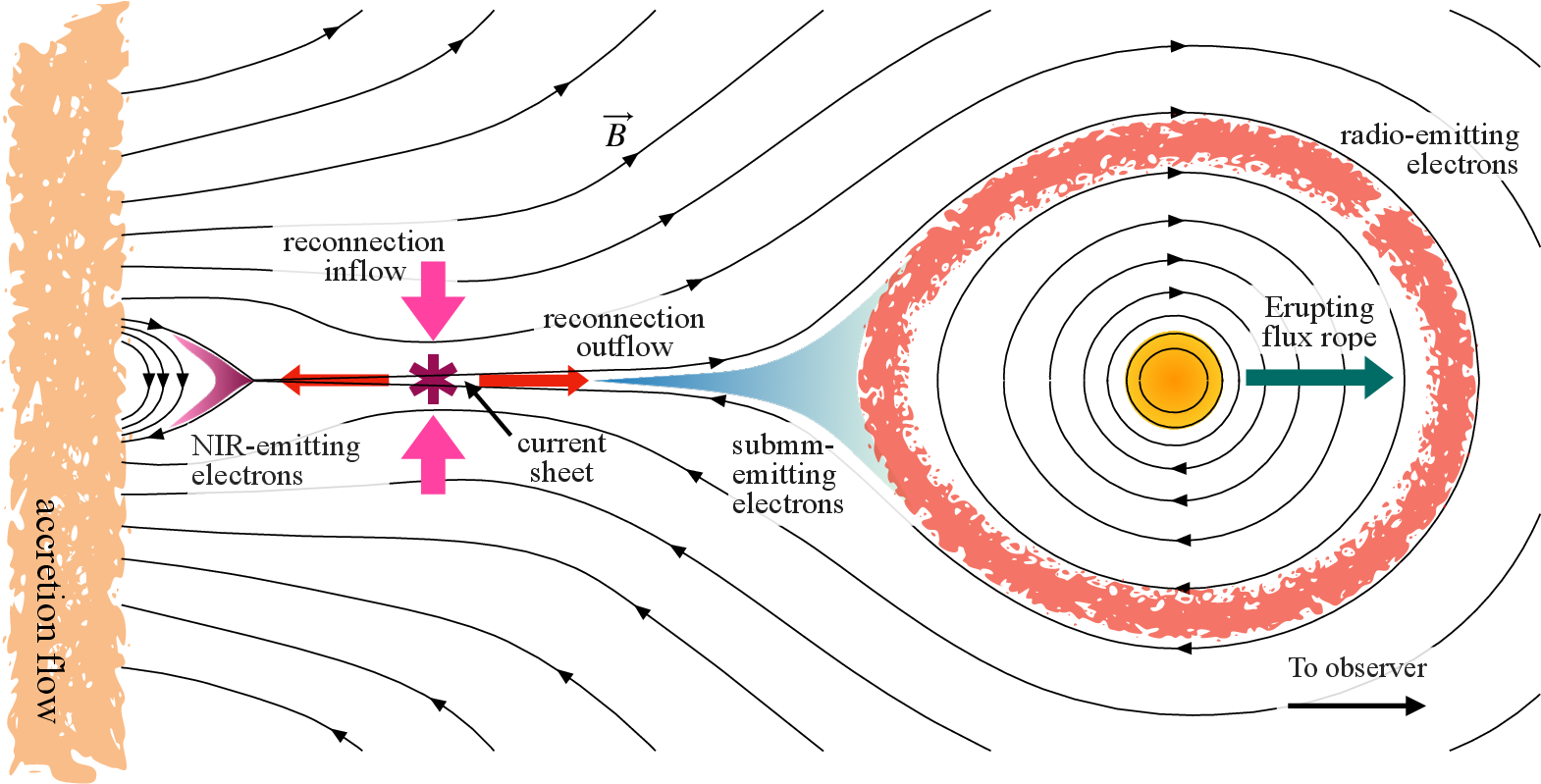
Abstract: Flux variability is a fundamental channel of information from Sgr A* because of its direct probe of processes occurring within an accretion disk under strong gravity. We present simultaneous IR, X-ray and radio observations of Sgr A* on 2024 Apr 05 using JWST, NuSTAR, and VLA. We report the detection of a strong X-ray flare with a luminosity of $\sim5.2x10{35}$ erg/s coincident with a bright near-IR flare, and a brightening in radio about an hour later. We investigate the candidate physical mechanisms for the X-ray flare emission and conclude that this can best be explained by inverse Compton scattering of near-IR flare radiation. We propose a dynamic scenario analogous to a coronal mass ejection in which a magnetic flux rope is ejected from Sgr A*'s inner accretion flow with a current sheet extending down from the rope to the bulk of the accretion flow. Reconnection within the sheet produces oppositely directed flows of accelerated particles moving upwards towards the rope and downwards towards the accretion flow. Infrared radiation from the approaching energetic electrons is enhanced by beaming and up-scattered by thermal electrons in the accretion flow to produce the strong X-ray flare. Meanwhile, the relativistic electrons moving in the opposite direction away from the disk experience weaker magnetic fields so radiate at longer wavelengths by feeding into the magnetic flux tube and adiabatically cooled during its subsequent expansion. This physical picture attempts to unify the origin of the variable emission from Sgr A* at IR, X-ray and radio/submm wavelengths.
Paper Prompts
Sign up for free to create and run prompts on this paper using GPT-5.
Top Community Prompts
Explain it Like I'm 14
Overview: What this paper is about
This paper studies a big “burp” from the supermassive black hole at the center of our Galaxy, called Sagittarius A* (Sgr A*). The team watched it at the same time with three powerful telescopes that see different kinds of light:
- JWST (infrared, or “heat” light),
- NuSTAR (X-rays), and
- the VLA (radio waves).
On April 5, 2024, they caught a strong X-ray flare that happened at the same time as a bright infrared flare, followed by a radio brightening about an hour later. They use these observations to build one simple, connected story about what caused all three signals.
Key questions the researchers asked
- Do the infrared (IR) and X-ray flares happen together or at different times?
- Why did the radio emission get brighter later, instead of at the same time?
- What physical process near the black hole made the X-rays so strong?
- Can one unified picture explain the changing infrared, X-ray, and radio light?
How they studied it (in everyday terms)
Think of the area around the black hole as a messy whirlpool of hot gas and magnetic fields called an accretion flow. Sometimes, this “storm” snaps and launches clumps of energy and particles.
To track one of these events, the team watched Sgr A* at three kinds of light all at once:
- Infrared with JWST (like watching heat),
- X-rays with NuSTAR (very energetic light),
- Radio with the VLA (longer waves).
They made light curves—graphs of brightness over time—for each type of light. Then they:
- Checked whether the peaks lined up in time (to see cause-and-effect),
- Measured how the “color” of the IR light changed (which tells you about the energy of the particles),
- Looked for delays in the radio peaks (to test how a blob of material expands and cools),
- Compared different explanations for the X-rays (like which physical process could produce such bright, fast X-rays).
Technical ideas translated:
- Magnetic reconnection: like twisted rubber bands (magnetic field lines) suddenly snapping and releasing energy.
- Flux rope/coronal mass ejection: a loop of magnetic field and particles getting thrown outward, similar to explosions on the Sun.
- Inverse Compton scattering: low-energy light (infrared photons) gets “kicked” by hot electrons and boosted up into X-rays—like a ping-pong ball getting slammed by a fast tennis ball.
- Optically thick vs. thin radio emission: when a cloud is “thick,” light struggles to get out; as it expands and thins, light escapes more easily and at different radio frequencies at different times.
What they found and why it matters
- Timing
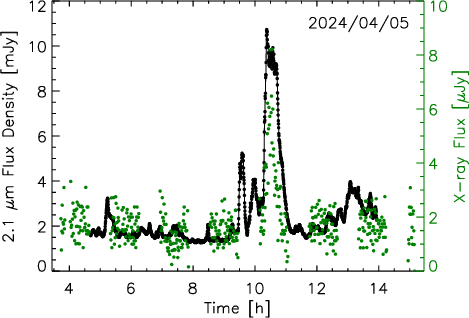
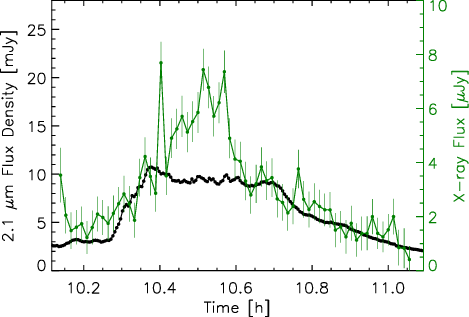
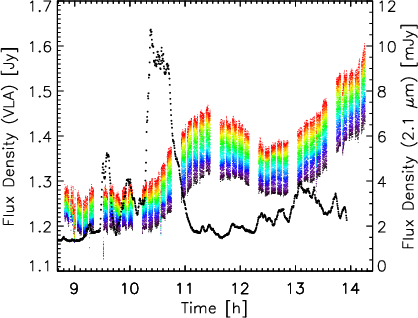
- A powerful X-ray flare lasted about 40 minutes and happened at the same time as a bright infrared flare—there was essentially no delay between them.
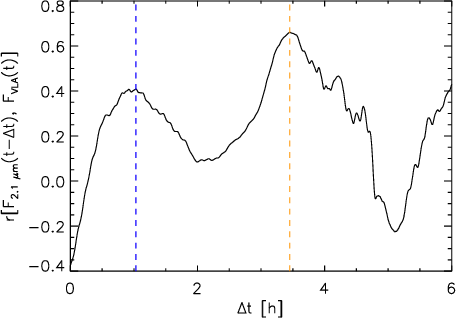
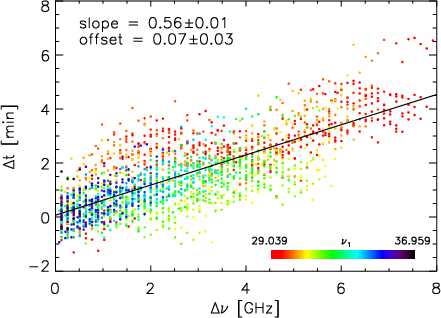
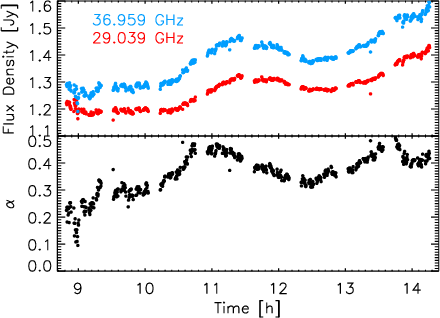
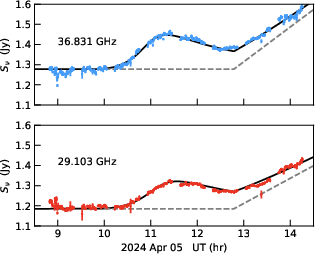
- The radio emission brightened later, with peaks about 1 hour and about 3.5 hours after the IR peak. Even within the radio band, the higher radio frequencies brightened slightly earlier than the lower ones. This is what you expect if a hot blob expands: higher-pitch (higher-frequency) radio escapes first, lower-pitch later.
- Brightness and “color”
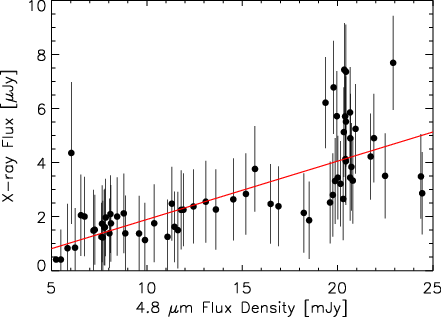
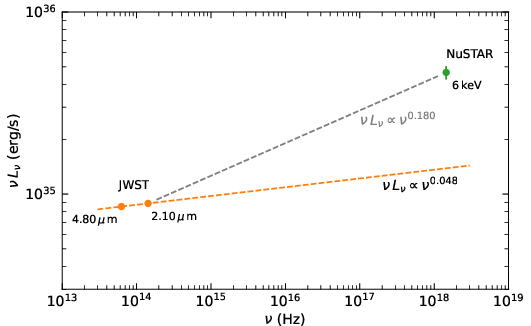
- The X-ray flare was extremely bright—too bright to be explained by the same electrons that made the infrared light simply radiating X-rays directly.
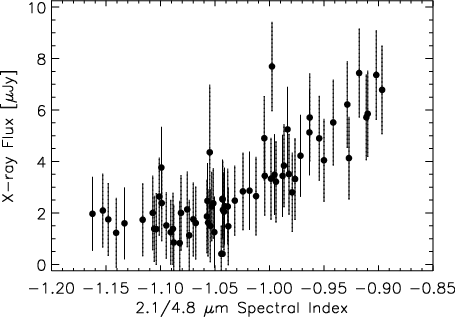
- The “color” of the infrared light (its spectral slope) changed during the flare in a way that matches particles being quickly energized and then cooling.
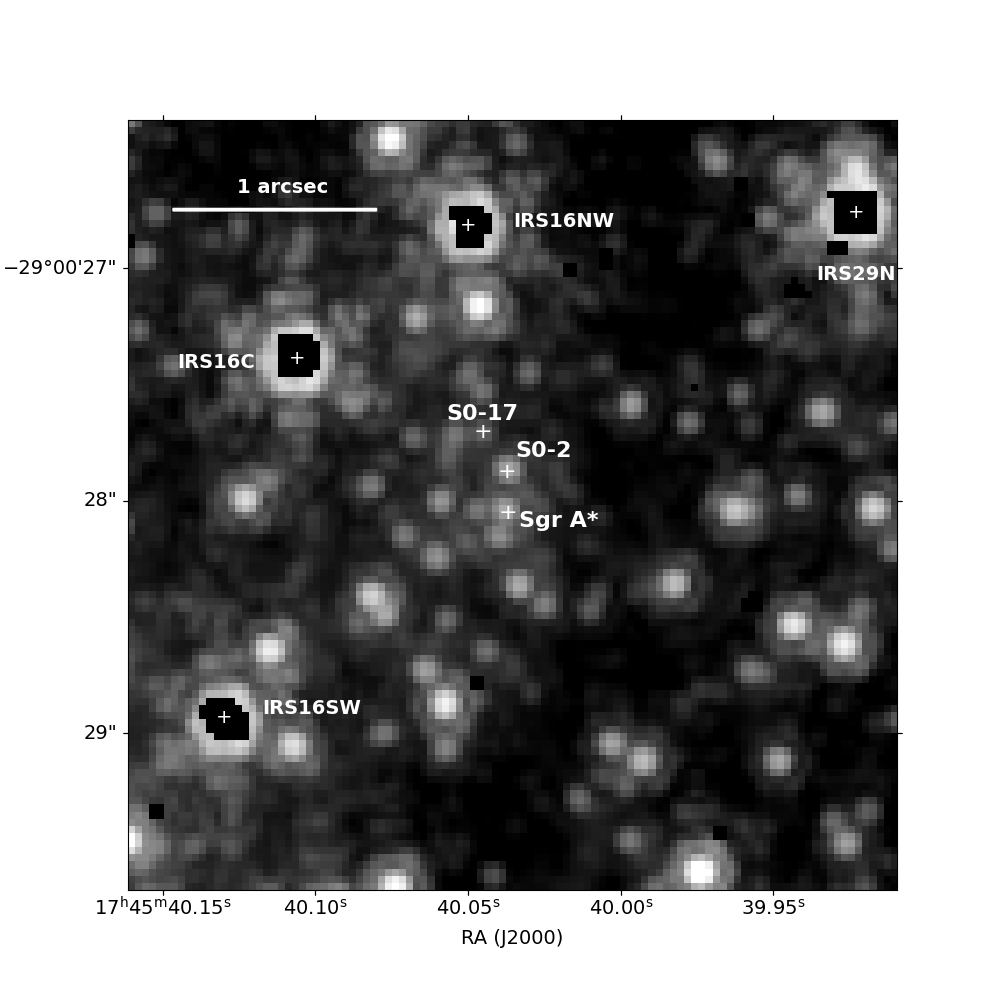
- At the brightest moments, the X-rays kept rising even after the infrared light stopped getting brighter. That’s a clue that the X-rays are made by a different step in the chain.
- Best explanation for the X-rays
- The team tested three common ideas: X-rays made directly by synchrotron radiation, by synchrotron-self Compton (SSC), or by inverse Compton scattering (ICS).
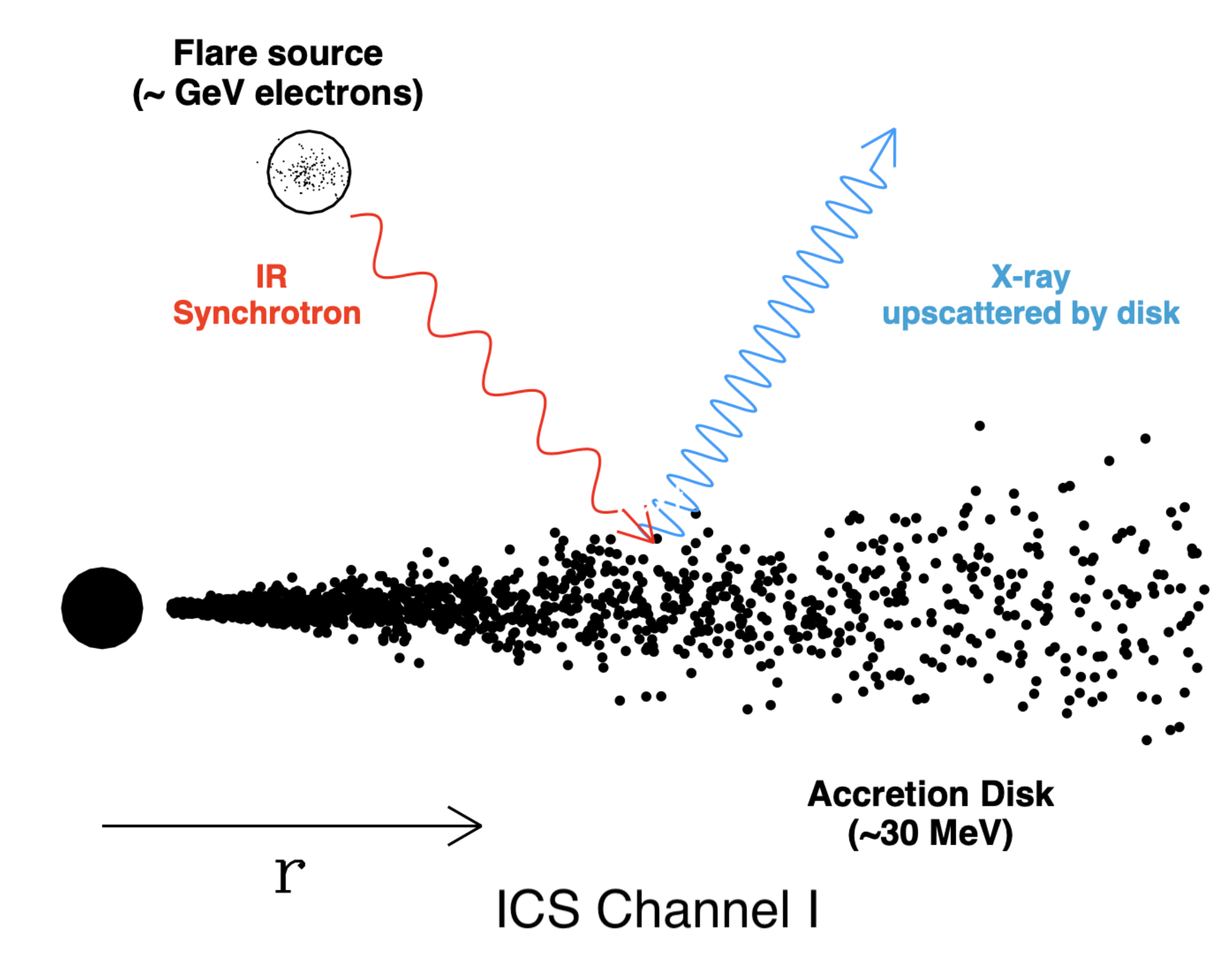
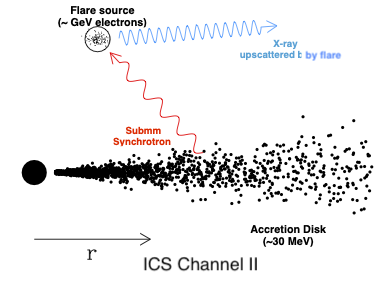
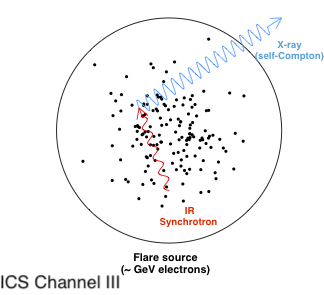
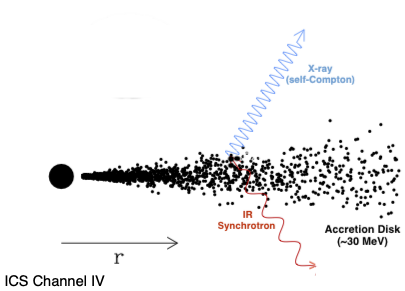
- They conclude ICS fits best: infrared photons from the flare get boosted to X-rays by fast but “ordinary” hot electrons in the surrounding disk. This naturally explains the very bright X-rays and their tight timing with the IR flare.
- A unified physical picture (one story for IR, X-ray, and radio)
- A magnetic “flux rope” (a loop of magnetic field) gets ejected from near the black hole, similar to a solar coronal mass ejection.
- A thin “current sheet” forms beneath it where magnetic reconnection accelerates electrons in two directions:
- Down toward the disk at very high speeds (a large fraction of light speed): these electrons beam their infrared light toward the disk, where hot electrons boost those IR photons into X-rays (ICS). This makes the IR and X-ray flares happen together.
- Up into the expanding flux rope: in weaker magnetic fields, these electrons shine mainly at longer wavelengths (radio). As the rope expands, they cool “adiabatically” (by expansion), which causes the radio brightening later (the time delay), and the frequency-by-frequency stagger within the radio band.
- Radio modeling supports the picture
- The radio light curves match a classic “expanding blob” model: a compact, synchrotron-emitting region expands, changing from “thick” to “thin” so that higher radio frequencies peak earlier than lower ones.
- The best-fit model suggests the blob size was only a few times the black hole’s gravitational radius, the magnetic field was strong (tens of Gauss), and the expansion was a few percent of light speed—reasonable numbers for a region so close to a black hole.
Why this matters:
- It ties together how different kinds of light (IR, X-ray, radio) are connected in time and physics.
- It points to magnetic reconnection and flux-rope ejections as key drivers of sudden energy releases near black holes.
- It shows that inverse Compton scattering likely powers the brightest X-ray flares in Sgr A*, giving a clearer target for future models and observations.
A simple mental picture
Imagine a stormy, magnetized whirlpool around the black hole. A twisted magnetic loop snaps and launches upward, like a solar flare on steroids:
- Right away, super-fast electrons make bright infrared light.
- Those IR photons get “supercharged” into X-rays when they collide with hot electrons in the nearby gas—so the X-rays and IR arrive together.
- The launched blob balloons outward; as it expands, its radio glow grows and peaks later, with higher radio tones arriving a bit earlier than lower ones.
Implications and what’s next
- This unified picture—reconnection, flux-rope ejection, IR-to-X-ray boosting (ICS), and delayed radio from an expanding blob—matches cutting-edge computer simulations and years of hints from earlier observations.
- Understanding these flare “recipes” helps scientists learn how black holes accelerate particles, release energy, and maybe even launch jets.
- More multi-telescope, simultaneous monitoring like this will test how universal this picture is and refine the details (like particle speeds, magnetic fields, and flare locations) near the event horizon.
In short: the team caught Sgr A* in the act across three kinds of light and showed how a single, magnetic “explosion” can explain the fast infrared and X-ray flash and the slower radio glow that follows.
Knowledge Gaps
Knowledge gaps, limitations, and open questions
Below is a consolidated list of unresolved issues, methodological limitations, and concrete open questions that emerge from the paper. Each item is framed to be actionable for future studies.
Observational constraints and data coverage
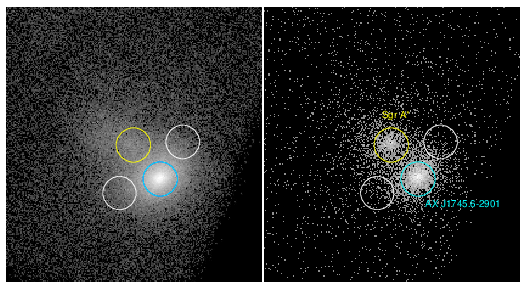
- NuSTAR’s spatial resolution cannot disentangle Sgr A* from nearby emission (e.g., Sgr A East, AX J1745.6–2901); the origin of the Fe K line and the exact background contribution during the flare remain uncertain, requiring simultaneous high-resolution X-ray imaging (e.g., Chandra) and spectroscopy (e.g., XRISM).
- The X-ray analysis largely focuses on 2–10 keV, despite NuSTAR’s 3–79 keV coverage. The absence of time-resolved spectroscopy across 10–50 keV leaves the presence of spectral curvature/cutoffs (critical for distinguishing ICS vs synchrotron/SSC) unconstrained.
- Absolute radio flux calibration at Ka band carries an atypical ≈20% uncertainty due to elevation differences with the flux calibrator (3C286), limiting robust energetics; future observations should match calibrator elevation or use in-band amplitude self-calibration tied to a stable calibrator.
- Limited radio bandwidth (29–37 GHz) and lack of simultaneous submm/mm coverage prevent a definitive test of the frequency-dependent delay and opacity evolution across the submm bump; coordinated ALMA/SMA campaigns are needed.
- The campaign reports only one simultaneous NIR–X-ray flare; generality across multiple events is not established. A larger sample of simultaneous JWST–NuSTAR–VLA (plus Chandra/ALMA) epochs is needed to determine whether the proposed mechanism is universal.
- Timing alignment precision between JWST and NuSTAR/Radio is not quantified at the sub-minute level; tighter cross-instrument clock synchronization and error budgets are required to test for small lags (≲1–2 min) predicted by detailed ICS geometries.
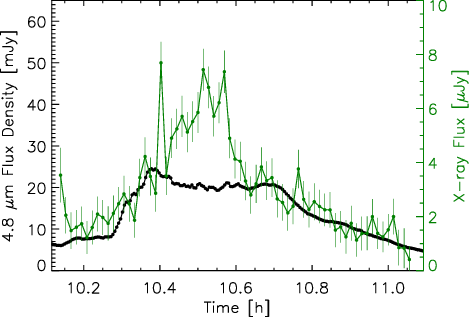
- Extinction corrections—especially at 4.8 µm (A_M = 1.0 ± 0.3)—introduce significant uncertainty in NIR spectral indices and brightness–color trends; a refined JWST-based extinction law toward Sgr A* is needed.
Analysis choices and model assumptions
- The radio flare is modeled as a single, spherical, adiabatically expanding synchrotron source with a very hard electron index (p ≈ 0.81), truncated between 10–1000 MeV and assumed equipartition. This choice is underconstrained and atypical (p < 1 implies divergent energy for a pure power law); broken/curved spectra and non-spherical geometries should be explored and constrained via broader-band radio/submm spectroscopy and polarization.
- The derived hotspot parameters (R0 ≈ 5.3 rg at 36.8 GHz, B0 ≈ 23 G, expansion speed ≈0.018 c) are contingent on equipartition and spherical geometry. Independent constraints (e.g., VLBI size, mm polarization, Faraday rotation measures) are needed to validate or revise these values.
- The “quiescent” radio component is modeled as a late linear rise (starting t_b ≈ 12.8 h), but its physical origin is not explained. Is this an independent flare, disk structural change, or an artifact of subtraction/calibration? Multi-component modeling and decomposition should be attempted.
- The cross-correlation shows two radio lags (≈1 h and ≈3.5 h) relative to NIR, but the modeling addresses only one (the early weaker radio bump). A physically consistent multi-flare/ejection model should fit both features and predict their relative amplitudes and frequencies.
- Unweighted radio light-curve fits (due to intrinsic scatter) reduce statistical rigor. Incorporating stochastic variability with Gaussian-process or hierarchical models would yield more robust parameter uncertainties.
ICS vs synchrotron/SSC: required tests
- The inverse Compton (ICS) claim (NIR seed photons upscattered by thermal disk electrons) is not quantitatively demonstrated. A radiative transfer calculation is needed to show that realistic disk electron temperatures, densities, and path lengths produce the observed Lx ≈ 5.2×1035 erg s⁻¹ and photon index Γ ≈ 2.1, with no measurable lag relative to NIR.
- There is no explicit demonstration that SSC fails under plausible magnetic fields and source sizes; a side-by-side SSC vs ICS calculation (with uncertainties) should be presented to robustly rule out SSC for this flare.
- Predictions for the 10–50 keV spectrum, time-resolved evolution (rise/peak/decay), and the X-ray/NIR flux ratio under the ICS model are not provided; these are essential for falsifiable tests with NuSTAR/Chandra/XRISM.
- ICS polarization predictions (seed NIR polarized synchrotron upscattered by thermal electrons) are not addressed; simultaneous JWST NIR polarimetry with IXPE/X-ray polarimetry could test the model’s geometric and scattering assumptions.
- The paper does not explore whether multiple scattering or high-energy tails would produce detectable hard X-ray or γ-ray emission; constraints/predictions for Fermi/CTA should be developed.
Geometry, dynamics, and microphysics
- The proposed reconnection-driven dual-flow scenario (Alfvén-speed electrons ≈0.7 c downward to the disk; upward electrons feed a flux rope that later emits at radio) is not quantitatively linked to the observed kinematics (radio expansion ≈0.018 c). A consistent GRMHD+PIC-informed dynamical model should connect particle bulk speeds, expansion speeds, and light-curve shapes.
- The cause of the NIR flux “saturation” (plateau) while X-rays continue to rise during the brightest flare is not explained. Is it due to beaming geometry, synchrotron self-absorption, acceleration limits, or radiative transfer effects? A time-dependent model should reproduce this divergence and predict when it occurs.
- The bright-flare NIR spectral index flattening (in contrast to the cooling-driven steepening in fainter events) lacks a microphysical explanation; PIC-based reconnection models should be used to predict injection spectra and spectral evolution consistent with the observed trends.
- The location of scattering within the disk (radius, height, optical depth, anisotropy) is not constrained. GR ray-tracing plus radiative transfer should predict light bending, anisotropy, and potential minor lags in the ICS signal.
- Energetics are not closed: the total electron and magnetic energy in the flare (NIR+X-ray+radio) should be compared to plausible reconnection energy release in the inner MAD disk to verify feasibility.
- The connection to GRAVITY centroid motions and polarization during flares is qualitative; specific geometric predictions (e.g., EVPA swings, centroid motion correlated with NIR–X-ray flux) should be derived and tested.
X-ray absorption and environment
- The fitted X-ray absorption columns vary widely between fits (e.g., N_H ≈ 1.1×1023 cm⁻² for the whole observation vs ≈2.5×1022 cm⁻² for non-flare, plus an additional ≈1.5×1023 cm⁻² during the flare). The origin and time variability of local absorption are unclear; high-resolution spectroscopy (XRISM, Chandra) during flares is needed to track N_H and Fe line behavior.
- Dust scattering and small-angle X-ray halos are not modeled; these effects can modulate the observed light curve and spectral shape near Sgr A* and should be quantified.
Radio/submm variability specifics
- Interstellar scattering and scintillation at ≈30 GHz are not assessed; their contribution to variability and timing (including artificial lags) should be explicitly bounded.
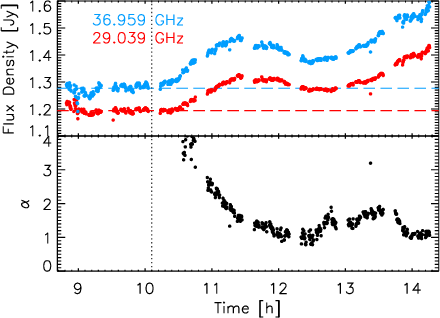
- The spectral index evolution of the variable radio component (after subtracting a constant baseline) shows a loose anti-correlation with flux but is based on endpoints of the band; wider-band radio/submm spectroscopy is needed to trace the optically thick-to-thin transition and validate Van der Laan-type models.
- Direct imaging or VLBI of morphological changes (e.g., post-flare expansion, flux rope/jet signatures) is not attempted; targeted 43–86 GHz VLBI with closure phases and polarimetry could directly test the outflow/flux-rope interpretation.
NIR pedestal and multi-state behavior
- The origin of the NIR “pedestal” (quiescent component) remains uncertain (nonthermal tail vs contamination). Its spectral shape, variability, and correlation with submm emission should be measured across multiple epochs to constrain the steady-state electron distribution.
- The paper does not provide a predictive criterion for when bright NIR flares will have X-ray counterparts (despite the common observation that many NIR flares lack X-rays). A model linking disk optical depth/temperature, seed flux, and geometry to the presence/absence of an X-ray counterpart is needed.
Methodological improvements and tests
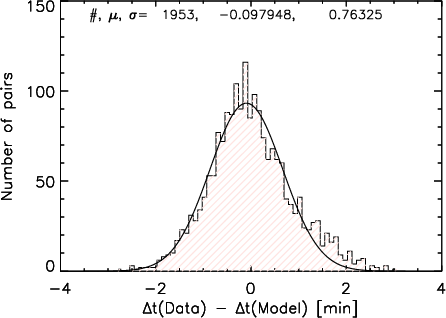
- Cross-correlation significance and lag estimation are not quantified with rigorous statistics (e.g., ZDCF, Monte Carlo with flux randomization); future work should include robust significance assessments and error bars on lag peaks.
- The reliance on a single flare event prevents assessment of variability in parameters (e.g., p, B, R, expansion speed) across events; a population study should be undertaken to establish distributions and correlations.
- Multi-band, time-dependent radiative transfer with GR effects (seed NIR synchrotron + ICS/SSC + synchrotron cooling + adiabatic expansion) should be performed to produce self-consistent NIR–X-ray–radio light curves, spectral indices, and time delays that can be directly compared with simultaneous datasets.
Practical Applications
Immediate Applications
The findings and methods in this paper can be put to work right away across observatories, data analysis, and signal processing. The following items highlight concrete use cases, relevant sectors, and practical workflows or tools, along with key assumptions and dependencies.
- Multi-observatory time-domain campaigns (sector: astronomy/observatories)
- Use case: Codify and deploy coordinated scheduling and real-time alerting for multi-wavelength monitoring (JWST NIRCam, NuSTAR, VLA/ALMA/MeerKAT), keyed to fast NIR triggers and expected radio delays.
- Workflow/tool: A “FlareMon” scheduler plugin and alert pipeline that triggers radio/submm follow-up based on NIR gradients and expected delay windows (e.g., 1–3.5 h for radio peaks; ~0.56 min GHz⁻¹ intra-band delay at 30–37 GHz).
- Assumptions/dependencies: Availability of time-series modes (e.g., JWST NIRCam Time Series Imaging), instrument latencies, cross-agency MOUs, and capacity to re-task arrays rapidly.
- Variable-source-aware interferometric calibration (sector: radio astronomy/software)
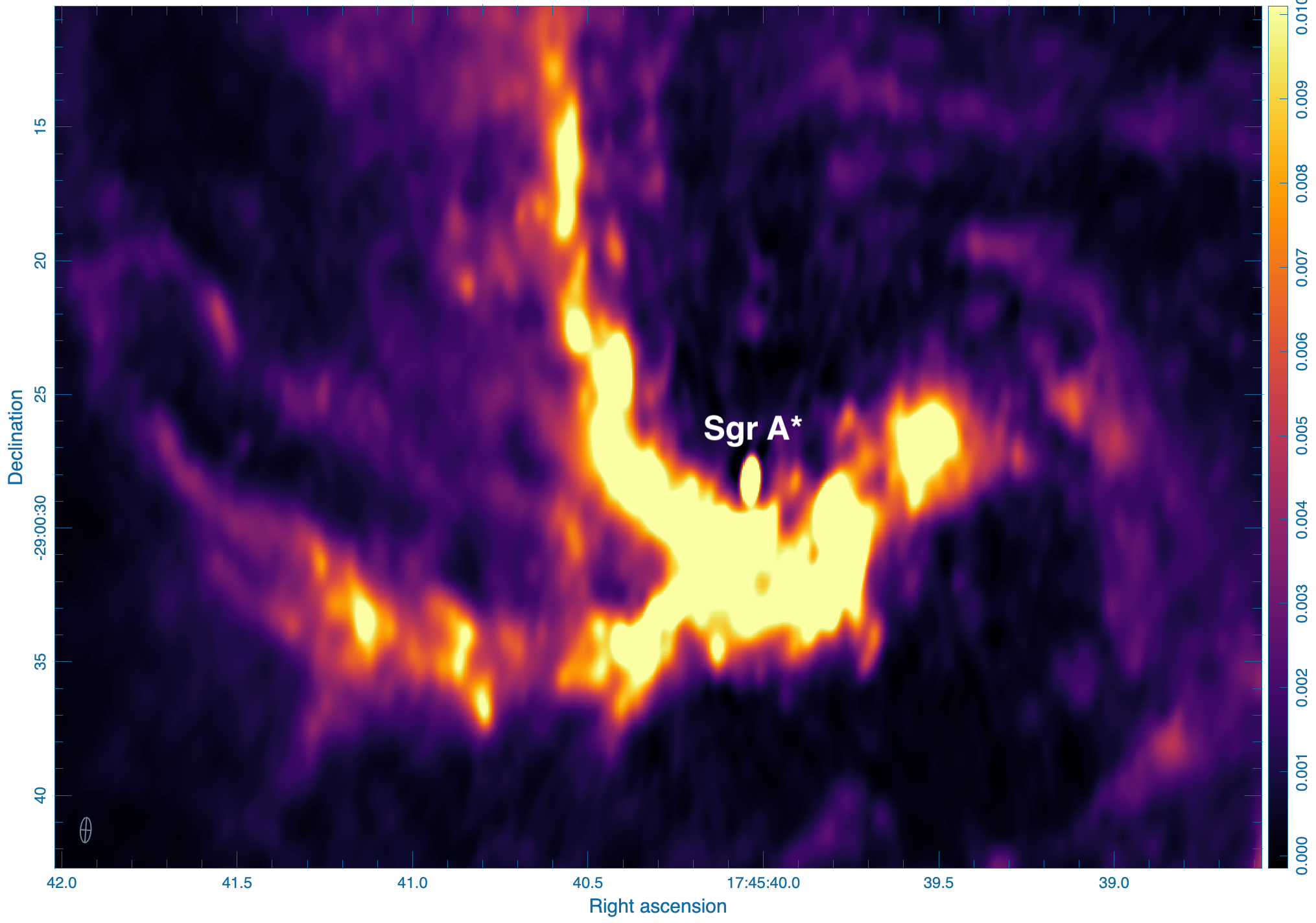
- Use case: Adopt the described time-dependent bandpass correction to “absorb” target variability in visibilities, enabling high-fidelity imaging of surrounding diffuse emission in variable fields (e.g., Galactic Center mini-spiral).
- Workflow/tool: A pipeline module for VLA/ALMA that derives and applies time-dependent bandpass and phase corrections using a point-source model at the phase center, subtracts the target, and restores imaging for non-variable structures.
- Assumptions/dependencies: A strong compact reference source in-field, stable instrumental bandpass, and careful QA to avoid bias if variability is not strictly point-like.
- Cross-correlation time-delay estimation across frequency channels (sector: signal processing/telecom/radar)
- Use case: Apply FFT cross-correlation with polynomial peak fitting to estimate time lags among spectral windows for nonstationary signals (e.g., spectrum-monitoring, phased arrays, synthetic aperture systems).
- Workflow/tool: A reusable library implementing the paper’s methodology (time interpolation, mean-slope removal, FFT cross-correlation, quartic peak fitting) to measure delays with sub-minute precision.
- Assumptions/dependencies: Adequate SNR, quasi-stationary delay structure, and sufficient bandwidth segmentation.
- Rapid flare detection via flux-normalized derivatives (sector: astronomy/data science)
- Use case: Distinguish “flares” from “flickers” using flux-normalized dF/dt thresholds, enabling automated triggers and prioritization during campaigns.
- Workflow/tool: Feature engineering module in time-domain pipelines (e.g., thresholds at ~0.3–0.45 min⁻¹ identify strong flares; ~0.1 min⁻¹ typical for flickering).
- Assumptions/dependencies: Accurate photometry and baseline subtraction (pedestal level), robust extinction correction.
- Unified physical interpretation for strong X-ray flares (sector: astronomy/astrophysics)
- Use case: Reinterpret archival and ongoing Sgr A* flares with inverse Compton scattering (ICS) of NIR flare photons by thermal accretion-flow electrons as the dominant mechanism in stronger X-ray events.
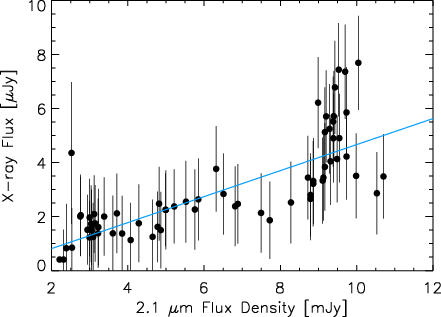
- Workflow/tool: Update modeling codes to prefer ICS over synchrotron/SSC when X-ray flux exceeds NIR extrapolations (as shown by the 3.5× excess relative to NIR power-law in this event).
- Assumptions/dependencies: Presence of thermal electrons in the disk, geometry favoring beaming and disk-viewed NIR emission, accurate absorption corrections.
- Predictive radio scheduling from NIR/X-ray triggers (sector: observatories/operations)
- Use case: Use observed radio delays (primary ~3.5 h; secondary ~1 h) and intra-band slope (~0.56 min GHz⁻¹) to allocate radio/submm time blocks that bracket expected peaks after NIR/X-ray flares.
- Workflow/tool: Scheduling heuristics incorporated in array control software or proposal planning tools.
- Assumptions/dependencies: Similar flare energetics and optical depth evolution; variability in delays between events should be accommodated.
- Model-constrained GRMHD validation (sector: academia/astrophysics)
- Use case: Use observed correlations (NIR–X-ray co-variation, radio delays), spectral trends (NIR index flattening in bright flares), and fitted hotspot parameters (e.g., B ~23 G, R₀ ~5.3 r_g, v_exp ~0.018c) to constrain reconnection rates, Alfvén speeds (~0.7c bulk flow), and flux-rope expansion in MAD disks.
- Workflow/tool: Incorporate empirical constraints into GRMHD and PIC reconnection simulations; calibrate plasmoid ejection and reconnection heating/acceleration models.
- Assumptions/dependencies: Equipartition assumptions for parameter inference; transferability of flare properties across epochs.
- Background subtraction in crowded fields via difference imaging (sector: astronomy/software)
- Use case: Apply the JWST difference-imaging approach to isolate variable sources in highly crowded fields (Galactic Center, dense clusters) while preserving spectral diagnostics.
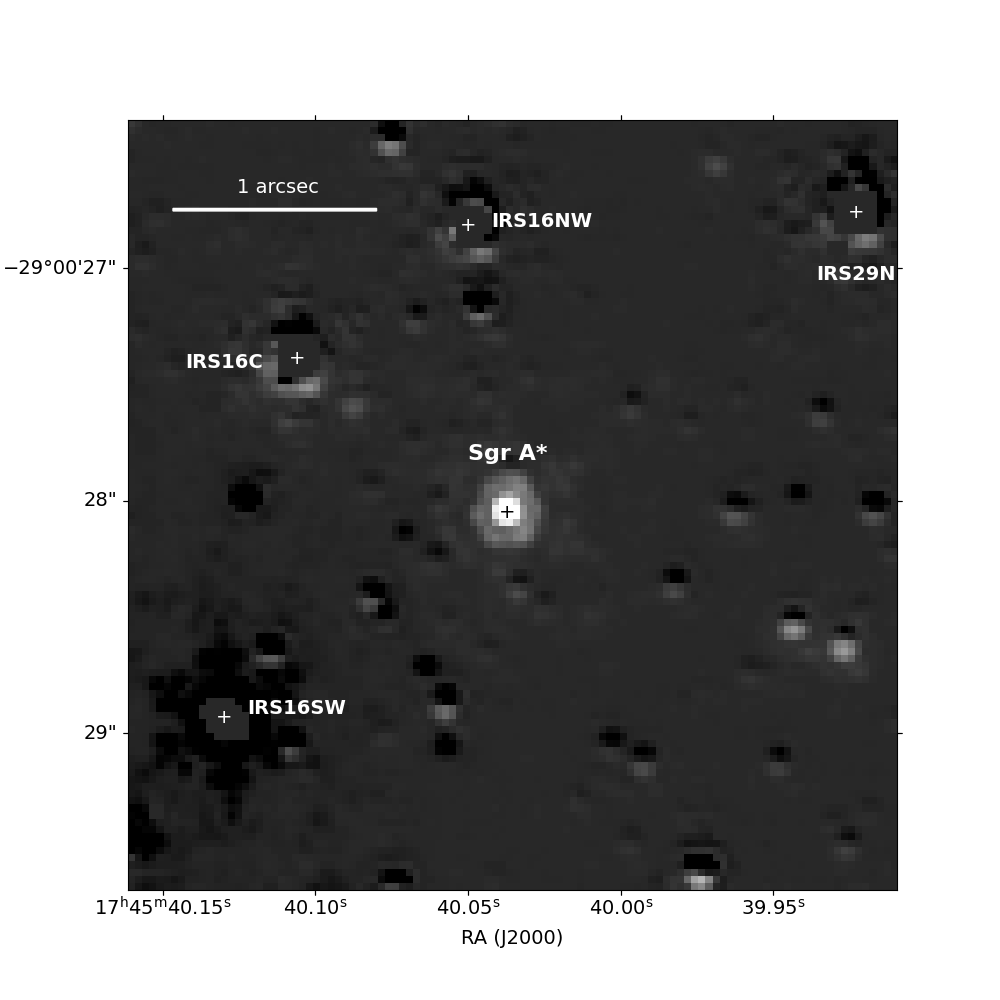
- Workflow/tool: Pipeline modules for baseline selection, difference imaging, and pedestal flux estimation to keep spectral indices physically plausible during low-level flux intervals.
- Assumptions/dependencies: Availability of non-flaring baselines, proper motion and saturation management, extinction corrections.
- X-ray spectral decomposition using non-flare as background (sector: astronomy/data analysis)
- Use case: Separate flare spectra from blended emission (e.g., Sgr A East SNR, nearby LMXBs) by treating the non-flare spectrum as the reference background.
- Workflow/tool: Standardized NuSTAR/Chandra data reduction recipes for crowded fields (region selection, background region symmetry, absorption fitting).
- Assumptions/dependencies: Spatial resolution limitations (NuSTAR 43″), spectral contamination (Fe K lines), and stability of non-flare components.
- Communication and education (sector: education/outreach)
- Use case: Use the CME/flux-rope analogy to communicate black hole variability physics to non-experts; develop educational materials and museum exhibits.
- Workflow/tool: Visualization packages linking solar CME behavior with Sgr A* flare sequences (IR, X-ray, radio timing).
- Assumptions/dependencies: Clear messaging of scale differences and the universality of reconnection physics.
Long-Term Applications
These applications build on the paper’s insights and require further research, scaling, or development, spanning instrumentation, cross-disciplinary plasma science, and advanced data systems.
- Next-generation high-energy X-ray imaging for the Galactic Center (sector: space instrumentation/policy)
- Use case: Design missions with finer angular resolution and sensitivity to isolate Sgr A* from surrounding SNRs and LMXBs, enabling clean flare spectroscopy and timing.
- Potential products: Lynx-class or HEX-P-like missions; advanced hard X-ray optics.
- Assumptions/dependencies: Mission approval and funding; technology readiness; community prioritization.
- Coordinated, high-cadence multi-band observatories and alert networks (sector: observatories/policy)
- Use case: Institutionalize real-time, multi-facility time-domain workflows for Galactic Center monitoring (IR/X-ray/radio/submm), including rapid follow-up protocols based on physical flare models.
- Potential products: Cross-mission alert standards, shared APIs, multi-instrument dashboards.
- Assumptions/dependencies: Data-sharing agreements, investment in operations software and staffing, robust time-series modes.
- Plasma physics and fusion diagnostics (sector: energy/plasma research)
- Use case: Translate reconnection-driven flux-rope ejection and adiabatic cooling insights into diagnostics for magnetic confinement devices (e.g., time-resolved ECE analyses that track optical-depth transitions via frequency-dependent delays).
- Potential workflows: Spectral-time delay analysis tools in ECE/microwave diagnostics; reconnection modeling benchmarks.
- Assumptions/dependencies: Scaling laws between astrophysical and laboratory plasmas; regime differences (collisionality, geometry); validation via experiments.
- Advanced array calibration for nonstationary targets (sector: radio astronomy/software/telecom)
- Use case: Generalize variable-source-aware calibration (time-dependent bandpass/phase corrections) to arrays beyond astronomy (e.g., phased arrays, SAR, passive RF sensing) where target nonstationarity biases imaging or beamforming.
- Potential products: Open-source calibration toolkit; firmware modules for commercial arrays.
- Assumptions/dependencies: Market adoption; integration with existing DSP chains; robustness to diverse signal environments.
- Physics-informed machine learning for time-domain astrophysics (sector: software/astronomy)
- Use case: Train models that embed physical priors (ICS dominance in strong X-ray flares, synchrotron cooling in NIR, adiabatic expansion at radio) to classify and forecast flares across bands.
- Potential products: Flare classifiers and predictors (e.g., “flare-to-radio” forecaster for ALMA/VLA scheduling).
- Assumptions/dependencies: Labeled multi-band datasets, generalization across flare types, continuous retraining with new campaigns.
- EHT synergy and horizon-scale constraints (sector: academia/astronomy)
- Use case: Use derived magnetic field strengths, sizes, and timing to inform polarization and morphology models for horizon-scale imaging at mm wavelengths.
- Potential tools: Joint modeling frameworks that couple GRMHD simulations with time-domain constraints.
- Assumptions/dependencies: Consistency of flare zones with mm-wave emission regions; availability of multi-epoch EHT data.
- Cross-disciplinary reconnection studies and space-weather science (sector: academia/policy)
- Use case: Leverage the CME-like scenario at Sgr A* to build joint research between heliophysics and astrophysics communities, refining plasmoid ejection and reconnection acceleration models.
- Potential products: Shared simulation campaigns; comparative reconnection workshops; funding programs bridging NSF/NASA offices.
- Assumptions/dependencies: Institutional support, interoperable codes, clear mapping of parameter spaces.
- Data and protocol standards for time-domain multi-mission fusion (sector: policy/software)
- Use case: Establish standards for time synchronization, barycentering, uncertainty reporting, and flare/event IDs across space and ground assets to streamline cross-band analyses.
- Potential products: Open standards, reference implementations, validation suites.
- Assumptions/dependencies: Community governance, alignment among stakeholders, backward compatibility for archival data.
- Enhanced predictive scheduling for arrays (sector: observatories/software)
- Use case: Build robust predictors of radio/submm evolution from NIR triggers using the expanding synchrotron hotspot model (parameters p, B, R₀, t_exp), enabling better utilization under variable weather and limited visibility windows.
- Potential tools: Integrations with ALMA/VLA ops software; scenario simulators for proposal planning.
- Assumptions/dependencies: Parameter variability across events; incorporation of uncertainties; real-time parameter inference.
- Public engagement and STEM pipelines (sector: education/policy)
- Use case: Use the unified IR–X-ray–radio flare model and CME analogy to develop curricula and citizen-science programs in time-domain astrophysics, building capacity for future campaigns.
- Potential products: Interactive platforms visualizing multi-band flare sequences; classroom modules.
- Assumptions/dependencies: Sustained funding; accessible datasets and tools; collaboration with science centers.
Glossary
- Accretion disk: A rotating disk of gas and plasma spiraling into a compact object due to gravity. "Flux variability is a fundamental channel of information from Sgr A* because of its direct probe of processes occurring within an accretion disk under strong gravity."
- Accretion flow: The inflowing gas and plasma feeding a black hole, often structured and magnetized. "magnetic flux is sporadically ejected from the inner accretion flow"
- Adiabatic cooling: Reduction of particle energy due to expansion without heat exchange, lowering emission frequency. "and are adiabatically cooled during its subsequent expansion"
- Alfven speed: The propagation speed of magnetohydrodynamic waves in a plasma, set by magnetic field and density. "with a bulk flow at the Alfven speed of ."
- Barycentered: Corrected to the Solar System’s center of mass to remove timing offsets in observations. "The X-ray data were barycentered with the position of Sgr A* using the FTOOL "
- Bondi radius: The radius within which material is gravitationally captured by a massive object from its surroundings. "on the scale of the Bondi radius )"
- Bremsstrahlung: Radiation from charged particles decelerating in the electric fields of other particles, typically in hot plasma. "by thermal bremsstrahlung from captured stellar wind material"
- Coronal mass ejection: A large-scale magnetic eruption expelling plasma and field structures, used here as an analogy for disk events. "We propose a dynamic scenario analogous to a coronal mass ejection in which a magnetic flux rope is ejected"
- Current sheet: A thin region in a plasma where magnetic field lines change direction and reconnection can occur. "with a current sheet extending down from the rope to the bulk of the accretion flow."
- Duty cycle: The fraction of time a source spends in an active or flaring state. "Detectable X-ray flares have a lower duty cycle than detectable NIR flares"
- Eddington luminosity: The maximum luminosity where radiation pressure balances gravity for spherical accretion. "about 10 times its Eddington luminosity"
- Equipartition: Approximate balance between energy densities of particles and magnetic fields in a system. "synchrotron emission from relativistic electrons in equipartition with a mG magnetic field"
- Fe K line: An X-ray spectral feature from iron atoms, often tracing hot, dense regions or reflection. "An Fe K line is clearly visible"
- Flux rope: A twisted bundle of magnetic field lines containing plasma, prone to eruption. "a magnetic flux rope is ejected from Sgr A*'s inner accretion flow"
- GRAVITY instrument: A near-infrared interferometric instrument on the VLTI for high-precision astrometry and imaging. "For the first time, the GRAVITY instrument \citep{gravity18} tracked relativistic, periodic motion of the centroid of the NIR flare emission."
- GRMHD simulations: General relativistic magnetohydrodynamic simulations modeling plasma flows in strong gravity. "This picture is consistent with GRMHD simulations in which magnetic flux is sporadically ejected from the inner accretion flow"
- Inverse Compton scattering (ICS): Up-scattering of low-energy photons by energetic electrons to higher energies. "We conclude that this can best be explained by inverse Compton scattering of NIR flare radiation."
- Ka band: A radio frequency band around 26.5–40 GHz used in observations. "We also carried out contemporaneous VLA observations at Ka band (34 GHz)"
- Light curve: A plot of brightness versus time, used to study variability. "Figure 2a shows a JWST light curve of Sgr A* at 2.1 m"
- LMXB (Low-mass X-ray binary): A binary system where a compact object accretes from a low-mass star, emitting X-rays. "the nearby bright LMXB AX J1745.6-2901"
- Magnetically arrested disk (MAD): An accretion state where strong magnetic fields impede inward gas flow. "a magnetically arrested inner disk (MAD) (strong, organized fields that can halt accretion)"
- Magnetohydrodynamics (MHD): The study of the dynamics of electrically conducting fluids like plasmas under magnetic fields. "MHD simulations support a picture in which magnetic flux eruptions of hot spots in the disk drive flares."
- Mini-spiral: Ionized gas structures near the Galactic Center seen in radio/millimeter imaging. "the mini-spiral ionized gas at 34 GHz"
- NIRCam: JWST’s Near Infrared Camera used for imaging and time-series photometry. "NIR photometric monitoring data of Sgr A* were obtained with the NIRCam instrument of JWST"
- NuSTAR: A space-based X-ray telescope sensitive to high-energy X-rays (3–79 keV). "The NuSTAR observations were taken simultaneously with JWST"
- Optical depth: A measure of transparency; high optical depth implies photons are likely to be absorbed or scattered. "where the optical depth to the center of the blob is,"
- Photon index: The slope of a power-law X-ray spectrum, characterizing energy distribution. "photon index 2.56"
- Plasmoid: A magnetically confined plasma structure formed during reconnection, potentially ejected. "previous suggestions that IR flares are driven by plasmoid ejection."
- Poloidal magnetic field: The component of the magnetic field threading the disk perpendicular to azimuthal direction. "the poloidal component of the magnetic field piles up"
- Radiatively inefficient accretion flow (RIAF): A hot, optically thin flow where most energy is advected rather than radiated. "radiatively inefficient accretion flow (RIAF)"
- Spectral energy distribution (SED): The distribution of a source’s energy output across frequencies. "The submillimeter bump in the SED of Sgr A* is due to thermal synchrotron emission from the disk"
- Spectral index: The exponent describing how flux density scales with frequency, indicating emission mechanisms. "the spectral index of NIR flare emission tends to become shallower"
- Stray light: Unwanted light in a detector from off-axis sources or reflections, contaminating measurements. "Stray light was visible at the northeast corner of the field of view"
- Submillimeter bump: A peak in Sgr A*’s spectrum around ~350 GHz due to synchrotron emission. "peaks at the around 350 GHz before falling steeply."
- Synchrotron: Radiation from relativistic electrons spiraling in magnetic fields. "optically thick synchrotron radiation"
- Synchrotron cooling: Energy loss of relativistic electrons due to synchrotron emission, causing flux decay and spectral steepening. "due to synchrotron cooling"
- Synchrotron cooling break: A change in spectral slope where higher-energy electrons have cooled more rapidly. "synchrotron cooling break models"
- Synchrotron-self Compton (SSC): Up-scattering of synchrotron photons by the same electron population that produced them. "synchrotron-self Compton (SSC) emission"
- Very Long Baseline Interferometry (VLBI): A radio astronomy technique using widely separated antennas for high resolution. "VLBI observations of Sgr A* suggest that the morphology of Sgr A* at 43 GHz is changed slightly"
Collections
Sign up for free to add this paper to one or more collections.

