- The paper establishes a comprehensive framework by formulating gravitational wave generation from both astrophysical and cosmological sources using linear and nonlinear general relativity.
- It details advanced observational techniques across multiple frequency bands, from CMB polarization to interferometric and pulsar timing methods.
- The review highlights significant implications for probing early universe physics and testing theories beyond standard gravity.
Gravitational Waves: Theory, Cosmology, and Observational Frontiers
Introduction and Motivation
This review provides an integrated exposition of gravitational wave (GW) physics, spanning foundational theory, cosmological implications, and observational strategies. Gravitational waves are described as propagating metric perturbations, predicted within general relativity as early as 1916. Their physical reality and energetic implications were rigorously established only decades later, culminating in frameworks that recognize GWs as carriers of energy and angular momentum. The observational window for GWs now encompasses a broad frequency spectrum, each regime probing distinctive aspects of gravity and the early universe.
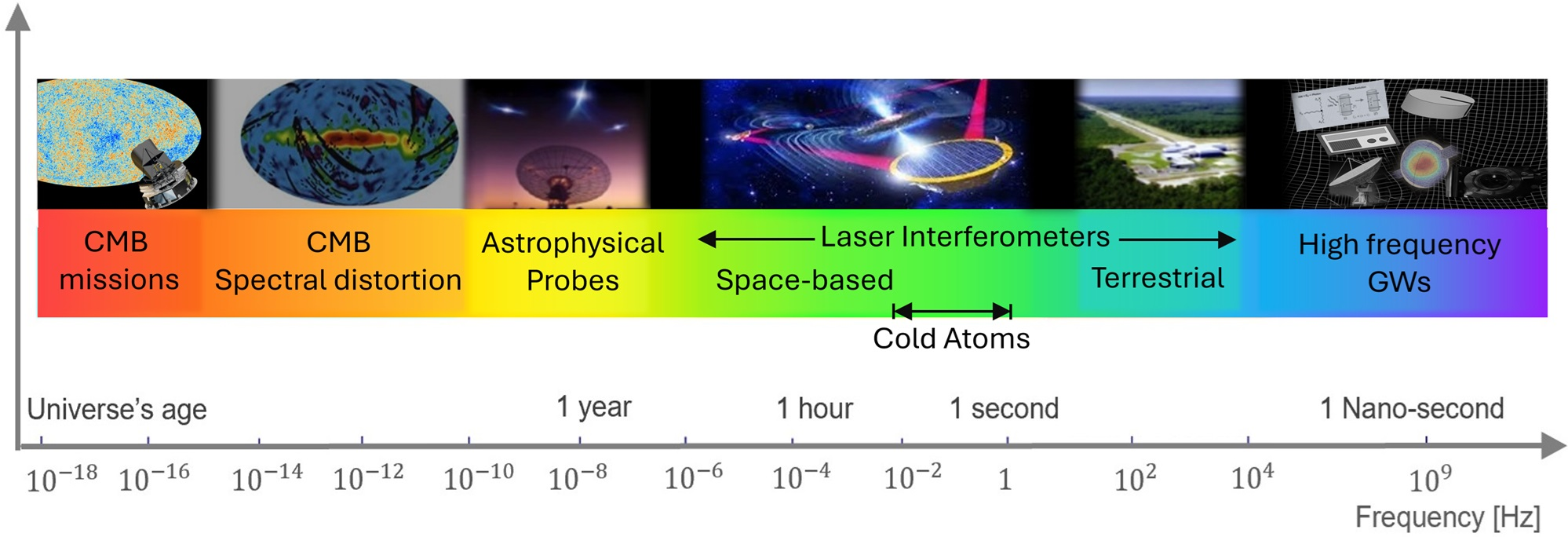
Figure 1: The gravitational wave 'rainbow', mapping current and future sensitivity across the frequency spectrum, from the CMB regime to high-frequency laboratory concepts.
Linearized Theory and Astrophysical Interpretation
The weak-field limit of Einstein's equations admits solutions corresponding to gravitational waves: small, transverse-traceless perturbations propagating at light speed. Linearized GR yields a wave equation for the metric perturbation, and the far-zone solutions—derived via the quadrupole approximation—demonstrate that GWs radiate only for time-varying mass quadrupole moments. Unlike electromagnetism, GW monopole and dipole radiation are forbidden by local conservation laws for mass-energy and momentum.
GWs have precisely two polarization states in four-dimensional GR, typically described as 'plus' and 'cross', or, equivalently, through circular helicities. The physical manifestation of each polarization mode is encapsulated in the geodesic deviation equation: a passing GW induces measurable distortions in the separation of freely-falling particles.

Figure 2: Deterministic versus stochastic GW signals: coherent binary merger waveforms contrasted with zero-mean Gaussian stochastic backgrounds.
Beyond the Linear Regime: Geometric and Algebraic Structures
Full general relativity introduces key conceptual distinctions absent in linear theory. The Weyl tensor, encoding free gravitational degrees of freedom in vacuum, is central for characterizing gravitational radiation in curved backgrounds. The Petrov classification provides an algebraic scheme for determining spacetime properties at a given point based on the multiplicity of principal null directions in the Weyl tensor.
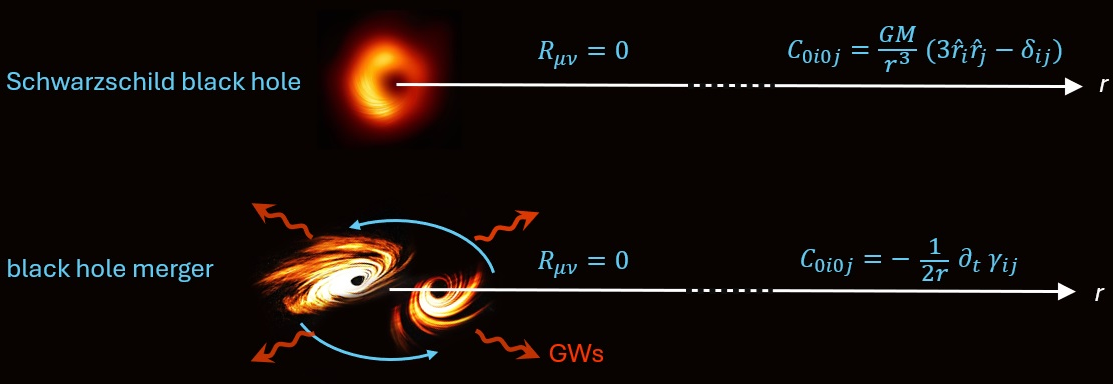
Figure 3: Weyl tensor behavior in Schwarzschild (non-radiative, 1/r3 falloff) and radiative binary merger (outgoing GWs, $1/r$ falloff).
A rigorous GW definition arises in asymptotically flat spacetimes via the Bondi-Sachs formalism, using retarded null coordinates. At future null infinity, GWs manifest as nontrivial Bondi news, with the Bondi mass decreasing monotonically due to radiative energy loss. Moreover, GWs carry not only energy but also angular momentum, both computable as fluxes across I+.
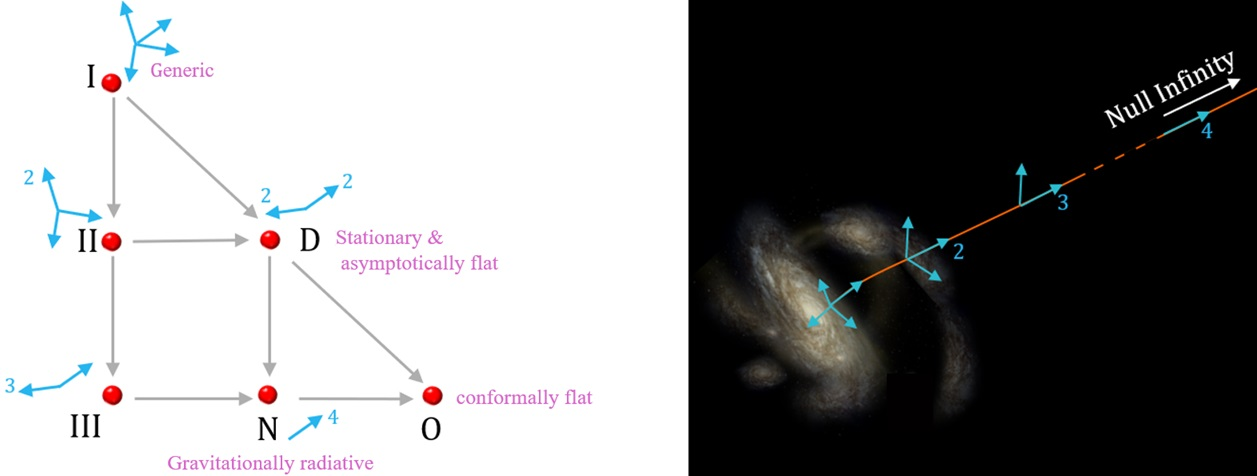
Figure 4: Petrov type transitions from general type I near sources to radiative type N at future null infinity, encapsulating the 'peeling' behavior of the Weyl tensor.
The asymptotic symmetry group at null infinity, originally expected to coincide with the Poincaré group, was found to be enhanced to the infinite-dimensional Bondi-Metzner-Sachs (BMS) group due to 'supertranslations'—a structure intimately connected to the presence of radiative gravitational degrees of freedom and to GW memory effects.
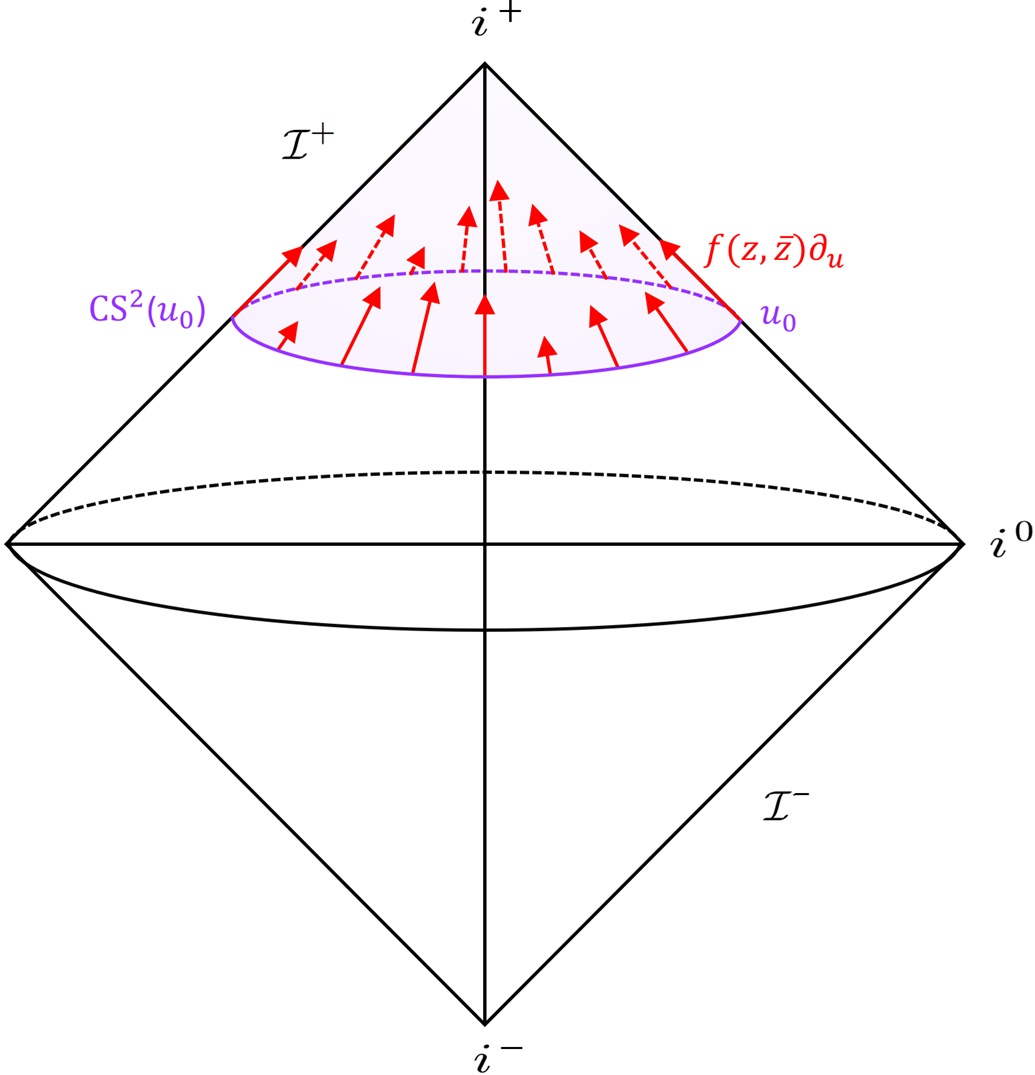
Figure 5: Supertranslation action on the celestial sphere, visualizing the angle-dependent shifts corresponding to BMS symmetry.
Gravitational Waves in an Expanding Universe
On scales exceeding ∼100~Mpc, cosmological expansion necessitates the FLRW metric. GW evolution across cosmic epochs is governed by the interplay of background expansion and horizon dynamics. The inflationary paradigm, motivated by CMB isotropy and horizon-scale correlations, predicts a nearly scale-invariant stochastic GW background originating from quantum fluctuations of the metric. These primordial GWs have been free-streaming since inflation, in contrast to CMB photons which decouple at much lower energies.
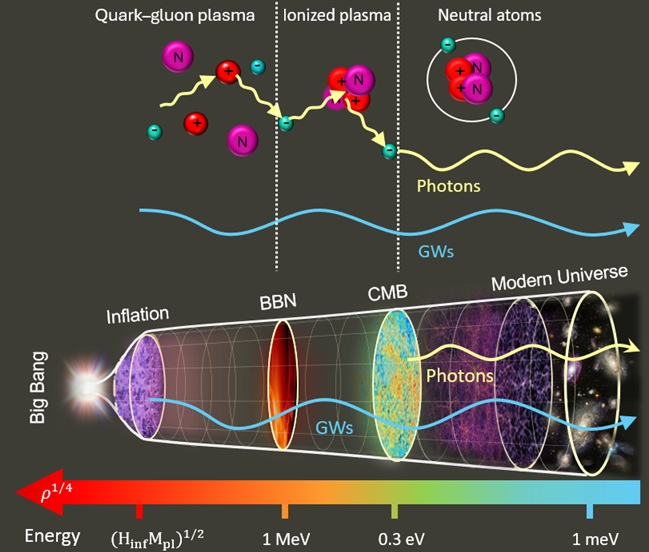
Figure 6: Thermal history of the universe, emphasizing early transparency to GWs and the limited accessibility of high-redshift epochs to electromagnetic probes.
The review systematically details the evolution of these primordial tensor modes, the generation of their observational spectra (parameterized by tensor-to-scalar ratio r and spectral tilt nT), and current constraints from CMB polarization experiments.
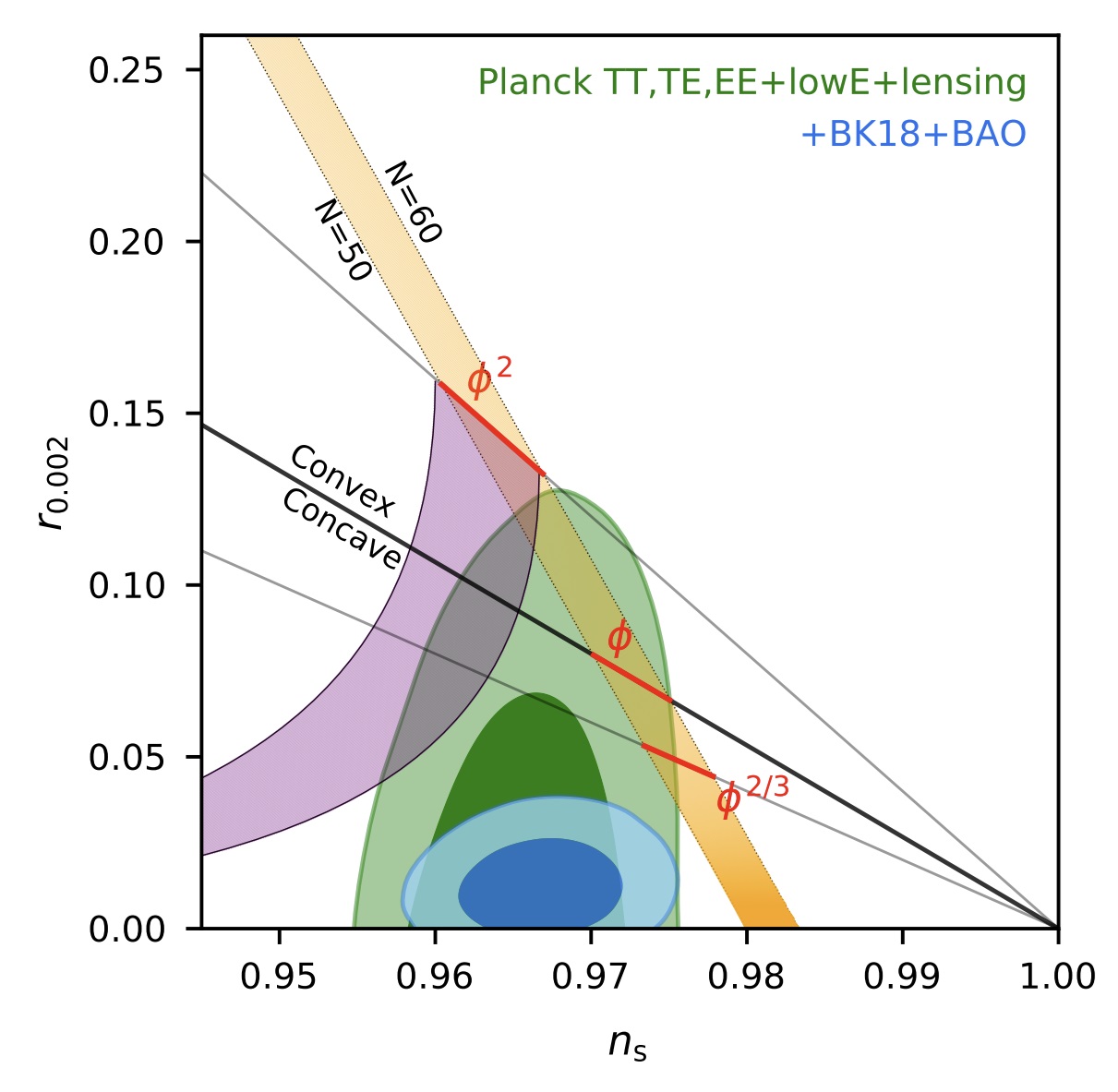
Figure 7: Observational constraints on the scalar spectral index ns and tensor-to-scalar ratio r, overlaid with inflationary model predictions.
Infrared Structure and Consistency Relations
The review devotes considerable attention to the infrared behavior of cosmological perturbations. Weinberg's adiabatic mode theorem guarantees the conservation of specific superhorizon modes regardless of detailed microphysics, ensuring robust predictions linking inflationary initial conditions with late-time cosmological observables. Maldacena's consistency relation, manifesting in the squeezed limit of n-point correlation functions, encodes the nonlinear realization of large gauge symmetry—directly tied to the structure of adiabatic modes.
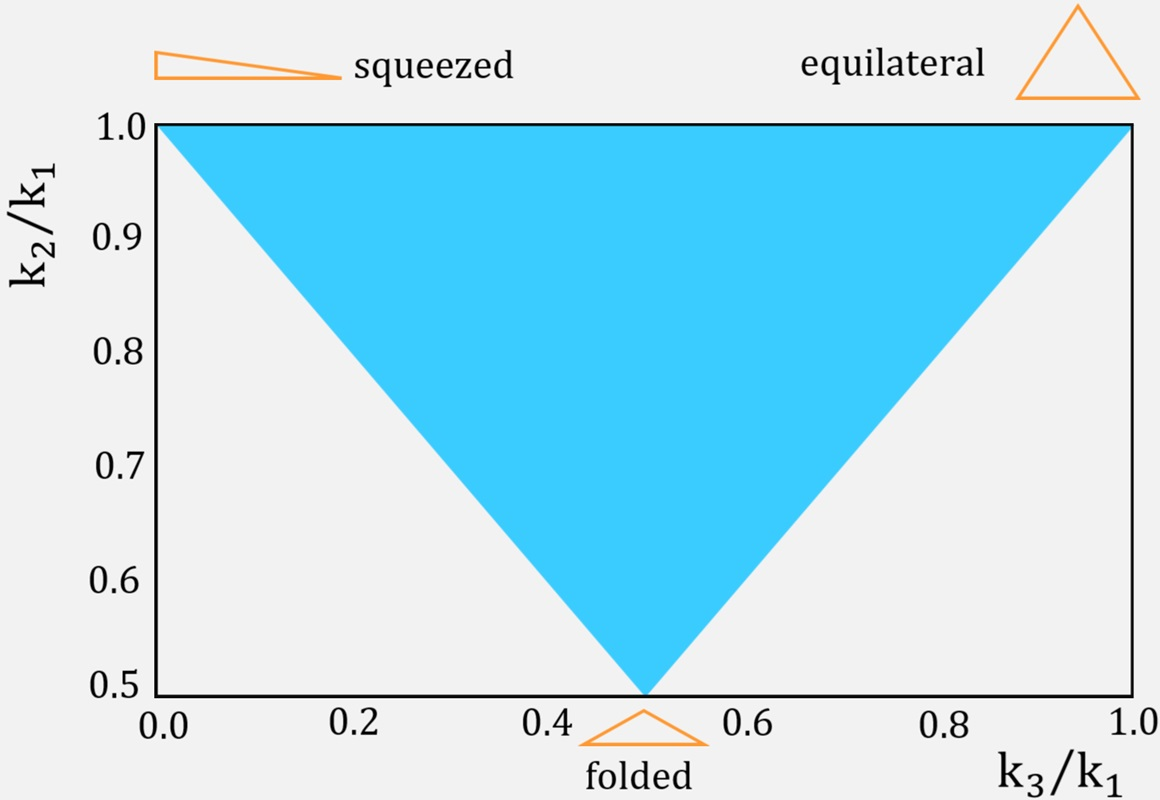
Figure 8: Configuration space of the bispectrum, highlighting squeezed, equilateral, and folded limits central to non-Gaussianity phenomenology.
Observational Strategies: Techniques and Sensitivity
The observational landscape for GW detection is inherently multi-band. Large-scale CMB polarization measurements access the lowest frequencies, offering constraints on inflationary backgrounds through E- and B-mode decomposition.
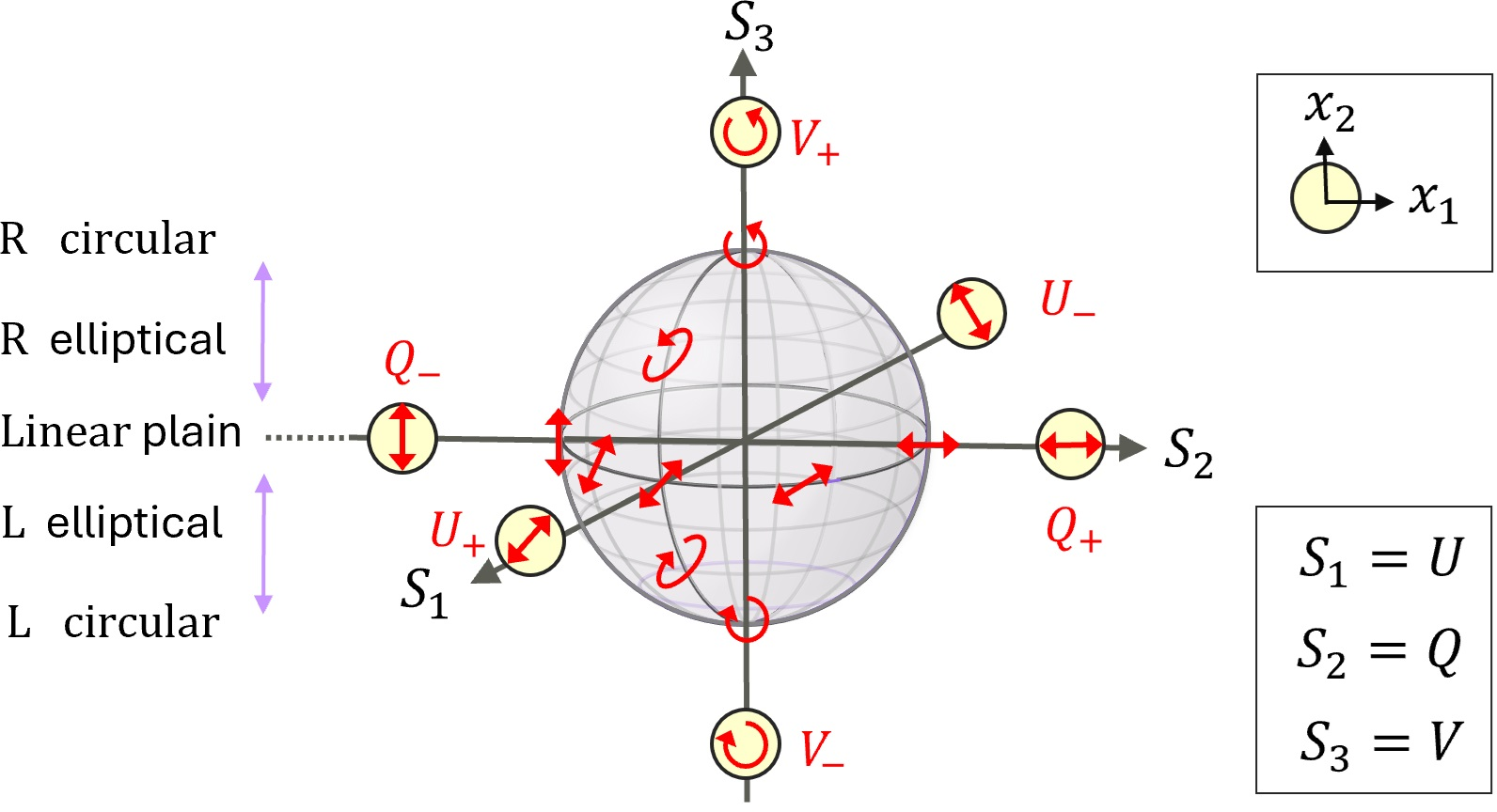
Figure 9: Poincaré sphere of light polarization, illustrating the relation of Stokes parameters to CMB polarization observables.
Pulsar timing arrays (PTAs) probe the nanohertz regime by measuring correlated timing residuals across galactic-scale baselines, providing the most stringent bounds and now evidence for a nanohertz stochastic GW background.
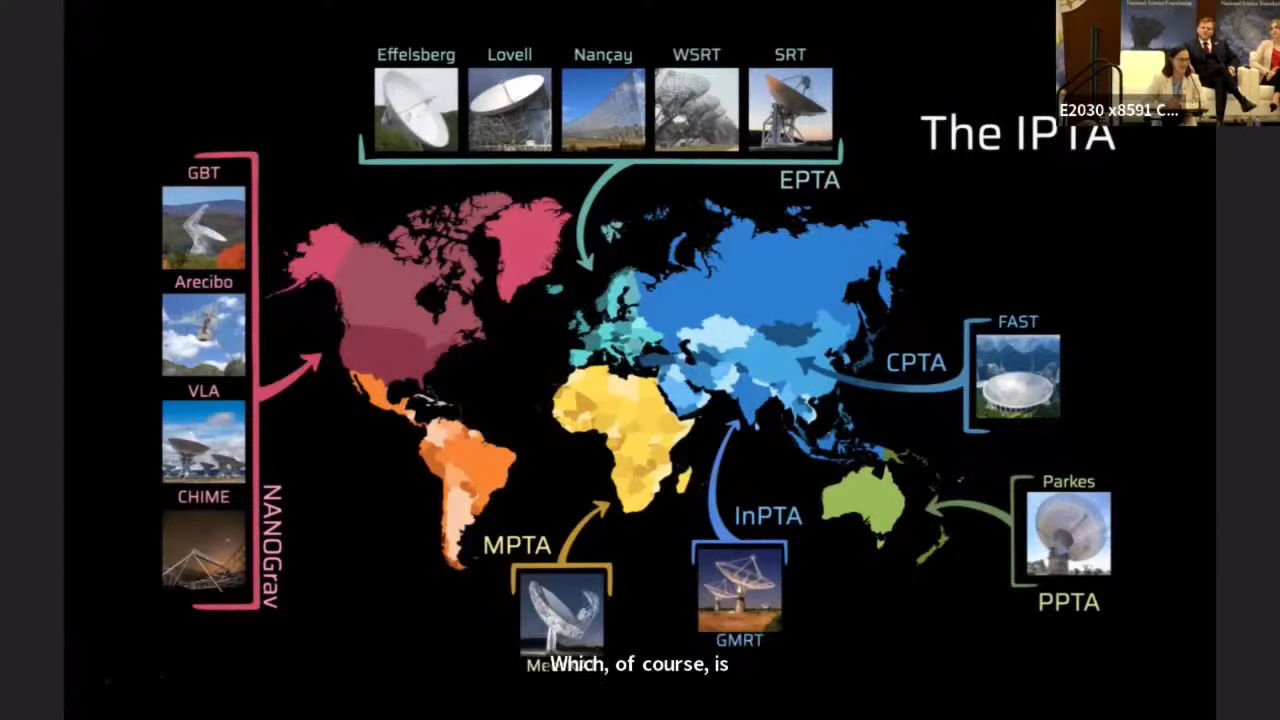
Figure 10: Schematic of a pulsar timing array, measuring timing residuals to detect nanohertz GWs.
Ground- and space-based laser interferometers, including LIGO, Virgo, KAGRA, and future instruments such as LISA and the Einstein Telescope, target GW frequencies from several Hz to tens of kHz, accessing signals from compact object binaries and stochastic backgrounds.
High-frequency GW detection is being advanced through resonant electromagnetic cavities subject to strong static fields (Gertsenshtein effect) and quantum-enhanced platforms exploiting highly populated bosonic qumodes, with projected sensitivity gains reaching below the single-graviton threshold.
Sources: Astrophysical and Cosmological Mechanisms
The primary astrophysical sources include compact binary coalescences (black hole and neutron star binaries), isolated neutron stars, and transient burst phenomena (supernovae, gamma-ray bursts). These produce deterministic signals and form the dominant background in the ground- and space-based interferometer frequency windows.
Cosmological mechanisms—first-order phase transitions, topological defects (notably cosmic strings), inflationary (vacuum and spectator field) GWs, and scalar-induced tensor modes—contribute to stochastic backgrounds with distinctive spectral and statistical properties. The review synthesizes the theoretical predictions and detection prospects for these sources across frequency regimes.
Implications and Future Directions
The synthesis provided in this review demonstrates the centrality of GWs in connecting observational gravitational physics, cosmology, and BSM phenomenology. The enhancement of detector capabilities across multiple frequency bands—complemented by theoretical advances in understanding nonlinear and quantized GW phenomena—positions the field to address open questions about cosmic initial conditions, high-energy physics, and the nature of gravity.
Prospective advances include precision mapping of the stochastic GW background, improved disentanglement of astrophysical and cosmological contributions, quantum-limited sensitivity in laboratory-scale detectors, and a refined algebraic and geometric understanding of radiative spacetimes in alternative theories of gravity.
Conclusion
This comprehensive review establishes a detailed framework for GW science, integrating analytic, geometric, and observational perspectives. By explicating the mathematical structure of gravitational radiation and its cosmological evolution, and by surveying the diverse experimental frontiers, the work provides a reference point for ongoing and future research in GW astronomy, fundamental physics, and early universe cosmology.