The Effect of Magnetic Field Dissipation in the Inner Heliosheath: Reconciling Global Heliosphere Model and Voyager Data
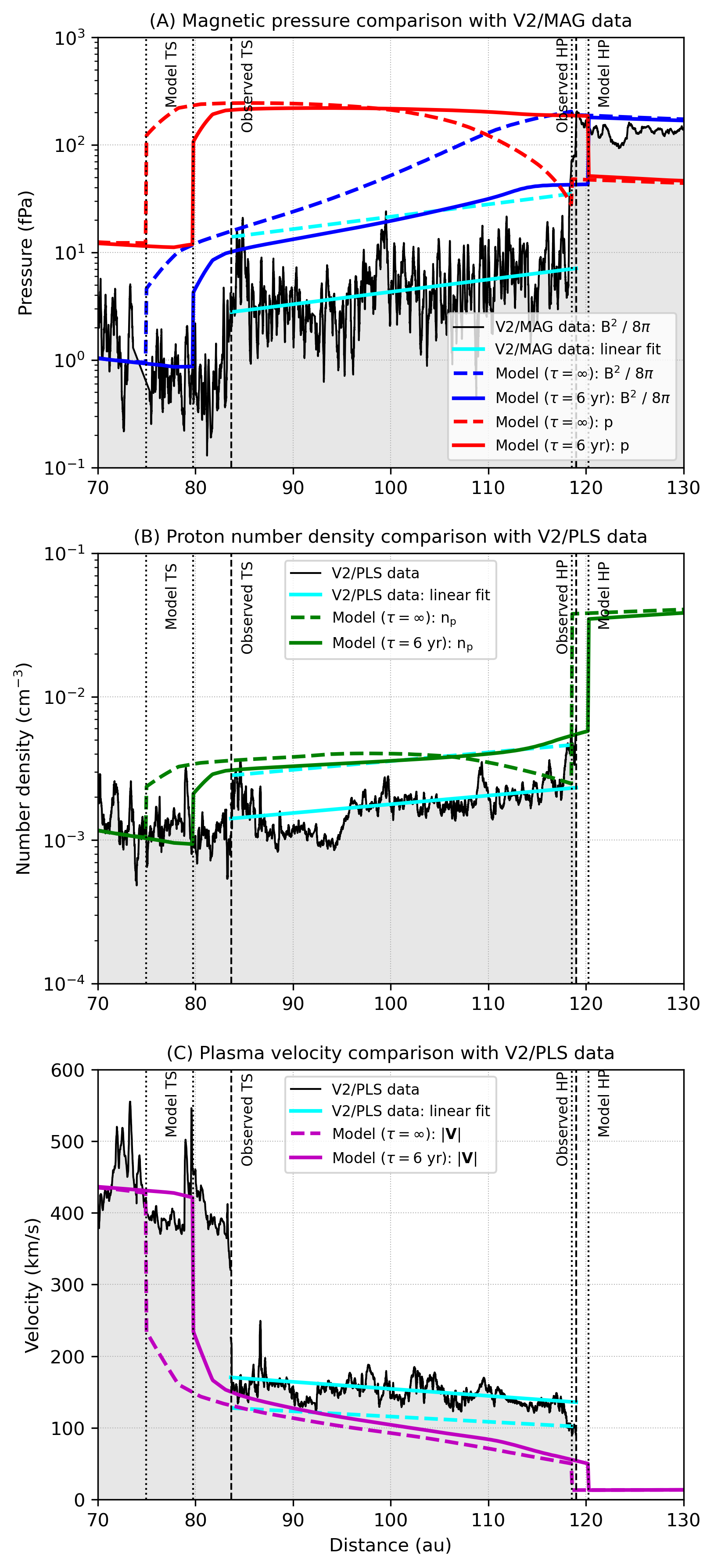
Abstract: Global ideal magnetohydrodynamic models of the heliosphere typically predict a greatly exaggerated magnetic field pile-up in the inner heliosheath (IHS), the region between the termination shock and heliopause. However, Voyager 1 and 2 observations show only a gradual increase throughout this region. This mismatch is largely attributed to the simplified assumption of a unipolar solar magnetic field in many global models, which neglects the complex, folded structure of the heliospheric current sheet (HCS). The IHS, especially at low heliolatitudes, contains these compressed sector boundaries, widely considered prime locations for magnetic dissipation via reconnection. To align global model simulations with observations without incurring the prohibitive computational cost of resolving the kinetic-scale current sheet, this work introduces a phenomenological term into the magnetic field induction equation. This term captures the macroscopic effect of magnetic energy dissipation due to unresolved HCS dynamics. It is designed to mitigate the artificial magnetic pile-up, preserve the topological integrity of the magnetic field lines, and avoid explicit magnetic diffusion. This study demonstrates that incorporating a phenomenological dissipation term into global heliospheric models helps to resolve the longstanding discrepancy between simulated and observed magnetic field profiles in the IHS. The proposed mechanism reduces exaggerated magnetic energy (converts it into thermal energy), aligns model output with Voyager measurements of both magnetic field and proton density, and produces the outward shift in termination shock position and a reduction of the IHS thickness. We found that the characteristic time for magnetic field dissipation of about 6 years provides improved agreement with Voyager data in the IHS.
Paper Prompts
Sign up for free to create and run prompts on this paper using GPT-5.
Top Community Prompts
Explain it Like I'm 14
Overview
This paper looks at a big “bubble” around our Sun called the heliosphere. It’s made by the solar wind—streams of charged particles blowing out from the Sun—pushing against the stuff between the stars. The authors focus on a zone inside this bubble called the inner heliosheath, which sits between two important boundaries:
- The termination shock (where the solar wind suddenly slows down), and
- The heliopause (the outer border where the Sun’s bubble meets the interstellar medium).
Spacecraft Voyager 1 and 2 flew through this region and measured the magnetic field and the plasma there. Many computer models predict the magnetic field should pile up too strongly near the heliopause, but Voyager saw only a gentle rise. The paper proposes a simple fix that helps models better match what Voyager actually measured.
Key Questions
The authors ask:
- Why do global computer models predict a big “traffic jam” of magnetic field near the heliopause, while Voyager sees only a gradual increase?
- Can we include the effect of magnetic energy “leaking away” (dissipating) in large-scale models without simulating tiny, detailed physics that would be too costly?
- What amount of magnetic dissipation makes the model line up with Voyager’s data?
Methods and Approach
The team uses a global magnetohydrodynamic (MHD) model. MHD is a way to treat plasma (electrically charged gas) like a fluid influenced by magnetic fields. Think of it as simulating a huge ocean of charged particles flowing from the Sun and interacting with the magnetic field.
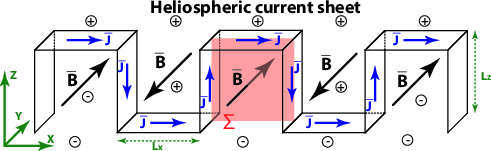
Here’s the challenge: in reality, the heliospheric current sheet (HCS)—a wavy, folded sheet separating opposite magnetic polarities—gets squeezed in the inner heliosheath. In those folds, magnetic reconnection can happen: magnetic field lines break and reconnect, turning magnetic energy into heat. That process reduces the magnetic field strength. But reconnection happens at very small scales, far too tiny to resolve in a global simulation that spans hundreds of astronomical units (1 au is the distance from Earth to the Sun).
To handle this, the authors add a simple “phenomenological” term to the magnetic field equation—think of it as a gentle brake on the magnetic field inside the inner heliosheath. This term:
- Smoothly reduces the magnetic field strength over a chosen timescale (like making a vibrating string gradually stop vibrating),
- Converts the lost magnetic energy into heat (warming the plasma),
- Leaves the direction of the magnetic field lines intact (so the large-scale magnetic structure isn’t scrambled),
- Avoids using explicit magnetic diffusion, which can cause artificial model problems.
They then run the model and compare it with Voyager 1 and 2 data, testing different “brake strengths” by changing the dissipation timescale, called τ (tau).
Main Findings
The authors find that setting the dissipation timescale to about 6 years produces model results that agree much better with Voyager’s observations in the inner heliosheath:
- Magnetic field: Instead of piling up too strongly near the heliopause, the magnetic pressure rises gently—matching the gradual trend seen by Voyager.
- Plasma density: The model no longer shows an unrealistic drop in proton number density near the heliopause. It agrees with Voyager’s measured trend of density staying steady or increasing toward the boundary.
- Temperature: Because the model turns magnetic energy into heat, the plasma gets warmer near the heliopause, which helps balance pressures realistically.
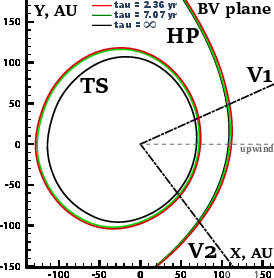
- Boundaries move: With dissipation, the termination shock shifts outward (farther from the Sun), and the inner heliosheath becomes thinner. This moves the model a step closer to the real structure the Voyagers crossed, though the simulated inner heliosheath is still a bit thicker than observed.
- Flow speed: The overall plasma flow speed doesn’t change much, and there’s still a known mismatch versus the measured speeds—an issue beyond just magnetic dissipation.
In short, adding a controlled “magnetic energy brake” fixes the long-standing problem where models created a strong magnetic wall that Voyager did not see.
Why It Matters
This work gives global heliosphere models a practical way to include the big-picture effect of magnetic reconnection—without simulating tiny details that are too expensive to compute. That helps scientists:
- Build more reliable models of the Sun’s protective bubble (our “heliospheric shield”),
- Better understand how cosmic rays and interstellar material interact with the heliosphere,
- Improve predictions relevant to spacecraft traveling to or beyond the heliopause.
The authors show that a simple, tunable dissipation term can bring models and measurements closer together. Future improvements could make the dissipation depend on local conditions, like how wide the magnetic sectors are, and may also include realistic magnetic diffusion. All of this moves us toward more accurate, trustworthy simulations of the region where our Sun meets the wider galaxy.
Knowledge Gaps
Knowledge gaps, limitations, and open questions
The following list identifies what remains missing, uncertain, or unexplored in the paper, highlighting concrete directions for future research:
- Quantitative derivation of the dissipation timescale τ from microphysics (e.g., using PIC or hybrid simulations to map HCS reconnection rates and turbulence-driven dissipation to a macroscopic closure).
- Spatially varying dissipation: the model assumes uniform, constant τ throughout the IHS, but reconnection/turbulence should depend on local sector width, current density, plasma β, turbulence level, and heliolatitude.
- Time dependence of dissipation: reconnection efficiency and HCS folding should vary over the solar cycle and with the tilt of the solar magnetic axis; τ(t) has not been explored.
- Localization of dissipation: the phenomenological term acts uniformly in the IHS rather than being concentrated at compressed sector boundaries and HCS folds where dissipation should physically occur.
- Topological realism: the -B/τ term reduces field magnitude while preserving direction and connectivity, but real reconnection changes field topology and generates magnetic islands and jets; the macroscopic consequences of missing topology changes are unquantified.
- Momentum coupling: dissipation converts magnetic energy to heat but omits explicit momentum/force source terms from reconnection outflows; the absence of momentum feedback may bias flow, stress balance, and stability.
- Divergence control: adding -B/τ to the induction equation presumes ∇·B=0 remains satisfied; numerical divergence control and its sensitivity to grid resolution are not assessed.
- Validation beyond V1/V2 trends: the τ=6 yr result is calibrated to Voyager gradients, but broader validation against ENA maps (IBEX/IMAP), radio emissions, Lyman-α backscatter, and field draping signatures is missing.
- Incomplete reconciliation with observations: the model still overestimates IHS thickness, misplaces TS/HP locations, and fails to match Voyager bulk flow speeds; the causes (boundary conditions vs. missing physics) are unresolved.
- LISM parameter sensitivity: the chosen B_LISM magnitude and BV-angle do not jointly reproduce both TS and HP distances; a systematic exploration of LISM configurations under dissipation is needed.
- Stationary approximation: time-dependent effects (solar wind variability, TS/HP motion, transient sector structure) are omitted, yet likely critical for matching Voyager crossings and IHS dynamics.
- Sector structure and tilt: realistic HCS geometry (solar dipole tilt, sector width evolution) is not modeled, even though it strongly modulates dissipation sites and rates.
- Turbulence and instabilities: dissipation is attributed to reconnection but other mechanisms (turbulence, instabilities) are not represented or parametrized; their relative contributions remain unknown.
- Pickup ions treatment: PUIs are lumped into a single fluid; known anisotropies and distinct thermodynamics/pressures of PUIs can critically affect IHS structure and should be separated (e.g., multi-fluid or kinetic PUI models).
- Electron thermodynamics: electrons are not treated separately; electron heat fluxes, anisotropy, and heat conduction—which can influence pressure balance and dissipation—are neglected.
- Thermal conduction: the paper references “thermal conduction equations,” but a physical conduction model is not implemented; the role of (an)isotropic conduction in redistributing dissipation-generated heat is untested.
- Ionization processes: photoionization and electron impact ionization are neglected; the impact of these omissions on neutral-plasma coupling and IHS structure is not quantified.
- Energy partition and closure: the assumption that dissipated magnetic energy fully heats the thermal plasma (with fixed γ=5/3) ignores possible partition into nonthermal populations; the closure may miss pressure components from suprathermal tails.
- Directional dependence: while some 3D effects are noted (e.g., varying IHS narrowing by direction), a comprehensive 3D mapping of how dissipation reshapes TS/HP and IHS properties across longitudes and latitudes is absent.
- Parameter sweep and robustness: sensitivity of results to τ beyond 2–10 years and to model numerics (grid resolution, solver choices) is limited; robustness and uncertainty quantification are needed.
- Stability and boundary layers: how dissipation impacts HP draping, boundary layer thickness, and instabilities (e.g., KH, RT) has not been analyzed.
- Application outside the IHS: potential dissipation in the supersonic solar wind and at/near the TS is not explored; the consequences of extending or localizing the mechanism at specific boundaries remain open.
- Consistency with energetic particle observations: implications of dissipation for ACR/GCR modulation and ENA fluxes are not connected to available data; predictions for IMAP-era constraints are not provided.
- Model comparability: systematic comparison with dipolar-field models that include under-resolved HCS (numerical dissipation) and with Hall/resistive MHD closures is missing, leaving unclear how phenomenological vs. explicit dissipation schemes fare.
Practical Applications
Immediate Applications
The paper introduces a simple, computationally inexpensive dissipation term that brings global heliospheric MHD models into closer agreement with Voyager observations. The following are actionable applications that can be deployed now:
- Industry/Aerospace — Dissipation-aware global heliosphere modeling module
- Use case: Integrate the phenomenological dissipation term QB = −B/τ (with heating) into existing MHD frameworks (e.g., BATS-R-US, MS-FLUKSS, CRONOS, EUHFORIA extensions) to suppress artificial magnetic pile-up in the inner heliosheath (IHS) while preserving topology.
- Tools/products/workflows: Code patch implementing operator splitting for the induction and internal-energy updates in the IHS; region masks for TS–HP; unit tests that verify conservation of ε + B2/(8π).
- Assumptions/dependencies: Stationary model; unipolar HMF approximation; constant τ ≈ 6 years within the IHS; neglects photoionization/e-impact ionization; topology is not changed by the term.
- Academia/Space Physics — Data-constrained calibration of magnetic dissipation
- Use case: Calibrate τ using Voyager MAG/PLS, IBEX ENA, and IMAP measurements to match observed magnetic pressure and proton density trends in the IHS.
- Tools/products/workflows: Bayesian/variational parameter estimation for τ; SPDF/CDAWeb data ingestion; reproducible pipelines comparing modeled and observed radial trends.
- Assumptions/dependencies: Requires high-quality time-series along specific trajectories; global boundary condition uncertainties (LISM B, BV-angle) affect optimal τ.
- Space Missions (NASA/ESA/JAXA) — Mission design for the outer heliosphere and Interstellar Probe
- Use case: Update predictions for TS/HP distances and IHS thickness (with dissipation-induced outward TS shift and thinner IHS) to plan crossing timelines, instrument dynamic ranges, and data rates.
- Tools/products/workflows: Pre-phase A studies and trade-space analyses that include dissipative model outputs; sensitivity runs across τ ∈ [2,10] years.
- Assumptions/dependencies: Results depend on selected LISM parameters and neglect time variability; stationarity can bias exact crossing dates.
- Space Weather/Radiation for Deep Space — Boundary conditions for cosmic-ray transport
- Use case: Use dissipation-adjusted heliosphere structures (higher β, reduced magnetic pile-up, realistic density trends) as boundary conditions for heliospheric modulation codes (e.g., HelMod, GALPROP interfaces) to refine GCR flux predictions for deep-space mission radiation assessments.
- Tools/products/workflows: Coupled MHD–CR pipelines; scenario analysis for astronaut dose planning beyond the magnetosphere.
- Assumptions/dependencies: Requires coupling to particle transport; stationarity and constant τ limit responsiveness to solar-cycle changes.
- Remote Sensing/ENA Science (IBEX, IMAP) — Improved ENA interpretation
- Use case: Reduce biases in ENA forward models that depend on IHS pressure and density distributions by including the dissipation term.
- Tools/products/workflows: ENA modeling suites parameterized by τ; comparison against ENA maps to validate the dissipation-informed pressure partition.
- Assumptions/dependencies: Multi-fluid neutrals are used; no explicit kinetic HCS structures; τ uniform in IHS.
- Computational Physics/Software — Controlled replacement for grid-dependent numerical dissipation
- Use case: In dipolar or tilted-field global runs where the HCS is under-resolved, replace uncontrolled, grid-dependent magnetic diffusion with the controlled, physics-inspired QB term to avoid over-weakening near the HP.
- Tools/products/workflows: Solver option flags for “phenomenological dissipation”; regression tests across resolutions to confirm grid independence.
- Assumptions/dependencies: Preserves large-scale topology; does not simulate reconnection-driven island formation.
- Education/Training — Teaching reconnection’s macroscopic effects without kinetic solvers
- Use case: Classroom or workshop modules showing energy conversion from magnetic to thermal energy (β increase) using simplified 1D/2D test problems.
- Tools/products/workflows: Jupyter notebooks; minimal MHD solvers with operator splitting and energy conservation checks.
- Assumptions/dependencies: Conceptual demonstration; not a substitute for kinetic reconnection.
- Program Management/Policy — Instrument and operations planning
- Use case: Use narrower IHS and adjusted TS positions as bounding cases for instrument cadence, telemetry budgeting, and contingency planning for outer-heliosphere missions.
- Tools/products/workflows: Requirements documents referencing τ-calibrated structures; design margins based on τ-sensitivity studies.
- Assumptions/dependencies: Must reflect uncertainty bands due to LISM and solar-cycle variability; model is steady-state.
Long-Term Applications
Several applications require further research, scaling, or model development beyond the current stationary, constant-τ framework:
- Academia/Space Physics — Multiscale reconnection-informed global MHD
- Use case: Replace constant τ with spatially and temporally varying dissipation tied to sector width, turbulence level, and HCS geometry; couple to reduced/kinetic models (PIC/hybrid) to derive τ(B, V, sector geometry).
- Tools/products/workflows: Embedded subgrid reconnection closures; machine-learned surrogate models for τ from local simulations.
- Assumptions/dependencies: Needs robust scaling laws bridging kinetic and MHD regimes; substantial HPC and code integration effort.
- Space Weather/Radiation — Time-dependent heliosphere–cosmic ray forecasting
- Use case: Incorporate τ(t) that evolves with solar cycle (HCS tilt/sector structure) into time-dependent global models to forecast GCR modulation for crewed deep-space missions and long-duration probes.
- Tools/products/workflows: Data-assimilative MHD with solar wind maps and synoptic magnetograms; coupled transport solvers for particles.
- Assumptions/dependencies: Requires validated τ(t) drivers; observational constraints off the ecliptic remain sparse.
- Astrophysics/Astrobiology — Astrosphere shielding and exoplanet habitability
- Use case: Apply the dissipation framework to stellar astrospheres to evaluate magnetic/thermal pressure partition and galactic cosmic-ray shielding around other stars.
- Tools/products/workflows: Grid of stellar-wind–ISM models with parameterized τ; coupling to exoplanetary radiation environment models.
- Assumptions/dependencies: Stellar wind properties and sector structure are highly uncertain; extrapolation from solar case may not hold.
- Space Missions/Operations — Adaptive navigation and health monitoring near HP
- Use case: Real-time (or campaign-based) updates of TS/HP proximity for probes approaching the heliopause using time-dependent models with τ(t) assimilation.
- Tools/products/workflows: Reduced-order models embedded in flight software; ground-based model assimilation of in situ data streams.
- Assumptions/dependencies: Requires near-real-time boundary condition updates and robust telemetry-model fusion; still needs validation.
- Radio Remote Sensing — Interpreting heliopause-related radio emissions
- Use case: Combine draping models with dissipation-influenced pressure profiles to interpret and predict radio emissions in the very local interstellar medium.
- Tools/products/workflows: Coupled MHD–wave/instability models that include dissipation-driven β changes; comparison with future outer heliosphere radio observations.
- Assumptions/dependencies: Requires additional physics (wave growth, kinetic instabilities); limited data availability.
- Computational Science — Standardized phenomenological dissipation API for MHD codes
- Use case: Establish a community plugin/API that provides configurable, region-aware dissipation with energy bookkeeping, applicable to heliospheres, magnetospheres, and astrophysical jets where thin current sheets are unresolved.
- Tools/products/workflows: Open-source library with validation suites; CI pipelines; cross-code benchmarks.
- Assumptions/dependencies: Community governance and adoption; case-specific calibration pathways.
- Policy/Standards — Refining deep-space radiation risk standards
- Use case: Use improved heliospheric shielding estimates to refine long-duration mission radiation exposure standards and design limits.
- Tools/products/workflows: Integrated assessments co-developed by agencies and standards bodies (NASA, ESA, ISO); scenario-based risk modeling.
- Assumptions/dependencies: Requires consensus on model uncertainty; linkage to biomedical dose-response remains the dominant uncertainty.
- Cross-Domain Science — Generalizing to other unresolved-reconnection environments
- Use case: Apply the controlled dissipation approach to planetary magnetospheres, bow shocks, and astrophysical outflows where current sheets are under-resolved but energy conversion must be captured macroscopically.
- Tools/products/workflows: Case studies comparing explicit resistivity, numerical diffusion, and phenomenological damping; selection criteria for each.
- Assumptions/dependencies: Calibration data are often sparse; topology-preserving damping may miss essential reconnection-driven topology changes.
Notes on Key Assumptions and Dependencies Affecting Feasibility
- τ is treated as uniform (≈6 years) and constant in the IHS; in reality, it likely varies with sector width, turbulence, and solar cycle.
- The present results are stationary; time-dependent effects (TS/HP motion, solar-cycle variability) are not included and can materially change predictions.
- The model preserves magnetic topology and does not explicitly simulate reconnection-driven changes in connectivity or kinetic-scale structures.
- Boundary conditions in the LISM (B magnitude and BV-angle) significantly influence TS/HP positions and asymmetries.
- Neutral hydrogen is modeled with four fluids; photoionization and electron impact ionization are neglected in this study.
- Validation is strongest along Voyager trajectories; extrapolations to other regions (flanks/tail) need further observation and modeling.
Glossary
- Adaptive moving grid: A numerical mesh that moves and adapts to capture evolving features like shocks or discontinuities with high accuracy. "3D adaptive moving grid with discontinuities capturing and fitting capabilities"
- Astronomical unit (au): A standard distance unit in space physics equal to the average Earth–Sun distance (~149.6 million km). "vastly smaller than the astronomical unit (au) scales characterizing the global heliosphere"
- Bow shock: A shock that may form in front of the heliosphere where the interstellar medium is abruptly compressed. "a third discontinuity, the bow shock, may exist in the interstellar medium upstream of the HP"
- BV-angle: The angle between the interstellar magnetic field and interstellar flow velocity vectors used to characterize heliospheric asymmetry. "BV-angle = 60"
- BV-plane: The plane spanned by the interstellar magnetic field and flow velocity vectors, used to visualize global structure. "BV-plane (the plane that contains and vectors)"
- Chakravarthy–Osher TVD procedure: A high-resolution numerical scheme enforcing total variation diminishing to prevent spurious oscillations near discontinuities. "ChakravarthyâOsher TVD procedure"
- Charge exchange: A process where a plasma ion and a neutral atom exchange an electron, altering momentum and energy distributions. "describe the influence of the charge exchange process between protons and H atoms"
- Charge-exchange cross-section: The effective area quantifying the likelihood of charge exchange between particles. "the charge exchange cross-section from \citet{lindsay2005} was used"
- Collisionless reconnection: Magnetic reconnection occurring without particle collisions, governed by kinetic plasma processes. "Explicit modeling of collisionless reconnection in large-scale simulations is infeasible"
- Dipolar magnetic field: A two-pole magnetic configuration (like a bar magnet) used to model the solar magnetic field’s large-scale structure. "Attempts to incorporate the HCS in global models using a dipolar field do not fully resolve the issue"
- Euler equations: Fluid dynamics equations describing conservation of mass, momentum, and energy for inviscid flows. "described by its own set of Euler equations"
- Finite-volume scheme: A discretization method that conserves fluxes through control volumes, suited for hyperbolic conservation laws. "finite-volume high-order Godunov's type scheme"
- Godunov-type scheme: A class of shock-capturing numerical methods based on solving local Riemann problems. "finite-volume high-order Godunov's type scheme"
- Harten–Lax–van Leer (HLLD) MHD Riemann solver: A specific approximate Riemann solver optimized for magnetohydrodynamics that resolves multiple wave families. "HartenâLaxâvan Leer discontinuity (HLLD) MHD Riemann solver"
- Heliopause (HP): The boundary separating solar wind plasma from the interstellar medium, modeled as a tangential discontinuity. "heliopause (HP), a tangential discontinuity that separates solar and interstellar plasmas"
- Heliospheric Current Sheet (HCS): A thin, wavy surface separating regions of opposite solar magnetic polarity within the heliosphere. "neglects the complex, folded structure of the heliospheric current sheet (HCS)"
- Heliospheric magnetic field (HMF): The magnetic field carried by the solar wind throughout the heliosphere. "unmodified (no dissipation) heliospheric magnetic field (HMF)"
- Induction equation (magnetic): The evolution equation for magnetic fields in conducting fluids, central to MHD. "introduces a phenomenological term into the magnetic field induction equation"
- Inner heliosheath (IHS): The region of shocked, heated solar wind between the termination shock and the heliopause. "inner heliosheath (IHS), the region between the termination shock and heliopause"
- Ion inertial length: A kinetic scale related to ion response time, below which fluid models break down. "typically at or below ion inertial lengths"
- Joule heating: Heating due to dissipation of electric currents; here, an MHD analog converts magnetic energy into thermal energy. "effectively representing the macroscopic equivalent of Joule heating in collisional plasmas"
- Local Interstellar Medium (LISM): The interstellar environment surrounding the heliosphere. "the local interstellar medium (LISM)"
- Magnetically dominated layer: A region where magnetic pressure exceeds thermal pressure (low plasma beta). "magnetically dominated layer ahead of the HP, characterized by a low plasma beta"
- Magnetic diffusion: The smoothing or spreading of magnetic fields due to resistive effects (numerical or physical). "avoid explicit magnetic diffusion"
- Magnetic field pile-up: Artificial accumulation of magnetic field strength due to modeling assumptions or inadequate dissipation. "greatly exaggerated magnetic field pile-up in the inner heliosheath (IHS)"
- Magnetic pressure: The pressure associated with magnetic fields, proportional to . "magnetic pressure "
- Magnetic reconnection: A process where magnetic field lines reconfigure and release energy, often converting it into heat. "Within the compressed folds of the heliospheric current sheet in the IHS, magnetic reconnection becomes highly active"
- Magnetic wall: A region of enhanced magnetic field near the heliopause that can expel plasma in certain models. "the effect of the magnetic wall and the plasma depletion around the HP"
- Method of fractional steps: A numerical approach (operator splitting) solving complex systems by sequential substeps. "operator splitting approach, also known as the method of fractional steps"
- Multi-fluid model: A modeling framework treating different particle populations (e.g., neutrals) as separate fluids with their own equations. "multi-fluid treatment of H atoms"
- Operator splitting: A technique separating complex equations into simpler subproblems solved in sequence. "operator splitting approach, also known as the method of fractional steps"
- Particle-in-cell (PIC) simulations: Kinetic simulations that track particles and fields to resolve microphysical plasma processes. "Particle-in-cell (PIC) or Vlasov simulations"
- Plasma beta (): The ratio of thermal pressure to magnetic pressure, indicating whether plasma or magnetic forces dominate. "plasma beta (, thermal to magnetic pressure ratio)"
- Pickup protons: Ions created from neutral atoms that are ionized and “picked up” by the solar wind, affecting heliospheric dynamics. "thermal protons, pickup protons, electrons, and helium ions"
- Riemann solver (MHD): A numerical component that resolves discontinuities by solving local wave-propagation problems in MHD. "HartenâLaxâvan Leer discontinuity (HLLD) MHD Riemann solver"
- Solenoidal condition: The divergence-free constraint on magnetic fields ensuring no magnetic monopoles. "this term must satisfy the solenoidal condition "
- Supersonic solar wind: Solar wind moving faster than the local sound speed, leading to a termination shock when decelerated. "the termination shock (TS), where the supersonic solar wind abruptly decelerates"
- Tangential discontinuity: A plasma boundary where normal components of velocity and magnetic field vanish, with a discontinuity in tangential components. "heliopause (HP), a tangential discontinuity that separates solar and interstellar plasmas"
- Termination shock (TS): The boundary where the supersonic solar wind slows to subsonic speeds due to interaction with the interstellar medium. "the termination shock (TS), where the supersonic solar wind abruptly decelerates"
- Thermal conduction equation: The equation governing heat transport due to temperature gradients; used in the dissipation substep. "corrected induction and thermal conduction equations in the IHS"
- Time-relaxation method: A technique to obtain steady-state solutions by evolving equations in time until transients decay. "The steady-state solution is obtained using the time-relaxation method"
- Total variation diminishing (TVD): A property of numerical schemes that prevents creation of new extrema, improving stability near shocks. "ChakravarthyâOsher TVD procedure"
- Unipolar solar magnetic field: A simplified, single-polality approximation of the solar magnetic field used in some global models. "simplified assumption of a unipolar solar magnetic field"
- Vlasov simulations: Kinetic plasma simulations solving the Vlasov equation for distribution functions without collisions. "Particle-in-cell (PIC) or Vlasov simulations"
Collections
Sign up for free to add this paper to one or more collections.